








Corporate learning and development looks very different as you enter 2026. What once worked such as course completions, static programs, annual skill reviews no longer tells you whether your workforce is actually ready. AI is accelerating this shift, exposing skill gaps across managers, frontline teams, and leaders, while raising expectations for real business impact.
In this blog, we’ll walk through the most important corporate learning and development trends for 2026, how skills-based learning is replacing role-based training, why upskilling must be continuous, and what it takes for L&D to operate as a strategic driver of workforce readiness.
Top Corporate Learning and Development Trends in 2026
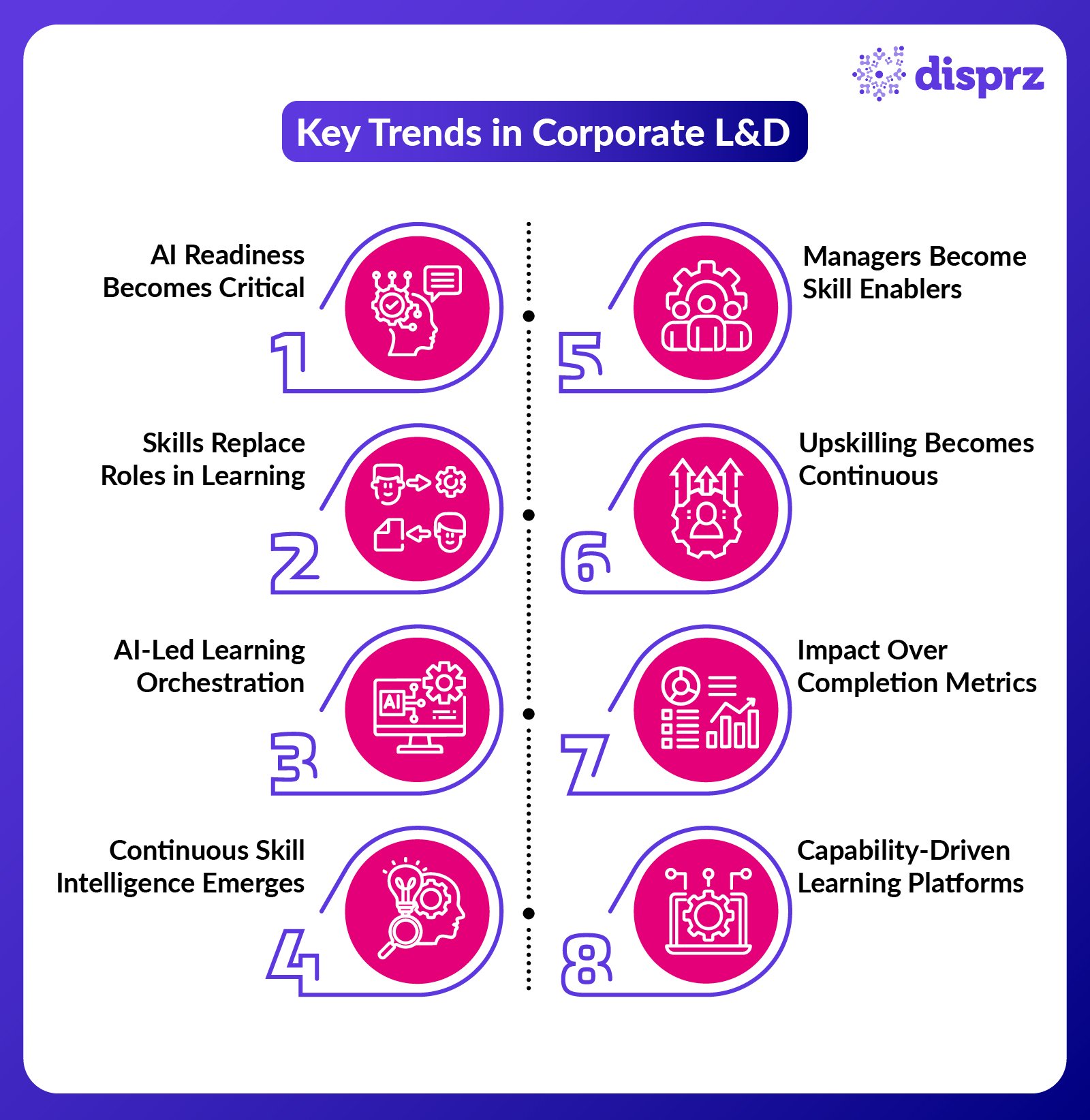
Corporate learning and development in 2026 is shifting from program-led training to continuous capability building. Skills are replacing roles as the foundation of workforce planning, while AI is moving beyond personalization to actively orchestrate learning based on real business needs. Managers are becoming skill enablers, learning is embedding itself into daily workflows, and success is measured through readiness and performance; not course completion.
The organizations pulling ahead are building capability ecosystems that connect skills intelligence, learning interventions, manager coaching, and analytics into one operating system. In short, L&D is evolving from a support function into a strategic driver of workforce readiness.
Trend 1 – Closing the AI Skills Gap Becomes the #1 Priority
Over the next three years, 92% of companies plan to increase their AI investments. Yet only 1% of leaders say their organizations are mature in deploying AI, where it’s fully embedded into workflows and driving real business outcomes. The constraint isn’t technology or capital. It’s workforce capability.
What’s different in 2026?
- AI rollout is moving faster than skills can keep up
- Value depends on human judgment, not just algorithms
- The gap now shows up across managers, frontline roles, and leaders, not just tech teams
Why traditional training failed to prepare you?
- AI learning sat in standalone programs, disconnected from work
- Focus stayed on tools, not decision-making and execution
- One-time interventions couldn’t match the pace of change
Why L&D must partner with business leaders?
This is no longer an L&D-owned problem:
- Skill priorities must tie directly to business strategy
- AI capability needs clear links to productivity, risk, and speed
- Leaders must co-own workforce readiness, not review it after the fact
In 2026, the organizations pulling ahead aren’t spending more on AI. They’re closing the gap between AI investment and human capability.
Trend 2 – Skills-Based Learning Replaces Role-Based Training
This year, we can no longer treat job descriptions as stable anchors for learning. Roles stretch, overlap, and change faster than they’re rewritten. Skills-based learning replaces role-based training because it maps learning to how work evolves, not how roles were once defined.
What’s changing?
- Roles evolve faster than formal job architectures
- Teams take on hybrid, fluid responsibilities
- Role-based curricula age quickly
As a result, learning is migrating away from who someone is toward what they can do.
Skills are now dynamic, not fixed
- Nearly 39% of workers’ core skills are expected to become outdated by 2030, pressuring continuous development.
- Skills decay, combine, and expand with new work realities
- Adjacent skills matter as much as core ones
What replaces static role training?
- Living skills taxonomies that evolve with business needs
- Continuous visibility into skill demand and supply through AI-powered skill gap analysis
- Real-time alignment between skills, learning, and work
The organizations pulling ahead aren’t updating role curricula faster. They’re building visibility into which skills matter now, who has them, and how quickly skill and knowledge gaps can be closed.
Trend 3 – AI Moves from Personalization to Learning Orchestration
If you look closely at why AI hasn’t delivered learning impact at scale, it’s not because recommendations were poor. It’s because recommendations don’t change execution. By 2026, that gap is hard to ignore. Most transformation value is still lost at the execution layer, not strategy or tools, and learning sits right in that gap.
What’s changing now is where AI operates. It’s moving upstream from suggesting content to deciding where learning should intervene.
You can see this shift in practice:
- When team productivity drops, targeted coaching and decision frameworks surface
- When workflows change, task-level guidance appears inside daily work
- When a capability becomes a bottleneck, learning intensity increases for some roles and deliberately recedes for others
This is orchestration. It’s about timing, sequencing, and prioritization, not playlists.
AI increasingly acts as decision-support:
- Highlighting where skill gaps create delivery or risk exposure
- Prioritizing interventions based on business pressure, not learning calendars
- Redirecting attention to where capability gaps actually affect outcomes
In 2026, personalization alone won’t unlock the full value of learning. That comes from systems that respond in real time to how the business is actually operating.
Trend 4 – Continuous Skill Intelligence Replaces Annual Skill Assessments
For years, skill assessments gave you a sense of control. Once a year, you measured gaps, published heat maps, and planned interventions. In 2026, that model quietly breaks down. By the time skills are assessed and gaps are agreed on, priorities have shifted and roles have evolved. What you’re left with are lagging indicators, useful for reporting, not for action.
What’s broken
- One-time assessments freeze skills at a single point in time
- Self-reported proficiency hides real capability gaps
- Results reflect yesterday’s roles, not today’s work
What’s replacing this model is continuous skill intelligence which entails reading skills through live signals rather than periodic surveys.
You start to see capability emerge through patterns:
- How people apply learning on the job
- Where performance improves, stalls, or requires rework
- Which skills consistently show up in high-impact outcomes
For example, instead of waiting for an annual assessment, early signals might show that managers who completed a learning intervention are resolving issues faster, or that a frontline team’s error rates drop after targeted frontline training. Learning data only becomes meaningful when it’s combined with performance data.
Trend 5 – Managers Become Skill Enablers, Not Just Reviewers
You can’t rely on quarterly reviews anymore to reinforce learning. Skills get reinforced only when they’re applied and coached in the flow of work. Managers are uniquely positioned to turn insights into capability, if they have the right support. That’s why leading organizations are shifting toward manager-led skill enablement, with coaching and checkpoints embedded in daily work, not tucked away in annual reviews.
AI plays a central role in this shift, not by automating admin, but by amplifying managerial judgment. Instead of burdening managers with extra tasks, AI provides real-time insights that help them coach, align, and accelerate their teams.
Here’s what this looks like in practice:
- Manager-led coaching becomes part of execution: When a project stalls, AI doesn’t just alert L&D; you see why it stalled and what skill or behavior will move it forward. Managers can facilitate targeted coaching conversations right then and there, not weeks later.
- Skill checkpoints tie to performance, not calendars: Rather than waiting for a scheduled review, skills get evaluated at meaningful moments - after a client pitch, during a product rollout, or when a new workflow is introduced. AI highlights patterns where support would make the biggest difference.
This isn’t about making managers “do more learning.” It’s about making learning part of how work happens, and giving managers the signals they need to enable capability rather than just reporting it.
Trend 6 – Upskilling Shifts from Programs to Continuous Capability Building
Traditional upskilling assumes skills can be built in advance and applied later. That assumption no longer holds. As tools, processes, and expectations change continuously, capability has to develop alongside the work.
Most roles now evolve through small, frequent shifts rather than clear transitions.
In an AI-driven role, change shows up in small but constant ways:
- A manager now reviews AI-generated forecasts before approving decisions
- A frontline employee handles exceptions automation can’t resolve
- A team shifts from doing the work to supervising AI-enabled workflows
These changes don’t require reskilling into new roles. They require continuous adaptation inside the same role.
That’s where program-based upskilling struggles. It teaches skills in advance, in bulk, and out of context.
What works instead is capability building that shows up in real work:
- Short learning interventions triggered by new tools or tasks
- Guidance embedded inside workflows, not separate portals
- Feedback loops that reinforce skills as they’re applied
Over time, these moments compound. Skills don’t feel “completed”, they become part of how work gets done.
Learn more about the benefits of upskilling your employees in 2026.
Trend 7 – Learning Metrics Shift from Completion to Business Impact
You usually spot this shift when learning data and business data stop lining up. Training goes out on time. Completion rates look strong. Yet when a new initiative launches, teams hesitate, managers escalate decisions, and productivity takes longer than expected to recover.
That’s when it becomes clear: completion only tells you who showed up, not who’s ready.
What replaces it are metrics that follow learning into execution. For example:
- After rolling out a new system, the signal isn’t who finished the module—it’s how long it takes teams to work without support tickets or overrides
- When managers attend coaching programs, the outcome isn’t certification; it’s fewer escalations, better quality decisions, and faster alignment
- In frontline roles, capability shows up in error rates, rework, and consistency under pressure, not assessment scores
As you connect learning data with performance data, patterns start to emerge. You see which skills shorten ramp-up time, which interventions actually reduce risk, and where learning activity has no measurable effect on outcomes.
This also introduces a new class of metrics: readiness signals. These are early indicators that tell you whether learning is translating into capability:
- Time to independent performance after change
- Reduction in supervision and hand-holding
- Speed of recovery when conditions shift
Once these signals are visible, learning metrics stop being defensive. You’re no longer proving that training happened. You’re showing whether learning helped the business move faster, operate more confidently, and absorb change with less friction.
Trend 8 – Learning Platforms Evolve into Capability Ecosystems
At some point, you realize the platform isn’t the bottleneck rather the fragmentation around it is. Learning lives in one place. Skills sit in another. Performance data is reviewed somewhere else. Managers operate outside all of it. No single system is wrong, but together they fail to answer the one question leaders care about: can we build capability fast enough to execute?
That’s where the idea of a “learning platform” quietly breaks.
What’s emerging instead is a capability ecosystem not a bigger LMS or a smarter Learning Experience Platform (LXP), but a system that connects how skills are defined, how learning happens, how managers intervene, and how impact is measured.
You can see the difference in how work actually flows:
- Skills aren’t just tagged to content; they’re linked to roles, decisions, and outcomes
- AI doesn’t just personalize learning; it prioritizes where intervention matters most
- Managers don’t just approve learning; they reinforce it through coaching and checkpoints
- Analytics don’t report activity; they surface readiness, risk, and progress
This is what platforms such as Disprz facilitate. Not as another layer of learning, but as connective tissue, bringing skills intelligence, AI-driven orchestration, manager enablement, and analytics into a single operating view of capability.
The shift is subtle but consequential. You’re no longer choosing a platform to deliver learning.
You’re choosing whether your organization has a system that can sense capability gaps early, respond intelligently, and scale reinforcement through managers.
That’s the difference between running learning as a function and running capability as a system.
What These Corporate L&D Trends Mean for 2026?
When you line these trends up, a clear pattern emerges. The same issue keeps surfacing in different forms: AI is changing work faster than skills are being built. That’s why role-based training breaks down, why annual skill assessments fall behind, why managers become critical, and why completion metrics lose relevance.
This puts direct pressure on how L&D operates.
If learning stays program-led, calendar-driven, and measured in isolation, it will always lag the business. It won’t spot skill gaps early, it won’t influence how managers coach, and it won’t help leaders decide where capability risk is building.
Operating as a strategic function means something very specific:
- You’re focused on skills that affect delivery, not content demand
- You’re aligned to business priorities before gaps become visible in performance
- You’re measuring readiness and speed, not participation
This year, L&D’s value won’t be defined by how much learning you deliver, rather it will depend on whether the business can execute changes faster because skills are in place when they’re needed.
Key Takeaways for L&D Leaders
- L&D now owns workforce readiness, not content volume: Your impact is measured by how quickly teams adapt to change and perform in new environments; not by how many courses you launch.
- The AI skills gap directly affects execution speed and decision quality: Without continuous capability building, AI investments stall. Closing this gap requires learning tied to real workflows, not standalone programs.
- Skills intelligence and AI orchestration matter more than learning tools: What gives you leverage is visibility into emerging skills, real-time gaps, and targeted interventions; not feature-heavy platforms.
- Managers are critical to turning learning into capability: With the right signals and insights, managers reinforce skills through coaching in daily work, making learning stick where it matters most.
- Upskilling only works when it’s continuous and embedded in work: One-time programs can’t keep pace with evolving roles. Skills grow through ongoing, contextual learning moments inside real tasks.
- Learning impact must be measured through performance and readiness: Completion rates don’t show capability. Focus instead on time to proficiency, reduced supervision, and speed of recovery after change.
- Capability ecosystems are replacing standalone learning platforms: Leading organizations connect skills, learning, managers, and analytics into one system; enabling faster response to gaps and stronger execution.
Ready to turn these priorities into action?
Our HR and L&D Priorities for 2026 eBook unpacks how leading organizations are approaching AI readiness, skills intelligence, and capability-driven learning, along with practical guidance to help L&D teams build workforce readiness at scale.
FAQs
1) What are the top corporate learning and development trends for 2026?
Key trends include the shift to skills-based learning, AI-led learning orchestration, continuous upskilling embedded in work, stronger manager involvement in capability building, real-time skills intelligence, and learning metrics tied to business outcomes rather than course completion. Together, these trends reflect a move from content delivery to workforce readiness.
2) Why is the AI skills gap a major L&D challenge in 2026?
The AI skills gap limits organizations’ ability to translate AI investments into productivity and performance gains. As AI reshapes decision-making and workflows across roles, gaps in capability create execution risk, slow adoption, and reduce return on investment.
3) How is corporate L&D different from traditional training today?
Corporate L&D has shifted from program-based training to continuous capability building. Learning is increasingly embedded into work, aligned to changing business priorities, and measured through performance impact rather than participation.
4) What role does AI play in modern corporate learning?
AI supports learning orchestration by prioritizing interventions, adapting learning paths based on role and performance context, and providing insight into workforce readiness and skill risk.
5) How is upskilling changing in enterprise organizations?
Upskilling is becoming ongoing and role-contextual, focused on helping employees adapt to evolving responsibilities rather than preparing them for one-time role transitions.
6) What metrics should L&D teams focus on beyond completion rates?
Beyond completion, L&D teams should focus on time to proficiency, skill application on the job, performance improvements, reduction in rework or supervision, and readiness after change.

 View More Resources