

On this page
Enterprise L&D teams are being asked to produce more learning content than traditional workflows can sustain. Every product launch, compliance update, or process change creates another queue of courses, simulations, assessments, translations, and reinforcement assets. Even with AI authoring tools, the workflow still relies heavily on manual structuring, rewriting, reviewing, and assembly. As business demand accelerates, production capacity becomes the constraint.
That pressure is driving the emergence of a new category in corporate learning: agentic AI for L&D content operations. Unlike traditional authoring tools that support isolated parts of content creation, agentic systems execute the workflow end to end. They autonomously read source material, generate multi-format learning outputs for different audiences, and validate quality before delivery. The shift moves L&D away from manual production toward scalable orchestration.
This blog explores that shift through Disprz Turo. The sections ahead examine how the Turo content layer structures source knowledge, generates learning assets across formats, and helps enterprise L&D teams scale content production without adding operational complexity.
The Production Problem Traditional Tools Cannot Solve
Enterprise L&D production still runs on a human-led workflow built around sequential stages: scoping, scripting, design, review, localisation, and publishing. Every stage creates another queue. Speed up one step, and the bottleneck shifts to the next. That model keeps timelines long, costs high, and backlogs permanent. Teams either stretch internal bandwidth or rely on generic off-the-shelf content that rarely fits business context.
Authoring tools, AI features, and outsourced content services have each addressed a slice of this problem. None of them changes the production model itself. The work still moves stage by stage, hand to hand, queue to queue.
That is the model Turo replaces. Here is how.
Turo’s AI-Powered Content Creation
When most teams say "AI is helping us with content," they mean someone on the team is using a chatbot to draft outlines and a video tool to turn scripts into talking-head explainers. That's useful. It's also Content 1.0 or AI-assisted authoring. The shape of the deliverable is still a course, the bottleneck is still the human stitching it together, and the output still looks like every other course on the LMS.
Turo's content layer compresses that whole chain into a workflow you steer rather than execute.
How Turo's AI-Powered Content Workflow Works:
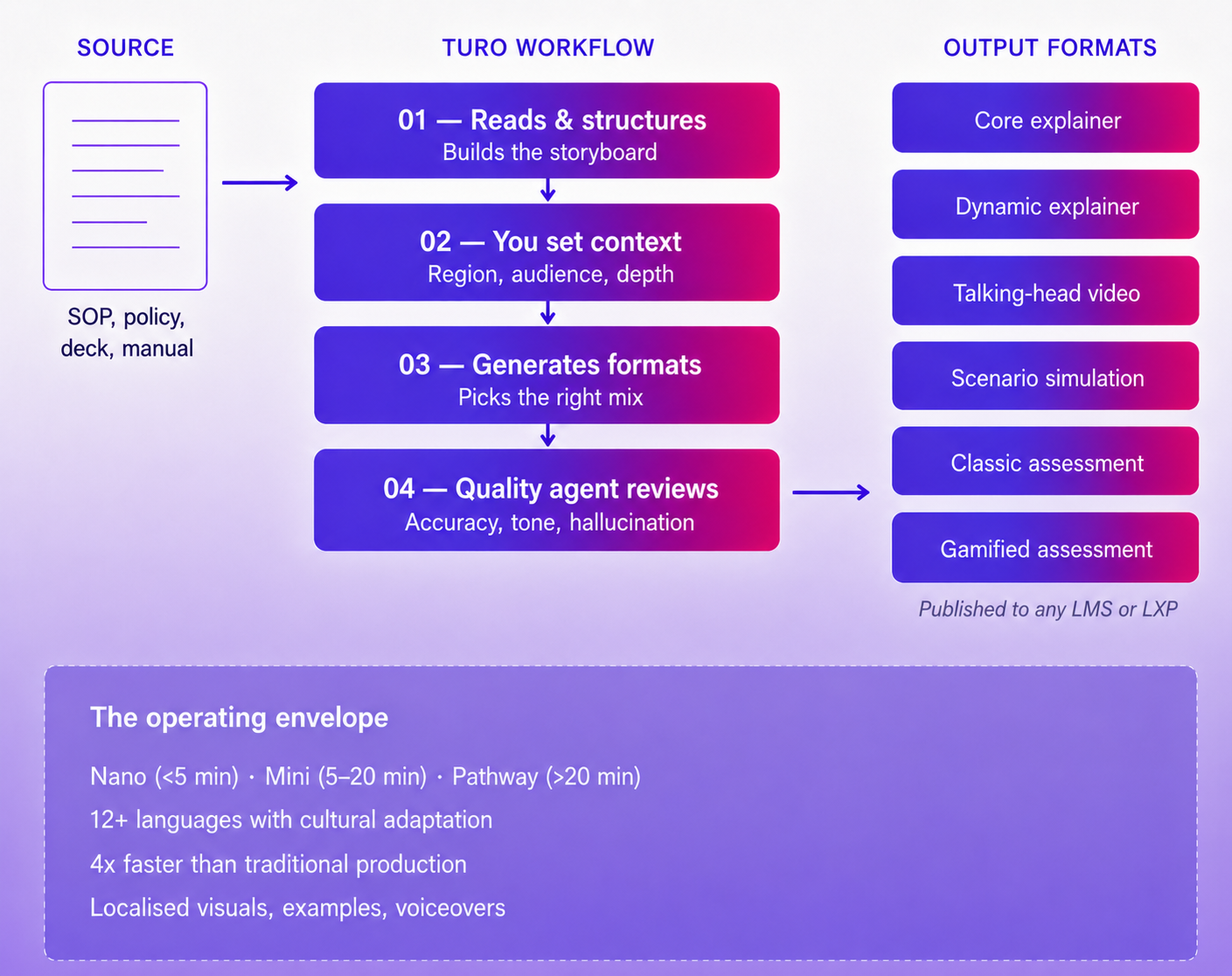
Figure — You upload the source. Turo reads it, structures it, asks you the four questions that matter, generates the formats, and runs a quality agent before anything ships.
What's actually happening inside the workflow
Four steps. Each one does work a human used to do, but doesn't anymore.
Step 1: Reads and structures the source
Upload a policy document, SOP, product deck, compliance manual, training PDF, or any structured business document. Turo analyses the source, identifies the core concepts, and converts it into a structured learning flow with chapters, objectives, and logical sequencing.
What traditionally takes instructional designers days of manual analysis and storyboarding happens in minutes. Because Turo is built on L&D-specific models such as instructional design frameworks, skill architectures, and assessment structures, the output reflects how experienced learning teams design learning, not how generic AI summarises documents.
Step 2: You set the context
This is where you direct the agent. Four inputs shape the entire output: what gets made, who it's made for, how deep it goes, and how interactive it feels.
- Document type: Is this a policy? An SOP? A product manual? A sales playbook? The framing changes the whole approach.
- Audience and region: Frontline workers in Indonesia. Knowledge workers in the UAE. Sales reps in India. Examples, scenarios, and cultural references adapt to fit.
- Depth: Nano under 5 minutes for a just-in-time nudge. Mini 5–20 minutes for focused skill building. Pathway over 20 minutes for a full capability journey.
- Engagement intensity: Standard, Enhanced, or Premium. This decides whether the output is mostly explainer videos, or includes interactive scenarios, or pulls in simulations and gamified assessments.
Step 3: Generates the formats
Based on the context you set, Turo decides which combination of formats actually serves the learning objective, and produces all of them.
Six output formats sit in Turo's library:
- Core explainer videos: clean, narrated overviews of a concept with on-screen text and visual support
- Dynamic explainer videos: video with on-screen presenters and narrative pacing, closer to a documentary feel
- Talking-head videos: AI-generated avatars delivering content with natural lip-sync and voice
- Scenario-based simulations: interactive branching scenarios where learners make decisions and see consequences
- Classic assessments: question-based knowledge checks aligned to the learning objectives
- Gamified assessments: game-mechanics-driven evaluations that lift completion and recall
The same SOP document might come out as a 4-minute explainer video plus a quiz for a Nano module, or expand into a full Pathway with three explainers, a branching simulation, and a gamified assessment for deeper training. The output adapts to the goal. The team doesn't have to specify every format manually.
Step 4: The quality agent reviews everything
This is the step most AI content tools skip, and it's the reason L&D teams reasonably hesitate to put AI-generated content in front of learners.
Turo includes a built-in quality agent that reviews every output before it reaches anyone. It checks for factual accuracy against the source document, structural integrity (does the learning objective flow logically?), tone consistency, and hallucination. If something fails the check, Turo regenerates that segment. The L&D team gets a clean draft, not a wall of AI-generated material they have to comb through paragraph by paragraph.
Human review still happens. But the team reviews for brand fit, tone, and audience, not for accuracy, structure, or whether the writing holds up. The quality agent has already handled that.
Once the content passes review, Turo auto-maps it to the skills, roles, and competencies in your framework and publishes one-click to Disprz or any LMS or LXP via SCORM, xAPI, or native integration. Built-in version control keeps every update tracked and live without disrupting learner journeys mid-course, so the last mile, where time usually gets lost, becomes a single step.
The Outcomes This Changes for L&D
Once the production model itself changes, three things shift quickly, and they're measurable inside the first quarter of using Turo.
Production speed. A 10-minute custom eLearning module from a content services vendor runs ₹1,500–₹5,000 per finished hour and takes 4–8 weeks. The same module built in-house with an authoring tool takes 2–4 weeks of an instructional designer's time, plus video, localisation, and review cycles. Turo produces it in under an hour.
Team capacity that compounds instead of clearing queues. Most L&D teams spend the majority of their time on production work, assembling courses, formatting modules, running localisation cycles. With the agent handling that, the same team gets time back for the work that actually compounds: content strategy, learning design, capability analysis, partnering with the business. The team doesn't shrink. It moves up the value chain.
The backlog stops being structural. Most large L&D functions operate a permanent 3–6 month content queue. With agentic production, that queue stops existing as a feature of the operating model. Requests get fulfilled in the same week they come in. The relationship between L&D and the business shifts from "we'll get to it" to "we shipped it Tuesday."
How Agentic AI Changes the L&D Team's Role
Beyond the measurable outcomes, three deeper shifts in how the team works and what it owns.
- From builder to director. Instructional designers stop assembling courses and start directing what gets produced. The work becomes editorial such as defining outcomes, reviewing the agent's draft, making the calls only a human can make about brand voice, learner empathy, and what good actually looks like for the business. The role gets bigger, not smaller.
- From buying content to making it. The off-the-shelf library budget shrinks because in-house production just got cheaper and faster than licensing third-party content for most use cases. Specialist domains still warrant external content; the bulk doesn't.
- From service desk to strategic partner. When the production constraint disappears, L&D stops being the function that takes orders from the business and starts being the function that anticipates capability needs. Conversations with the COO and CHRO change from "when can you have this ready" to "what should we be building next."
How to Think About This for Your Team
If you've read this far, you're probably weighing what an agentic AI content layer would actually change in your stack. One honest question is worth sitting with before you do anything.
Where is your content backlog right now? If your team is shipping everything the business is asking for, on time, in every language and format you need, the case for changing anything is weak. But most L&D teams we talk to are quietly running a 3–6 month queue, with off-the-shelf libraries plugging the gap and frontline teams asking for content that never arrives. If that's your reality, the question isn't whether to bring agentic AI into the workflow; it's how soon.
The most useful thing you can do is run a real test. Pick one document: a policy, an SOP, a product playbook, and one role. See what Turo produces. Compare it to how that piece of content would have shipped through your current process. The decision gets a lot clearer once it stops being abstract.
(And the content is only one half of the story. Turo also includes a practice and coaching layer, voice-guided SOP rehearsal, AI-powered sales simulations, conversational assessments, that closes the gap between content consumed and capability built. That's a longer conversation for a separate piece. Coming next on the Disprz blog.**)
Not ready for a demo yet? Explore how Turo works →
Frequently Asked Questions
Is Turo a replacement for our LMS or LXP?
No. Turo sits on top of your existing learning stack as the content and practice layer. It publishes courses, assessments, simulations, and learning experiences into any LMS or LXP through SCORM, xAPI, or native integrations. Organisations using Disprz can unlock deeper orchestration, but Turo is built to work across platforms.
How is this different from AI-enabled authoring tools?
Most authoring tools still rely on humans to run the workflow manually, with AI assisting in isolated tasks like scripting or summarisation. Turo changes the workflow itself. The agent reads source material, structures the learning flow, generates content, creates practice experiences, reviews outputs, and prepares deployment. Humans direct and refine the outcome instead of building every asset step by step.
How does Turo handle accuracy and hallucinations?
Turo works from your enterprise knowledge base, documents, and learning frameworks rather than generic internet data. A built-in validation layer checks outputs for accuracy, consistency, tone, and instructional quality before publishing. L&D teams remain fully in control with review, editing, and approval workflows at every stage.
What kinds of source documents can Turo work with?
Turo can process policies, SOPs, product decks, compliance manuals, sales playbooks, technical documents, training PDFs, and regulatory updates. It supports DOCX, PPT, and PDF formats natively and performs best with structured business documents where institutional knowledge already exists.
How does multilingual content generation work?
Turo generates learning natively in more than 12 languages instead of translating from a single English source. The system adapts examples, visuals, tone, and narration to local audiences, making the learning experience feel regionally relevant rather than mechanically translated.
What does pricing look like?
Turo offers usage-based pricing across content creation and AI-driven practice capabilities. Organisations can deploy it as a standalone solution or alongside the broader Disprz platform. Most teams significantly reduce production costs and turnaround time compared to traditional content development models.
How long does implementation take?
Most teams begin generating production-ready learning content within the first week using their existing business documents. The broader rollout typically focuses on identifying high-impact use cases, integrating systems, and helping teams shift from manual production to AI-directed workflows.