

On this page
Upskilling is the process of helping employees develop new skills that improve performance and prepare them for future responsibilities.
As AI, automation, and digital transformation continue to reshape work, the skills employees need are evolving faster than ever. Organizations can no longer rely on one-time training programs to keep their workforce ready. Continuous employee upskilling has become essential for staying competitive and closing emerging skill gaps.
Modern upskilling programs extend beyond traditional training to build both technical and human skills. When done well, upskilling improves employee productivity, engagement, and organizational agility, while preparing them for future roles and reducing reliance on external hiring.
Success depends on a clear strategy, relevant skill frameworks, measurable outcomes, and the right technology to drive adoption and continuous learning. In this guide, we'll discuss what is upskilling, explore the upskilling meaning and upskilling definition, examine key differences in upskilling vs reskilling, review practical upskilling examples, and understand why the importance of upskilling continues to grow in today's workplace.
What is Upskilling?
Upskilling Definition in Simple Terms
Upskilling refers to the process of helping employees develop new or advanced skills that build on their existing capabilities. In simple terms, it means learning new skills or improving current ones to perform the same job more effectively or take on higher-value responsibilities within the same role or career path.
The core upskilling definition focuses on growth and progression, not replacement. Employees strengthen what they already know instead of starting from scratch. This approach helps organizations improve workforce performance while preparing employees for changing job requirements.
Typical outcomes of employee upskilling include:
- Deeper expertise in current responsibilities
- Improved efficiency and quality of work
- Readiness for expanded or evolving roles
- Greater confidence in using new tools and technologies
What Upskilling Means in Today's AI-Powered Workplace
The upskilling meaning has expanded significantly in recent years. Today, upskilling is not only about improving existing skills. It is also about helping employees adapt to AI, automation, and new ways of working.
As technology changes how work gets done, many roles now require a combination of technical and human skills. Employees need to learn how to use AI tools effectively, work with data, make better decisions, and collaborate across teams. At the same time, skills such as critical thinking, communication, adaptability, and leadership remain essential.
Workforce upskilling helps organizations:
- Respond faster to technology and business changes
- Reduce the risk of skill gaps and skill obsolescence
- Improve employee confidence with AI and digital tools
- Enable career growth without changing roles
For example, Walmart has committed nearly $1 billion to skills training and development through 2027. As part of this investment, Walmart Academy is expanding access to AI training and certifications for U.S.-based associates, helping employees build capabilities needed for the future of work.
How Upskilling Differs from Traditional Training
Traditional training is often one-time, generic, and focused on immediate needs such as compliance, onboarding, or process updates. Upskilling, by contrast, is continuous, personalized, and future-focused. It aligns learning with long-term business goals and evolving skill requirements rather than short-term knowledge transfer.
Modern upskilling programs emphasize practical application, measurable skill growth, and ongoing reinforcement. Supported by the right technology, learning becomes part of everyday work rather than a separate activity.
In essence, what is upskilling today? It is a strategic approach to building skills that help both employees and organizations succeed in a rapidly changing business environment.
Why is Upskilling Important in 2027?
Organizations are facing faster skill changes than ever before. AI, automation, digital transformation, and changing customer expectations are reshaping job roles across every industry. As a result, the importance of upskilling continues to grow. Organizations that invest in upskilling employees are better positioned to improve performance, adapt to change, and build a workforce ready for the future.
Impact of Upskilling on Employee Performance
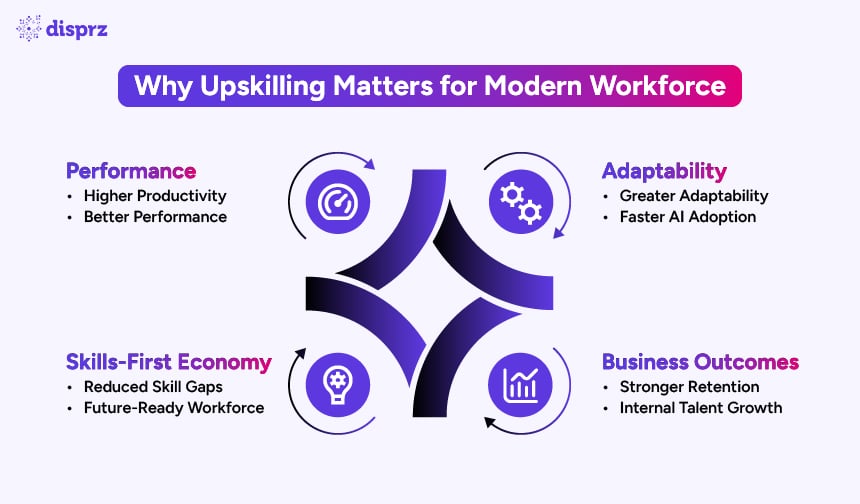
Upskilling has a direct and measurable impact on employee performance. When employees strengthen existing skills or develop advanced capabilities, they work more efficiently, make better decisions, and deliver higher-quality outcomes.
Employee upskilling also improves confidence. People are more likely to take ownership of their work when they feel capable and prepared for future challenges. Organizations with strong learning cultures see 57% employee retention rates compared to 27% for those without.
Key performance benefits include:
- Faster task completion and improved quality of work
- Greater problem-solving and decision-making ability
- Increased accountability and ownership
- Stronger alignment with role expectations
Role of Upskilling in Workforce Adaptability
In a rapidly changing business environment, learning agility and workforce adaptability have become a competitive advantage. New technologies and evolving business models can quickly make existing skills outdated. Upskilling helps employees adapt to these changes and stay productive.
Research from global workforce studies shows that many business leaders expect skill gaps within their organizations over the next few years. According to Deloitte, 65% of organizations have abandoned AI projects due to skills gaps. Organizations that continuously invest in employee upskilling are better prepared to respond to these challenges.
This adaptability helps organizations:
- Reduce reliance on external hiring
- Shorten time-to-productivity for new initiatives
- Support smoother change adoption across teams
- Build internal talent pipelines for future roles
Why Upskilling Matters in a Skills-First Economy
The modern economy increasingly values skills over job titles and degrees. Organizations are focusing more on what employees can do today and how quickly they can develop new capabilities tomorrow.
According to the World Economic Forum's Future of Jobs Report, 39% of workers' core skills are expected to change by 2030. This highlights why a proactive upskilling strategy is no longer optional.
Upskilling enables organizations to close skill gaps, prepare employees for emerging responsibilities, and strengthen workforce resilience. It also improves retention, as employees are more likely to stay with organizations that invest in their growth and career development.
Ultimately, the importance of upskilling extends beyond learning. It helps organizations remain competitive, build future-ready talent, and create a culture of continuous growth.
To explore the business and workforce benefits in more detail, read our guide on the benefits of employee upskilling and how it drives sustainable workforce growth.
Upskilling vs Reskilling vs Cross-Skilling
Organizations use upskilling, reskilling, and cross-skilling to address different workforce challenges. While all three approaches focus on skill development, each serves a distinct purpose. Understanding the differences helps you choose the right strategy based on your business goals, workforce needs, and future talent requirements.
What is Reskilling?
Reskilling is the process of training employees with entirely new skills so they can move into a different role or function. It is typically used when certain jobs become obsolete or when organizations need to redeploy talent into emerging areas driven by technology or market change.
Unlike upskilling, which deepens existing expertise, reskilling helps employees transition from one skill set to another, such as moving a customer support executive into a data operations or quality analysis role.
Common reskilling scenarios include:
- Shifting employees from declining roles to high-demand functions
- Supporting digital transformation initiatives
- Reducing layoffs by enabling internal role mobility
What is Cross-Skilling?
Cross-skilling involves developing skills outside an employee's primary role, enabling them to perform adjacent or complementary tasks. The goal is flexibility rather than role transformation. For example, a sales professional learning basic data interpretation or a software tester gaining exposure to product management workflows.
Cross-skilling improves collaboration, reduces dependency on specific roles, and helps teams operate more efficiently during workload fluctuations.
It is especially valuable for:
- Agile and cross-functional teams
- Project-based work environments
- Scaling operations without adding headcount
Key Differences Between Upskilling, Reskilling, and Cross-Skilling
The key difference lies in intent and scope. Upskilling enhances current capabilities to improve performance and prepare for role evolution. Reskilling equips employees with new capabilities to move into different roles altogether. Cross-skilling expands skill breadth to support multi-functional collaboration.
| Aspect | Upskilling | Reskilling | Cross-Skilling |
|---|---|---|---|
| Primary intent | Enhance existing skills | Build entirely new skills | Broaden skill range |
| Role impact | Same role, higher effectiveness | Transition to a new role | Support multiple roles or functions |
| Scope of learning | Deepens current expertise | Shifts to a different skill domain | Adds complementary skills |
| Typical use case | Role evolution, performance improvement | Role change due to automation or restructuring | Cross-functional collaboration |
| Time to impact | Short to medium term | Medium to long term | Short term |
| Business outcome | Higher productivity and quality | Workforce redeployment and continuity | Greater agility and flexibility |
| Workforce maturity fit | Stable roles with evolving requirements | Disrupted or transforming roles | Dynamic, team-based environments |
When Should You Use Each Approach?
Choosing between upskilling, reskilling, and cross-skilling depends on the challenge you are trying to solve.
| If your goal is to... | Use | Why? |
|---|---|---|
| Improve performance in existing roles | Upskilling | Employees need deeper expertise or new capabilities within their current jobs. |
| Move employees into new roles | Reskilling | Existing roles are changing, shrinking, or becoming obsolete. |
| Improve team flexibility and collaboration | Cross-skilling | Employees need complementary skills outside their core responsibilities. |
A simple decision framework:
Choose upskilling if:
- Roles remain relevant but skill requirements are changing
- Employees need AI, digital, or advanced functional skills
- You want to improve productivity and performance
Choose reskilling if:
- Technology or business changes are creating new job requirements
- Certain roles are becoming redundant
- You want to redeploy talent instead of hiring externally
Choose cross-skilling if:
- Teams need greater agility
- Employees frequently work across functions
- Business continuity depends on broader capability coverage
What's the Difference Between Upskilling and Reskilling?
The difference between upskilling and reskilling is simple. Upskilling helps employees improve skills for their current role, while reskilling teaches entirely new skills for a different role. If a relationship manager learns AI-powered advisory tools, that is upskilling. If the same employee transitions into a data analyst role through new training, that is reskilling.
Most organizations need both approaches. Upskilling supports continuous growth, while reskilling helps employees adapt to major business and technology changes.
Examples of Upskilling in the Workplace
Upskilling looks different across roles and industries. The right approach depends on the skills employees need to perform better today and prepare for future responsibilities. These upskilling examples show how organizations can strengthen workforce capabilities while improving business outcomes.
Upskilling Examples for Frontline Employees
Frontline employees often need upskilling to keep pace with changing customer expectations, tools, and processes. Common examples include customer service teams learning advanced communication and problem-resolution techniques, retail staff developing digital point-of-sale and inventory analytics skills, and operations teams strengthening process optimization capabilities.
These employee upskilling initiatives help improve service quality, reduce errors, and enhance customer experiences without changing core job responsibilities.
Additional examples include:
- Call center agents learning CRM and AI-assisted support tools
- Field teams adopting mobile workflows and digital reporting
- Service staff strengthening compliance and safety skills
- Store associates learning customer data and personalization tools
Upskilling Examples for Managers and Leaders
Managers and leaders require continuous learning as their responsibilities expand. Upskilling programs for leaders often focus on people management, coaching, decision-making, and change leadership.
Examples include first-time managers learning coaching and feedback techniques, mid-level leaders developing data-driven decision-making skills, and senior leaders strengthening digital leadership and strategic thinking capabilities.
Leadership upskilling supports:
- Stronger employee engagement and retention
- Better cross-functional collaboration
- More effective change management
- Consistent leadership behaviors across teams
Digital and Technical Upskilling Examples
Digital and technical skills are among the most common focus areas in modern upskilling programs. Employees across functions are learning how to work with data, automation, AI tools, cybersecurity practices, cloud technologies, and low-code platforms.
Even non-technical employees benefit from digital upskilling. Marketers may learn marketing automation platforms, HR teams may develop people analytics skills, and finance professionals may adopt advanced reporting and forecasting tools.
Common examples include:
- Learning data analytics and visualization tools
- Using AI assistants to improve productivity
- Building automation workflows
- Developing cybersecurity awareness
- Strengthening cloud and digital platform skills
These initiatives help organizations accelerate technology adoption while building workforce confidence in new tools.
Upskilling Examples in Banking and Financial Services
The banking and financial services industry is undergoing rapid digital transformation, making employee upskilling a strategic priority.
Relationship managers are increasingly learning how to use digital advisory platforms, customer insights tools, and AI-powered recommendations to deliver more personalized customer experiences. Frontline branch employees are being trained on digital transactions, self-service banking technologies, and omnichannel customer engagement.
Compliance and risk teams also require continuous upskilling to keep pace with changing AML, KYC, regulatory, and cybersecurity requirements. As regulations evolve, organizations need employees who can quickly adapt to new compliance expectations while maintaining operational efficiency.
Common banking upskilling examples include:
- Relationship managers learning digital advisory tools
- Branch staff adopting digital banking workflows
- Compliance teams staying current on AML and KYC regulations
- Operations teams strengthening data and automation skills
- Customer service teams using AI-assisted support platforms
Learn how Disprz helps financial institutions build future-ready talent through personalized learning and skill development solutions for the banking industry.
Common Challenges in Employee Upskilling
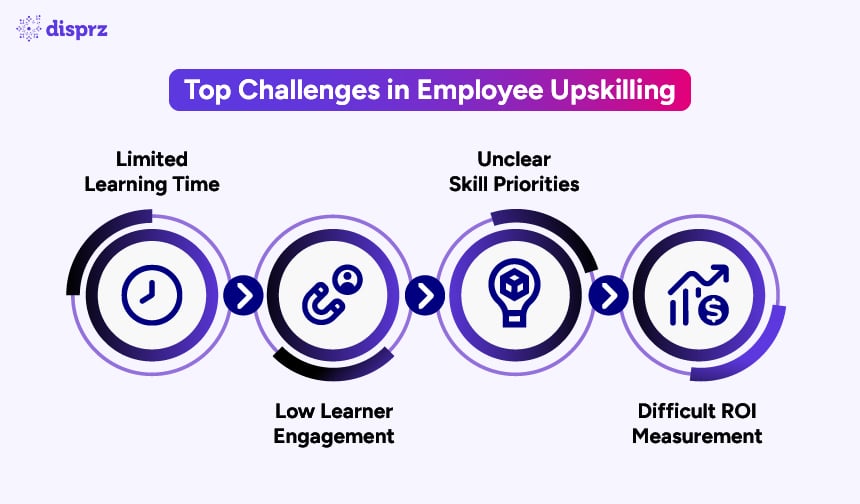
While the benefits of employee upskilling are clear, many organizations struggle to achieve consistent results. Limited time, low engagement, unclear skill priorities, and weak measurement practices can reduce the impact of even well-designed upskilling programs. Understanding these challenges is the first step toward building a more effective upskilling strategy.
Time Constraints and Heavy Workloads
One of the biggest barriers to upskilling employees is time. Most employees already manage demanding workloads, tight deadlines, and day-to-day responsibilities. Learning can quickly become a lower priority when it feels disconnected from work.
Without flexible learning options and manager support, participation often drops and completion rates suffer.
Organizations commonly face:
- Low participation due to workload pressures
- Learning treated as an additional task
- Difficulty finding dedicated learning time
- Inconsistent support from managers
To overcome this challenge, learning should be embedded into everyday work through microlearning, mobile learning, and on-the-job practice opportunities.
Low Learner Engagement
Low engagement is often the result of generic learning experiences. When content feels irrelevant to an employee's role or career goals, motivation declines.
Effective upskilling programs focus on personalized learning pathways, role-specific content, and clear connections between learning, performance, and career growth. Employees are more likely to engage when they understand how new skills will help them succeed.
Organizations can improve engagement by:
- Personalizing learning journeys
- Linking learning to career progression
- Recognizing and rewarding progress
- Providing continuous feedback and coaching
Identifying the Right Skills to Develop
Many organizations struggle to determine which skills should be prioritized. Without a clear understanding of current capabilities and future business needs, upskilling efforts can become fragmented and ineffective.
Successful workforce upskilling starts with a clear view of:
- Existing skill levels across roles
- Future business and technology requirements
- Emerging industry trends
- Critical capability gaps
Using skill assessments, role-based frameworks, and workforce planning data helps ensure learning investments focus on the skills that matter most.
Measuring Skill Progress and Business Impact
Measuring the success of employee upskilling is often more difficult than delivering the learning itself. Many organizations track course completions but fail to measure whether employees are actually building skills and improving performance.
Without clear measurement frameworks, it becomes difficult to demonstrate upskilling ROI or identify opportunities for improvement.
A simple starter framework includes three key metrics:
| Metric | What It Measures | Why It Matters |
|---|---|---|
| Completion Rate | Percentage of employees completing learning paths | Indicates adoption and participation |
| Pre- and Post-Skill Assessment Scores | Skill growth before and after training | Shows whether capabilities are improving |
| 90-Day Manager Performance Ratings | Observable changes in workplace performance | Connects learning to business outcomes |
Organizations should also establish clear proficiency benchmarks and regularly review learning and performance data together.
Common measurement gaps include:
- Overreliance on activity metrics
- Lack of standardized skill assessments
- Weak links between learning and performance outcomes
- Limited visibility into long-term capability growth
By combining learning metrics with performance indicators, organizations can better understand what is working and continuously improve their upskilling strategy.
How to Build an Effective Upskilling Strategy
A successful upskilling strategy goes beyond delivering training courses — it starts with a structured capability building model that ties learning to long-term business goals. It requires a clear understanding of skill needs, personalized learning pathways, continuous reinforcement, and measurable outcomes. When done right, upskilling becomes a long-term capability-building initiative rather than a one-time learning event.
Identify Skill Gaps and Future Skill Needs
A strong upskilling strategy starts with understanding both current skill gaps and future capability requirements. This involves mapping skills across roles, assessing proficiency levels, and aligning them with business goals and upcoming changes in technology, AI adoption, and market demands.
Organizations should combine skill assessments, performance data, and workforce planning to identify the capabilities that will have the greatest business impact.
Effective skill identification typically includes:
- Role-based skill frameworks and proficiency benchmarks
- Analysis of future business and technology trends
- Input from business leaders and frontline managers
- AI-driven skill gap analysis where available
Design Structured Upskilling Programs
Once priorities are clear, organizations need structured upskilling programs that move beyond ad-hoc training. Effective programs are role-based, outcome-driven, and built around clear learning milestones.
The most successful programs combine learning with practice so employees can apply new skills directly on the job.
Key elements include:
- Clear learning objectives and success criteria
- Hands-on practice and real-world application
- Assessments and reinforcement activities
- Alignment with business and performance goals
Create Personalized Learning Pathways
Not every employee starts with the same skills, experiences, or career goals. That's why personalization is critical.
Personalized learning pathways adapt content, pace, and learning recommendations based on individual skill gaps, proficiency levels, and career aspirations. This improves relevance, reduces learning fatigue, and increases completion rates.
Modern AI-powered learning platforms can automatically recommend learning experiences based on employee needs, helping organizations scale employee upskilling more effectively.
Drive Adoption and Continuous Learning
Even the best-designed upskilling programs will fail if employees do not actively participate.
Organizations need leadership support, manager involvement, and clear communication about why upskilling matters. Employees should see a direct connection between learning, career growth, and business success.
Organizations can improve adoption by:
- Embedding learning into daily workflows
- Recognizing learning achievements
- Encouraging peer learning and coaching
- Connecting learning to career progression
See how Disprz helps organizations automate skill gap analysis, build personalized learning pathways, and measure workforce capability growth.
Book a Demo
Applying the 70-20-10 Model to Your Upskilling Program
Many successful upskilling programs follow the 70-20-10 learning model. The framework suggests that 70% of learning happens through on-the-job experiences, 20% through coaching and collaboration, and 10% through formal training.
Instead of relying only on courses, organizations should create opportunities for employees to practice new skills, learn from peers, and receive ongoing feedback. This approach improves skill retention and accelerates real-world application.
Learn more about how to merge upskilling with the 70-20-10 learning model.
Choosing the Right Upskilling Platform
Technology plays a critical role in the success of workforce upskilling initiatives. The right platform should do more than deliver content. It should help you identify skill gaps, personalize learning, measure progress, and connect learning outcomes to business goals.
When evaluating an upskilling platform, look for:
- AI-powered learning recommendations and personalization
- Mobile-first learning experiences for frontline employees
- Built-in skill frameworks and assessments
- HRMS and enterprise system integrations
- Real-time analytics and skill insights
- Support for continuous learning and career development
Platforms such as Disprz combine AI-powered skill intelligence, personalized learning pathways, and workforce analytics to help organizations scale employee upskilling and reskilling initiatives while maintaining measurable business impact.
Learn more about Disprz's upskilling and reskilling solutions.
How to Measure Upskilling ROI
Many organizations invest heavily in employee upskilling but struggle to prove its business value. Measuring upskilling ROI helps you understand whether learning initiatives are improving skills, changing performance, and contributing to business outcomes.
The key is to move beyond activity metrics and connect learning data to workforce and organizational performance.
Key Metrics to Track
A practical upskilling ROI framework starts with four core metrics:
| Metric | What It Measures | Why It Matters |
|---|---|---|
| Completion Rate | Percentage of employees completing assigned learning | Shows participation and adoption |
| Skill Proficiency Scores | Pre- and post-training skill assessments | Measures actual skill growth |
| Time-to-Competency | How quickly employees reach target proficiency | Indicates learning effectiveness |
| 90-Day Performance Ratings | Manager evaluation after training | Connects learning to workplace performance |
Together, these metrics provide a balanced view of learning engagement, capability development, and business readiness.
Organizations should establish baseline measurements before launching upskilling programs so they can accurately track progress over time.
Linking Upskilling to Business Outcomes
The real value of employee upskilling becomes visible when learning outcomes are connected to business results.
For example, stronger skills can lead to:
- Higher revenue per employee
- Faster sales ramp-up and productivity
- Lower error and compliance-risk rates
- Increased internal promotions
- Reduced employee attrition
- Faster adoption of new technologies and processes
This is why leading organizations increasingly connect learning data with HR, performance, and business systems. Instead of measuring training alone, they measure how skills influence operational and business outcomes.
According to the World Economic Forum, skills development is becoming one of the most important drivers of workforce competitiveness as organizations prepare for rapid changes in technology, AI, and job requirements. When organizations consistently invest in workforce upskilling, they create stronger internal talent pipelines and reduce dependence on external hiring.
The most successful organizations treat upskilling ROI as an ongoing measurement process rather than a one-time calculation. By regularly reviewing skill, performance, and business metrics together, they can continuously improve learning investments and maximize impact.
Want to estimate the value of your learning initiatives? Use the Disprz L&D ROI Calculator to understand how skill development programs can influence productivity, performance, retention, and business outcomes.
→ Try the Disprz L&D ROI Calculator
Upskilling in the Age of AI [2027]
AI is changing how work gets done across every industry. As organizations adopt generative AI, automation, and intelligent workflows, employees need new skills to remain effective and productive. This makes AI upskilling one of the most important workforce priorities in 2027.
There are two sides to modern upskilling.
The first is upskilling with AI. Employees need to learn how to use AI tools effectively to improve productivity, automate routine tasks, analyze information faster, and make better decisions. Whether it's using AI assistants, content-generation tools, or workflow automation platforms, AI literacy is quickly becoming a core workplace skill.
The second is upskilling for AI. As AI changes job responsibilities, employees must develop new capabilities that complement technology. Skills such as critical thinking, problem-solving, communication, adaptability, and data interpretation are becoming increasingly valuable.
Here are three major shifts organizations are seeing:
- AI is automating repetitive tasks, allowing employees to focus on higher-value work.
- Digital and data skills are becoming essential across almost every role.
- Human skills such as creativity, leadership, and collaboration are growing in importance.
Organizations that invest early in AI upskilling can help employees adapt more confidently to change while building a workforce ready for future opportunities.
To learn more, explore our guide on GenAI upskilling and employee learning.
Key Takeaways
- Upskilling helps employees build new capabilities while growing within their existing roles and responsibilities.
- A successful upskilling strategy aligns skill development with business goals, workforce needs, and change.
- Organizations should combine upskilling, reskilling, and cross-skilling based on evolving talent requirements.
- Measuring upskilling ROI requires tracking skill growth, performance improvements, and business outcomes consistently.
- AI upskilling is becoming essential as technology reshapes jobs, workflows, and workforce expectations globally.
Conclusion
As skill requirements continue to evolve, organizations that build a continuous learning culture will be better positioned to adapt, innovate, and grow.
Upskilling has become a strategic imperative for organizations aiming to build a future-ready workforce. As roles continue to evolve and skill requirements shift faster than ever, the question is no longer what is upskilling, but how effectively organizations can embed it into everyday work. A well-executed upskilling strategy empowers employees to grow within their roles, improves performance, and strengthens long-term organizational resilience.
Successful workforce upskilling is not about isolated training initiatives. It requires a clear understanding of skill needs, structured and personalized upskilling programs, strong leadership support, and the right technology to enable continuous learning. When organizations align employee upskilling with business priorities, learning becomes more relevant, measurable, and impactful. Employees feel more confident and engaged, while organizations benefit from improved agility, retention, and internal talent mobility.
As the shift toward a skills-first economy accelerates, organizations that invest consistently in upskilling will be better positioned to adapt, innovate, and compete. Upskilling is not just about preparing for the future; it is about performing better today while building capabilities for what's next.
To support this journey, Disprz's AI-powered Learning Experience Platform (LXP) helps organizations identify skill gaps, deliver personalized learning pathways, and track real skill progress, ensuring upskilling translates into measurable performance on the job.