

On this page
The Coaching Math That Doesn't Add Up
Every sales leader knows the feeling. You have 120 reps spread across eight zones. Your six sales managers are stretched: running pipeline reviews, joining critical sales calls, handling escalations, supporting late-stage deals across the sales cycle, and somehow also expected to run a consistent coaching program for every rep on their team. But the calendar doesn't lie.
A typical sales manager has between eight and twelve direct reports. Meaningful sales coaching takes time. Reviewing a call recording, running coaching conversations, providing roleplay feedback, and refining a rep's sales skills can easily require three hours per rep every month to make a measurable difference. That's 24 to 36 hours of coaching time before the manager has tackled any other responsibility in the sales process.
Most managers don't have 36 spare hours. Most barely have six.
The result is a system that looks effective on paper. One-to-ones are scheduled. A coaching plan exists. Managers are expected to function as effective sales coaches. Yet very little effective coaching actually reaches most team members.
Instead, coaching is typically reserved for struggling reps or high-priority deals, while the majority of the team receives little structured feedback or practice. That means many capable reps never develop the habits that separate average performers from top performing sales professionals.
This is why many organizations are rethinking traditional sales coaching programs as part of their broader sales training strategy. They're looking for ways to deliver consistent coaching, frequent practice, and personalized feedback at scale, without adding more hours to a manager's week.
If you're exploring how AI addresses the broader picture of rep development, our complete guide to AI sales coaching covers the full landscape, including how it strengthens sales training, modern sales coaching programs, and long-term L&D strategy; not just your sales stack.
What Is the Sales Manager Bandwidth Problem?
The sales manager bandwidth problem is structural, not personal. It's the gap between the amount of coaching your reps need to improve and the amount your managers can realistically deliver; given the size of their teams and every other demand on their time.
It shows up in three predictable ways:
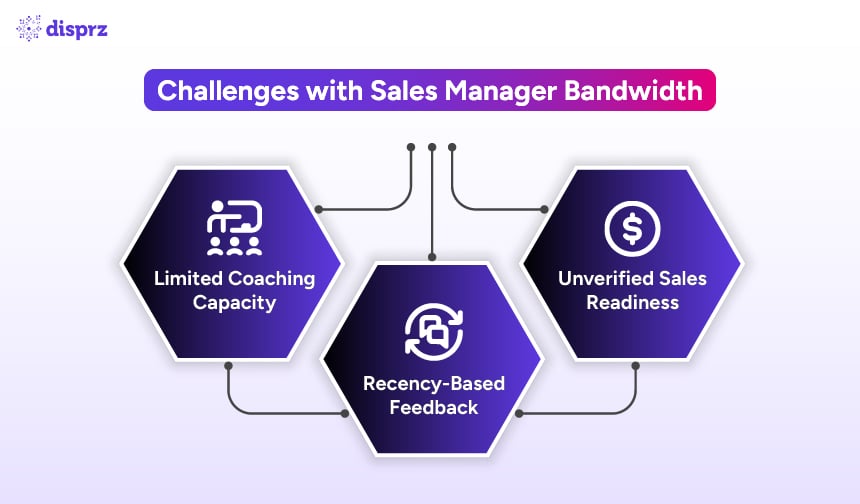
1) Coaching concentration: Managers spend the most time with the reps they're most worried about: those on a PIP, those with open escalations, or the reps they personally connect with. The middle 60% of your distribution gets almost nothing. Those are exactly the reps where coaching would have the most impact.
2) Recency bias in feedback: When a manager does find time for a rep, they tend to focus on what happened last week: the deal that slipped, the call that went sideways. They rarely step back to see patterns across six weeks of conversations, because they haven't listened to six weeks of calls.
3) Unverified readiness: Before a rep goes live on a key account, a renewal, or a high-stakes outbound push, a manager has almost no objective way to know if that rep is actually ready. The first signal is often a missed deal or a customer complaint.
None of this is the manager's fault. It's a capacity problem masquerading as a performance problem.
Why Traditional Coaching Fails at Scale
Traditional sales coaching was designed for small teams. In the 1990s, when a sales manager ran a team of four or five reps in a single geography, weekly one-to-ones were achievable. Ride-alongs were normal. You could sit in on every important call, provide personalized sales coaching for reps, and reinforce the team's sales strategy through regular feedback. That level of hands-on sales performance coaching simply doesn't scale in today's larger, distributed sales organizations.
That model hasn't scaled with the way enterprise sales organizations are built today. Consider what most managers are actually managing:
- Eight to twelve direct reports, not four or five
- Distributed across cities, time zones, or countries
- Each running eight to fifteen live opportunities at any time
- Making twenty to forty calls per week
A manager trying to give meaningful call-by-call coaching to twelve reps making thirty calls a week would need to review 360 calls per week. That's not a coaching system. That's a full-time listening job for five people.
Training workshops don't fill the gap. Research consistently shows that around 70% of what's taught in a training event is forgotten within a week without reinforcement and practice. Without repeated practice in realistic scenarios, training spend is largely wasted.
Peer roleplay is better than nothing; but it introduces evaluator inconsistency, scheduling friction, and the social awkwardness of being assessed by a colleague. Most reps treat it as a box to tick.
The Data Behind the Coaching Gap
The gap between coached and uncoached reps isn't abstract. It's measurable, and it's large.
According to the MySalesCoach State of Sales Report, there is a 29 percentage point attainment gap between reps who receive weekly coaching (76% quota attainment) and reps who receive only quarterly coaching (47% quota attainment). That gap (29 points) is not the difference between a good manager and a bad manager. It's the difference between a coached rep and an uncoached one.
The same coaching deficit drives onboarding costs. Average B2B sales ramp-up time has increased from 4.3 months in 2020 to 5.7 months. Every week a new rep isn't at full productivity is revenue your organization isn't generating.
According to Ebsta’s State of GTM Report, 78% of sales reps missed quota in 2025. The coaching deficit is a direct contributor to that number.
Meanwhile, per a Gartner Workforce Survey, 6 in 10 employees say they aren't getting the on-the-job coaching they need. Reps know it. Managers know it. Leadership knows it. The system just doesn't have enough hours to fix it.
What Reps Actually Need (and How Often)
The learning science on this is unambiguous. Skill development requires three things that most coaching programmes fail to deliver: repetition, immediate feedback, and psychological safety.
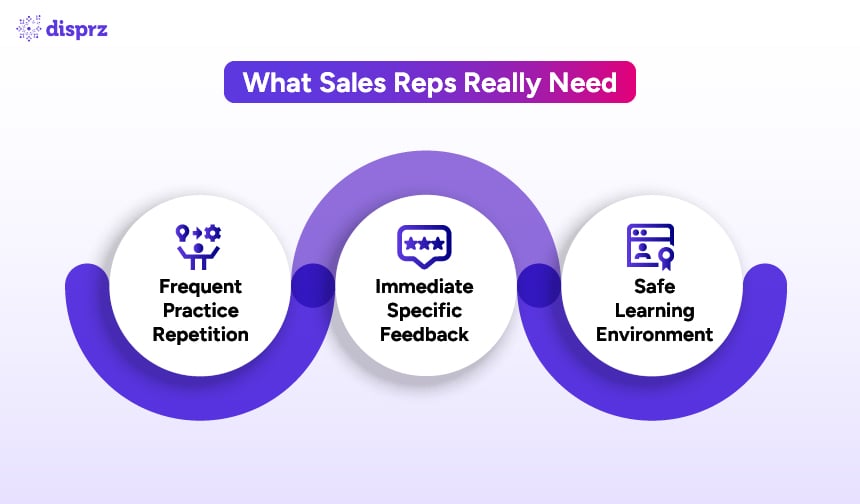
1) Repetition (spaced practice): A rep needs to practice an objection response dozens of times (not twice in a quarterly roleplay) before it becomes a reliable, calm, instinctive reply. The same applies to discovery questioning, multi-stakeholder navigation, and closing sequences. One practice attempt isn't practice. It's performance anxiety.
2) Immediate, specific feedback: Generic feedback (“you need to be more confident”) doesn’t change behaviour. Feedback that is timestamped, specific, and tied to a concrete moment (“at 02:14, you agreed with the objection instead of redirecting it: here’s what you could have said”) changes behaviour. Managers rarely have time to deliver feedback at that level of granularity.
3) Psychological safety: Most reps hate being watched and evaluated by their manager. The performance dynamic makes it harder to take risks, try new approaches, or honestly expose a weakness. A practice environment where there are no consequences (where a rep can fail fifty times privately before they fail once publicly) produces faster, deeper skill development.
Traditional manager-led coaching fails on all three dimensions at scale. There aren't enough repetitions, the feedback isn't specific enough, and the power dynamic removes the psychological safety that makes practice effective.
The Real Cost of Under-Coached Reps
The bandwidth problem isn't just a training quality issue. It has direct revenue consequences.
1) Lost deals from skill gaps that went undetected: When a rep loses a deal because they can't handle a procurement objection or hold their ground in a multi-stakeholder negotiation, the post-mortem rarely identifies coaching deficiency as the root cause. It gets attributed to pricing, product fit, or competitive pressure. The actual root cause (the rep never practiced that conversation) goes unaddressed.
2) High attrition in the first year: Reps who don't feel supported leave. A significant proportion of first-year attrition in sales organizations is driven not by poor hiring but by poor onboarding and insufficient coaching. The cost to replace and ramp a new rep (factoring in recruiting, onboarding, and the productivity gap during ramp) typically ranges from 50% to 150% of annual salary.
3) Coaching inconsistency across geographies: In a distributed sales organization, your best zone manager produces rep attainment rates three times higher than your worst zone. That gap rarely reflects talent distribution. It reflects coaching quality. Reps in undercoached zones will eventually figure this out; and they'll vote with their feet.
4) The live-learning problem: When a rep doesn't have a safe space to practice, they practice on real customers. Every early-career rep is burning leads, making mistakes on real calls, mishandling real objections; and that is expensive. In enterprise BFSI settings, a single botched conversation can cost a relationship worth crores.
Why Hiring More Managers Isn't the Answer
The obvious solution to a manager bandwidth problem is to hire more managers. Reduce span of control from twelve to six. Double your management layer.
This fails for four reasons.
1) The economics don't work: A senior sales manager in India costs ₹30–60 lakh per year fully-loaded. In the US, $150,000–$250,000. Hiring enough managers to genuinely coach every rep at a meaningful frequency (across an enterprise sales force of 500+) would add tens of crores to your cost base before you've moved a single quota number.
2) Managers don't consistently deliver quality coaching: Not every manager is a great coach, even when they have time. Some are great at running pipeline reviews. Some are great at closing deals alongside reps. Very few are trained, disciplined coaches who can identify the specific conversation behaviours that need to change and give actionable, objective feedback on them.
3) Coaching quality varies across managers: Even if you hire more managers, you've now introduced more variance. Your best manager coaches one way; your second-best coaches another. The rep experience becomes inconsistent, and you have no objective data on whether any of it is working.
4) The problem compounds with growth: Every time you expand headcount (new markets, new product lines, a new city), you need more managers. Scaling coaching through headcount means coaching scales linearly with cost. You never get ahead of it.
The bandwidth problem isn't solvable by adding humans. It's only solvable by removing the human from the repetitive practice loop and saving managers for the conversations where human judgment is irreplaceable.
What AI Sales Coaching Actually Does
AI sales coaching is not a chatbot. It's not a training video with a quiz. It's a system that puts every rep inside a realistic, voice-led simulation of a real buyer conversation; and then analyses every moment of that conversation to tell the rep exactly what they did well, what they missed, and what to do differently next time.
Here's how it works in practice with the Disprz Sales Coach.
1) Build the scenario: The manager (or L&D team) defines the buyer persona: name, role, seniority, emotional state at the start of the call, decision style, prior knowledge of your product. They upload product context: pitch decks, battle cards, competitive positioning, SOPs. Sales Coach uses all of that to create a hyper-realistic AI buyer ready to engage.
2) Practice the roleplay: The rep enters a live, voice-based two-way conversation with the AI buyer. No hints. No scripts. The AI responds dynamically to everything the rep says (just as a real buyer would) including pushing back, raising objections, asking difficult follow-up questions, and testing how the rep handles pressure.
3) Get detailed feedback: After the call, post-session analytics identify every missed moment, scored against the specific sales framework being trained (BANT, SPIN, Challenger). The rep sees their talk ratios, filler word count, a timestamped breakdown of key moments; and a personalized coaching action plan for their next session.
The manager doesn't need to be present. The AI runs the practice session, evaluates it, and produces the coaching output. The manager reviews a dashboard showing which reps are ready and which aren't; without listening to a single recording.
How AI Coaching Solves the Bandwidth Problem
The bandwidth problem has three components: not enough time, not enough consistency, and not enough data. AI coaching addresses all three.
1) Time: An AI coach can run a coaching session with every rep on the team simultaneously, at any hour of the day or night. A manager with twelve direct reports who each need three hours of meaningful practice per month needs 36 hours. An AI coach needs zero manager hours to deliver those 36 hours of practice. The manager's time is now freed for what humans do better: strategic direction, motivation, escalation support, and closing the deals where their involvement makes the difference.
2) Consistency: Every rep gets the same quality of scenario, the same scoring rubric, the same feedback framework; regardless of which manager they report to, which zone they work in, or which shift they're on. Coaching quality stops being a function of manager quality and becomes a function of scenario quality, which is controllable.
3) Data: For the first time, a VP Sales or Head of Sales Enablement can answer the question: "Which of my reps are call-ready right now?" Not based on gut feel, not based on tenure, but based on scored simulation data. Reps who consistently score below the readiness threshold get flagged before they're put on high-stakes accounts. Reps who improve their scores over multiple sessions get recognised for it.
The manager's role doesn't disappear. It shifts. Instead of spending 80% of their coaching time on logistics and listening, they spend it on the conversations that require their experience and judgment: the deals, the motivation, the strategy. The AI handles the repetitive practice infrastructure that was previously impossible to scale.
Why Enterprises Choose Disprz Sales Coach
Disprz Sales Coach is purpose-built for enterprise sales organizations that need to solve the bandwidth problem at scale; not as a bolt-on feature, but as a dedicated AI coaching agent integrated natively with the learning infrastructure your teams already use.
Here's what enterprise customers deploy:
- Sales-framework-trained AI: Sales Coach is trained on BANT, SPIN, and Challenger frameworks and understands the nuances of different deal stages: from discovery through to closing and renewal. It doesn't give generic communication feedback; it scores sales-specific behaviours.
- Hyper-realistic buyer personas: Build buyer simulations from your actual ICP: name, seniority, emotional state, decision style, objection profile. The AI buyer adapts dynamically to how each rep responds; not a scripted decision tree.
- Voice-based roleplay with real-time transcription: Every word, pause, and filler is captured. The evaluation runs in the background during the call so feedback is available immediately after, not days later.
- Moment-by-moment scoring with timestamps: The post-session scorecard identifies the exact second a rep missed a buying signal, agreed with an objection instead of redirecting it, or failed to advance the deal stage. Reps know exactly what to fix.
- Personalised coaching action plans: Each rep gets a specific next-step plan tied to their personal gaps, not a generic recommendation. Over sessions, performance trends are tracked.
- Manager dashboard for readiness visibility: Sales managers and VPs see across the whole team: who's improving, who's stuck, who is ready for live accounts, and who needs intervention.
- Platform-neutral deployment: Sales Coach operates across LMS and LXP ecosystems, with deeper native integration within Disprz's own LXP; so reps practice inside the same environment where they learn.
- Autonomous quality controls: A built-in quality agent continuously reviews scenario outputs and scoring to minimise hallucination and ensure enterprise-grade reliability.
- India enterprise-ready: BFSI-specific personas, insurance agent scenarios, and vernacular support built for India's sales culture; not retrofitted from US product libraries.
- Fast to deploy: Three custom roleplay scenarios built from your actual buyer personas and product context, live within 48 hours of onboarding.
Disprz is recognised by Josh Bersin as an HR Tech AI Trailblazer 2025 and is rated a G2 Enterprise Grid Leader (Spring 2025) and Asia Regional Leader (Spring 2025); with coverage in the Gartner Market Guide for Corporate Learning Technologies 2025.
Key Takeaways
- The bandwidth problem is structural. A manager with 8–12 direct reports cannot deliver the 3+ hours of monthly coaching each rep needs. The calculation makes it impossible without AI.
- The attainment gap is 29 percentage points between weekly-coached and quarterly-coached reps: a direct, measurable cost of insufficient coaching frequency.
- Traditional solutions don't scale. Hiring more managers adds cost without adding consistency. Workshops are forgotten within a week. Peer roleplay lacks safety and objectivity.
- AI coaching solves all three dimensions of the bandwidth problem: it multiplies time, standardises quality, and produces data on readiness that managers have never had before.
- The manager's role doesn't disappear; it improves. AI handles repetitive practice infrastructure so managers can focus on judgment, strategy, and motivation.
Conclusion
The sales manager bandwidth problem isn't going away by itself. Sales teams are getting larger, more distributed, and more complex; and the gap between the amount of coaching that reps need and the coaching they get is widening.
The organizations that solve it first will build a structural competitive advantage: more reps ready faster, more quota attainment, less attrition, and more consistent performance across every geography. The organizations that don't will keep attributing missed targets to market conditions and talent problems when the real cause is sitting in a calendar that has no room for coaching.
AI sales coaching doesn't replace great managers. It gives them the one thing they've never had enough of: time. Time to focus on the conversations, deals, and people decisions that actually require human experience; because the practice infrastructure is now running itself.
FAQs
1) What is the sales manager bandwidth problem?
The sales manager bandwidth problem is the structural gap between the amount of coaching enterprise sales reps need (typically 3+ hours per rep per month) and the amount a manager with 8–12 direct reports can realistically deliver alongside their other responsibilities. The result is that most reps receive insufficient coaching, which directly impacts quota attainment and ramp speed.
2) How much does coaching frequency actually affect quota attainment?
The attainment gap between weekly-coached reps (76% quota attainment) and quarterly-coached reps (47% quota attainment) is 29 percentage points. That's not a marginal difference; it represents roughly a third more revenue generated per rep by simply increasing coaching frequency.
3) Why can't hiring more managers solve this problem?
Adding management layers addresses span of control but not coaching quality or consistency. Senior sales managers are expensive (₹30–60 lakh per year in India), not all managers are strong coaches, and coaching quality still varies by individual. AI coaching delivers consistent quality at zero marginal cost per additional rep.
4) What does AI sales coaching actually do?
AI sales coaching puts reps inside realistic voice-led simulations of buyer conversations, then analyses every moment of the conversation to deliver timestamped, specific feedback tied to a sales framework (BANT, SPIN, Challenger). Reps get a personalized coaching action plan after every session. Managers get a dashboard showing readiness scores across the team.
5) How is AI sales coaching different from a training video or e-learning module?
Training content tells reps what to do. AI sales coaching makes them practice doing it (under realistic pressure, with a buyer who pushes back dynamically) until the behaviour is embedded. It's the difference between reading about how to swim and getting in the pool. The practice loop is what traditional e-learning doesn't provide.
6) How long does it take to set up AI sales coaching scenarios?
With Disprz Sales Coach, a manager or L&D team can configure a full buyer persona and roleplay scenario in under 30 minutes. Three custom scenarios built from your actual product context and buyer profiles can be live within 48 hours of onboarding.
7) What sales frameworks does Disprz Sales Coach score against?
Disprz Sales Coach is trained on BANT, SPIN, and Challenger sales frameworks. Scoring evaluates stage-specific behaviours: discovery quality, needs uncovering, solution positioning, objection handling, and closing discipline; not just communication style.
8) How does a sales manager know which reps are ready for live accounts?
The manager dashboard in Disprz Sales Coach shows readiness scores across the whole team: individual session scores, improvement trends over multiple sessions, specific skill gap areas, and a flag system for reps who fall below the readiness threshold. For the first time, readiness is based on scored simulation data; not tenure or gut feel.
9) Can AI coaching work for India's frontline and BFSI sales teams?
Yes. Disprz Sales Coach includes BFSI-specific buyer personas, insurance agent scenarios, and is built for India's sales culture; not retrofitted from US product libraries. It's already deployed across Disprz's 500+ India enterprise customer base, including HDFC Ergo and AIA Singapore.
10) Does AI sales coaching replace the sales manager?
No. AI coaching handles the repetitive practice infrastructure that currently consumes most of a manager's coaching time: running sessions, delivering feedback, tracking performance. Managers shift their focus to strategic direction, deal support, motivation, and the conversations that require real human judgment. The manager's role becomes higher-leverage, not redundant.