

On this page
AI sales coaching uses AI-powered roleplay and call analysis to give every rep realistic practice and personalized feedback at scale. Here's how it works, what outcomes to expect, and how it differs from traditional coaching.
Your reps complete the training. They pass the certification. They sit through the workshop. And then they walk into a live sales call with a real customer; and the wheels come off. The discovery question never gets asked. The objection lands and the rep freezes. The deal that should have closed slips a quarter.
This is the gap every sales leader and sales manager knows but few platforms address: the distance between knowing what to say and actually saying it when a tough buyer pushes back. Training fills the first half. Coaching is supposed to fill the second; but coaching doesn't scale. One manager can sit in on a handful of calls a week. They have dozens of sales reps and sales professionals to support. The math has never worked.
The stakes are rising. According to Ebsta’s State of GTM Report, 78% of sales reps missed quota in 2025. Average B2B sales ramp-up time has increased from 4.3 months in 2020 to 5.7 months in 2026. In addition, the MySalesCoach State of Sales Report found that sales reps receiving weekly coaching achieved a 76% quota attainment rate, compared to 47% for those coached only quarterly; a gap of 29 percentage points. That gap is not a talent problem. It is a coaching-capacity problem, expressed as lost revenue, lower win rates, and inconsistent sales performance across the sales team.
This is where AI sales coaching enters the picture. The best AI sales coaching tools combine artificial intelligence, AI-driven feedback, and scalable personalized coaching to help sales organizations develop skills that traditional coaching often misses. Through realistic AI sales roleplay and role playing scenarios that mirror real-world buyer conversations, these platforms act as a virtual sales coach, helping reps practice objection handling, improve execution of their sales methodology, and close critical skill gaps before they ever speak with a customer.
Here we explain what AI sales coaching is, how modern sales coaching tools work, the key features to look for, what they actually change for both L&D and revenue teams, and how to tell a serious platform from a rebranded chatbot; so you can decide whether AI sales coaching belongs in your sales readiness stack.
What Is AI Sales Coaching?
AI sales coaching is the use of artificial intelligence to give sales reps realistic, on-demand practice and personalized, objective feedback; without requiring a manager to be in the room.
In its most advanced form, it works through voice-led roleplay. An AI plays the role of a buyer with a defined persona, emotional state, and objection profile. The rep plays themselves; no script, no hints. The AI responds dynamically to whatever the rep says, the way a real buyer would. When the conversation ends, the rep gets a detailed breakdown: what they did well, where they missed, how they handled objections, and exactly what to work on next.
It is useful to separate two things the term often gets blurred with:
- Sales training teaches the rep what to do: frameworks, product knowledge, talk tracks.
- Sales coaching helps the rep get better at doing it: through practice, feedback, and reinforcement over time.
AI sales coaching lives firmly in the second category. It is not a content library or a course catalog. It is the practice and feedback layer that turns training into capability. The best implementations connect the two: reps practice inside the same environment where they learn, so the gap between classroom and call collapses.
Why Sales Coaching Is Suddenly a Revenue Priority
Coaching has always mattered. What changed is that the cost of not coaching became impossible to ignore, and the technology to coach at scale finally arrived.
Three forces are converging:
- Ramp time is climbing. A new rep now takes around six months to reach productivity. Every extra week of ramp is revenue you hired for but aren't collecting.
- Coaching is uneven and infrequent. Six in ten employees say they aren't getting the on-the-job coaching they need, per a Gartner Workforce Survey. The reps who get frequent coaching outperform those who don't by a wide margin; but frequent coaching has been operationally impossible.
- The technology caught up. AI can now hold a realistic, adaptive voice conversation, score it against sales frameworks, and prescribe next steps. What used to require a skilled manager's full attention can now happen for every rep, every day.
The result is a category forming in real time. Adoption is already moving. According to Allego's 2025 research, 43% of revenue enablement leaders now use AI-powered roleplay to enhance sales coaching, and teams using AI in coaching report being roughly 20% more likely to improve revenue outcomes than those that don't.
How AI Sales Coaching Works: The Three-Step Loop
Modern AI sales coaching runs on a simple, repeatable loop: build the scenario, practice the roleplay, get feedback. Then repeat.
Step 1: Build the Scenario
You define the buyer persona, the situation, and the objective of the call. You upload your own context (product decks, battle cards, SOPs, objection libraries); so the simulation sounds like your buyers, not a generic template. You can set the buyer's seniority, decision style, prior knowledge of your product, and emotional state at the start of the call (cautious, skeptical, rushed, enthusiastic).
Step 2: Practice the Roleplay
The rep enters a two-way, voice-led simulation. There are no hints and no script. The AI buyer responds to everything the rep says and adapts in real time; if the rep fumbles discovery, the buyer gets harder to read; if the rep handles an objection well, the conversation advances. Everything is transcribed live, and evaluation runs silently in the background so the practice stays realistic.
Step 3: Get Detailed Feedback
When the call ends, the rep receives a structured analysis: an overall readiness score, a breakdown by competency (discovery, needs uncovering, objection handling, closing), timestamped "missed moments," talk-to-listen ratio, filler-word count, and a deal-likelihood read. Critically, the rep also gets a personalized coaching action plan for the next session; not just a grade, but a prescription.
The power isn't in any single session. It's in the loop. A rep can run the same scenario ten times before their first real call, and the manager can see exactly who is call-ready and who isn't; before a deal is on the line.
AI Sales Coaching vs. Traditional Sales Coaching
Traditional coaching isn't wrong. It's just constrained. AI doesn't replace the manager; it removes the constraints that have always capped how much coaching reps actually get.
| Dimension | Traditional Sales Coaching | AI Sales Coaching |
|---|---|---|
| Frequency | A few sessions per quarter, if that | On-demand, every day |
| Reach | 5–10 reps per manager, realistically | Unlimited reps, simultaneously |
| Consistency | Varies by manager, mood, and geography | Same rubric for every rep, every time |
| Feedback | Subjective, from memory, often delayed | Objective, timestamped, immediate |
| Practice Safety | Performed for the manager; high pressure | Practiced privately; psychologically safe |
| Readiness Visibility | Discovered after a deal is lost | Measured before the rep goes live |
| Cost to Scale | Linear; more reps need more managers | Flat; scales without added headcount |
A short but important caveat: AI coaching is strongest at practice and reinforcement; the high-volume reps. The human manager still owns strategy, motivation, career development, and the judgment calls AI can't make. The winning model is both: the manager sets the agenda; the AI executes it at scale.
The Manager Bandwidth Problem AI Coaching Solves
Behind almost every sales coaching purchase is one unspoken math problem.
A sales manager can meaningfully coach 5–10 reps a week. A typical manager has 8–12 direct reports, each of whom needs several hours of coaching a month to genuinely improve. In a 500-rep organization, doing this properly would require managers to deliver 500 coaching touches a week; when they have capacity for 50 to 100.
So coaching gets rationed. The top reps and the obvious problem cases get attention; the broad middle (where most of your quota actually lives) gets a quarterly check-in and a "you've got this." The reps who most need reps don't get them.
This is the structural reason for traditional coaching plateaus, and it's why "just have managers do more roleplay" has never worked. You cannot solve a bandwidth problem by asking the bandwidth-constrained resource to do more. AI coaching changes the ratio: 1,000 reps, one AI coach, every conversation scored. The manager stops being the bottleneck and becomes the orchestrator.
See it in action: Request a demo and watch a single rep run a live, AI-scored roleplay end to end: scenario to scorecard. Request a Demo →
The Learning Science That Makes AI Coaching Stick
This is where AI sales coaching, done by a company with genuine learning DNA, separates from a roleplay gimmick. Effective coaching isn't just "more reps"; it's reps built on how adults actually learn.
Three principles do the heavy lifting:
- Deliberate practice. Skill comes from repeated practice at the edge of ability, with immediate feedback on what to fix. A manager debrief once a quarter offers neither the repetition nor the immediacy. AI roleplay offers both: unlimited attempts, instant, specific feedback.
- Spaced repetition. Research consistently shows that a large share of what's taught in a workshop is forgotten within a week without reinforcement. Practice spread across time (a scenario revisited days later, then again); converts fragile knowledge into durable behavior.
- Psychological safety. Reps don't perform their best when they're being judged by their manager in real time. They play it safe. A private AI simulation removes the social risk, so reps experiment, fail, and learn without the fear of looking bad in front of the person who decides their promotion.
Traditional roleplay violates all three. It's infrequent, it's performed for an audience of one, and it's uncomfortable. AI roleplay fixes all three at once; and platforms grounded in learning science build these principles in by design, not by accident.
Core Capabilities of an AI Sales Coaching Platform
Not every tool that claims "AI roleplay" delivers the same thing. These are the capabilities that define a serious platform.
| Capability | Why It Matters |
|---|---|
| Voice-led adaptive roleplay | Reps practice speaking, not typing. The AI responds dynamically, making practice closer to a real sales call. |
| Custom buyer personas | Personas built from your real buyers make practice relevant rather than generic. |
| Your own context ingestion | Upload product decks, battle cards, and SOPs so scenarios reflect your products and objections. |
| Sales framework scoring | Scores against BANT, SPIN, Challenger, and deal stages instead of just speech quality. |
| Moment-by-moment feedback | Timestamped feedback turns vague comments into specific coaching opportunities. |
| Readiness analytics | Objective readiness scores help leaders know who is prepared before live customer interactions. |
| Personalized coaching plans | Every rep receives recommended next steps instead of only a score. |
| Platform-neutral integration | Works alongside your existing LMS or LXP. |
| Quality guardrails | Built-in validation helps minimize hallucinations and improves enterprise reliability. |
The line that matters most: a generic AI chatbot tells a rep what to say. A purpose-built AI sales coach trains the rep to respond, in real time, to what the buyer actually says. Everything above is what makes that difference real.
AI Sales Coaching Across the Sales Lifecycle
AI coaching isn't only for onboarding. It maps to every high-stakes conversation a rep has, from their first week to their biggest renewal.
| Sales Stage | What Reps Practice |
|---|---|
| New Rep Onboarding | Foundational pitch, qualifying questions, and product fundamentals before the first customer call. |
| Discovery Calls | Open-ended questioning, active listening, and uncovering customer pain points. |
| Product Pitch | Positioning value, tailoring conversations, and handling competitive comparisons. |
| Objection Handling | Pricing objections, competitor conversations, and common stalls. |
| Negotiation & Closing | Defending value, gaining commitment, and defining next steps. |
| Cross-Sell & Upsell | Expanding accounts and introducing complementary solutions. |
| Renewal Conversations | Reinforcing value and handling at-risk accounts. |
| Promotional / Outbound Outreach | Cold opens, first-meeting conversations, and persona-specific hooks. |
The same loop applies everywhere: build the scenario, practice it dozens of times, measure readiness, reinforce over time. A rep can be "renewal-ready" or "discovery-ready" as a measurable state; not a hopeful assumption.
What Outcomes to Expect from AI Sales Coaching
Revenue leaders don't buy practice. They buy outcomes. Here's where AI sales coaching shows up on the scoreboard.
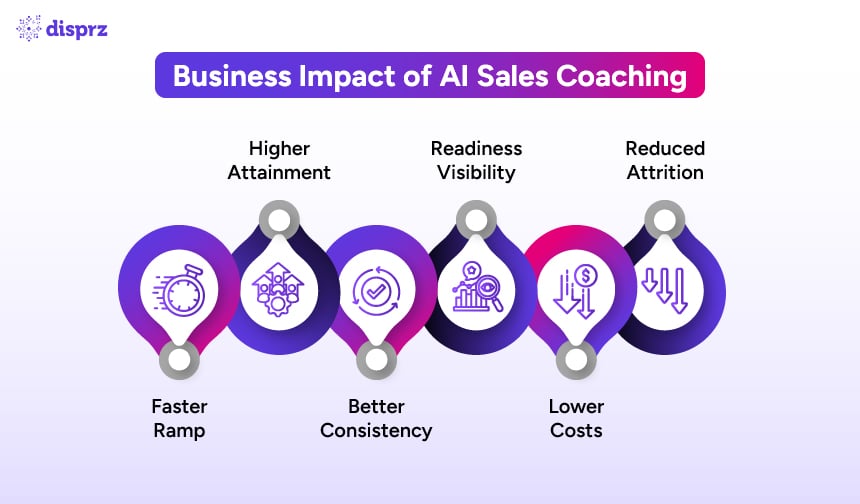
- Faster ramp. When reps practice the real conversation dozens of times before their first live call, time-to-first-deal compresses. The biggest lever on ramp is reps, and AI removes the cap on how much reps get.
- Higher quota attainment. Frequent coaching correlates with a large attainment advantage. AI makes "frequent" the default instead of the exception, narrowing the gap between your top and bottom performers.
- Consistent pitch quality across geographies. Your rep in a tier-2 city gets the same coaching rigor as your top performer at headquarters; without flying anyone anywhere.
- Readiness visibility before deals are at risk. You see who's call-ready before they go live, so skill gaps surface in practice, not in a lost deal.
- Lower coaching cost. You add coaching capacity without adding managers, breaking the linear cost curve.
- Reduced attrition risk. Reps who feel competent and supported stay longer; and confidence is built through practice, not pressure.
A note on rigor: be wary of any vendor promising a precise percentage lift sight unseen. The honest framing is that AI coaching attacks the specific, measurable bottlenecks (ramp, coaching frequency, readiness visibility) that drive those numbers. Define two or three KPIs up front and measure against them from day one.
Where AI Coaching Fits: The L&D and Revenue Enablement Intersection
Here's the part most sales-tech coverage misses, and it's the most important part for anyone who owns a training budget.
AI sales coaching sits at the intersection of two functions that usually operate in separate silos: L&D, which owns the learning, and revenue enablement, which owns the selling. For years these teams have been measured on different things. L&D reports completion rates. Sales reports quota. And the handoff between them (the moment a rep finishes a learning journey and has to apply it on a live call) is exactly where capability leaks out.
Completion is not capability. A rep can complete every module and still freeze on the call. The missing piece has always been the practice layer that connects what was learned to what gets done.
This is why the platform a company builds its coaching on matters. A pure sales-tech tool has the roleplay but no learning backbone. A pure LMS has the content but no realistic practice. The teams that win connect both: learning, practice, and readiness in one environment, with shared data on who's ready and who isn't. That gives L&D the outcome data sales leaders have always demanded (which reps are call-ready, which aren't, and exactly what to fix); and gives revenue leaders a readiness signal they can actually trust.
If you own L&D, AI sales coaching is how you finally prove your training drives revenue. If you own sales, it's how you get coaching at a scale your managers could never deliver. It's the same product solving two problems at once.
For L&D and revenue leaders evaluating their readiness stack: See how AI coaching connects learning to live-call performance. Request a Demo →
How to Evaluate an AI Sales Coaching Platform
If you're comparing options, these are the criteria that separate a genuine coaching platform from a roleplay feature. Score each vendor honestly.
| Evaluation Criterion | What to Look For |
|---|---|
| Realism of Practice | Voice-led, adaptive roleplay rather than scripted videos or chatbot conversations. |
| Scoring Depth | Framework-based scoring with deal-stage feedback instead of only filler-word analysis. |
| Customization | Ability to build scenarios using your personas, products, and objections. |
| Readiness Analytics | Objective rep- and team-level readiness metrics. |
| Coaching Prescription | Specific action plans after each session, not just a score. |
| Platform Fit | Integration with your existing LMS or LXP. |
| Enterprise Reliability | Quality guardrails, security, and scalability for large deployments. |
| Regional and Language Fit | Support for the languages and scenarios relevant to your markets. |
| Speed to Value | Ability to launch custom scenarios within days instead of months. |
The takeaway: the flashy demo is the easy part. Ask every vendor how their scoring works, how fast you can build a scenario from your own content, and what the readiness report actually tells your sales leadership. The answers separate the platforms from the parlor tricks.
Common Myths About AI Sales Coaching
"AI will replace my sales managers." No. It removes the bandwidth ceiling so managers spend their limited time on strategy, motivation, and judgment (the things AI can't do); instead of sitting through every roleplay.
"It's just a chatbot with a sales label." A chatbot answers questions. An AI sales coach plays an adaptive buyer with an emotional state and an objection profile, then scores the rep moment by moment against sales frameworks. Different category entirely.
"Reps won't take it seriously without a manager watching." The opposite tends to be true. Private practice removes the social risk that makes reps play it safe, so they experiment more; and the readiness data still rolls up to managers.
"It only works for SaaS inside sales." AI coaching maps to any high-stakes conversation (insurance agents, bank relationship managers, field reps, pharma detailing); anywhere pitch quality and objection handling decide outcomes.
Why Enterprises Choose Disprz for AI Sales Coaching
Disprz Sales Coach is a purpose-built AI coaching agent that puts every sales rep inside realistic, voice-led buyer simulations with deep, moment-by-moment feedback on every conversation. What sets it apart is the combination most vendors can't offer: serious AI roleplay built on a genuine enterprise learning platform.
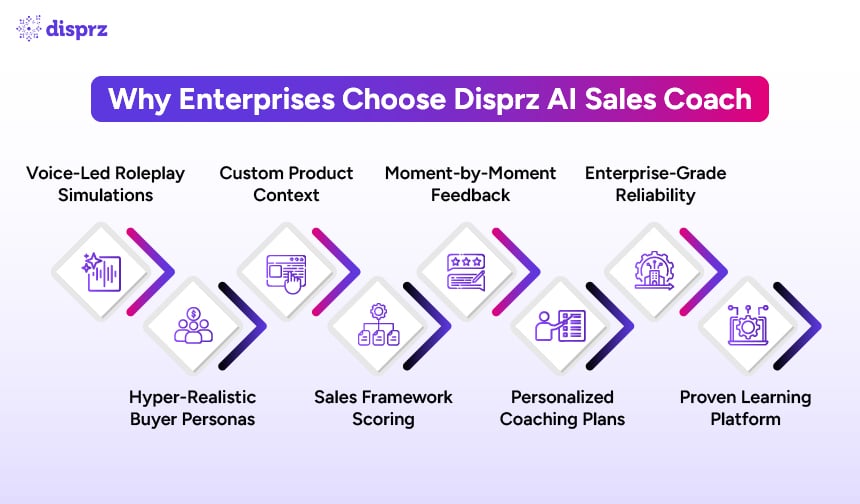
- Voice-led, adaptive roleplay: Reps practice the real conversation out loud, with an AI buyer that responds dynamically and never follows a script.
- Hyper-realistic, custom personas: Define buyer type, seniority, decision style, and emotional state; the simulation sounds like your buyers, configured in minutes.
- Built from your own context: Upload product decks, battle cards, and SOPs so scenarios reflect your actual product and objections.
- Sales-framework scoring: Trained on BANT, SPIN, and Challenger, with scoring across discovery, needs uncovering, positioning, objection handling, and closing.
- Moment-by-moment feedback: Timestamped missed moments, talk ratios, filler words, and deal-likelihood reads after every session.
- Personalized coaching plans: Every rep leaves with a prescribed next step, not just a number.
- Platform-neutral by design: Operates across LMS and LXP ecosystems, with deeper native intelligence inside Disprz, so practice lives where learning already happens.
- Enterprise-grade guardrails: A built-in quality agent continuously reviews and validates outputs to minimize hallucination and ensure reliability.
- Backed by a proven L&D platform: More than 3.5M learners across 500+ organisations in 25+ countries, recognized by the Josh Bersin Company as an HR Tech AI Trailblazer 2025 and named a G2 Enterprise Grid Leader.
- Frontline and regional depth: Built for distributed, field-heavy sales forces, including the BFSI and insurance teams where coaching at scale matters most.
The result is the one thing a content library and a standalone roleplay tool each can't deliver alone: a place for every rep to practice the real conversation, hundreds of times, before it costs you a deal; connected to the learning they're already doing.
Key Takeaways
- AI sales coaching closes the gap between training and doing. It's the practice and feedback layer that turns "knowing what to say" into "saying it under pressure."
- It solves the manager bandwidth problem. One manager can coach a handful of reps; AI coaches every rep, every day, with the manager orchestrating instead of bottlenecking.
- It works because of learning science, not novelty. Deliberate practice, spaced repetition, and psychological safety are what make coaching stick; and AI roleplay delivers all three.
- It lives at the L&D and revenue enablement intersection. The biggest wins come from connecting learning, practice, and readiness in one environment with shared data.
- Evaluate on scoring depth and customization, not the demo. Framework-based scoring, your-context scenarios, and a real readiness report separate platforms from parlor tricks.
Conclusion
Sales coaching has always been the highest-leverage activity in revenue; and the hardest to scale. The frequency that drives performance was operationally impossible, so coaching got rationed and most reps got the bare minimum. AI sales coaching removes that constraint. It gives every rep realistic, repeated, psychologically safe practice, and gives leaders an objective readiness signal before deals are at risk.
The organizations that pull ahead won't be the ones with the most managers or the biggest training catalog. They'll be the ones that treat practice as infrastructure; connecting what their reps learn to what they do on live calls, and measuring readiness as rigorously as they measure pipeline. That shift, from completion to capability, is what AI sales coaching makes possible. The question for revenue and L&D leaders isn't whether to adopt it. It's whether your reps keep learning on real customers while you decide.
Frequently Asked Questions
1) What is AI sales coaching in simple words?
AI sales coaching is technology that lets a sales rep practice real sales conversations with an AI that plays the buyer, then gives instant, detailed feedback on how they did. It delivers the kind of coaching a great manager would; but to every rep, on demand.
2) How is AI sales coaching different from sales training?
Training teaches reps what to do: frameworks, product knowledge, talk tracks, etc. AI sales coaching helps them get better at doing it through realistic practice and feedback. Training is the content; coaching is the practice that turns it into capability.
3) Will an AI sales coach replace human sales managers?
No. It removes the bandwidth limit that caps how much coaching managers can give, freeing them for strategy, motivation, and judgment calls AI can't make. The manager sets the agenda; the AI executes the practice at scale.
4) How is an AI sales coach different from a generic AI chatbot?
A chatbot answers questions or tells a rep what to say. An AI sales coach plays an adaptive buyer with a defined persona, emotional state, and objection profile, responds in real time, and scores the rep moment by moment against sales frameworks like BANT, SPIN, and Challenger.
5) What outcomes can revenue leaders expect from AI sales coaching?
The main levers are faster rep ramp, higher quota attainment through more frequent coaching, consistent pitch quality across locations, and readiness visibility before deals are at risk; all without adding management headcount. Define two or three KPIs up front and measure against them.
6) Does AI sales coaching work for industries beyond SaaS?
Yes. It applies to any high-stakes conversation (insurance agents, bank relationship managers, field sales reps, pharma detailing); anywhere pitch quality and objection handling decide outcomes. Frontline and field-heavy sales forces often see the most benefit because coaching there has been hardest to scale.
7) What should I look for when choosing an AI sales coaching platform?
Prioritize voice-led adaptive roleplay, framework-based scoring (not just speech metrics), the ability to build scenarios from your own product and personas, objective readiness analytics, a coaching action plan after each session, and integration with your existing LMS or LXP.
8) How does AI sales coaching connect to our existing L&D platform?
The strongest implementations sit alongside your learning platform so reps practice in the same environment where they learn. That connection links completion data to live-call readiness; giving L&D the outcome evidence sales leaders ask for, and giving sales a readiness signal they can trust.
9) How quickly can a team get started with AI sales coaching?
A purpose-built platform can be live with your first custom scenarios in days, not months. You define a persona and objective, upload your product context, and reps can start practicing; without a multi-quarter implementation project.