
On this page
The rise of remote learning has transformed how enterprises assess workforce readiness, making AI proctoring for enterprises a critical capability for conducting secure, scalable, and trustworthy remote assessments. Compliance certifications, hiring assessments, partner enablement, and employee training can now be delivered at scale, regardless of location. As organizations increasingly rely on remote assessments for high-stakes decisions, they need more than basic monitoring. They need a way to verify assessment integrity, deter malpractice, and produce evidence that stands up to audits and compliance reviews.
However, as remote assessments have become commonplace, so have more sophisticated ways to compromise them. From browser switching and secondary devices to AI-powered assistants and impersonation, the methods used to bypass traditional proctoring continue to evolve. Simply recording an assessment session or monitoring a webcam is no longer enough. Organizations need a way to detect suspicious behavior, generate objective evidence, and ensure that assessment outcomes remain credible without creating an intrusive experience for learners.
AI proctoring addresses this challenge by moving beyond passive monitoring. It continuously analyzes assessment sessions, detects integrity risks in real time, and captures objective evidence that helps trainers review flagged incidents and make informed decisions with confidence.
In this article, we'll explore how AI proctoring helps enterprises secure remote assessments, the capabilities that distinguish modern solutions, and how Disprz combines intelligent monitoring, configurable controls, and human oversight to help organizations conduct trustworthy, defensible assessments.
Why Traditional Online Proctoring Is No Longer Enough
Traditional online proctoring was designed for a time when monitoring a webcam and recording a learner's screen were enough to discourage malpractice. As remote assessments became more widespread, however, both the scale of assessments and the sophistication of cheating methods evolved faster than traditional systems could adapt. What once served as a deterrent gradually became inadequate for protecting high-stakes assessments.
- Rule-based monitoring couldn't keep up with new forms of malpractice such as AI-generated answers, secondary devices, and impersonation.
- Manual review wasn't scalable, requiring trainers to sift through hours of recordings to investigate flagged assessments.
- Most systems analyzed events in isolation, making it difficult to determine whether individual incidents actually indicated compromised assessment integrity.
- Limited evidence made investigations harder, especially during audits, certification disputes, or regulatory reviews.
- High false positives increased administrative effort, forcing trainers to spend time validating harmless events instead of focusing on genuine integrity risks.
How AI Is Transforming Online Proctoring
Unlike traditional systems that rely on predefined rules or manual review, AI-powered proctoring continuously analyzes multiple signals throughout an assessment to identify behaviors that may compromise its integrity. Instead of simply recording events, AI provides context, prioritizes genuine risks, and presents trainers with evidence that supports informed decision-making.
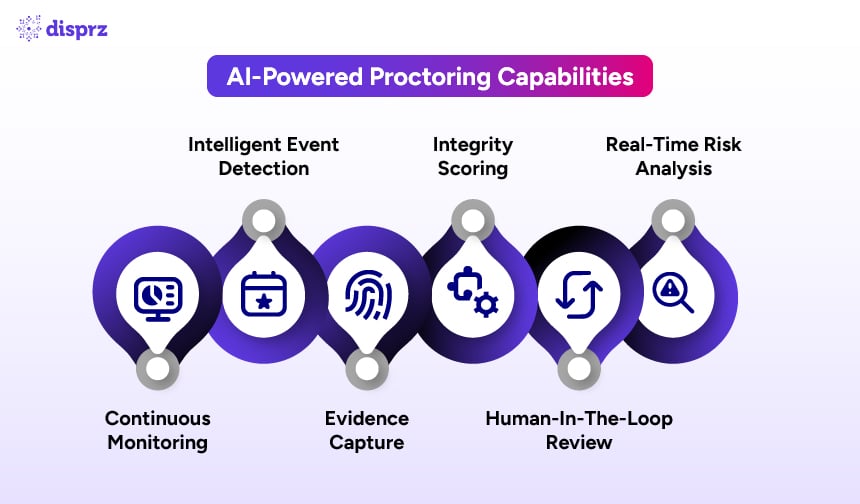
Key capabilities of AI-powered proctoring include:
- Continuous monitoring of video, audio, screen activity, and learner interactions throughout the assessment.
- Intelligent event detection to identify behaviors such as multiple faces, prolonged absence, background noise, use of unauthorized materials, or frequent application switching.
- Evidence capture through snapshots, video clips, timestamps, and detailed event logs for every flagged incident.
- Integrity scoring that combines multiple detected events into an overall measure of assessment integrity rather than treating every event equally.
- Human-in-the-loop review, allowing trainers to validate AI findings, override flagged events, and make the final assessment decision.
- Real-time risk analysis that let organizations define detection rules, scoring thresholds, and compliance requirements based on the nature of the assessment.
By combining AI with human oversight, enterprises can scale assessment integrity across thousands of learners while reducing manual effort and building confidence in every assessment outcome.
How Disprz Approaches AI-Powered Proctoring
Disprz approaches AI proctoring as an assessment integrity framework rather than a surveillance tool. The objective isn't to prevent learners from taking an assessment or automatically assume malpractice. Instead, the platform continuously monitors assessment sessions, captures objective evidence, calculates an Integrity Score, and equips trainers with the context they need to make fair, informed decisions. Every assessment follows a structured workflow that balances AI-driven monitoring with human oversight.
The assessment journey includes:
- Consent and permissions: Learners review a privacy notice and grant camera, microphone, screen-sharing, and location permissions before starting the assessment.
- Continuous AI monitoring: Throughout the assessment, AI monitors configurable integrity events without interrupting the learner's experience.
- Evidence-backed detection: Every detected event is supported by snapshots or short video clips, creating an auditable evidence trail instead of simple alerts.
- Integrity scoring: Each learner begins with an Integrity Score of 100, with configurable deductions applied based on detected events. Organizations can also define their own compliance thresholds and pass criteria.
- Trainer review and audit: Trainers can review every flagged event, examine supporting evidence, override AI findings when necessary, and maintain a complete audit log of every decision.
Instead of generating isolated alerts, the platform captures contextual evidence for every detected event, helping trainers understand what happened before making a decision.
Disprz continuously monitors:
- Not Looking at the Screen – Detects when a learner repeatedly looks away from the assessment, indicating possible distraction or consultation of external resources.
- Multiple Faces Detected – Flags the presence of additional people in the camera frame, helping identify potential external assistance.
- Screen or Tab Switching – Detects when learners navigate away from the assessment window or switch browser tabs during web-based assessments.
- Background Noise Detected – Monitors unusual audio activity that may indicate conversations or assistance from others.
- Books or Mobile Phones Detected – Identifies unauthorized physical materials or mobile devices visible during the assessment.
For every event, Disprz captures supporting snapshots or short video clips, creating an evidence-backed audit trail rather than relying solely on automated alerts.
Integrity Score: Measuring Assessment Credibility
To provide a more complete picture, Disprz introduces an Integrity Score alongside the quiz score, helping organizations evaluate both learner performance and assessment credibility.
- Every assessment starts with an Integrity Score of 100.
- Configurable point deductions are applied for each detected integrity event based on organization-defined policies.
- Integrity Status is automatically classified as Compliant or Non-Compliant based on the configured pass threshold.
- Organizations can require both a passing quiz score and a passing Integrity Score before an assessment is considered successful.
- Scoring rules, event weights, learner notifications, and pass thresholds can all be configured to align with organizational and regulatory requirements.
This moves assessment evaluation beyond a simple pass-or-fail model, giving trainers a transparent and evidence-backed measure of assessment integrity before making certification or compliance decisions.
Where AI Proctoring Creates the Greatest Impact
While AI proctoring can strengthen the integrity of any remote assessment, its value is most evident in scenarios where assessment outcomes influence compliance, certification, hiring, or operational readiness. In these environments, organizations need more than a quiz score; they need confidence that every assessment was conducted fairly and can withstand scrutiny.
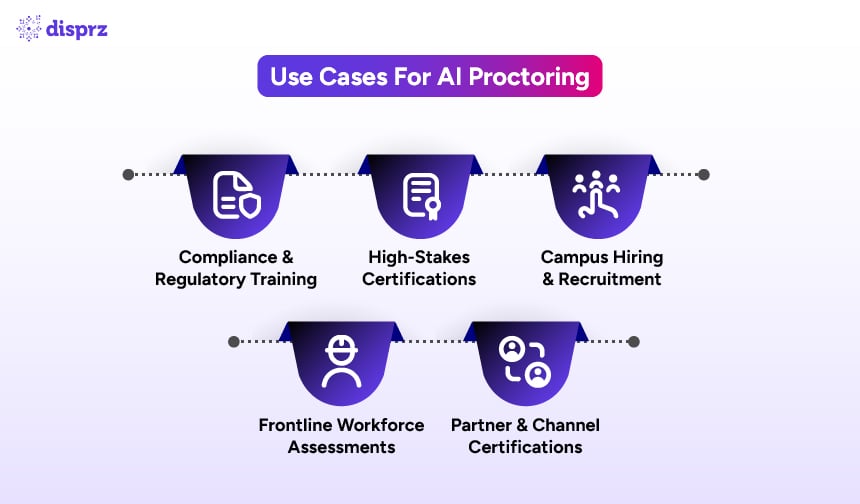
- Compliance and Regulatory Training: Ensure mandatory compliance training and certifications are backed by verifiable evidence that supports audits and regulatory reviews.
- High-Stakes Certifications: Protect the credibility of internal and external certification programs where assessment outcomes determine role readiness or professional credentials.
- Campus Hiring and Recruitment: Conduct remote assessments with greater confidence by reducing the risk of impersonation, unauthorized assistance, and other forms of malpractice.
- Frontline Workforce Enablement: Assess distributed employees across retail, banking, healthcare, manufacturing, and other frontline industries without the need for physical invigilators.
- Partner and Channel Certifications: Maintain consistent assessment standards across geographically dispersed partners, distributors, and franchise networks.
Best Practices for Implementing AI Proctoring
AI proctoring is most effective when implemented as part of a broader assessment strategy rather than as a standalone technology. Organizations should:
- Clearly communicate privacy and consent requirements to learners.
- Configure detection rules based on the risk level of each assessment.
- Use Integrity Scores alongside quiz scores instead of relying on either metric alone.
- Keep trainers involved in reviewing high-risk assessment attempts.
- Periodically review detection policies as new assessment formats and cheating techniques emerge.
Key Takeaways
- Assessment integrity is becoming a strategic priority. As remote assessments influence hiring, compliance, and workforce readiness, organizations need reliable ways to validate every assessment outcome.
- Modern assessment risks demand modern proctoring. AI-assisted cheating, impersonation, and unauthorized resources have made traditional monitoring approaches increasingly ineffective.
- AI strengthens trust through evidence, not assumptions. Continuous monitoring, intelligent event detection, and contextual evidence help trainers make objective and defensible assessment decisions.
- Disprz takes a human-centric approach to AI proctoring. By combining configurable Integrity Scores, evidence-backed reviews, and trainer oversight, Disprz helps organizations balance automation with fairness and transparency.
- The future of enterprise assessments will be measured by credibility. Organizations that can confidently certify skills and competencies will be better equipped to make workforce decisions and meet evolving compliance expectations.
Conclusion
The conversation around AI in assessments will soon move beyond detecting malpractice. As AI becomes deeply embedded across enterprise learning, the real differentiator will be how confidently organizations can validate skills, certifications, and workforce readiness at scale. Assessment platforms will increasingly be judged not just by how well they deliver learning, but by how well they establish trust in every outcome.
AI proctoring is an important step in that evolution. Over time, it will become part of a broader intelligence layer that continuously evaluates learner readiness, assessment quality, and certification credibility. For enterprises building a future-ready workforce, the question will no longer be whether assessments can happen remotely—it will be whether their outcomes are trusted enough to drive business decisions.
Whether you're conducting compliance certifications, employee assessments, or hiring evaluations, Disprz AI Proctoring helps you protect the credibility of every outcome with intelligent monitoring, configurable integrity policies, and complete audit trails.
Schedule a demo to see how Disprz can help you deliver assessments that are trusted by learners, trainers, and the business alike.
FAQs
1. What is AI-powered online proctoring?
AI-powered online proctoring uses artificial intelligence to monitor remote assessments by analyzing video, audio, screen activity, and learner interactions in real time. It helps identify behaviors that may affect assessment integrity while providing evidence for trainers to review.
2. How is AI proctoring different from traditional online proctoring?
Traditional proctoring primarily relies on recordings, browser restrictions, and manual review. AI proctoring continuously analyzes multiple signals, automatically detects suspicious events, captures supporting evidence, and helps prioritize cases that require human attention, making the review process more scalable and efficient.
3. Does AI proctoring make assessment decisions automatically?
No. AI is designed to assist, not replace, human judgment. It detects integrity events, captures evidence, and calculates an Integrity Score, while trainers or administrators review the findings and make the final decision based on organizational policies.
4. What types of assessments benefit most from AI proctoring?
AI proctoring is particularly valuable for high-stakes assessments such as compliance certifications, employee certifications, campus hiring, professional credentialing, partner enablement, and other remote assessments where maintaining integrity and auditability is critical.
5. How does AI proctoring improve assessment integrity?
By continuously monitoring assessment sessions, identifying potential integrity risks, recording evidence, and presenting findings in a structured manner, AI proctoring helps organizations conduct fair, transparent, and defensible assessments without relying solely on manual invigilation.
6. Why should organizations choose Disprz AI Proctoring?
Disprz AI Proctoring combines intelligent event detection, configurable Integrity Scores, evidence-backed review, and human oversight in a single solution. This enables organizations to conduct secure, scalable, and trustworthy assessments while giving trainers complete visibility and control over the review process.
7. Is AI proctoring accurate?
Yes, AI proctoring is highly accurate at detecting potential assessment integrity risks when combined with human review. It analyzes video, audio, screen activity, and learner behavior to identify suspicious events and capture supporting evidence. Solutions like Disprz AI Proctoring complement AI insights with trainer oversight, ensuring fair, transparent, and well-informed assessment decisions.