
On this page
Skills intelligence is a system that keeps a live record of what your people can actually do, instead of guessing from job titles. The way it works is that AI pulls signals from your HR system, your learning platform and assessments, translates the messy wording into one common skills vocabulary, then compares that picture against what the business needs. What makes it hard is not the AI. It is having skills data worth reading in the first place.
- Skills intelligence replaces the job title as the unit of measurement. Instead of asking what someone's role is, it asks what they can demonstrably do, and keeps that answer current.
- Most organisations have started this and very few have finished it. The gap between adoption and working deployment is the single most important thing to understand before you buy.
- The AI is the easy part. Four stages do the work: ingestion, taxonomy, inference, action. Only the last one changes anything.
- Skills intelligence and competency mapping are not the same thing. Mapping sets the standard once. Intelligence keeps score against it continuously.
- Five questions separate a real skill inference engine from a skills matrix with a dashboard. They are in the evaluation section.
- Written for L&D leaders being asked to justify a skills platform, or already running one that has not produced a decision yet.
Ask an L&D leader what their people can do and you will usually get one of two answers. Either a list of job titles, or a spreadsheet somebody built eighteen months ago that three managers have quietly stopped updating.
Neither answers the question. A job title tells you what someone was hired to do, not what they have learned since. A skills spreadsheet tells you what people said about themselves on the day they filled it in.
Skills intelligence exists to close that gap, and the promise is genuinely good: a picture of workforce capability that stays current on its own. The reason it deserves a careful look rather than an enthusiastic one is that a lot of organisations have bought this promise and comparatively few have made it pay.
What is skills intelligence in simple terms?
Simple. Skills intelligence is the practice of using AI to build and maintain a live, evidence-based record of what every person in the organisation can do, mapped against what the business needs them to do.
Three words in that definition carry the weight.
Live: The record updates as people complete assessments, finish learning, and take on work. It is not an annual survey.
Evidence-based: A skill is recorded because something demonstrated it, not because someone claimed it. This is the difference between skills intelligence and a self-rating exercise, and it is where most implementations quietly compromise.
Mapped against need: A skills inventory with nothing to compare it to is a list. The comparison to role requirements and business priorities is what turns it into a decision.
The World Economic Forum makes a related point worth holding onto: static taxonomies like O*NET and ESCO are becoming insufficient because the underlying work changes faster than a periodic update cycle can track. Whatever you build has to keep moving on its own, or it becomes another spreadsheet.
What a skills taxonomy actually looks like
Abstract definitions of skills cause most of the confusion in this category. A taxonomy resolves it by breaking capability into four layers, so that a gap can be named precisely enough to act on.
| Domain | Skill cluster | Atomic skill | Proficiency levels |
|---|---|---|---|
| Data and analytics | Data visualisation | Building a dashboard in your BI tool | 1 Reads a shared dashboard. 2 Builds a custom report. 3 Designs the underlying data model. |
| Operations | Process governance | Managing a sprint backlog | 1 Follows the process. 2 Runs it for a team. 3 Redesigns it across functions. |
| Leadership | People management | Delivering corrective feedback | 1 Runs a routine one-to-one. 2 Handles a difficult performance conversation. 3 Coaches other managers to do it. |
The atomic skill column is the one that matters. Communication skills is not a gap anyone can close. Delivering corrective feedback, currently at level 1 against a level 2 requirement, is a training brief.
Why do most skills intelligence rollouts stall before they deliver?
Because starting is easy and finishing is not, and the numbers on that gap are stark.
The first two come from research cited in Deloitte's work on skills-based talent models: a Workday survey of 2,300 business leaders, and a Gartner survey of HR leaders. The third is from the World Economic Forum's Future of Jobs Report.
That is not a small shortfall. It means the common outcome is a partial deployment: a skills taxonomy that exists, a dashboard nobody opens, and talent decisions still being made the old way.
Three failure patterns account for most of it.
Why skills intelligence rollouts stall
- The data was never good enough. The AI inherits whatever your HRIS and LMS contain. Duplicate role titles, courses with no skill tags, and performance data locked in a format nothing can read all produce a confident, wrong skills map.
- Nothing was wired to a decision. Plenty of organisations build the map and stop. If no promotion, no learning assignment and no hiring decision changes because of it, the platform is an expensive reporting layer.
- Employees did not trust it. People who suspect a skills system is a layoff shortlist will under-report, over-report, or ignore it. Adoption collapses quietly and the data degrades from there.
Market. Vendor content on this category is almost uniformly optimistic, because almost all of it is written by vendors. Every definition page moves from what it is to the benefits without passing through here is why your first attempt will probably underdeliver. Read the category with that bias in mind. The technology is real and the outcomes in the case studies are real. The implementation failure rate is also real, and it is not usually caused by the software.
How does AI for skills intelligence actually work?
Four stages, running as a loop. Understanding them matters because vendors sell all four as one thing, and they are not equally mature.
| Stage | What happens | Where it goes wrong |
|---|---|---|
| Ingestion | Pulls signals from your HRIS, LMS, assessments, certifications and, in some setups, work tools | Missing integrations, or source data too messy to read |
| Taxonomy and skill graph | Normalises SQL, data extraction and reporting into one skill, then maps how skills relate to each other | Taxonomies bought off the shelf and never fitted to your actual roles |
| Inference | Assigns a proficiency level from evidence rather than a claim, and infers adjacent capability | Inference from thin evidence. A course completion is not proficiency. |
| Action | Assigns learning, surfaces internal candidates, flags succession readiness | The stage most often skipped, and the only one that changes an outcome |
The skill graph is the part that does the genuinely useful work and the part buyers understand least. It calculates proximity: if someone is strong in financial modelling, the graph knows they are a short bridge from data visualisation and a long way from network security. That proximity calculation is what makes internal mobility recommendations possible, and it is why a real skills intelligence engine is not something you can approximate in a spreadsheet.
Mistake. The most common error is treating course completions as proficiency evidence. Completion means someone reached the end of a module. It says nothing about whether they can do the task under pressure with a customer watching. Any platform that maps completions straight to skill levels will hand you a workforce that looks far more capable on screen than it is on the floor. Insist on assessment or manager validation in the inference layer, and treat completion as a weak signal at best.
What data does skills intelligence need before the AI is any use?
Four things, and the order matters, because each one makes the next possible.
- A role architecture you can defend. Fifteen to twenty-five clean role profiles, not four hundred legacy job titles. If your HRIS contains six variants of Operations Executive, the AI will treat them as six different roles and split your data six ways.
- A learning catalogue with skill tags. Courses need to say which skills they build. Untagged content cannot be recommended against a gap, which breaks the action stage before it starts.
- At least one form of validated evidence. Assessments, manager ratings, or observed performance. Self-rating alone produces a skills map that reflects confidence rather than capability, and the two correlate poorly.
- A named owner for the taxonomy. Skills vocabularies drift. Without someone accountable for keeping it current, you are back to a static framework within eighteen months, which is the exact problem you bought the platform to solve.
Most of the real work in a first deployment is items one and two, and most implementation plans underestimate both. A useful rule: if you cannot answer which skills does this course build for your top fifty courses, you are not ready to connect an AI engine to your catalogue.
How is skills intelligence different from competency mapping or a skills matrix?
They answer different questions and operate on different clocks.
| Dimension | Skills matrix | Competency mapping | Skills intelligence |
|---|---|---|---|
| What it is | A grid of people against skills | A defined standard of what each role requires | A live system scoring people against that standard |
| How it is built | Manually, usually in a spreadsheet | A structured framework exercise | Automated ingestion and inference |
| How often it updates | When someone remembers | On a review cycle | Continuously |
| What it tells you | Who said they can do what | What good looks like | Who is below standard right now, and by how much |
| Main risk | Goes stale immediately | Becomes shelfware | Bad input data producing confident wrong answers |
The relationship is sequential rather than competitive. Competency mapping defines the standard. Skills intelligence keeps score against it. Attempting the second without the first is the most common sequencing mistake, because an AI engine with nothing to compare against will happily produce an inventory of skills that nobody asked whether the business needs.
How is skills intelligence different from work intelligence?
Skills intelligence tells you what your people can do. Work intelligence tells you what they are actually spending their time on. Different questions, different data, and the gap between the two answers is often the most useful thing either one produces.
| Dimension | Skills intelligence | Work intelligence |
|---|---|---|
| The question | What capability do we have? | Where is the effort actually going? |
| Data it reads | HR records, learning history, assessments, certifications | Activity in project tools, calendars, communication platforms |
| What it improves | Development, mobility, succession, hiring decisions | Process efficiency, workload distribution, automation targets |
| Owned by | HR and L&D | Operations, and increasingly IT |
Why an L&D leader should care about the distinction: the two can disagree, and the disagreement is diagnostic. Skills intelligence might show a senior engineer with expert-level cloud security capability, while work intelligence shows most of their week going into status reports and low-level tickets. Read alone, the skills dashboard says the team is ready for a cloud programme. Read together, the picture is that the capability exists and is being wasted, which is a deployment problem no training will fix.
Most organisations run one or the other, rarely both. If you only have skills intelligence, keep the limitation in view: it tells you what people are capable of, not whether they are being given the chance to use it.
How does AI for skills intelligence change employee training?
It changes what training gets built, who receives it, and when.
Traditional L&D allocates by request and by calendar. A department asks, a budget is split, a programme is scheduled. Skills intelligence allocates by measured gap against business priority, which produces four practical differences.
- Onboarding stops repeating what people already know: A day-one diagnostic identifies which parts of the standard induction a new hire can skip, which compresses time to productivity without cutting anything they actually needed.
- Learning is assigned by gap, not by role: Two people with the same job title and different proficiency profiles receive different paths. This is the difference between personalisation as a marketing word and personalisation as a mechanism.
- Content demand becomes visible in advance: When the system flags that a capability is thin across a function, L&D knows what to build before the business escalates it.
- Effectiveness becomes measurable: Because a baseline exists before the training and a reassessment follows it, movement in the skill score is available as evidence. Completion rates never gave you that.
The reason this matters commercially is visible in the Deloitte case data. One technology firm found 40% of employees had skills their current roles did not use. Surfacing them lifted internal mobility 45%, cut critical time-to-fill from 127 days to 47, and reduced annual external hiring cost by $14.3 million. None of that came from better courses. It came from knowing what people could already do.
Where else does skills intelligence get used beyond training?
Four other places, and knowing them matters even if you only own L&D, because they are how the business case gets funded.
| Use case | The question it answers | What changes |
|---|---|---|
| Talent acquisition | Do we already employ someone who can do this? | The role is checked against the internal skill graph before a job advert is written. Hiring becomes the fallback rather than the reflex. |
| Internal mobility | Where could this person realistically go next? | Employees see adjacent roles and the specific gap between here and there, instead of guessing from a job board. |
| Learning and development | Which gaps are worth funding? | Assignment by measured gap rather than by request. |
| Succession | Who is genuinely ready, and for what? | Readiness becomes a score built from assessment and performance data, rather than whoever the manager remembers. |
| Workforce planning | Can we actually deliver next year's strategy? | Capability is planned alongside headcount, so a skills shortfall surfaces before it stalls a launch. |
A note on scope. Running all five at once is the most common way this becomes a two-year programme that delivers nothing. The five share one engine, but each needs its own owner and its own decision. Pick the one where a decision is already being made badly, and prove it there.
How do you tell whether a vendor's skills intelligence is real?
Five questions. They are deliberately awkward, and a strong platform will answer all five without hedging.
Five questions to ask any skills intelligence vendor
Ask all five of every vendor, including the one in the next section.
- What evidence sources feed proficiency, and can we see a profile built without any self-rating? If self-assessment is the only real input, this is a survey tool with a graph on top.
- Is the taxonomy ours or theirs, and who maintains it after go-live? An off-the-shelf taxonomy is a reasonable starting point and a poor finishing one. Ask specifically what happens when your roles change.
- Show us the action, not the dashboard. Ask them to demonstrate a gap being detected and a learning assignment firing from it, without an administrator in the middle. If that flow needs manual configuration for every case, the automation claim is thin.
- How does the skill graph handle a role it has never seen? Every enterprise has roles that do not appear in any standard framework. The answer tells you whether the graph is genuinely inferential or a lookup table.
- What does a reassessment cost us in effort? The whole value is continuity. If measuring again is as expensive as measuring the first time, you have bought a project rather than a system.
A platform that cannot answer them is selling a skills matrix with better graphics.
Should skills intelligence sit inside your LMS or alongside it?
Alongside works. Inside removes a category of problem that most teams do not price in.
The standalone path is a dedicated skills platform integrated with your LMS and HRIS by API. It is a legitimate choice, particularly if your learning platform is fixed and you have engineering capacity to own the integrations. The cost is that skills data and learning data live in different systems, so every question that spans both becomes a reporting project, and the action stage depends on an integration staying healthy.
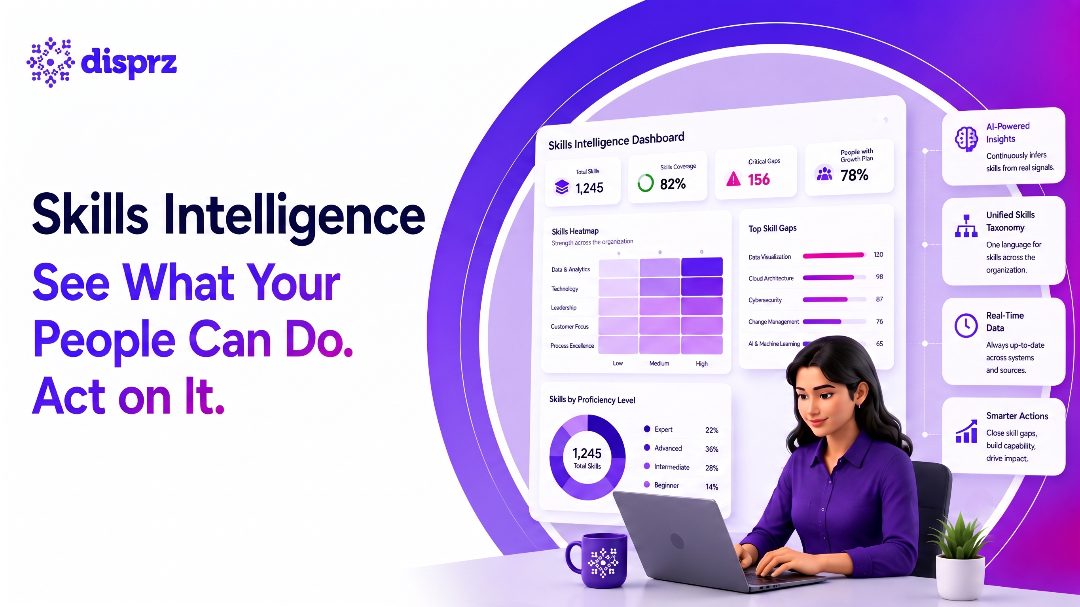
Disprz takes the other path, with skills intelligence built into the same platform as the LMS and LXP rather than connected to it. Roles map to a defined skill framework, people are scored against that framework through self and manager assessment rather than completions alone, and the output surfaces as a skill heat map at organisation, department and role level. Because learning content sits in the same system, a detected gap can trigger an assignment without crossing a boundary.
Two consequences are worth weighing against the standalone option.
- The action stage has no integration to fail. Gap detection and learning assignment are the same system, which removes the most common point of breakage in the loop described earlier.
- Baseline and reassessment share a data model. Movement in a skill score is directly comparable over time, which is what makes training effectiveness arguable in front of a CFO.
The honest limitation: this only helps if you are willing to run learning on the same platform. If your LMS is not moving, a standalone skills engine is the more realistic option, and the five questions above matter more than ever.
How do you use skills intelligence responsibly?
By keeping a human on every talent decision, auditing what the model actually measures, and being straight with employees about what is being collected.
This is not a compliance footnote. A skills platform influences who gets promoted, who gets moved and, in some organisations, who gets kept. Three risks are worth naming before you deploy.
Three risks to name before you deploy
- The black box promotion. If an internal candidate is shortlisted or passed over and the only explanation is a model output, you cannot defend that decision to the person, to a works council, or in a tribunal. Use the platform to produce the shortlist and keep a named human accountable for the choice.
- Inherited bias. Models trained on historical promotion patterns can treat the characteristics of past leaders as requirements. Audit the taxonomy so it scores demonstrable capability rather than pedigree markers such as employer names or institutions.
- Surveillance drift. Inferring skills from communication tools and activity logs sits close to monitoring. Employees who suspect they are being watched will under-report, game the assessments, or disengage, and the data quality collapses with them.
The mitigation that matters most is also the cheapest: let people see their own profile and contest it. A skills record an employee can read, correct and add to is one they will help keep accurate. One they cannot see is one they will work around.
A framing test before launch. If the honest internal answer to what happens when the system finds a gap is anything other than we invest in closing it, the rollout will be read as a layoff exercise, and it will behave like one.
Where should L&D leaders start with skills intelligence?
Start with the data audit, not the vendor demos.
Count your role profiles. If the number is in the hundreds, consolidating them is your first project and it has nothing to do with AI. Check whether your top fifty courses carry skill tags. Decide which form of validated evidence you can realistically collect, and from whom.
Then pick one function and one decision you want the system to change. Not five. One. Onboarding speed in a single department, or internal fill rate for one job family. A narrow deployment that visibly changes a decision within a quarter is what earns the budget for the second one.
The organisations sitting in that 2% did not have better AI than everyone else. They had cleaner inputs and a decision waiting at the other end.
Frequently Asked Questions
What L&D leaders ask most often about skills intelligence.
What is skills intelligence?
Skills intelligence uses AI to keep a live, evidence-based record of what your workforce can do. That record is mapped against what each role and the business require, replacing static job titles and manually maintained skills spreadsheets.
How does skills intelligence work?
Through four stages: ingestion, taxonomy, inference and action. Data comes from HR and learning systems, gets normalised into one vocabulary, proficiency is inferred from evidence, then an action fires. That last stage is the one that changes outcomes and the one most often left out.
What is the difference between skills intelligence and competency mapping?
Competency mapping defines the standard for each role. Skills intelligence keeps score against that standard continuously. Mapping is a periodic exercise, intelligence is an always-on system, and attempting the second without the first rarely works.
Is skills intelligence the same as a skills matrix?
No. A skills matrix is a manually maintained grid that reflects what people said about themselves. Skills intelligence infers proficiency from evidence and updates on its own, which is why it stays useful past the first quarter.
What data do you need for skills intelligence?
Four things: a clean role architecture, a tagged learning catalogue, validated evidence, and a taxonomy owner. Most first deployments underestimate the first two, which is where the real work sits.
Why do skills intelligence projects fail?
Usually poor input data, no decision wired to the output, or employee distrust. A Gartner survey found only 2% of HR leaders report success across all processes, against 55% who have started, so partial deployment is the norm rather than the exception.
What is the difference between skills intelligence and work intelligence?
Skills intelligence tells you what people can do. Work intelligence tells you what they actually spend time on. When the two disagree, you usually have capable people trapped in low-value work, which is a deployment problem rather than a training one.
Does skills intelligence replace your LMS?
No. It sits either inside the learning platform or alongside it. Standalone engines integrate by API, which works but leaves skills and learning data in separate systems and makes the automated action stage dependent on that integration.
How does AI for skills intelligence support employee learning?
It assigns learning by measured gap rather than by job title, so two people in the same role can receive different paths. It also makes effectiveness measurable, because a baseline exists before training and a reassessment follows it.
How long does it take to implement skills intelligence?
Weeks for a single function with clean data, considerably longer if role profiles and course tagging need work first. Narrow deployments that change one decision are the ones that survive to a second phase.
Can skills intelligence be biased?
Yes. Models trained on historical promotion data can treat past patterns as requirements. Audit the taxonomy so it measures demonstrable capability rather than pedigree markers, and keep a human decision-maker on every talent outcome.
What should you ask a skills intelligence vendor?
Five questions, listed in full above. The sharpest one is whether they can show a gap triggering a learning assignment with no administrator in the middle. Also ask what evidence feeds proficiency, who owns the taxonomy after go-live, how the graph handles an unfamiliar role, and what a reassessment costs in effort.
About the authors


Madhu Karunakaran
Vice President - People & Culture
Madhu Karunakaran is a senior HR and Learning & Development (L&D) leader with 20+ years of experience spanning people strategy, organizational development (OD), talent management, leadershi...
Reviewed for accuracy on 03 Sep 2026