

On this page
TL;DR
- Corporate e-learning has moved from a cost-saving alternative to classroom training into the core system that keeps a workforce current as skills change.
- The real value is not completion tracking. It is closing the gap between what employees know and what the business needs them to do.
- Delivery models range from self-paced modules and microlearning to virtual classrooms and mobile-first learning for frontline teams.
- Industry context decides what you build: compliance certification in BFSI, mobile onboarding in retail, safety training in manufacturing, accredited modules in healthcare.
- The programs that work in 2026 tie learning to business outcomes and reach every employee, including the deskless majority.
If your e-learning shows high completion but no change in performance, the format is the problem, not the effort. This guide covers how to fix that.
For years, corporate e-learning was pitched as the cheaper version of classroom training. Fewer venues, less travel, one set of slides for everyone. That framing is now out of date.
In 2026 the pressure on L&D is different. Skills are changing faster than annual training cycles can absorb, and executives increasingly expect learning to show up in business results, not attendance sheets. The LinkedIn 2025 Workplace Learning Report found that 49% of L&D and talent professionals agree their executives worry employees lack the right skills to execute business strategy. That is the actual problem corporate e-learning has to solve now.
The same report highlights a structural gap that most programs quietly ignore: only 15% of employees said a manager helped them build a career plan in the past six months, a five-point drop from the prior year. Learning is being delivered, but it is not connected to the person's role, growth, or performance. This is part of a wider shift across corporate learning and development trends, where the focus is moving from content delivery to workforce readiness.
This guide covers what corporate e-learning is, why it matters more than it used to, the delivery models available, how the approach changes by industry, and the criteria that separate a program that moves business metrics from one that just records clicks.
“What is corporate e-learning: Corporate e-learning is the digital delivery of employee training through online platforms, short modules, videos, and assessments. It helps organisations train at scale, keep knowledge consistent across locations, and measure learning progress.”
Why Does Corporate E-Learning Matter More in 2026?
The case for corporate e-learning used to rest on cost and convenience. Both still hold, but they are no longer the point.
The reason it matters now is speed. When a product changes, a regulation updates, or a new system rolls out, the workforce has to know it in days, not quarters. Classroom training cannot move at that pace across a distributed enterprise. E-learning can, which is why it has become the default operating layer for capability rather than an occasional supplement.
There is also a measurement shift. L&D leaders are being asked to prove that learning helps the business make money, save money, or reduce risk. According to the LinkedIn 2025 report, leaders are being pushed to move away from activity metrics toward outcome metrics. A program built only to record completions cannot answer that question. One built around skills and performance can.
For an L&D head, this reframes the goal. Corporate e-learning is not about digitising the old training catalogue. It is about building a system that closes skill gaps quickly and shows the result.
“Market: The LinkedIn 2025 Workplace Learning Report describes a workforce skills crisis, with nearly half of L&D professionals reporting executive concern that employees lack the skills to execute strategy. Internal skill building, not hiring, is increasingly the expected fix.”
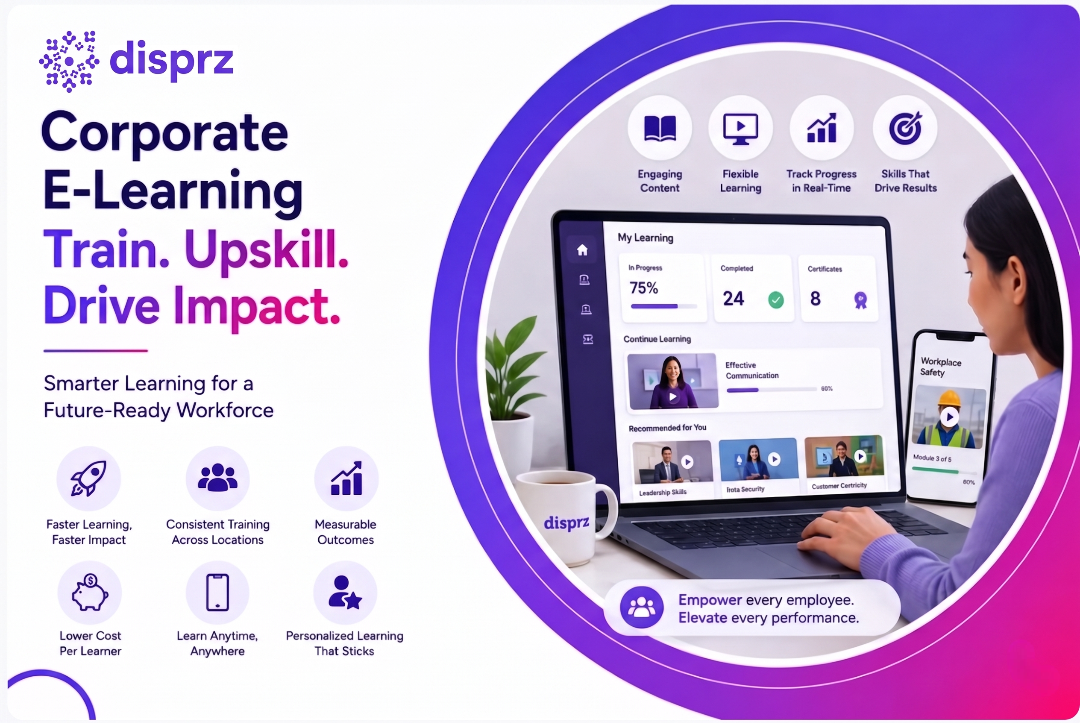
What Are the Benefits of E-Learning Corporate Training?
The benefits are real, but they land differently depending on whether you measure activity or impact. The list below leads with the outcomes an L&D leader can defend to a CFO.
1. Speed to capability:
New hires, product updates, and compliance changes reach the whole workforce in days, shortening time-to-productivity.
2. Consistency at scale:
Every employee across every location gets the same standard of training, which matters most in regulated and multi-site operations.
3. Measurable progress:
Well-designed programs track skill development and performance, not just whether a course was opened.
4. Lower cost per learner:
Travel, venue, and trainer time fall away, though this is a side effect rather than the main reason to invest.
5. Flexibility for the learner:
Employees learn at their own pace and in the flow of work, which raises completion for busy and deskless teams.
6. Personalisation:
Modern platforms adapt paths to a person's role and skill gaps, so learning is relevant rather than generic.
The benefit that ties the rest together is relevance. Consistency and cost mean little if the content does not match what the employee actually needs to do. That is where many programs fall short, and where the delivery model matters.
What Are the Main Corporate E-Learning Delivery Models?
Corporate online learning is not a single format. Most enterprise programs combine several, matched to the audience and the type of skill being built. Two of these models often get confused, so it helps to understand the difference between an LMS and an LXP before designing your mix.
| Delivery Model | Best For | What It Looks Like |
|---|---|---|
| Self-paced modules | Foundational knowledge, policies, product basics | Structured courses employees complete on their own schedule |
| Microlearning | Just-in-time knowledge, reinforcement, frontline teams | Short 3 to 5 minute lessons that fit into a workday |
| Virtual instructor-led training (VILT) | Complex topics, discussion, live practice | Scheduled online sessions led by an expert |
| Mobile learning | Deskless and distributed employees | Training delivered to phones, often offline-capable |
| Assessments and certification | Compliance, licensing, proof of competence | Quizzes and gated evaluations tied to a record |
| AI-personalised paths | Role-based upskilling at scale | Adaptive journeys built from a person's skill gaps |
The mix is what matters. A compliance topic in banking may need self-paced modules with gated assessments, while a retail rollout needs mobile microlearning. Choosing one format for everything is the most common design mistake. The AI-personalised model is the fastest growing of these, and the role of AI in corporate training is worth understanding in its own right.
“Mistake: The most common corporate e-learning failure is treating high completion as success. A thirty-minute course finished in eight minutes, or a 100% completion rate with no change in on-the-job performance, means employees clicked through without learning. Completion is an activity metric. Capability is the business metric.”
How Does Corporate E-Learning Change by Industry?
The structure of a program stays similar across sectors. What changes is the priority, the format, and the workforce environment.
1. Banking and Financial Services (BFSI):
Compliance and risk lead. Mandatory certification for topics like AML and KYC, delivered through gated assessments with an audit-ready record.
2. Retail and Ecommerce:
High turnover and seasonal hiring make speed critical. Mobile-first microlearning gets new associates onto the floor with product and point-of-sale knowledge fast.
3. Insurance:
Complex policy and regulatory knowledge suits modular courses paired with scenario-based practice for claims and underwriting.
4. IT and ITeS:
Skills go stale quickly. On-demand technical libraries and hands-on practice keep engineering and security skills current.
5. Manufacturing and Automotive:
Safety and standard operating procedures dominate. Short visual modules and just-in-time refreshers reduce floor downtime.
6. Pharma and Healthcare:
Patient safety and accreditation require stringent, tracked modules with enforced passing scores for shifting-shift staff.
7. Food Services and Hospitality:
Guest experience and brand consistency call for short, video-based lessons on service and food safety for frontline teams.The common thread is that regulated sectors center on accuracy and proof, while frontline-heavy sectors center on speed and mobile reach. Both need the format matched to the reality of the job.
Who Owns and Drives Corporate E-Learning?
A corporate e-learning program runs on two groups working together.
- The L&D core team owns whether it works: The Head of L&D sets strategy and budget, instructional designers build the content, and platform administrators handle delivery, assignments, and reporting.
- Subject matter experts make it accurate: Compliance officers define regulatory content, operations managers specify process training, and technical leads shape upskilling.
For the L&D leader, the real constraint is capacity, not budget. Instructional design is slow, SMEs are busy, and content ages faster than a small team can rebuild it. That bottleneck limits most programs, and it is the gap AI-assisted authoring has started to close.
What Makes a Strong Corporate E-Learning Program?
Before you build or audit a program, check it against these criteria. Missing any one caps how much business impact the program can produce.
| S.No | Criterion | What It Means |
|---|---|---|
| 1 | Tied to business metrics | Success is measured against performance, not course completion. |
| 2 | Relevant and role-based | Content matches what the specific employee needs to do. |
| 3 | Accessible to everyone | Mobile-first and offline-capable, so deskless teams are included. |
| 4 | Chunked and current | Short modules, updated as fast as the business changes. |
| 5 | Active, not passive | Scenarios and practice, not click-through slideshows. |
| 6 | Compliance-ready | Gated assessments and audit-ready records where regulation demands it. |
| 7 | Measurable at the skill level | Visibility into skill growth, not just who finished. |
Five of these are about design. The two that decide business impact are the first and the last: whether learning is tied to outcomes, and whether you can see capability actually building.
Why Do Most Corporate E-Learning Programs Underperform, and How Do You Fix It?
Most programs are not undone by bad content. They are undone by a disconnect between learning and performance.
The pattern is familiar. Courses are built, completions are logged, dashboards look healthy, and nothing changes on the ground. Sales conversations do not improve, safety incidents do not drop, onboarding still takes months. The program measured activity and assumed capability would follow.
Closing that gap takes three things.
1. Map learning to skills and roles:
Training that is not tied to a specific role and a specific skill gap produces generic content people ignore. The starting point is knowing which skills matter for which roles, then building against that, which is the core idea behind a learning experience platform.
2. Reach every employee, including the frontline:
A large share of the enterprise workforce never sits at a desk. If the program assumes desktop access, it excludes the exact people whose performance most affects customers and operations. Purpose-built frontline training and enablement that is mobile-first and offline-capable is not a nice-to-have for these teams. It is the difference between a program that runs and one that does not.
3. Measure capability, not clicks:
The point of the program is a more capable workforce. That means tracking skill growth and business outcomes, and giving managers visibility they can act on. Choosing a system that does this well starts with comparing the best online learning platforms for employees.
This is where an AI-powered skilling platform changes the outcome. Disprz combines an LMS, an LXP, and skills intelligence in one platform, so learning is mapped to roles, personalised to each employee's gaps, and measured against capability rather than completion. Its purpose-built Frontline Enablement solution is mobile-first and offline-capable, delivering training where retail, manufacturing, and field teams actually work, with completion rates above 45% against an industry average below 30%.
The impact shows up in real deployments. Wellness Forever brought new employees to productivity within 30 days across 400+ stores. ROSHN reached 91% platform adoption and attributed 15% annual business growth to its skilling program. Those are outcomes a completion report cannot produce.
For the content bottleneck specifically, Disprz Turo converts existing SOPs and internal documents into microlearning far faster than manual instructional design, so the training a fast-moving business needs does not take weeks to build.
Conclusion
Corporate e-learning in 2026 is no longer the cheaper substitute for classroom training. It is the system that keeps a workforce current as skills change and business moves faster than any annual cycle.
The programs that succeed share a clear pattern. They tie learning to business outcomes, they reach every employee including the deskless majority, and they measure capability rather than clicks. The ones that fail usually have good content trapped in a format that never touches performance.
For L&D leaders, the decision is less about whether to run corporate e-learning and more about whether the program is built to prove its value. When learning is mapped to roles, personalised to real gaps, and measured against outcomes, it stops being a cost line and becomes a driver of workforce readiness.
Frequently Asked Questions
1. What is corporate e-learning?
Corporate e-learning is the digital delivery of employee training through online platforms, short modules, and assessments that employees can access on any device, at any time.
2. What are the main types of corporate e-learning?
The main types are self-paced modules, microlearning, virtual instructor-led training, mobile learning, and AI-personalised learning paths, usually combined to match the audience.
3. How is corporate e-learning different from classroom training?
Corporate e-learning scales instantly across locations, updates quickly, and tracks progress digitally, while classroom training is limited by time, venue, and trainer availability.
4. What makes corporate online learning effective?
Corporate online learning is effective when it is tied to business outcomes, matched to the employee's role, accessible on mobile, and measured by skill growth rather than course completion.
5. Does corporate e-learning work for frontline employees?
Yes. Frontline employees need mobile-first, offline-capable microlearning delivered where they work, so training reaches them without requiring desktop access.
6. How do you measure the ROI of e-learning corporate training?
You measure ROI by tracking business results before and after a program, such as faster onboarding, fewer safety incidents, or higher sales, rather than completion rates alone.