

On this page
These two terms sound alike, and mixing them up is the most common reason buyers evaluate the wrong tool. The simple way to keep them apart is to separate the thing from the place that holds the thing.
- Learning record: the data itself. It is the file, portfolio, or profile that tracks what one person has learned, achieved, and experienced. This term simply describes the information.
- Learning record store (LRS): the storage system. It is a database that helps securely store, organize, and share those records, often through a technical format such as xAPI. This term describes the infrastructure, not the data.
Simple analogy: A learning record is like a bank statement showing your financial history. A learning record store is like the bank's secure vault and computer system that holds and organizes all of those statements. The statement is the record; the vault is the store. This distinction helps clarify every decision that follows in this guide.
TL;DR
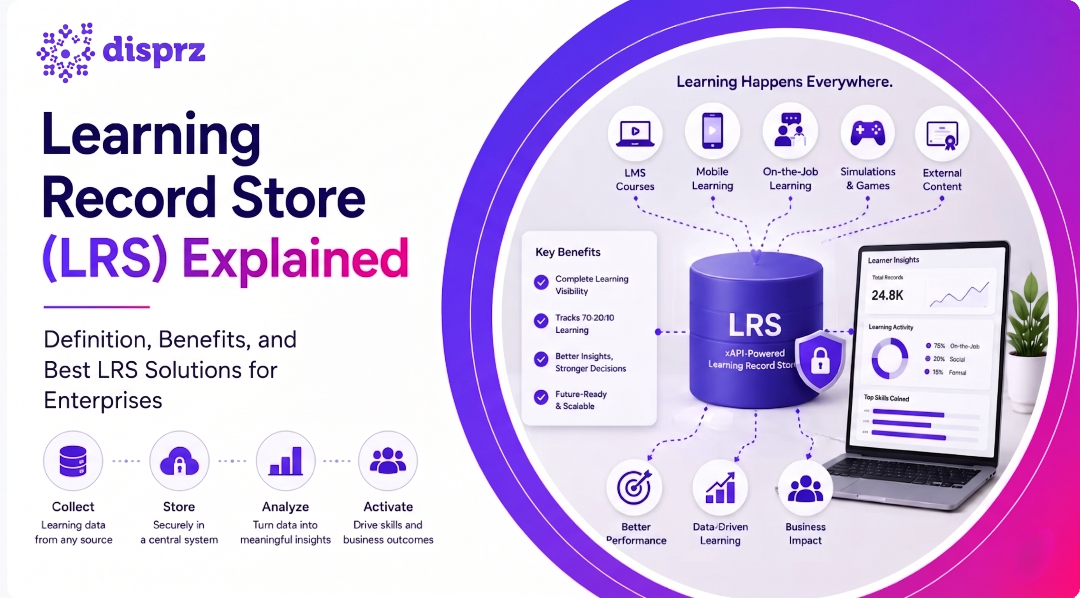
- A learning record store (LRS) is a database that collects learning activity from every source your people learn through, formal courses, mobile apps, simulations, on-the-job coaching, and stores it in one standard format using xAPI.
- An LRS is not an LMS. An LMS delivers and manages training. An LRS records and analyzes what happened, including the learning that occurs outside any course.
- Most enterprises do not buy a standalone LRS. They choose a learning platform that already speaks xAPI and stores records natively, which removes an extra system to integrate and maintain.
- Top options at a glance: dedicated stores such as Rustici, Watershed, and Learning Locker handle pure xAPI data, while enterprise platforms with built-in xAPI/LRS support (Disprz, Cornerstone Learning, SAP SuccessFactors) combine delivery and records in one place, with Disprz suited to L&D teams that also need skills and business-outcome analytics.
- What you will walk away with: a clear definition, the difference from an LMS, an honest view of when a standalone LRS is worth it, and a short evaluation checklist.
Why Are L&D Leaders Being Asked About Learning Record Stores?
The question rarely starts with technology. It starts with a board slide.
A CHRO asks the Head of L&D to show how a year of training moved a business number. Sales ramp time. Compliance readiness before an audit. Frontline productivity in the first 30 days. The L&D leader opens the reporting dashboard and finds course completions, quiz scores, and time spent. Useful, but none of it answers the question that was actually asked.
That gap is where the learning record store enters the conversation. Enterprises now run learning across many surfaces at once: an LMS for compliance, a content library for self-paced upskilling, mobile apps for field teams, virtual sessions, and coaching that never touches a system at all. Each surface holds a fragment. No single view exists.
Simple: A learning record store is one place that collects records of what people learned, from every tool they learned in, in a shared format.
The shift matters now because two things changed. First, work moved off the desktop. Retail associates, bank branch employees, and manufacturing teams learn on phones, on the floor, and offline. Second, leadership expectations changed. According to the LinkedIn Talent Velocity Advantage Report 2026, 90% of leaders want clear visibility into workforce skills, yet only 14% of organizations qualify as talent velocity leaders. The appetite for skills data is high. The infrastructure to capture it usually is not.
What Problem Does a Learning Record Store Solve?
Before defining the technology, it helps to name the pain in business terms, because the pain is what justifies the investment to a CFO.
For two decades, most enterprise training ran on SCORM, a standard built in the late 1990s. SCORM tracks a learner only while they are logged into a course inside a browser window. It reports a thin set of outcomes: completed yes or no, a score, time spent. It treats a course as a sealed box.
That model breaks in a modern enterprise for four reasons.
Market: Corporate development follows the 70:20:10 pattern, where roughly 70% of learning happens on the job, 20% through others, and only 10% in formal courses. SCORM-based reporting captures mostly that formal 10%.
- Learning happens off the browser: A field technician trained on equipment, a nurse practicing on a simulator, a sales rep rehearsing a pitch. None of it launches inside an LMS window, so none of it is recorded.
- Data lives in fragments: The LMS knows about compliance modules. The content vendor knows about self-paced courses. The mobile app knows about frontline nudges. Nobody holds the full learner picture.
- Reporting stays shallow: Pass or fail tells you nothing about where a learner hesitated, which module confused 80% of the workforce, or which training actually shortened ramp time.
- Switching systems risks history: When learning data is locked inside one vendor's LMS, migrating to a better platform threatens years of records.
This is the problem a learning record store was designed to solve.
How an LRS helps the corporate L&D team
An LRS gives you a single, standard record of learning across every tool, so a Head of L&D can finally answer the board slide with evidence rather than completion counts.
How an LRS helps compliance-heavy functions
Banking, insurance, pharma, and healthcare teams can produce timestamped proof that a specific protocol was practiced, not just that a course was marked done, which is what auditors increasingly want to see.
How an LRS helps frontline-heavy operations
Retail and logistics leaders can capture learning that happens on mobile and offline, then connect it to store or route performance, instead of losing that activity entirely.
What Does a Learning Record Store Actually Do?
An LRS is a specialized database. What makes it different from an ordinary database is the language it speaks: xAPI (the Experience API, also called Tin Can).
Every time someone learns something, the source tool sends the LRS a short statement in a fixed shape:
Actor + Verb + Object.
For example: "Sofia" + "completed" + "Anti-Money-Laundering Module 2." Or: "Ahmed" + "practiced" + "objection-handling roleplay."
Those statements stream in from any connected source, and the LRS validates and compiles them into one learner profile. Because the format is standardized, a mobile app, a simulator, and an LMS can all feed the same record without custom engineering for each one.
Three capabilities follow from that design.
Cross-platform consolidation. Every disconnected tool feeds one profile, so the learner's full history lives in a single place you own.
Behavioral depth. Instead of pass or fail, the LRS can record granular actions, which lets instructional designers see exactly where training breaks down.
Portability. Because records sit in an open standard inside a store you control, changing your delivery platform later does not erase your history.
Mistake: Treating an LRS as a place learners log in to. They never see it. It is back-end plumbing. If a vendor shows you a learner-facing LRS "portal," they are describing an LMS or LXP, not the store itself.
What Is the Difference Between an LRS and an LMS?
This is the single most common point of confusion, and getting it wrong leads to buying the wrong thing.
| Dimension | Learning Record Store (LRS) | Learning Management System (LMS) |
|---|---|---|
| Primary job | Store and analyze learning activity | Deliver and manage courses |
| Data scope | Formal and informal learning across any connected tool | Mostly structured courses inside the system |
| Standard | xAPI, cmi5 | Often SCORM first |
| Learner interface | None, it is invisible infrastructure | A portal learners log into |
| Core value | Deep analytics, portability, cross-tool tracking | Content delivery, enrollment, compliance tracking |
The short version: an LMS is the delivery layer, and an LRS is the data layer. They answer different questions. An LMS answers "did people take the training." An LRS answers "what did people actually learn, everywhere, and did it change anything."
A useful way to frame it for your own leadership: the LMS is the classroom, the LRS is the permanent transcript that follows the learner across every classroom they ever enter.
Which Industries Prioritize a Learning Record Store?
An LRS earns its cost fastest where learning happens outside a browser and where proof of practice matters. That pattern shows up clearly across sectors your enterprise peers operate in.
| Industry | Why an LRS Matters | What Gets Tracked |
|---|---|---|
| Healthcare | Patient safety demands proof of hands-on skill | Simulation performance, procedure sequencing, credential cycles |
| Banking & Insurance | Audits require evidence, not completion checkmarks | Timestamped protocol practice, roleplay outcomes |
| Retail & Logistics | Huge frontline workforce learns on mobile and offline | App-based microlearning, on-the-job task completion |
| Manufacturing & Energy | Mistakes carry safety and compliance risk | Safety procedure steps, equipment handling drills |
| Aviation & Defense | Training happens in simulators and offline field settings | Telemetry, reaction time, offline sync once reconnected |
If your organization is desk-bound and every course lives inside one LMS, the case for a separate LRS is weak. If your workforce is distributed, frontline, or regulated, the case gets strong quickly.
What Are the Types of Learning Record Store?
Not every LRS is deployed the same way. Four shapes cover most enterprise decisions. The first two describe how the store connects to your tools; the last two describe where the store lives.
1. Standalone LRS
- Runs independently and collects records from many different systems at once.
- Neutral by design, so no single vendor can lock you out of your own history.
- Tradeoff: every source tool must be connected and maintained by your team.
- Best when you already use several learning tools and want one independent store.
2. Integrated (native) LRS
- Built into a learning platform, so records are captured automatically as learning happens.
- No separate system to connect, secure, or pay for, and one support relationship.
- Tradeoff: slightly less vendor-neutrality in exchange for far less overhead.
- Best when you want fewer moving parts and faster time to value.
3. Cloud-based LRS
- Hosted by the provider and scales as your learner numbers grow.
- Reachable from anywhere, with no servers or infrastructure on your side.
- Suits workforces spread across regions such as India, the Gulf, and Southeast Asia.
- Best for distributed, multi-region enterprises that do not want to run servers.
4. On-premise LRS
- Installed on your own servers for maximum control over the data.
- You decide exactly where records sit and who can access them.
- Tradeoff: hosting, updates, and security all fall to your internal IT team.
- Best for organizations with strict data-residency or sovereignty requirements.
For most 500+ employee enterprises, the real choice is not "which standalone LRS," it is "standalone store plus more integration work, or a platform with a native, xAPI-compliant store already inside it."
What Are the Best Learning Record Store Options?
When people search for the "best learning record store," they usually mean one of two different things. Clarifying which one you are decides your shortlist.
If you need a pure, standards-based store whose only job is to ingest and query xAPI at scale, dedicated LRS products are the natural fit. If you need learning delivery plus records in one place, a learning platform with native xAPI and LRS support is the better path.
| Option | Category | Best Suited For |
|---|---|---|
| Disprz | AI-powered LMS + LXP with xAPI/LRS support | Enterprises wanting delivery, skills, and records in one platform |
| Cornerstone Learning | Enterprise LMS with native LRS and xAPI | Large regulated organisations inside a full talent suite |
| SAP SuccessFactors | Enterprise LMS with xAPI support | Organisations standardised on the SAP HCM ecosystem |
| Litmos | Cloud LMS with xAPI support | Fast-deploy compliance and extended-enterprise training |
| TalentLMS | Mid-market LMS with SCORM, cmi5, and xAPI | Smaller teams wanting quick setup and standards support |
| Rustici | Dedicated LRS and standards tooling | Deep xAPI infrastructure, developer-led setups |
| Watershed | Enterprise learning analytics LRS | Large organisations feeding BI tools such as Tableau or Power BI |
| Learning Locker | Open-source LRS | Teams wanting a customizable, self-hosted store |
The list above is category context, not a ranking. It mixes full learning platforms that support xAPI and LRS records with dedicated stores whose only job is data. The right pick depends entirely on whether you are buying data plumbing or a complete learning platform. That distinction is exactly where the next section becomes practical.
Do You Actually Need a Standalone Learning Record Store?
Here is the question most vendor content avoids, answered plainly for an L&D leader who has to justify the spend.
Buy a standalone LRS if:
- You run a genuinely multi-vendor learning ecosystem and want one neutral store nobody can lock you out of.
- Your data science team wants raw event streams to merge with performance data in external BI tools.
- You use immersive hardware, VR, simulators, specialized field devices, that must report into a central profile.
You probably do not need a separate LRS if:
- Most of your learning already flows through one modern platform.
- You want fewer systems to integrate, secure, and maintain, not more.
- Your priority is connecting learning to business outcomes without building a data pipeline from scratch.
For the majority of enterprises in this second group, adding a standalone LRS means one more system to procure, integrate, and govern. The alternative is choosing a learning platform that already captures records in an open standard and already turns them into skills and business insight.
Where Does Disprz Fit in the Learning Record Store Picture?
Disprz is not a standalone learning record store, and it is worth being direct about that. It is an AI-powered LMS and LXP that is xAPI and LRS compatible, which means it addresses the underlying reason most L&D leaders started asking about an LRS in the first place: scattered learning data that never connects to business results.
A few things make that relevant for a 500+ employee enterprise.
1. It speaks the open standard:
Disprz supports xAPI alongside SCORM, so it works with external content, simulation tools, and third-party libraries rather than trapping data in a closed box. Its healthcare deployments, for instance, run LRS/xAPI-compatible alongside clinical simulation tools and integrate with HRIS and SSO.
2. It captures learning where frontline work actually happens:
The platform is mobile-first and offline-capable, queuing learning activity on the device and syncing once a connection returns. That is the exact frontline gap SCORM-only reporting misses, and it is why Disprz sees frontline completion rates above 45% where the industry average sits below 30%.
3. It turns records into skills, not just logs:
A raw LRS gives you statements. Disprz feeds learning activity into its Skills Intelligence layer, mapping role-to-skill gaps and building the analytics an L&D leader needs to answer the board slide.
4. It links learning to business outcomes:
This is the part completion reports cannot reach. ROSHN attributed a 15% boost in business outcomes to its Disprz-powered program, alongside 91% platform adoption and a 50% reduction in manual work. Wellness Forever reached productivity within 30 days across 400+ stores with 50% faster onboarding. Those are the numbers that justify the investment upward.
So if your search for a learning record store is really a search for "one place where learning data lives and finally proves its worth," a unified platform with native xAPI support answers that need without adding a separate system to run.
How Should You Evaluate a Learning Record Store?
Before you commit to any path, pressure-test it against these questions.
- Does it support xAPI and cmi5, not SCORM alone?
- Can it capture learning from mobile and offline, where your frontline actually works?
- Do you own and control the records, with clean export if you ever switch?
- Does it turn activity into skills and business insight, or stop at raw logs?
- Does it reduce the number of systems you maintain, or add one more?
- Can it show proof in markets and industries like yours, not just a feature list?
If a single platform answers yes across that list, you likely do not need a separate store bolted on. If your needs are unusually specialized, a dedicated LRS remains a legitimate choice.
Frequently Asked Questions
1. What is a learning record store?
A Learning Record Store (LRS) is a specialized database or server that collects, stores, and shares data about learning experiences
2. What is a learning record?
A learning record is a digital document or database that tracks a person's educational activities, skills, and progress over time.
3. What is an LRS types?
An LRS (Learning Record Store) can either be standalone a separate database that gathers data from different apps and games or integrated, meaning it is built right inside an existing LMS so you do not have to buy two separate tools.
4. What is the difference between LMS and LRS?
An LMS is a user-facing platform that delivers and manages structured training courses. An LRS is a background database that collects and stores detailed learning data from multiple sources.
5. Is a learning record store the same as an LMS?
No. An LMS is the delivery layer and an LRS is the data layer. Many modern platforms now include a native LRS, so you run one system instead of two.
6. What is the best learning record store?
It depends on need. Dedicated stores such as Watershed or Rustici suit pure data use, while platforms with native xAPI support suit delivery plus records in one place.
7. Does an LRS replace my LMS?
No. They do different jobs. An LRS is the data layer and an LMS is the delivery layer. Many platforms now include a native LRS so you run one system.
8. What is xAPI's role in a learning record store?
xAPI is the language that lets any tool send activity to the LRS as short Actor, Verb, Object statements, which makes cross-platform tracking possible.
9. Do enterprises need a standalone LRS?
Most enterprises do not need a standalone Learning Record Store (LRS) if their training happens strictly inside a single Learning Management System (LMS)
The Takeaway
A learning record store solves a real problem: learning data scattered across tools, disconnected from the business outcomes leadership cares about. Understanding it is now part of the job for any Head of L&D being asked to prove impact.
The deciding question is not "which LRS," it is "do I want another system, or a platform that already captures records in an open standard and turns them into skills and results." For most large enterprises, the second path is simpler and stronger.
If you are evaluating how to bring scattered learning data into one place and connect it to business performance, see how Disprz helps enterprises turn learning into measurable capability.