







A Healthcare LMS helps you streamline clinical, compliance, and role-based training across hospitals, pharma, and medtech teams. Unlike generic platforms, it’s built for high-risk environments; ensuring regulatory compliance, improving patient safety, and accelerating workforce readiness.
Here you’ll learn key benefits, real-world use cases, must-have features, and how to choose the best healthcare LMS software for your organization in 2026.
What is a Healthcare LMS?
A Healthcare LMS (Learning Management System) is a specialized platform designed to help you create, manage, deliver, and track training for healthcare professionals. Unlike a generic LMS, a healthcare learning management system is built to handle clinical training, compliance requirements, certifications, and continuous skill development in high-stakes environments.
You can use healthcare LMS software to onboard new hires, upskill clinical and non-clinical staff, and ensure everyone stays compliant with industry regulations; without disrupting day-to-day operations.
Who uses a Healthcare LMS?
A learning management system for healthcare is widely used across different segments of the healthcare ecosystem:
- Hospitals & healthcare providers: To train doctors, nurses, and administrative staff on clinical protocols, patient care, and compliance.
- Pharmaceutical companies: To educate sales reps, medical representatives, and partners on drug information and regulatory guidelines.
- Medtech & medical device companies: To train internal teams and external stakeholders on product usage, safety, and maintenance.
In short, if your organization operates in a high-risk, compliance-heavy environment, a healthcare training LMS becomes essential; not optional.
Why Healthcare Needs a Specialized LMS (Not a Generic LMS)
If you’re in healthcare, a generic LMS simply won’t cut it. This is where enterprise-grade learning platforms become critical, especially in high-risk sectors where training directly impacts outcomes.
Healthcare is high-risk, highly regulated, and constantly evolving (training isn’t just about knowledge), it’s directly tied to patient outcomes and compliance. That’s why you need a Healthcare LMS built specifically for your realities.
1. Compliance isn’t optional; it’s critical
Healthcare organizations must comply with strict regulations such as HIPAA, NABH, and OSHA. A healthcare compliance LMS helps you automate training assignments, track completions, and maintain audit-ready records; so you’re never caught off guard during inspections.
2. Patient safety depends on training quality
In healthcare, even small errors can have serious consequences. A specialized healthcare training LMS ensures that your staff is always up to date with the latest clinical protocols, treatment guidelines, and safety procedures; helping you minimize risks and improve patient outcomes.
3. High-risk, fast-changing environment
From new medical technologies to evolving treatment standards, your teams need continuous learning. A healthcare learning management system allows you to quickly roll out critical updates, ensuring your workforce stays current without disrupting operations.
4. Role-based complexity across teams
Hospitals and healthcare organizations have diverse roles such as doctors, nurses, technicians, admin staff, and more. A hospital learning management system enables personalized, role-based learning paths so each employee gets exactly the training they need.
5. Accountability and audit readiness
You need clear visibility into who has completed what training; and when. Healthcare LMS software provides detailed reporting and compliance tracking, making audits faster, easier, and stress-free.
Bottom line: a generic LMS supports learning. A healthcare LMS supports safe, compliant, and high-quality care delivery.
Key Features of a Healthcare LMS
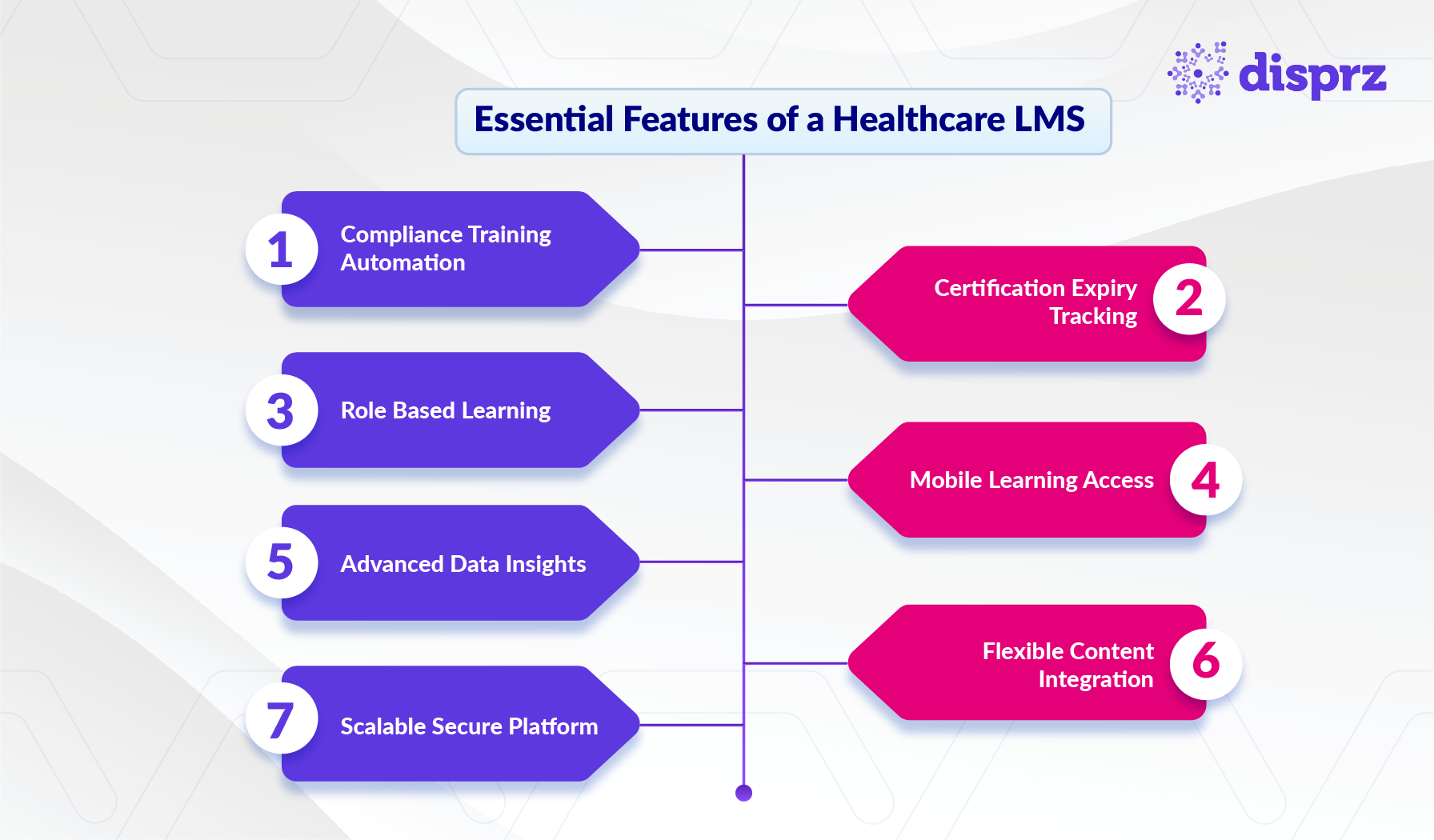
When you’re evaluating a Healthcare LMS, it’s important to look beyond basic course delivery. You need a platform that supports compliance, clinical accuracy, and continuous workforce readiness in a high-stakes environment. Here are the must-have features you should prioritize:
1. Compliance tracking
A strong healthcare compliance LMS should automatically assign mandatory training, track completions, and generate audit-ready reports. This ensures you stay aligned with regulations such as HIPAA, NABH, and OSHA; without manual follow-ups.
2. Certification management
In healthcare, certifications are time-bound and critical. A healthcare LMS software should help you manage license renewals, send automated reminders, and track expiry dates; so no credential lapses slip through the cracks.
3. Role-based learning paths
Your doctors, nurses, technicians, and admin staff all require different training. A learning management system for healthcare should enable you to create personalized learning journeys based on roles, departments, and experience levels.
4. Mobile learning for frontline staff
Healthcare professionals are always on the move. A healthcare training LMS must offer seamless mobile access, allowing your teams to learn anytime, anywhere (whether on the hospital floor or between shifts).
5. Advanced reporting and analytics
You need clear visibility into training effectiveness. A hospital learning management system should provide real-time dashboards, compliance reports, and performance insights. These insights help you measure training effectiveness and continuously improve workforce performance.
6. Content flexibility and integrations
From clinical videos to SOPs and simulations, your LMS for hospitals should support multiple content formats and integrate easily with existing systems such as HRMS, EHR, or CRM tools.
7. Scalability and security
As your organization grows, your LMS for healthcare should scale with you; while ensuring enterprise-grade security and data protection, which is critical in healthcare environments.
In short, the best LMS for healthcare doesn’t just deliver content; it ensures compliance, drives performance, and supports better patient care outcomes.
Benefits of LMS for Healthcare Organizations
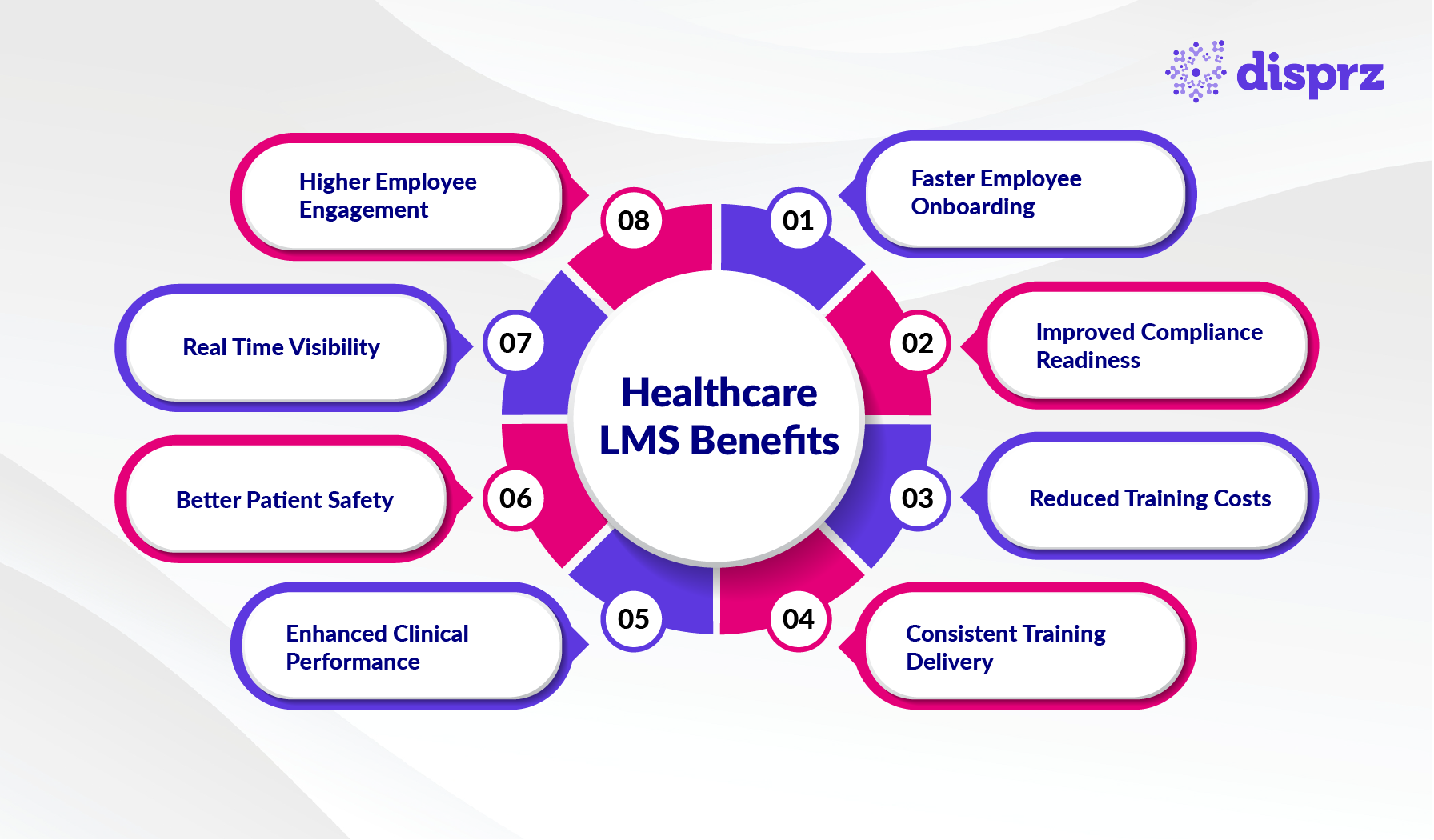
When you implement a Healthcare LMS, you’re not just digitizing training; you’re directly impacting compliance, efficiency, and patient outcomes. Here’s how a healthcare learning management system drives real, measurable value for your organization:
1. Faster onboarding and time-to-competency
You can onboard new hires (doctors, nurses, or support staff) faster with structured, role-based learning paths. Structured onboarding programs supported by modern learning platforms can significantly reduce ramp-up time for frontline employees. This reduces time-to-productivity and ensures your workforce is job-ready from day one.
2. Improved compliance and audit readiness
A healthcare compliance LMS automates mandatory training, tracks completions, and maintains audit trails. This helps you stay compliant with regulations and eliminates last-minute scrambling during audits.
3. Reduced training costs at scale
With healthcare LMS software, you can move away from repetitive in-person sessions. Digital learning reduces trainer dependency, travel costs, and administrative overhead; while scaling training across locations.
4. Consistent training across locations
If you manage multiple hospitals or units, consistency is a challenge. A hospital learning management system ensures standardized training delivery, so every employee follows the same protocols and best practices.
5. Better clinical and operational performance
Continuous learning ensures your teams stay updated with the latest medical practices, technologies, and SOPs, leading to improved performance across clinical and non-clinical functions.
6. Enhanced patient safety and care quality
Well-trained staff make fewer errors. A healthcare training LMS helps reinforce critical protocols and procedures, directly contributing to safer patient care and better health outcomes.
7. Real-time visibility into workforce readiness
With built-in analytics, you can track skill gaps, training progress, and compliance status in real time. This allows you to take proactive actions instead of reacting to issues later.
8. Increased employee engagement and retention
Modern, mobile-first learning experiences make training more accessible and engaging. When your staff feels supported in their growth, it positively impacts retention and job satisfaction.
Ultimately, the right LMS for healthcare helps you move from fragmented training to a scalable, compliant, and outcome-driven learning ecosystem.
Use Cases of Healthcare LMS (Real Scenarios)
A Healthcare LMS isn’t just a training tool; it becomes a critical part of your day-to-day operations. Here’s how you can apply a healthcare learning management system across real-world scenarios:
1. Clinical training and upskilling
You can deliver continuous clinical education to doctors, nurses, and technicians through structured modules, simulations, and assessments. Whether it’s new treatment protocols or updated care guidelines, a healthcare training LMS ensures your teams stay current without interrupting patient care.
2. Medical device training
If you’re introducing new equipment or working in a medtech environment, proper training is essential. A healthcare LMS software allows you to train staff (and even external partners) on device usage, safety procedures, and maintenance; reducing operational risks and errors.
3. Compliance and regulatory training
From HIPAA to NABH and OSHA, compliance training is mandatory and recurring. A healthcare compliance LMS automates course assignments, tracks completions, and provides audit-ready reports; so you’re always prepared for inspections.
4. Sales enablement for pharma and medtech
Your sales teams need to understand complex products, regulations, and market positioning. A learning management system for healthcare helps you deliver structured product training, certifications, and continuous updates; ensuring your reps are always field-ready.
5. Onboarding and cross-functional training
Healthcare organizations often deal with high attrition and frequent hiring. A hospital learning management system enables you to standardize onboarding and provide cross-functional training; so employees can quickly adapt to new roles or departments.
6. Emergency and protocol-based training
In critical situations (such as infection outbreaks or new safety protocols), you need to train your workforce fast. An LMS for hospitals allows you to roll out urgent training modules instantly and track completion in real time.
7. Partner and extended enterprise training
If you work with distributors, clinics, or external healthcare providers, you can extend training beyond your organization. The best LMS for healthcare lets you train partners at scale while maintaining consistency and compliance.
In essence, a healthcare LMS helps you turn training into a continuous, embedded process that directly supports operational excellence and patient care.
How to Choose the Right Healthcare LMS in 2026?
Choosing the right Healthcare LMS is a critical decision; it directly impacts compliance, workforce readiness, and patient outcomes. With multiple options available, you need to focus on what truly matters for your organization.
Must-have features you should look for
When evaluating a healthcare learning management system, make sure it checks these essentials:
- Compliance-first capabilities: Built-in support for regulatory training, audit trails, and certification tracking
- Role-based learning paths: Ability to personalize training for doctors, nurses, technicians, and admin staff
- Mobile-first experience: Seamless access for frontline workers who are always on the move
- Robust reporting & analytics: Real-time visibility into compliance, skill gaps, and training effectiveness
- Content flexibility: Support for videos, simulations, SOPs, and blended learning formats
- Integrations: Easy connectivity with HRMS, EHR, CRM, or other enterprise systems
- Scalability & security: Enterprise-grade infrastructure with strong data protection
Questions you should ask vendors
Before you finalize a healthcare LMS software, ask the right questions:
- Can the platform handle healthcare-specific compliance requirements such as HIPAA or NABH?
- How does it manage certifications, renewals, and audit readiness?
- Does it support role-based and personalized learning journeys at scale?
- How easy is it to deploy and integrate with existing systems?
- What kind of reporting and analytics capabilities are available?
- Is the platform mobile-friendly for frontline healthcare staff?
- What support, onboarding, and training do you provide post-implementation?
Red flags to watch out for
Not all LMS platforms are built for healthcare. Be cautious if you notice:
- Generic, one-size-fits-all approach with no healthcare-specific capabilities
- Limited compliance tracking or lack of audit-ready reporting
- Poor user experience, especially on mobile devices
- Complex implementation with heavy IT dependency
- Lack of scalability as your organization grows
- Weak customer support or slow response times
The right LMS for healthcare should feel like a strategic enabler; not just a training tool. When chosen well, it helps you stay compliant, improve workforce performance, and ultimately deliver better patient care.
If you're comparing multiple options, reviewing the top learning management platforms can help you make a more informed decision.
Best Healthcare LMS Platforms in 2026
There’s no one-size-fits-all when it comes to choosing the best LMS for healthcare; the right platform depends on your organization’s size, complexity, and training needs. Here are some widely used healthcare LMS platforms you can consider:
1. Disprz
Disprz is a modern, AI-powered healthcare LMS focused on capability building, not just content delivery. It combines learning, skilling, and performance into a single platform, making it ideal for hospitals, pharma, and medtech organizations looking to drive measurable outcomes at scale.
 Explore the Disprz learning platform to understand how it supports role-based training, compliance tracking, and workforce readiness.
2. HealthStream LMS
A well-established healthcare learning management system designed specifically for hospitals and healthcare providers. It offers strong compliance tracking, clinical training content, and workforce development tools tailored for the healthcare industry.
3. Relias Healthcare LMS
A popular healthcare training LMS known for its extensive compliance and clinical training libraries. It’s widely used by healthcare organizations for regulatory training, certifications, and ongoing staff education.
4. Absorb LMS
A flexible and scalable LMS for healthcare that supports compliance training, onboarding, and extended enterprise learning. It’s suitable if you’re looking for a balance between usability and enterprise-level capabilities.
5. Tovuti LMS
A user-friendly healthcare LMS software with strong course authoring, automation, and reporting features. It works well for organizations that want quick deployment and interactive learning experiences.
In short, while each platform has its strengths, you should evaluate them based on your specific use cases (such as compliance, clinical training, scalability, or user experience) to find the best fit for your needs.
Healthcare LMS Trends (2026)
The Healthcare LMS landscape is evolving rapidly as organizations move beyond basic training toward continuous capability building. Here are the key trends shaping how you’ll use a healthcare learning management system in 2026:
1. AI-driven personalized learning
AI is transforming how training is delivered. Modern healthcare LMS software can recommend personalized learning paths based on roles, skills, and performance; helping your teams learn faster and more effectively.
2. Microlearning for busy professionals
Healthcare professionals don’t have time for long training sessions. Short, focused modules (often mobile-first) are becoming the norm in healthcare training LMS platforms, improving completion rates and knowledge retention.
3. Skills-based training and workforce readiness
Organizations are shifting from course completion to skill mastery. A learning management system for healthcare now focuses on identifying skill gaps, mapping competencies, and building job-ready capabilities.
4. Data-driven decision making
Advanced analytics are enabling you to measure training effectiveness in real time. From compliance tracking to performance insights, healthcare LMS platforms are becoming key decision-making tools.
5. Integrated learning ecosystems
A hospital learning management system is no longer standalone. It’s increasingly integrated with HRMS, EHR, and other enterprise systems, creating a unified ecosystem for learning, performance, and workforce management.
6. Simulation and immersive learning
With advancements in AR/VR and interactive simulations, healthcare LMS platforms are enabling hands-on, risk-free training environments; especially useful for clinical and device-based learning.
These trends clearly show that the best LMS for healthcare is no longer just about delivering content; it’s about building a future-ready, skilled, and compliant workforce at scale.
Key Takeaways
- A Healthcare LMS ensures compliance, workforce readiness, and consistent training across hospitals, pharma, and medtech teams.
- Generic LMS platforms fall short in handling regulatory, clinical, and high-risk healthcare training requirements effectively.
- Key features such as compliance tracking, certifications, and role-based learning are essential for healthcare organizations.
- A healthcare LMS software improves onboarding speed, reduces training costs, and enhances overall workforce performance outcomes.
- Real-world use cases span clinical training, compliance, medical devices, onboarding, and partner enablement at scale.
- Choosing the best LMS for healthcare requires evaluating compliance capabilities, scalability, integrations, and user experience carefully.
- AI, microlearning, and skills-based training are shaping the future of healthcare learning management systems in 2026.
Conclusion
A Healthcare LMS is a critical system that directly impacts compliance, workforce performance, and patient safety. If you want to keep up with evolving regulations, train your teams efficiently, and deliver consistent, high-quality care, investing in the right healthcare learning management system is essential.
The key is to move beyond a generic LMS and choose a platform that’s purpose-built for healthcare; one that supports compliance, enables role-based learning, and scales with your organization’s needs.
If you're evaluating solutions, it's important to choose a platform that not only delivers training but also improves workforce performance and compliance at scale.
Book a personalized demo to see how Disprz supports healthcare organizations with AI-powered learning and measurable outcomes.

FAQs Related to Healthcare LMS
1) What is a healthcare LMS?
A Healthcare LMS is a specialized learning management system designed to train healthcare professionals, manage certifications, and ensure compliance with industry regulations. It helps you deliver, track, and optimize training across hospitals, pharma, and medtech organizations.
2) Why do hospitals need an LMS?
Hospitals need an LMS for healthcare to manage large-scale training, ensure regulatory compliance, standardize learning, and keep staff updated with the latest clinical practices; ultimately improving patient care and safety.
3) What are the key features of a healthcare LMS?
Key features include compliance tracking, certification management, role-based learning paths, mobile learning, reporting and analytics, content flexibility, and integrations with systems such as HRMS or EHR.
4) How does an LMS help with healthcare compliance training?
A healthcare compliance LMS automates training assignments, tracks completions, sends reminders for renewals, and generates audit-ready reports; helping you stay compliant with regulations such as HIPAA, NABH, and OSHA.
5) What is the best LMS for healthcare organizations?
The best LMS for healthcare depends on your needs. Platforms such as Disprz, HealthStream LMS, Relias Healthcare LMS, Absorb LMS, and Tovuti LMS are commonly used; each offering different strengths in compliance, scalability, and user experience.
6) Can an LMS improve patient safety and outcomes?
Yes. A healthcare training LMS ensures that staff are consistently trained on the latest protocols and procedures, reducing errors and improving the overall quality of patient care.
7) How much does a healthcare LMS cost?
The cost of a healthcare LMS software varies based on features, number of users, and deployment model. Pricing can range from affordable SaaS subscriptions to enterprise-level investments depending on your scale and requirements.
8) What is the difference between a healthcare LMS and a regular LMS?
A healthcare learning management system is built specifically for compliance-heavy, high-risk environments. It includes features such as certification tracking, audit readiness, and clinical training support; capabilities that a generic LMS typically lacks.

 View More Resources