
On this page
TL;DR
- Skills-based hiring evaluates what a candidate can actually do, not the credentials on their resume.
- Adoption is high and rising: most employers say they now use it, and hiring for skills is far more predictive of performance than hiring for degrees.
- The catch is follow-through. Harvard research found many companies that dropped degree requirements did so in name only.
- The reason follow-through fails is usually the same: you can hire for a skill, but the role still evolves, and the gap reopens unless you can build skills continuously.
- Skills-based hiring and skills-based development are two halves of one system. This guide covers both.
If your skills-based hiring stalls after the offer, the missing half is a way to keep building the skills you hired for. That is where L&D owns the outcome.
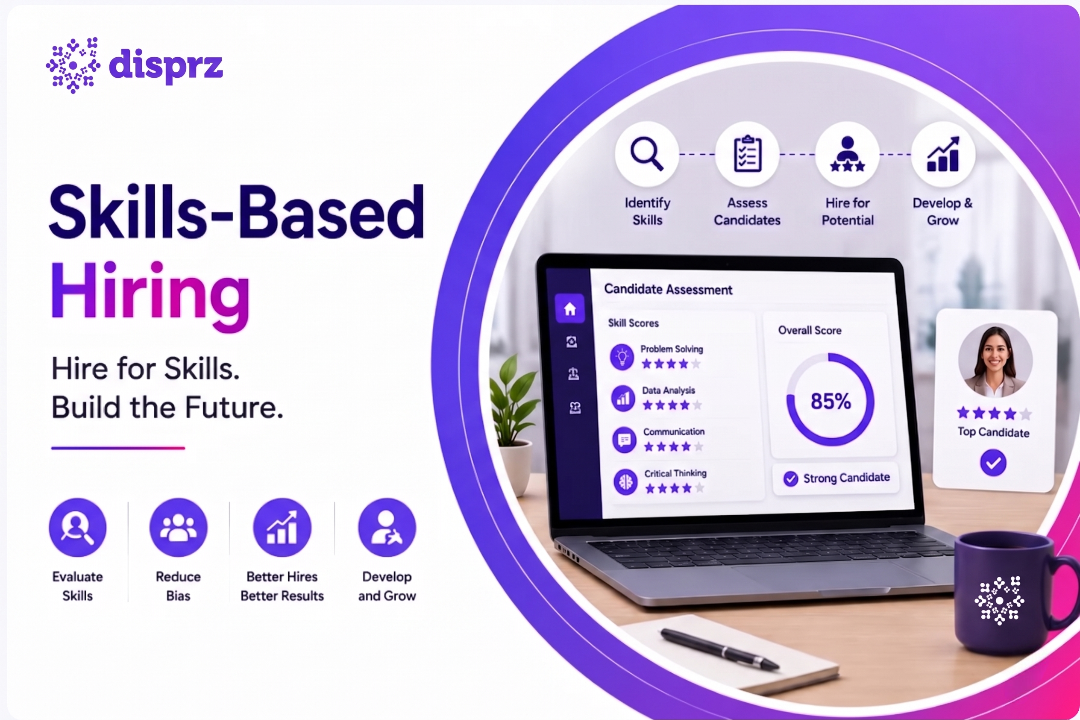
For most of the last century, a resume was the filter. A degree, a set of job titles, a number of years. Skills-based hiring rejects that shortcut and asks a more direct question: can this person do the work?
The shift is real and accelerating into 2026. NACE's Job Outlook 2026 found that 70% of employers now use skills-based hiring, up from 65% the year before, and 71% of them use it at least half the time. It shows up most at the interview stage, where 87% apply it, and in screening, where 65% do. The clearest sign of the change is what has faded: GPA screening, used by 73% of employers in 2019, has dropped to just 42% in 2026. McKinsey research adds the reason it sticks, finding that hiring for skills is roughly five times more predictive of job performance than hiring based on education.
But there is a gap between saying and doing. Research from Harvard Business School and the Burning Glass Institute found that a large share of companies that publicly dropped degree requirements changed little in practice, with many doing so in name only. The intent is there. The follow-through is patchy.
That gap is the reason this guide is written for L&D and HR leaders rather than recruiters alone. Skills-based hiring does not end at the offer letter. The skills you hired for keep shifting, and the only way to hold the advantage is to keep building them. This guide covers what skills-based hiring is, why it matters now, how to run it, how it changes by industry, and why it only works when paired with skills-based development.
What is skills-based hiring: Skills-based hiring is a recruitment approach that evaluates candidates on demonstrated ability rather than degrees or job titles. It uses assessments, work samples, and structured tasks to verify what a person can actually do.
Why Does Skills-Based Hiring Matter Now?
Three forces have made skill-based hiring move from a progressive idea to a practical necessity.
The first is the collapse of the resume as a signal. Generative AI lets any candidate produce a polished, keyword-optimised resume in seconds, so a document that once hinted at capability now proves very little. Employers need a way to verify skill directly, which is exactly what an assessment does.
The second is the speed at which skills change. A qualification earned a few years ago may already be dated in fast-moving functions. What matters is whether a person can do the work now and learn the next thing fast, neither of which a degree captures.
The third is the size of the talent pool. Filtering strictly by degree screens out a large share of capable workers who built their skills through other routes. Dropping that filter, when paired with real assessment, opens access to people who can do the job and were previously invisible.
For an L&D or HR leader, the takeaway is not just that hiring is changing. It is that hiring and development are converging on the same currency: skills.
Market: McKinsey research indicates hiring for skills is around five times more predictive of performance than hiring for education. LinkedIn analysis shows that shifting from job titles to skills can expand the qualified candidate pool several times over, and considerably more for fast-growing fields like AI.
What Are the Benefits of Skills-Based Hiring?
The benefits are strongest when skill-based hiring is treated as a system, not a slogan. The list below leads with outcomes a leadership team can measure.
- Better job fit and performance: Candidates are matched to what the role actually requires, so new hires contribute faster.
- A wider talent pool: Dropping unnecessary degree filters opens access to capable people from non-traditional routes.
- Reduced bias: Structured, standardised assessments judge output rather than pedigree, which supports fairer and more diverse hiring.
- Faster time to productivity: When someone is hired for verified skills, onboarding starts from a higher baseline.
- A clearer development path: Skills-based job profiles tell both the company and the employee exactly what capability the role needs, which makes growth measurable.
The last benefit is the one most guides skip, and it is the one that matters most to L&D. A skills-based hire arrives with a defined skill profile. That same profile is the starting point for developing them, which is what turns a good hire into a lasting one.
How Do You Implement Skills-Based Hiring?
Implementation is a shift from screening credentials to measuring capability. It runs in four phases
| Phase | Focus | What It Involves |
|---|---|---|
| 1. Define | Map the real skills | Interview top performers, list must-have skills, strip unnecessary degree filters from the job description. |
| 2. Assess | Measure objectively | Build short, role-relevant work samples with clear scoring rubrics, kept brief to avoid candidate drop-off. |
| 3. Interview | Standardise and de-bias | Ask every candidate the same competency questions, score against a rubric, and review blind where possible. |
| 4. Measure | Track and refine | Monitor time to productivity and early retention, then update assessments as the role changes. |
Mistake: The biggest skills-based hiring failure is treating it as a job-description edit. Removing the degree line and adding a skills list, while still screening resumes and interviewing on gut feel, produces the same hires with new language. Harvard research found a large share of companies dropped degree requirements in name only. The practice, not the posting, is what changes outcomes.
How Does Skills-Based Hiring Change by Industry?
The core method holds across sectors, but how far a company can go depends on regulation and safety liability. It helps to think in three tiers.
1. Leaders (skills-first for most roles):
IT and ITeS, Retail and Ecommerce, and Hospitality lean heavily on practical tests and work samples, because output is easy to demonstrate and degrees say little about it.
2. Hybrids (split by role):
BFSI, Insurance, and Manufacturing use skills-based hiring for digital, service, and operational roles, while licensed tracks such as actuaries, chartered accountants, or professional engineers still require formal credentials.
3. Restricted (credential-bound core):
Pharma and Healthcare cannot hire clinical employees on a work sample alone, since licensing law governs those roles. Skills-based methods still apply to administrative, support, and technology positions.
The pattern is consistent. The further a role sits from a legal license requirement, the more skills-based hiring can do. And in every tier, the roles hired on skills are exactly the roles where continuous skilling keeps that advantage from fading.
Who Owns Skills-Based Hiring, HR or L&D?
The honest answer is both, and that is the point.
Talent acquisition owns the front half: defining role skills, building assessments, and running a fair selection process. This is where the hire is made.
L&D owns the back half: taking the skill profile each hire arrives with and continuing to build on it as the role evolves. This is where the hire is kept.
The two halves share one language, which is skills. When hiring defines a role by its skills and development builds against the same map, the organisation gets a single, continuous view of capability from candidate to tenured employee. When they operate separately, the hiring gains leak away within a year or two as roles change and no one closes the new gaps.
This shared ownership is why skills-based hiring is an L&D concern, not only a recruiting one.
What Makes Skills-Based Hiring Actually Work?
Before committing to the model, check your approach against these criteria. Missing any one is how skills-based hiring slips into name only.
| S.No | Criterion | What It Means |
|---|---|---|
| 1 | Real assessment, not a skills list | Candidates prove ability through work samples, not just claim it. |
| 2 | Job-relevant tests | Every task measures a capability the role genuinely needs. |
| 3 | Structured, scored interviews | Same questions, same rubric, for every candidate. |
| 4 | Bias controls | Blind review and standardised scoring where possible. |
| 5 | Reasonable candidate effort | Short assessments to avoid losing strong applicants. |
| 6 | Outcome tracking | Measure time to productivity and retention, not just fill speed. |
| 7 | A path to build skills after hire | The skill profile feeds development, so gains hold as roles change. |
Why Skills-Based Hiring Fails Without Skills-Based Development
Here is the pattern that undoes most skills-based hiring programs. A company defines roles by skill, assesses candidates properly, and makes genuinely better hires. Then the role changes. A new system, a new regulation, a new product. The skill that was verified at interview is now partly out of date, and there is no mechanism to rebuild it. Within a year, the organisation is back to a capability gap, this time in people it hired specifically for capability.
Hiring for skills is a snapshot. Keeping a workforce skilled is a continuous process. The two only pay off together.
Closing that loop takes three things.
Map skills to roles, once, for both hiring and development. When the skill profile that defines a job posting is the same one that drives training, the handoff from candidate to employee stays clean, and no gap reopens unseen. A skills gap analysis turns that map into a live view of where capability actually stands.
Build the skills you hired for, continuously. A verified skill at interview decays as the role moves. Structured, role-based skill-based training keeps each hire current instead of letting the gap silently reopen.
Measure capability, not activity. The point is a more capable workforce over time, which means tracking skill growth and business outcomes rather than courses completed.
This is where an AI-powered skilling platform closes the loop. Disprz combines an LMS, an LXP, and skills intelligence in one platform, so the same skill map that informs a skills-first hire also drives that person's development, with capability visible to managers at every stage. Its purpose-built frontline training and enablement solution is mobile-first and offline-capable, extending this to the retail, manufacturing, and field roles where skills-based hiring is most common and desktops are not.
The impact shows up in real deployments. Wellness Forever brought new employees to productivity within 30 days across 400+ stores. ROSHN reached 91% platform adoption and attributed 15% annual business growth to its skilling program. Those outcomes come from building skills after the hire, not just screening for them at the door.
Conclusion
Skills-based hiring is one of the clearer shifts in how organisations build teams. Judging people on what they can do, rather than where they studied, produces better fit, a wider pool, and fairer decisions, and the adoption numbers reflect that.
But the model has a well-documented failure point. Many companies adopt it in name and not in practice, and even those that hire well often watch the gains fade as roles evolve. The reason is almost always the same missing half: no way to keep building the skills they hired for.
For L&D and HR leaders, that is the opportunity. Skills-based hiring and skills-based development share one language and one map. Run them as a single system, and capability compounds from the first assessment through years of tenure. Run them apart, and you rehire the same gap you thought you had closed.
Frequently Asked Questions
1. What is skills-based hiring?
Skills-based hiring is a recruitment approach that evaluates candidates on demonstrated ability through assessments and work samples, rather than on degrees, job titles, or years of experience.
2. What is the difference between skills-based hiring and traditional hiring?
Skill-based hiring filters for proven, real-time capability, while traditional hiring filters for historical credentials like degrees and job titles that may not predict performance.
3. How do you implement skills-based hiring?
You implement skills-based hiring by defining the real skills a role needs, assessing candidates with job-relevant work samples, running structured scored interviews, and tracking outcomes to refine the process.
4. Which industries use skills-based hiring most?
IT, retail, and hospitality lead because output is easy to demonstrate, while regulated sectors like healthcare use it for non-licensed roles such as administration, support, and technology.
5. Does skills-based hiring reduce bias?
Yes. Structured assessments and standardised, blind-reviewed scoring judge candidates on output rather than pedigree, which helps reduce bias and widen access to non-traditional talent.
6. Why does skills-based hiring need L&D involvement?
Because a skill verified at hire decays as the role changes. L&D uses the same skill profile to keep building capability, so the hiring advantage holds instead of fading.
About the authors


Madhu Karunakaran
Vice President - People & Culture
Madhu Karunakaran is a senior HR and Learning & Development (L&D) leader with 20+ years of experience spanning people strategy, organizational development (OD), talent management, leadershi...
Reviewed for accuracy on 11 Aug 2026