

On this page
Technical skills may help employees get hired, but soft skills help them succeed and grow. As AI automates more routine and technical work, human skills are becoming more valuable than ever. Organizations now need employees who can communicate clearly, collaborate across teams, adapt to change, solve problems, and build strong relationships.
That is why soft skills in the workplace have become a top priority for employers and learning leaders. Whether you are developing new managers, onboarding frontline employees, or preparing teams for future roles, investing in professional soft skills can improve performance, engagement, and business outcomes.
Here we will explore 30 soft skills examples every employee should develop in 2026. You will also learn the difference between soft skills vs hard skills, discover the most important soft skills for employees in 2026, and find practical ways to deliver effective soft skills training across your workforce.
TL;DR
Soft skills are interpersonal and behavioral abilities that help employees communicate, collaborate, solve problems, and adapt effectively in the workplace.
- Most in-demand skills: Communication, adaptability, problem-solving, emotional intelligence, and collaboration.
- Hardest to develop: Self-awareness, empathy, conflict resolution, coaching, and cultural competence.
- AI can't replace: Human judgment, empathy, relationship building, ethical decision-making, and coaching.
- How to train them: Use assessments, coaching, practice-based learning, feedback, and LMS-driven learning paths.
What Are Soft Skills? Definition and Examples
Soft skills are personal and interpersonal abilities that help employees work effectively with others, adapt to change, communicate clearly, solve problems, and perform successfully in the workplace. Unlike technical skills, soft skills are transferable across roles and industries and influence how people collaborate, lead, and contribute at work.
Soft Skills vs Hard Skills
| Soft Skills | Hard Skills |
|---|---|
| Focus on how you work and interact with others | Focus on what you know and can do technically |
| Often related to behaviour, mindset, and communication | Often related to technical knowledge and job-specific expertise |
| Difficult to measure directly | Easier to test and measure |
| Transferable across different roles and industries | Usually specific to a role, function, or industry |
| Examples: teamwork, adaptability, empathy, communication | Examples: coding, financial analysis, data modeling, graphic design |
| Developed through experience, coaching, and practice | Developed through education, certifications, and technical training |
Both soft skills and hard skills are important for career success. However, as technology continues to automate routine tasks, organizations are placing greater emphasis on soft skills examples for employees such as communication, collaboration, adaptability, and leadership.
For example, a software developer may have strong coding skills, but they also need active listening, teamwork, and problem-solving skills to work effectively with product managers and stakeholders. Similarly, a sales professional needs product knowledge as well as relationship-building and communication skills to succeed.
Understanding the different types of soft skills helps organizations build a workforce that can perform well, adapt quickly, and thrive in a changing business environment.
Why Soft Skills Matter More in 2026 (The AI Context)
AI is transforming how work gets done. It can automate routine tasks, analyze large amounts of data, generate content, and support decision-making. However, AI cannot fully replace the human skills needed to build trust, manage relationships, lead teams, and navigate complex workplace situations.
This shift is making soft skills in the workplace more important than ever. According to LinkedIn's latest skills research, one in five professionals globally say not having the right skills is making the job search more challenging, reflecting the growing demand for human-centered capabilities.
As AI becomes a workplace co-pilot, employees who combine technical expertise with strong professional soft skills will create the most value. The ability to communicate clearly, adapt to change, solve problems, influence others, and work effectively across teams will become a key differentiator.
That is why organizations are investing heavily in employee upskilling and soft skills training to prepare them for the future of work. While technology will continue to evolve, human skills will remain essential for business success.
Top Soft Skills Examples for Employees in 2026
The most successful employees combine technical expertise with strong people skills. While job-specific knowledge remains important, employers increasingly value employees who can communicate, collaborate, adapt, and lead effectively.
Below is a comprehensive soft skills list covering 30 of the most important soft skills for employees in 2026.
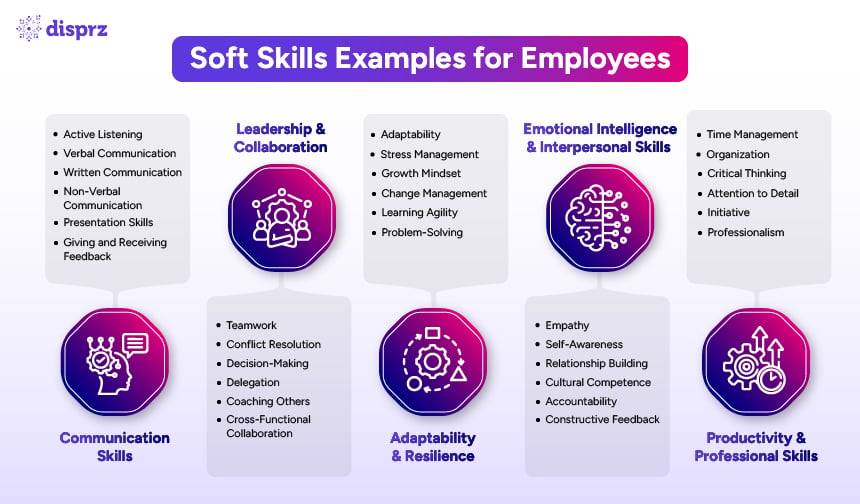
Communication Skills Examples
1) Active Listening
Definition: Paying full attention to understand what others are saying before responding.
Workplace example: A customer support executive listens carefully to a customer's issue before recommending a solution.
How to train this: Practice paraphrasing key points during meetings and one-on-one conversations.
2) Verbal Communication
Definition: Sharing ideas clearly and confidently through spoken communication.
Workplace example: A sales representative explains product benefits to a prospective customer during a demo call.
How to train this: Encourage regular presentations, discussions, and team meetings.
3) Written Communication
Definition: Communicating information clearly through emails, reports, messages, and documents.
Workplace example: A project manager sends a concise project update that all stakeholders can easily understand.
How to train this: Use writing exercises and feedback-based communication workshops.
4) Non-Verbal Communication
Definition: Using body language, facial expressions, and tone to support communication.
Workplace example: A manager maintains eye contact and positive body language during a performance review discussion.
How to train this: Record presentations and review body language and speaking style.
5) Presentation Skills
Definition: Delivering information in a clear, engaging, and structured manner.
Workplace example: A marketing executive presents campaign results to senior leadership.
How to train this: Provide opportunities for employees to present in meetings and training sessions.
6) Giving and Receiving Feedback
Definition: Sharing constructive feedback and accepting feedback professionally.
Workplace example: A team lead provides actionable suggestions to improve a team member's performance.
How to train this: Incorporate peer reviews and structured feedback sessions into daily work.
Leadership & Collaboration Skills Examples
7) Teamwork
Definition: Working effectively with others to achieve shared goals.
Workplace example: A product, engineering, and marketing team work together to launch a new feature on schedule.
How to train this: Use group projects, collaborative learning activities, and cross-team assignments.
8) Conflict Resolution
Definition: Managing disagreements constructively and finding mutually beneficial solutions.
Workplace example: A team leader helps two employees resolve a disagreement about project priorities without affecting delivery timelines.
How to train this: Conduct role-play exercises based on common workplace conflicts.
9) Decision-Making
Definition: Evaluating information and choosing the best course of action.
Workplace example: A store manager decides how to allocate staff during peak business hours to improve customer service.
How to train this: Use case studies and scenario-based learning exercises.
10) Delegation
Definition: Assigning tasks to the right people while maintaining accountability.
Workplace example: A department head delegates reporting tasks to team members so they can focus on strategic planning.
How to train this: Teach workload planning and responsibility-sharing techniques.
11) Coaching Others
Definition: Helping colleagues improve skills, performance, and confidence.
Workplace example: A senior sales executive mentors a new hire on handling customer objections.
How to train this: Introduce peer coaching programs and manager-led development conversations.
12) Cross-Functional Collaboration
Definition: Working effectively with people from different teams and departments.
Workplace example: HR, finance, and operations teams collaborate to implement a new employee onboarding process.
How to train this: Create cross-functional projects that require employees to solve problems together.
Strong leadership and collaboration skills help employees build trust, improve team performance, and contribute more effectively to organizational goals. These examples of soft skills at work are especially valuable as organizations become more connected, agile, and team-driven.
Adaptability & Resilience Skills
13) Adaptability
Definition: Adjusting quickly to new situations, priorities, and ways of working.
Workplace example: A customer service agent successfully adapts to a new CRM system without disrupting customer support.
How to train this: Expose employees to new projects, tools, and responsibilities regularly.
14) Stress Management
Definition: Staying productive and composed during pressure-filled situations.
Workplace example: An operations manager remains calm and organized while handling unexpected supply chain disruptions.
How to train this: Provide training on prioritization, workload management, and resilience techniques.
15) Growth Mindset
Definition: Believing that skills and abilities can improve through learning and effort.
Workplace example: A software engineer actively seeks feedback and learns new technologies to improve performance.
How to train this: Encourage continuous learning and celebrate progress rather than perfection.
16) Change Management
Definition: Supporting and adapting to organizational changes effectively.
Workplace example: An employee helps colleagues transition smoothly during a company-wide process transformation.
How to train this: Use change-readiness workshops and real-world transformation projects.
17) Learning Agility
Definition: Quickly learning new skills and applying knowledge in unfamiliar situations.
Workplace example: A marketing specialist learns AI-powered campaign tools and applies them to improve campaign performance.
How to train this: Assign stretch projects that require employees to learn new concepts rapidly.
Explore a detailed guide on learning agility and how to build it across your workforce.
18) Problem-Solving
Definition: Identifying challenges and finding practical solutions.
Workplace example: A warehouse supervisor redesigns inventory processes to reduce shipping delays.
How to train this: Use scenario-based learning, simulations, and problem-solving exercises.
In a workplace shaped by constant technological and business change, adaptability and resilience are among the most important soft skills for employees in 2026. Employees who learn quickly, manage uncertainty, and solve problems effectively are better equipped to succeed in evolving roles and environments.
Emotional Intelligence & Interpersonal Skills
19) Empathy
Definition: Understanding and considering the feelings, perspectives, and needs of others.
Workplace example: A manager adjusts their communication approach after recognizing that a team member is struggling with a heavy workload.
How to train this: Use role-play exercises and customer or employee perspective-taking activities.
20) Self-Awareness
Definition: Understanding your strengths, weaknesses, emotions, and impact on others.
Workplace example: A team leader recognizes that their communication style can appear too direct and makes adjustments to improve team relationships.
How to train this: Encourage reflection exercises, assessments, and regular feedback discussions.
21) Relationship Building
Definition: Creating and maintaining positive professional relationships.
Workplace example: A customer success manager develops strong relationships with clients, leading to higher retention rates.
How to train this: Promote networking opportunities, mentoring, and collaborative projects.
22) Cultural Competence
Definition: Working effectively with people from different backgrounds, cultures, and perspectives.
Workplace example: A global project team successfully collaborates across multiple countries and time zones.
How to train this: Provide diversity, inclusion, and cross-cultural communication learning experiences.
23) Accountability
Definition: Taking ownership of actions, decisions, and outcomes.
Workplace example: A project coordinator openly acknowledges a missed deadline and creates a recovery plan.
How to train this: Set clear expectations and encourage ownership through goal tracking.
24) Constructive Feedback
Definition: Providing feedback that helps others improve while maintaining trust and respect.
Workplace example: A supervisor helps an employee improve presentation skills by offering specific and actionable suggestions.
How to train this: Teach feedback frameworks and practice through peer coaching sessions.
Emotional intelligence is becoming one of the most valuable types of soft skills in modern organizations. Employees who understand themselves, build strong relationships, and work effectively with diverse teams contribute to stronger collaboration, higher engagement, and better business outcomes.
Productivity & Professional Skills
25) Time Management
Definition: Planning and prioritizing work to meet deadlines efficiently.
Workplace example: A project manager organizes tasks across multiple projects and consistently delivers milestones on time.
How to train this: Teach prioritization frameworks, scheduling techniques, and workload planning.
26) Organization
Definition: Managing tasks, information, and resources in a structured manner.
Workplace example: An HR executive maintains accurate employee records and onboarding documents without delays.
How to train this: Introduce task management tools and workflow planning exercises.
27) Critical Thinking
Definition: Evaluating information objectively to make informed decisions.
Workplace example: A business analyst reviews multiple data sources before recommending a new business strategy.
How to train this: Use case studies, business simulations, and decision-making exercises.
28) Attention to Detail
Definition: Identifying small errors and ensuring accuracy in work.
Workplace example: A finance professional catches reporting errors before financial statements are submitted.
How to train this: Incorporate quality checks, review processes, and accuracy-focused assignments.
29) Initiative
Definition: Taking action without waiting to be instructed.
Workplace example: An employee identifies an inefficient process and proposes a solution that saves time for the entire team.
How to train this: Encourage ownership through stretch assignments and innovation challenges.
30) Professionalism
Definition: Demonstrating reliability, integrity, respect, and ethical behaviour at work.
Workplace example: A client-facing consultant consistently communicates professionally and follows through on commitments.
How to train this: Reinforce workplace expectations through coaching, mentoring, and real-world examples.
These professional soft skills help employees stay productive, maintain high standards, and contribute positively — pairing them with a strategy to develop employee strengths creates even stronger performance outcomes.
While technical expertise may help employees perform specific tasks, these examples of soft skills at work often determine long-term career growth, leadership potential, and workplace effectiveness.
Soft Skills That AI Cannot Replace in 2026
AI can analyze data, generate content, and automate workflows. However, many human-centered skills still require emotional understanding, context, judgement, and trust.
These capabilities remain difficult to replicate with technology and will continue to be highly valued across industries.
1. Empathy
Empathy allows employees to understand the emotions, concerns, and perspectives of others. Whether supporting a customer, leading a team, or managing change, empathy helps build trust and stronger relationships. AI can recognize patterns in language, but it cannot genuinely understand human experiences in the way people can. This makes empathy one of the most valuable soft skills in the workplace.
2. Conflict Resolution
Workplace disagreements often involve emotions, competing priorities, and complex interpersonal dynamics. Resolving these situations requires active listening, negotiation, and human judgement. While AI may suggest possible solutions, employees and leaders must ultimately navigate conversations, build consensus, and restore trust between individuals and teams.
3. Cultural Competence
Global organizations depend on employees who can work effectively across cultures, backgrounds, and perspectives. Cultural competence requires awareness, sensitivity, and adaptability in human interactions. AI can provide information about cultural norms, but successful collaboration still depends on people building understanding and meaningful connections with one another.
4. Ethical Judgement
Business decisions often involve ethical considerations that extend beyond data and rules. Employees must weigh risks, values, fairness, and long-term consequences when making decisions. AI can provide recommendations, but human judgement remains essential for determining what is responsible, appropriate, and aligned with organizational values.
5. Creative Problem-Solving
AI can generate ideas based on existing information, but breakthrough solutions often come from human creativity, curiosity, and experience. Employees who can connect unrelated concepts, challenge assumptions, and develop innovative approaches will continue to create value in a rapidly changing business environment.
6. Coaching and Mentoring
Effective coaching involves trust, encouragement, emotional support, and personalized guidance. Great coaches help employees grow by understanding individual motivations and challenges. While AI can provide learning recommendations, meaningful development conversations and mentorship relationships remain deeply human experiences.
As AI becomes a larger part of everyday work, organizations will place even greater emphasis on these uniquely human capabilities. Investing in soft skills training helps employees strengthen the skills that technology complements rather than replaces.
Soft Skills Employers Look for Most in 2026
As organizations adopt AI, automation, and new ways of working, hiring managers are placing greater emphasis on human-centered capabilities. The following soft skills examples for employees consistently rank among the most sought-after skills across industries.
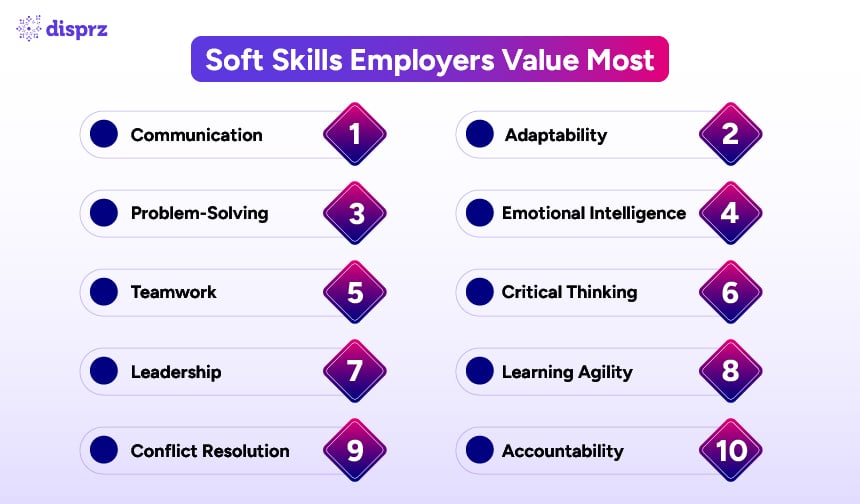
1. Communication
Employees who communicate clearly can collaborate better, reduce misunderstandings, and improve productivity.
Why this matters for L&D: Communication skills should be embedded into leadership, onboarding, customer-facing, and team collaboration programmes.
2. Adaptability
Organizations need employees who can adjust quickly to changing technologies, priorities, and business needs.
Why this matters for L&D: Learning programmes should help employees build confidence in navigating change and uncertainty.
3. Problem-Solving
Employers value people who can identify challenges, evaluate options, and implement effective solutions.
Why this matters for L&D: Scenario-based learning and real-world business simulations can strengthen problem-solving capabilities.
4. Emotional Intelligence
Employees with high emotional intelligence build stronger relationships and contribute to healthier workplace cultures.
Why this matters for L&D: Coaching, feedback, and self-awareness programmes should be part of every development strategy.
5. Teamwork
Cross-functional collaboration has become essential in modern organizations.
Why this matters for L&D: Learning experiences should encourage collaboration across teams, functions, and geographies.
6. Critical Thinking
Employers need employees who can evaluate information carefully and make sound decisions.
Why this matters for L&D: Learning programmes should challenge employees to analyze situations rather than simply memorize information.
7. Leadership
Leadership is no longer limited to managers. Organizations expect employees at all levels to take ownership and influence outcomes.
Why this matters for L&D: Leadership development should begin early and extend beyond formal management roles.
8. Learning Agility
The ability to learn new skills quickly is becoming a competitive advantage.
Why this matters for L&D: Continuous learning pathways help employees stay relevant as job requirements evolve.
9. Conflict Resolution
Healthy teams depend on employees who can handle disagreements professionally and constructively.
Why this matters for L&D: Role-play exercises and coaching can help employees navigate difficult conversations effectively.
10. Accountability
Employers want individuals who take ownership of results and follow through on commitments.
Why this matters for L&D: Development programmes should reinforce responsibility, ownership, and goal achievement.
While every organization has unique talent needs, these important soft skills for employees in 2026 consistently appear at the top of employer surveys and workforce reports. Organizations that develop these capabilities across their workforce will be better positioned to improve performance, strengthen culture, and adapt to future business challenges.
How to Assess Soft Skills Gaps Across Your Workforce
Before launching any soft skills training initiative, you need to understand where the gaps exist. Many organizations invest in learning programmes without knowing which skills employees actually need. A structured assessment process helps you focus learning efforts where they will have the greatest impact.
1. Skills Assessments
Use competency assessments, including AI-powered skill gap analysis, to evaluate employee proficiency across key soft skills such as communication, leadership, adaptability, and problem-solving. These assessments provide a baseline for measuring future improvement.
2. 360-Degree Feedback
Collect feedback from managers, peers, direct reports, and other stakeholders. This approach provides a more complete view of how employees demonstrate soft skills in real workplace situations.
3. Manager Observation
Managers interact with employees daily and can identify strengths and development areas that formal assessments may miss. Regular observation and coaching conversations can uncover important soft skills gaps.
4. Performance Data
Performance reviews, customer satisfaction scores, project outcomes, employee engagement data, and retention metrics often reveal underlying soft skills challenges. For example, recurring collaboration issues may indicate a need for teamwork or communication development.
5. LMS and Learning Analytics
Modern learning platforms can provide valuable insights into learner engagement, skill progression, assessment results, and training completion patterns. These analytics help learning leaders identify workforce-wide development needs and track improvement over time.
The most effective organizations combine multiple assessment methods rather than relying on a single source of data. By understanding current capability levels, L&D teams can build targeted learning programmes that address real business needs and deliver measurable results. This creates a stronger foundation for developing professional soft skills across the organization and preparing employees for future workforce demands.
How to Build a Soft Skills Training Programme for Your Employees
Building effective soft skills training requires more than simply assigning courses — it starts with a strong capability building model that aligns learning with business goals, employee needs, and measurable outcomes. Here is a five-step framework to create a scalable and impactful programme.
Step 1: Identify Skills Gaps
Start by assessing current workforce capabilities. Use skills assessments, 360-degree feedback, manager observations, performance reviews, and learning analytics to identify the most important development areas. Focus on skills that directly support business priorities.
Step 2: Define Clear Learning Outcomes
Establish specific goals for each programme. For example, you may want managers to improve coaching conversations, sales teams to strengthen communication skills, or frontline employees to enhance customer interactions. Clear outcomes make it easier to measure success.
Step 3: Choose the Right Delivery Methods
Different soft skills require different learning approaches. Combine methods such as microlearning, scenario-based learning, role-play exercises, peer learning, manager coaching, and instructor-led sessions to create engaging learning experiences.
Step 4: Deploy Training Through an LMS
A modern learning platform helps you deliver learning at scale, personalize development journeys, track progress, and provide continuous reinforcement. Employees can access learning when and where they need it, making skill development part of everyday work.
Step 5: Measure Impact and Continuously Improve
Track learning completion, assessment scores, behavioural changes, manager feedback, employee engagement, and business performance metrics. Use these insights to refine programmes and ensure long-term effectiveness.
Soft skills development is not a one-time event — it thrives inside a continuous learning culture that reinforces practice and feedback every day. Organizations that invest in structured, ongoing development programmes are more likely to build adaptable, collaborative, and high-performing teams.
Scale Soft Skills Development with Disprz
Disprz helps organizations deliver personalized soft skills training across the workforce through AI-powered learning journeys, skill assessments, coaching workflows, mobile learning, analytics, and continuous capability development. Whether you are developing future leaders, strengthening communication skills, or improving workforce adaptability, Disprz enables learning teams to drive measurable skill growth at scale.
See how Disprz can help you build, deliver, and measure impactful soft skills training programmes across your organization.
Best Methods for Delivering Soft Skills Training
The most effective soft skills training programmes go beyond traditional classroom sessions. Employees develop soft skills through practice, feedback, and real-world application. A blended learning approach often delivers the best results.
Scenario-Based Learning
Employees learn by applying skills in realistic workplace situations. This method helps learners practice decision-making, communication, leadership, and problem-solving in a safe environment.
Role-Play Exercises
Role-play allows employees to practice conversations and workplace interactions before facing them in real situations. It is especially effective for communication, conflict resolution, coaching, and customer service skills.
Microlearning
Microlearning supports continuous development without disrupting daily work schedules. Short, focused learning modules make it easier for employees to learn and retain new skills.
Peer Learning
Employees often learn best from colleagues who face similar challenges. Peer discussions, collaborative projects, and knowledge-sharing sessions encourage practical learning and stronger workplace relationships.
Manager Coaching
Managers play a critical role in reinforcing learning. Regular coaching conversations help employees apply new skills, receive feedback, and improve performance over time.
No single method can develop all types of soft skills. Organizations that combine scenario-based learning, role-play, microlearning, peer learning, and coaching create stronger learning experiences and improve long-term skill adoption across the workforce.
Explore the full range of employee training methods that work best for skill-based development.
Key Takeaways
- Soft skills are becoming the primary differentiator as AI automates more technical and routine work.
- Communication, adaptability, emotional intelligence, and problem-solving rank among the most valuable workplace skills.
- Organizations should assess workforce skill gaps before designing targeted soft skills training programmes.
- Effective soft skills development requires practice, feedback, coaching, and continuous learning reinforcement.
- Modern learning platforms help deliver, measure, and scale soft skills training across organizations.
Conclusion
As the workplace continues to evolve, technical expertise alone is no longer enough. Employees also need strong human skills to communicate effectively, collaborate with others, adapt to change, and solve complex challenges. These capabilities help individuals succeed in their current roles while preparing them for future opportunities.
The 30 soft skills examples covered in this guide highlight the skills that organizations increasingly value in 2026. From communication and teamwork to emotional intelligence and critical thinking, these skills influence employee performance, leadership potential, customer experiences, and business outcomes.
The good news is that soft skills can be developed. With the right learning strategy, organizations can help employees strengthen these capabilities through continuous practice, coaching, feedback, and personalized learning experiences.
For learning and development leaders, the focus should be on building structured programmes that align skill development with business goals. By assessing workforce needs, delivering targeted learning, and measuring outcomes, organizations can create a more agile, productive, and future-ready workforce.
As AI takes over more routine and technical tasks, human-centered skills will become even more important. Organizations that invest in soft skills training today will be better positioned to improve employee performance, strengthen collaboration, and drive long-term business success.
Frequently Asked Questions About Soft Skills Training
1) What are soft skills? Give examples.
Soft skills are personal and interpersonal abilities that help employees work effectively with others and perform successfully in the workplace. Common soft skills examples include communication, teamwork, adaptability, problem-solving, emotional intelligence, time management, leadership, and conflict resolution. These skills influence how people interact, collaborate, and contribute at work.
2) What is the difference between soft skills and hard skills?
Soft skills relate to how employees work and interact with others, while hard skills refer to technical knowledge and job-specific expertise. For example, communication and teamwork are soft skills, whereas coding and financial analysis are hard skills. Both are important, but soft skills often determine long-term career success.
3) What soft skills are most important for employees in 2026?
Some of the most important soft skills for employees in 2026 include communication, adaptability, emotional intelligence, problem-solving, critical thinking, teamwork, leadership, learning agility, and accountability. These skills help employees succeed in AI-enabled workplaces where human capabilities remain a key competitive advantage.
4) Which soft skills cannot be replaced by AI?
While AI can automate many tasks, skills such as empathy, conflict resolution, cultural competence, ethical judgement, coaching, and creative problem-solving remain difficult to replicate. These human-centered capabilities require emotional understanding, trust, contextual awareness, and interpersonal connection that technology cannot fully replace.
5) Can soft skills be taught or trained?
Yes. Soft skills can be developed through structured learning programmes, coaching, mentoring, practice, feedback, and real-world experience. Effective soft skills training combines learning content with opportunities for employees to apply new behaviours and receive continuous reinforcement over time.
6) How do you measure soft skills development in employees?
Organizations can measure soft skills development using skills assessments, 360-degree feedback, manager evaluations, performance reviews, employee engagement data, customer feedback, and learning analytics. Tracking behaviour changes and business outcomes helps determine whether training programmes are delivering measurable improvements.