

On this page
Soft skills are personal and interpersonal abilities that help employees work effectively with others, adapt to change, and contribute positively to the workplace.
TL;DR
- Soft skills training for employees develops the interpersonal and behavioral abilities they need to communicate, collaborate, adapt, and lead effectively
- 92% of employers now consider soft skills as critical as, or more important than, technical skills during hiring decisions
- The most in-demand soft skills in 2027: communication, adaptability, emotional intelligence, problem-solving, and critical thinking
- Generic, one-size-fits-all programs rarely change behavior. Effective soft skills training programs for employees require role-specific content, practice-based delivery, and continuous reinforcement
- Recommended reading: The State of Workplace Learning Report 2026, based on data from 500+ organizations, surfaces the engagement patterns and behavior shifts that shape effective workforce training
Introduction: Why Soft Skills Training Has Become a Business Priority
Soft skills training for employees has become one of the most important investments an enterprise can make in workforce performance. A survey by LinkedIn found that 92% of talent professionals and hiring managers agree soft skills matter as much as, or more than, hard skills. That number has been climbing steadily for three years.
The reason is straightforward. Technical expertise gets someone hired. But the ability to communicate clearly during a client escalation, adapt when a project scope changes overnight, or give feedback that actually improves a direct report's performance: those are the capabilities that determine whether someone delivers business results or just completes tasks.
For L&D managers, this shift creates a practical challenge. Most soft skills training programs for employees were built around generic communication or teamwork modules, assigned to everyone, measured by completion. That approach doesn't change behavior, and it doesn't connect to the outcomes leadership cares about.
This guide covers what soft skills training actually involves, which skills matter most in 2027, how to structure effective programs, and what delivery methods produce measurable change. If you are responsible for training employees at scale, whether in banking, insurance, retail, manufacturing, or IT services, this is the practical framework to work from.
What Is Soft Skills Training for Employees?
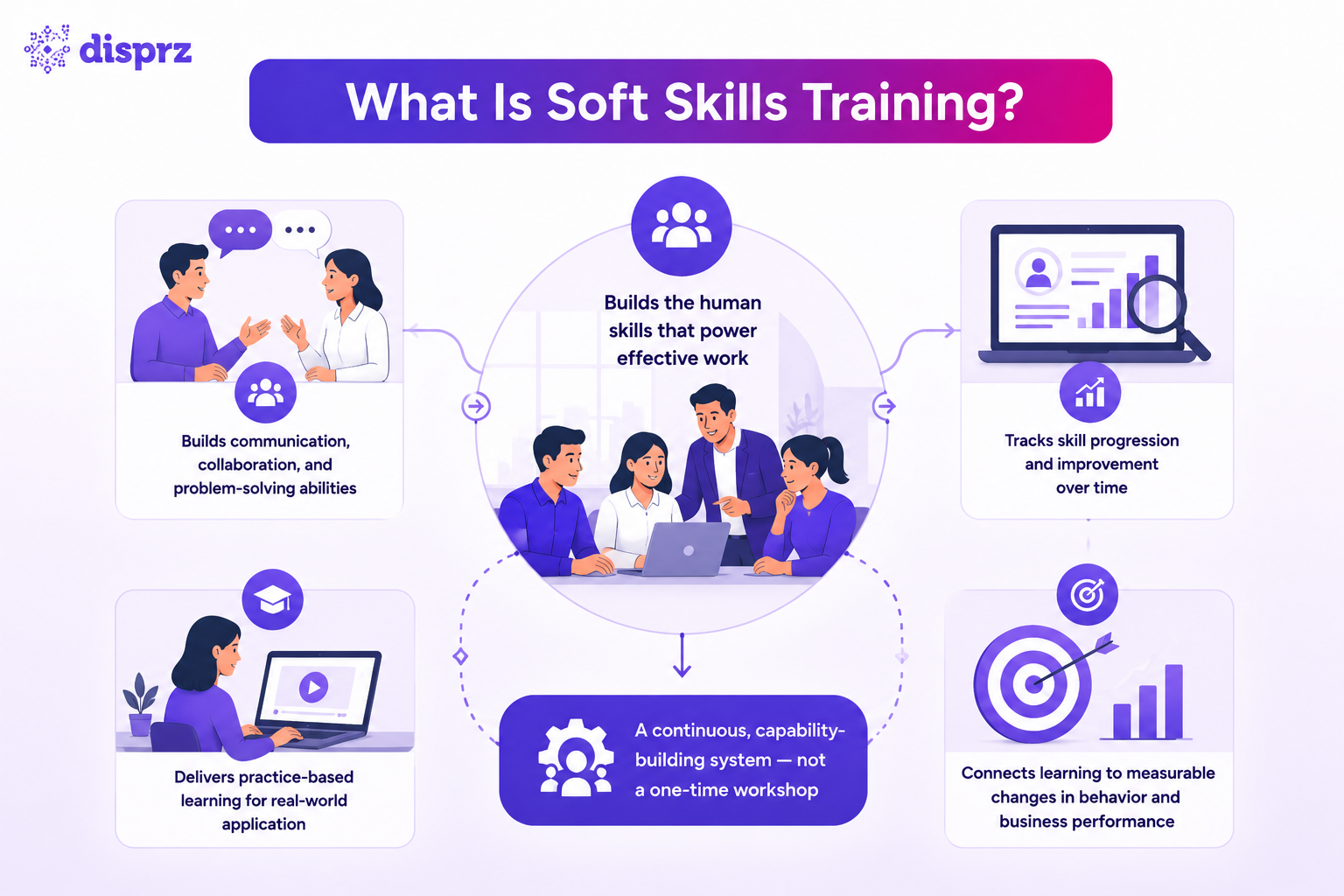
For any professional: Soft skills training builds the communication, collaboration, and problem-solving abilities that determine how effectively someone works with others. Technical training teaches what to do. Soft skills training teaches how to do it well.
For L&D managers: Soft skills training is a structured program that maps behavioral competencies to roles, delivers practice-based learning, and tracks skill progression over time. It connects learning to measurable changes in employee behavior and business performance, not just course completion.
The difference between programs that work and programs that get ignored usually comes down to this: treating soft skills as a capability-building system rather than a one-time workshop.
Why Soft Skills Matter More in 2027
Three forces are pushing soft skills from "nice to have" to business-critical.
1. AI is absorbing routine technical work.
- A Deloitte study projects that most work by 2030 will require strong interpersonal abilities as AI handles more analytical and process-driven tasks
- Employees who combine technical skill with communication, problem-solving, and emotional intelligence are the ones organizations invest in retaining.
2. Soft skills directly impact financial performance.
- Researchers at Harvard, Boston University, and the University of Michigan found that employees with soft skills training are 12% more productive, translating to a 256% ROI within eight months.
- That ROI shows up in reduced turnover, faster onboarding, better customer satisfaction, and fewer escalations.
3. Employers are already hiring for soft skills.
- 84% of employees and managers believe new hires must demonstrate soft skills during the hiring process.
- If hiring teams screen for communication and adaptability at the door, the training function needs to develop and reinforce those skills once people are inside.
For organizations in India, Southeast Asia, and the Middle East, these trends hit harder: rapid digital transformation, large distributed workforces, and high frontline turnover mean generic training doesn't scale, and the cost of weak soft skills (poor customer experience, slow onboarding, inconsistent service) is immediate.
Types of Soft Skills: A Functional Framework
Most content on this topic lists individual skills without much structure. That makes it harder to decide what to prioritize and how to train each one. A more useful approach is to categorize soft skills by function, since each category responds to different training methods.
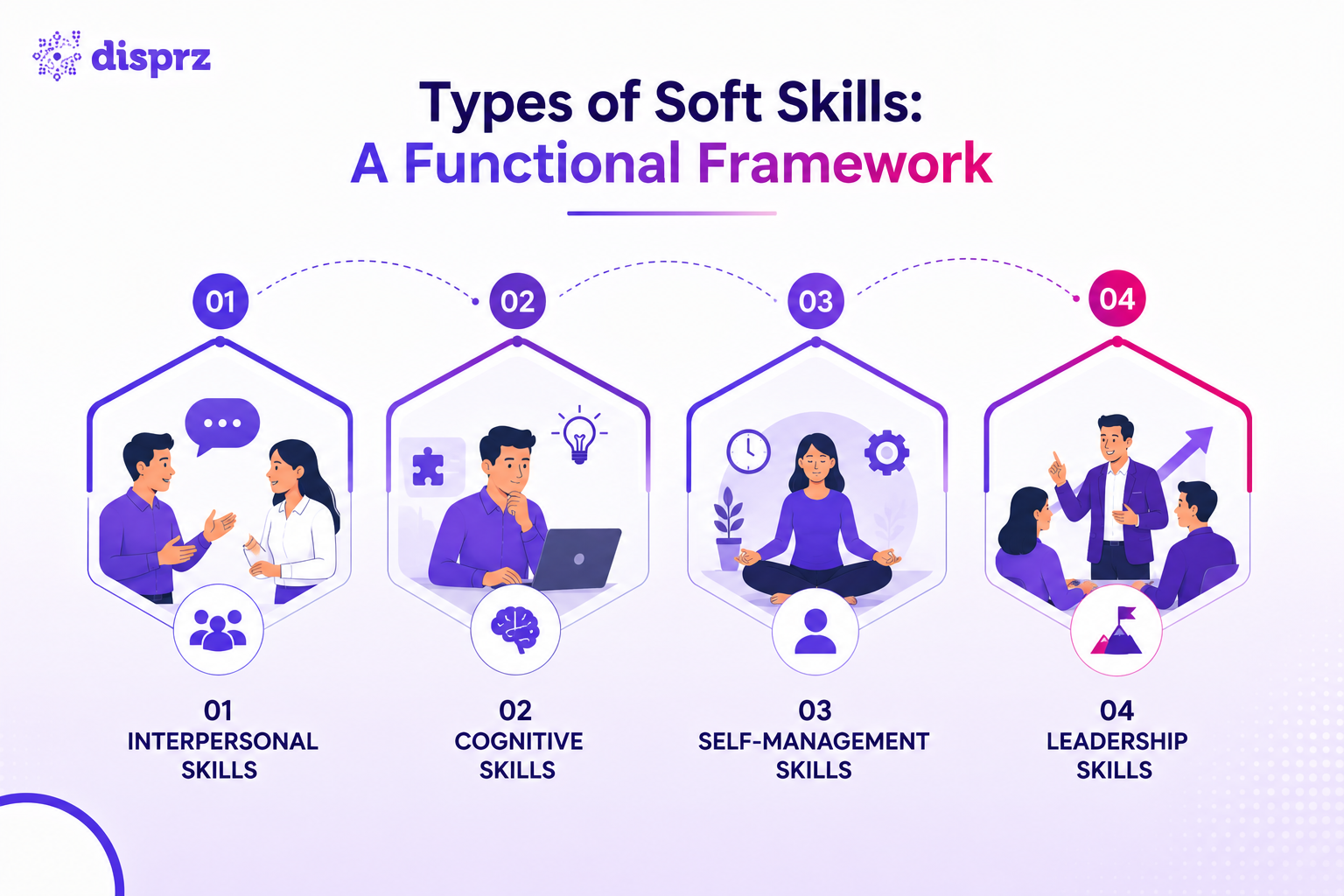
1. Interpersonal Skills
These govern how employees interact with others: communication, active listening, empathy, conflict resolution, and relationship building.
Communication consistently ranks as the most important soft skill across industries. In banking and insurance, clear communication during a claims process or loan discussion can directly affect customer retention. In retail, it determines whether a floor interaction ends in a sale or a complaint.
How to train: Role-play exercises, scenario-based simulations, peer feedback sessions, and coaching conversations. Interpersonal skills improve through practice and immediate feedback, not through reading or watching.
2. Cognitive Skills
These govern how employees think and decide: critical thinking, problem-solving, decision-making, and attention to detail.
According to data from MuchSkills, problem-solving was the single most frequently cited soft skill among 100,000+ professionals surveyed in 2026. Critical thinking ranked seventh, reinforcing its growing relevance in workplaces where decisions are increasingly shaped by data and algorithms.
How to train: Case studies, business simulations, structured problem-solving exercises, and scenario-based learning where employees must evaluate options and justify decisions.
3. Self-Management Skills
These govern how employees manage themselves: time management, adaptability, stress management, accountability, and a growth mindset.
Adaptability is particularly critical in fast-changing markets. Employees who adjust quickly to new systems (a CRM rollout, a process change, a new compliance requirement) reduce the drag on team productivity during transitions.
How to train: Coaching and reflection exercises, goal-setting frameworks, workload planning tools, and stretch assignments that push employees into unfamiliar territory.
4. Leadership Skills
These govern how employees influence and guide others: delegation, coaching, giving and receiving feedback, and decision-making under ambiguity.
70% of organizational change efforts fail due to a lack of soft skills among leaders, according to workforce development research. Leadership training, particularly for first-time managers who often get promoted for technical skill rather than people management ability, directly addresses this gap.
How to train: Mentorship programs, manager coaching workshops, real-world leadership assignments, and continuous 360-degree feedback loops.
Which Soft Skills Matter Most in Your Industry?
Generic soft skills lists don't help L&D managers decide what to prioritize. The skills that move the needle depend on the industry, the role, and how the team actually works.
1. BFSI
The problem: 24% attrition rate across India's financial services sector, highest of any industry. Most churn happens in relationship management and sales roles.
The soft skills that reduce it:
- Trust-building in first-time client conversations
- Objection handling during loan rejections and claims denials
- Compliance-safe communication
- Consultative selling, not transactional pitches
2. Retail and Frontline
The problem: 60-80% annual turnover. Each departure costs $5,000-$10,000 in hiring, onboarding, and lost productivity.
The soft skills that reduce it:
- Customer de-escalation during complaints and returns
- In-the-moment upselling
- Shift-based teamwork under time pressure
- Consistent service across every location
3. Manufacturing
The problem: Safety incidents and production delays tied to miscommunication across shifts and languages.
The soft skills that reduce it:
- Safety communication and handover clarity
- Team coordination under production pressure
- Behavior consistency across locations
4. IT and Services
The problem: Client dissatisfaction and project delays caused by unclear communication and poor stakeholder management.
The soft skills that reduce it:
- Client-facing communication
- Cross-functional collaboration
- Problem-solving in ambiguous situations
For 30 specific skills with workplace examples and training methods, this guide to soft skills examples for employees covers that in detail.
How Should You Deliver Soft Skills Training?
63% of individuals who received soft skills training reported improved job performance. But that improvement depends entirely on how the training is delivered.
Scenario-based learning and role-play
- Employees practice real situations: handling a difficult customer, giving feedback, presenting to leadership
- Best method for interpersonal and conflict-resolution skills
- Works because soft skills are built through repetition, not reading
Microlearning
- Short modules (3 to 7 minutes) that fit between tasks, not blocked-off hour-long sessions
- Essential for frontline and distributed teams with no desk access
- Mobile-first, offline-capable formats reach shift workers where they actually work
Manager and peer coaching
- Ongoing feedback from people employees interact with daily
- Reinforces behavior change far more effectively than course completion alone
- 360-degree feedback and manager observation make this systematic, not informal
AI-powered role-play and simulations
- Employees practice conversations (sales objections, customer escalations) with immediate AI-driven feedback
- Turns soft skills practice from a scheduled event into an on-demand capability
- Removes the dependency on a trainer being available every time someone needs to practice
Continuous reinforcement
- Embed soft skills into performance conversations, team routines, and learning analytics
- Organizations with strong soft skills development report 35% higher employee retention
- That retention only holds when reinforcement is ongoing, not a one-time event
Why combining methods matters
No single format changes behavior alone. Programs that blend practice, feedback, and reinforcement consistently outperform those that rely on static e-learning or isolated workshops.
What Are the Business Benefits of Soft Skills Training?
When soft skills training programs are built and delivered well, the impact shows up in specific, measurable places.
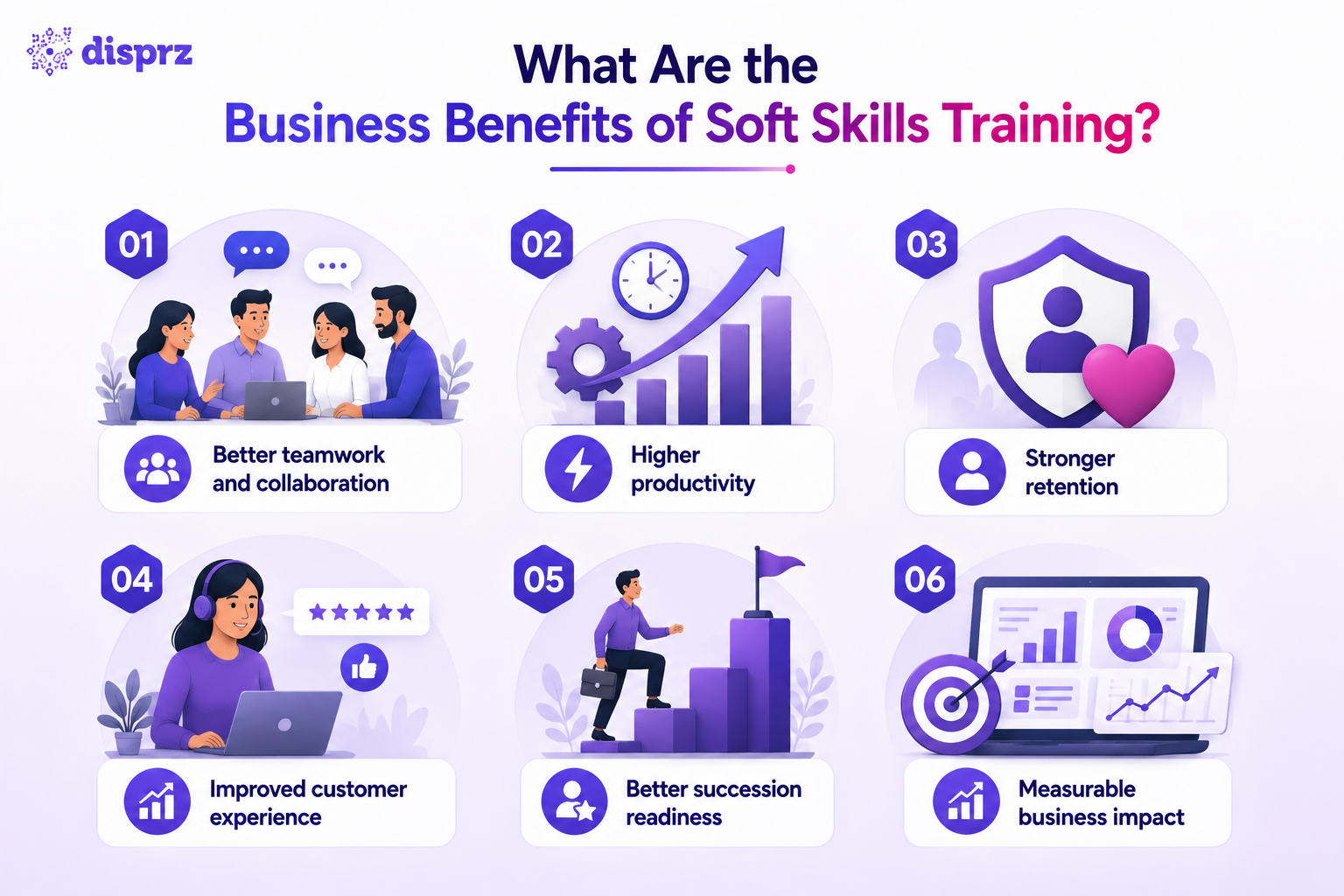
1. Better teamwork and collaboration
- Employees resolve disagreements faster and communicate more clearly across functions.
- Directly reduces coordination overhead in distributed teams across multiple regions.
2. Higher productivity
- Poor communication alone costs large organizations an average of $62.4 million per year.
- Clearer communication, better time management, and stronger problem-solving reduce the rework that quietly drains output.
3. Stronger retention
- Replacing a frontline employee costs roughly 40% of their annual salary in recruiting, onboarding, and lost productivity.
- Employees who feel equipped, supported, and connected to a growth path stay longer.
4. Improved customer experience
- In BFSI and retail, soft skills directly shape NPS, CSAT, and revenue per interaction.
- AIA Insurance saw a 46% increase in sales performance through role-specific onboarding and learning.
5. Better succession readiness
- Leadership soft skills like coaching, delegation, and feedback build a pipeline ready for bigger roles.
- Employees with visibility into their career path and required skills are more likely to grow internally.
6. Measurable business impact
- The gap between "we trained 500 people" and "here's what changed" is where most programs fail.
- Connecting learning investments to retention, customer satisfaction, and sales performance is what turns soft skills training from a cost center into a business case.
How Should L&D Teams Structure a Soft Skills Training Program for Employees?
Most L&D teams know soft skills matter. The challenge is building a program that changes behavior at scale, not just adds another course to the catalog. Here's a five-step framework that works across industries.
Step 1: Map soft skills to roles, not to the org chart
Not every role needs the same skills at the same depth.
- If you manage L&D for a retail chain: your floor associates need de-escalation and upselling. Your store managers need coaching and shift coordination. Same company, different skill maps.
- If you run training for a BFSI team: your relationship managers need trust-building and compliance-safe communication. Your branch managers need feedback and delegation skills.
- If you lead L&D in manufacturing: your shop-floor supervisors need safety communication and handover clarity. Your plant managers need cross-team coordination.
Pick 3 to 5 soft skills per role cluster. More than that dilutes focus.
Step 2: Assess where the real gaps are
Assumptions don't work here. What leadership thinks the gaps are and what the data shows are often different.
- Self-assessment gives you the employee's own view.
- Manager feedback gives you the on-the-ground reality.
- 360-degree feedback surfaces blind spots neither side sees alone.
- Performance data (customer complaints, escalation rates, team attrition) tells you where weak soft skills are already costing the business.
Combine at least two of these. One source alone gives an incomplete picture.
Step 3: Build role-specific learning paths
This is where most programs fail. They assign the same generic course to everyone and call it done.
- For frontline teams: mobile-first, short-format modules that fit into a shift.
- For sales and client-facing roles: scenario-based practice with real objection-handling situations.
- For new managers: coaching workshops paired with ongoing peer feedback.
- For distributed teams: content available offline, in local languages, accessible without desk access.
The learning path should match how the team actually works, not how the L&D team wishes they worked.
Step 4: Deliver through practice, not just content
Reading about communication doesn't make someone a better communicator. Practice does.
- Role-play and scenario simulations for interpersonal skills.
- AI-powered conversation practice for sales and customer-facing teams.
- Manager coaching conversations built into weekly routines, not quarterly reviews.
- Peer feedback loops where colleagues reinforce what formal training introduces.
The goal is repeated practice with feedback, not one-time content consumption.
Step 5: Measure what actually changed
Completion rates tell you who clicked through. They don't tell you what has improved.
- Track skill progression over time through assessments, not just course completion.
- Connect learning data to business metrics: customer satisfaction, retention, sales performance, time-to-productivity.
- Report to leadership in their language: "onboarding time dropped by 3 weeks" matters more than "450 employees completed the module".
If you can't connect the training to a business number, the program will lose budget in the next review cycle. That's not a guess. That's what happens in most organizations where L&D can't show ROI.
What Benchmarks Should You Check Before You Start?
The State of Workplace Learning Report 2026, based on data from 500+ organizations, surfaces the engagement patterns and maturity benchmarks that separate high-performing L&D functions from the rest. Worth reading before building or restructuring a program.
Conclusion
Soft skills training for employees is no longer a soft investment. When it is mapped to roles, delivered through practice, and measured against business outcomes, it changes behavior in the places that matter most: customer conversations, team coordination, and manager effectiveness. The organizations that treat it as a capability-building system rather than a one-time workshop are the ones that see the retention, productivity, and customer-experience gains the data points to. Start with one role cluster, prove the impact, then scale.
Frequently Asked Questions
1. What is soft skills training for employees?
Soft skills training helps employees build abilities like communication, adaptability, and problem-solving that help teams collaborate better and win at work.
2. Why is soft skills training important in 2027?
Soft skills training is important because AI is automating routine tasks. This process makes human skills like judgment, empathy, and adaptability the key differentiators that help employees and organizations win in hiring and performance.
3. What are the most important soft skills for employees?
Communication, emotional intelligence, adaptability, problem-solving, and critical thinking. These terms describe the human abilities that help teams perform better across industries.
4. How do you deliver effective online soft skills training for employees?
The most effective process is to combine multiple methods: scenario-based learning, role-play, microlearning, AI-powered simulations, and manager coaching. This approach helps employees practice real situations rather than just consume static e-learning content.
5. What is the ROI of soft skills training programs?
Structured soft skills training helps organizations achieve up to 256% ROI. This return comes from reduced turnover, faster onboarding, and improved customer experience, which are the outcomes that help L&D teams win budget approval from leadership.
3. Which soft skills matter most for bank employees?
Trust-building, objection handling, compliance-safe communication, and consultative sales skills are the most business-critical soft skills for BFSI teams specifically.
4. How do you measure soft skills training effectiveness?
Track skill progression through assessments and 360-degree feedback, then connect development data to business metrics like retention, customer satisfaction, and sales performance.
About the authors

Madhu Karunakaran
Vice President - People & Culture
Madhu Karunakaran is a senior HR and Learning & Development (L&D) leader with 20+ years of experience spanning people strategy, organizational development (OD), talent management, leadershi...
Reviewed for accuracy on 14 Sep 2026