
On this page
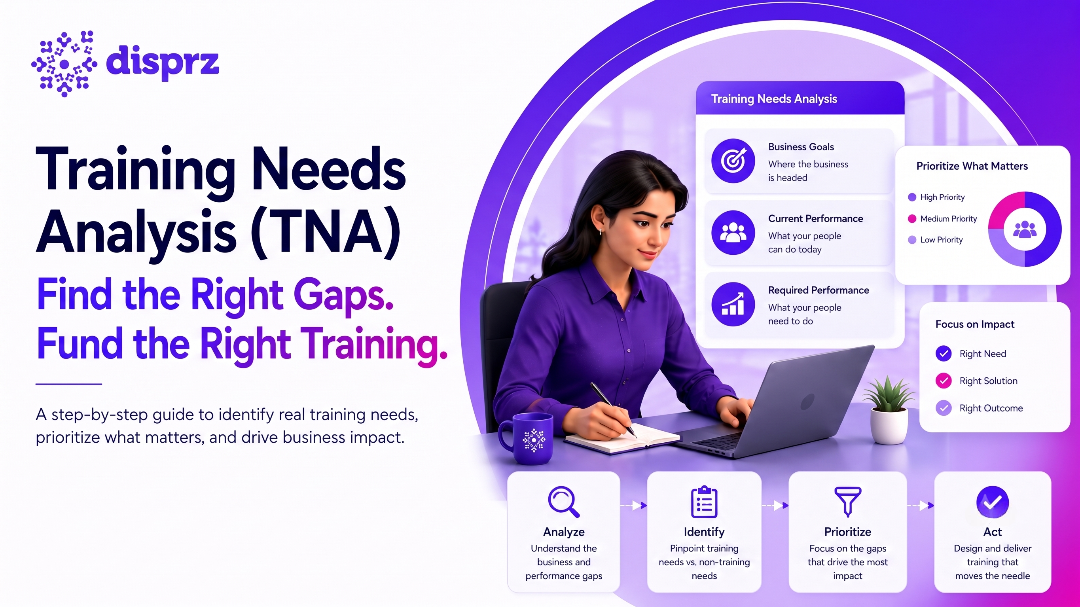
A training needs analysis is how you find out what your people cannot do yet that the business needs them to do. The way it works is straightforward enough: look at where the business is heading, what each role actually demands, and where people stand today. What makes it worth doing is the step most teams skip, deciding which of those gaps training can genuinely close and which ones need a different fix altogether.
- A training needs analysis decides two things: whether training is the right fix, and which gaps are worth funding. Most TNAs skip the first question and go straight to the second.
- Four questions separate a real training need from something else wearing its clothes: do they know what good looks like, could they do it under pressure, does the environment allow it, and does the reward structure point the right way.
- Three levels: organisational, task, individual. Skipping the organisational level is why so many TNAs produce a training list nobody funds.
- A usable sample TNA sits further down, six questions and a scoring matrix, ready to copy.
- The enterprise problem is not method, it is speed. A TNA that takes a quarter describes a workforce that has already moved on.
- Written for L&D leaders at 500+ employee organisations who have to cover every department and cannot spend six months doing it.
Every L&D leader has run the version of this that does not work.
A request goes out to department heads asking what training their teams need. Twelve replies come back. Sales wants negotiation training. Operations wants Excel. Someone in finance asks for a leadership programme for a person who was passed over for promotion. The list gets costed, half of it gets cut for budget, and the surviving half gets delivered to people whose actual problem was a broken handover process.
That is not a training needs analysis. It is a wish list with a spreadsheet attached.
A real TNA is harder and considerably more useful, because it starts one step earlier: with the business result you are trying to move, and with an honest question about whether training is what stands between you and it.
What is a training needs analysis (TNA)?
Simple. A training needs analysis is a structured way of finding the gap between what your workforce can do now and what the business needs it to do, then deciding which parts of that gap training can actually close.
The second half of that definition is where most TNAs fall over. A gap between current and required performance can come from missing skills, but it can equally come from unclear expectations, bad tooling, a process with a hole in it, or a pay structure that rewards the wrong behaviour. Training fixes exactly one of those.
Getting this right changes what you spend. Every gap you correctly diagnose as a process problem is budget you do not waste on a course that was never going to work, and credibility you keep with the business leader who would have watched it fail.
Training needs analysis or training needs assessment? The two terms are used interchangeably in practice. Analysis is the more common term in enterprise L&D and in academic literature. Assessment shows up more often in public sector and compliance contexts. There is no meaningful difference in method.
Why do you need a training needs analysis before you fund any training?
Because the alternative is funding whatever the loudest department asked for, and because the cost of getting it wrong has gone up.
Skills are moving faster than training calendars. The World Economic Forum expects 39% of workers' core skills to change by 2030, and 63% of employers now name skill gaps as the main barrier to transforming their business. Josh Bersin's 2026 research puts the internal picture more bluntly: 74% of companies say they are not keeping up with their own demand for new skills.
The number that should worry an L&D leader most is a quieter one from the same WEF report. Out of every 100 workers, 11 will need training by 2030 and will not receive it. Not because the training does not exist. Because nobody identified them.
That is a needs analysis failure, and it is invisible on every dashboard you currently look at.
There is a second reason, and it is political. LinkedIn's Workplace Learning Report found 49% of L&D professionals report their executives are worried that employees do not have the right skills to execute business strategy. A TNA that starts from business strategy gives you the one thing that conversation needs: a defensible answer to what you are doing about it.
Market. Most enterprise L&D functions already run something they call a TNA. It is usually an annual request for input from department heads, collated into a training calendar. That process is not wrong so much as inverted. It collects opinions about solutions before anyone has diagnosed the problem, which guarantees the output is a list of courses rather than a list of business gaps. The functions that get taken seriously by their CFO run it the other way around, and the difference shows up in whether the budget survives the next review.
What are the three levels of a training needs analysis?
Organisational, task and individual. Run them in that order, because each one narrows the next.
| Level | Question it answers | What you look at | What it produces |
|---|---|---|---|
| Organisational | Where does the business need to be stronger for its strategy to work? | Business goals, expansion plans, regulatory change, technology rollouts, attrition and productivity data | A shortlist of capability areas that actually matter this year |
| Task | What does good performance in this role require? | Job descriptions, SOPs, competency frameworks, top-performer behaviour, quality and error data | A defined standard to measure people against |
| Individual | Who is below that standard, and by how much? | Assessments, manager reviews, self-ratings, observation, system usage data | Named people, named gaps, sized |
Most TNAs start at the individual level, because that is the easiest data to collect and the easiest survey to send. The result is a list of gaps with no argument behind them. When a CFO asks why this training matters, "our people rated themselves low on it" is not an answer. "This closes the capability gap behind the 2027 regional expansion" is.
A practical shortcut: If your organisational level is thin, get thirty minutes with two or three business leaders and ask one question: what will your function have to do next year that it cannot do reliably today? That single question produces a better organisational analysis than most formal exercises, and it takes an afternoon.
How do you tell whether training is actually the right fix?
Run the gap through four questions before you cost a single course. If the honest answer to any of the first three is no, training is not your problem.
The four-question test
- Do they know what good looks like? If expectations were never made explicit, this is a management and communication gap. Training will not fix an unstated standard.
- Could they do it if their life depended on it? If someone can perform the task under pressure but does not do it routinely, they have the skill and lack something else: time, tooling, or a reason.
- Does the environment let them? Broken systems, missing access, contradictory SOPs and understaffing all look exactly like a skills gap from a dashboard. They are not.
- Is the reward structure pointing the right way? People do what they are measured on. If the incentive rewards volume and you are training for quality, the training loses.
Only what survives all four is a genuine training need. Everything else is a finding worth reporting, because a TNA that hands a business leader an accurate diagnosis of a process problem earns more trust than one that quietly converts it into a course.
Mistake. The most expensive error in a TNA is accepting the requester's diagnosis. A sales director who says "my team needs negotiation training" has already skipped the analysis and jumped to a solution. The useful reply is not to argue, it is to ask what is happening in deals that should not be happening. Often the answer is that discounting is being approved too easily, which is an authorisation problem wearing a training costume. Ask about the outcome, never about the course.
What methods are used to conduct a TNA?
Five, and the good ones combine at least three. Numbers tell you where something is wrong. Conversations tell you why.
| Method | Data type | Best for | Effort |
|---|---|---|---|
| Performance and KPI analysis | Quantitative | Finding where output is actually breaking, before anyone gives an opinion | Low, the data already exists |
| Stakeholder and manager interviews | Qualitative | Organisational level, and the political buy-in you will need later | High, but the highest value per hour |
| Surveys and self-assessment | Mixed | Reaching everyone, including a distributed frontline | Low to run, easy to over-trust |
| Observation and job shadowing | Qualitative | Finding the workarounds people invented because the SOP was unusable | High, worth it for one or two critical roles |
| Assessments and system data | Quantitative | Establishing a real baseline rather than a self-reported one | Low once set up, and repeatable |
Two cautions from practice.
Self-assessment is the most used method and the least reliable one on its own. People with the weakest grasp of a skill routinely rate themselves highest, and confident self-raters skew a departmental average enough to hide a real gap. Pair every self-rating with either a manager rating or an objective assessment.
Observation is the method everyone skips and the one that finds things no survey ever will. You do not need to shadow everyone. Two days with the two roles that matter most will surface more usable insight than a thousand survey responses.
What does a sample training needs analysis look like?
Here is a working one. Six questions, deliberately short enough that a frontline employee will finish it on a phone between shifts, and a scoring matrix that turns the answers into a funding decision.
The sample TNA questionnaire
Copy these as they are. The wording matters more than it looks, because vague questions produce vague gaps.
- Which part of your job most often takes longer than it should? Open text, one line. Keep it open. A dropdown here would pre-decide the answer you are trying to discover.
- When that happens, what is usually the cause? Single choice. I am not sure how to do it, the process or system gets in the way, I am waiting on someone else, expectations are unclear, or something else. This question does most of the diagnostic work in the whole survey.
- Rate your confidence in the core tasks of your role. Scale of 1 to 5 across four to six named tasks. Name the actual tasks. Never ask about generic communication skills, because nobody can act on the answer.
- What is one thing you were never properly shown how to do? Open text. This question finds more real gaps than the rating scale above it, because people answer it honestly in a way they will not when scoring themselves.
- In the next twelve months, what change is coming that you do not feel ready for? Open text. This is the organisational level asked from the bottom up, and it often surfaces changes L&D had not been told about.
- For managers only. Where does your team fall short of its targets, and what do you believe is behind it? Open text, two parts. Keep the two parts separate, because the gap between what a manager observes and what they attribute it to is often the most useful data in the entire exercise.
The scoring matrix
Score every gap on two axes, then act by quadrant.
| Verdict | High business impact | Low business impact |
|---|---|---|
| Training will close it | Fund now. These are your programme. | Queue it. Useful, not urgent. |
| Training will not close it | Escalate. Hand it to the process or systems owner with evidence. | Log it and move on. |
A worked example
A pharmacy retail chain finds that new store staff take eleven weeks to reach full productivity against a six-week target. Question 2 shows most respondents selecting "I am not sure how to do it", and question 4 repeatedly names the stock return process. Manager responses attribute the delay to staff quality.
The organisational level says onboarding speed is limiting a store expansion plan, so business impact is high. The four-question test confirms staff genuinely do not know the return process rather than being blocked by it. That lands in fund now, and the specific need is a short process module on stock returns, not the general customer service programme the managers asked for.
That is the whole point of a TNA. It replaced a broad, expensive request with a narrow, cheap one that will actually move the number.
How do you run a training needs analysis across every department at once?
In stages, with a fixed deadline, and by refusing to treat every department the same.
The enterprise version of this problem is not conceptual. Every L&D leader running a 500 person organisation knows the three levels and the five methods. The problem is that doing it properly across sales, operations, support, finance, IT and a distributed frontline takes a quarter, and by the time the report lands the organisation it describes has changed.
Four things keep it inside a month.
- Start with data you already hold. Performance dashboards, support ticket categories, quality logs, exit interview themes and compliance expiry reports are all sitting in systems right now. Read those before you send anyone a survey. They will tell you which three departments deserve the deep work, which means the other five get the light version.
- Send one survey, not eight. A single short instrument across the whole organisation, with the role-specific task list in question 3 swapped per function. Eight bespoke departmental surveys cannot be compared to each other, which defeats the purpose of doing this at once.
- Interview eight people, not eighty. Two or three business leaders for the organisational level, and one manager from each of the departments your data flagged. This is the step people over-scope and then abandon.
- Publish a deliberately incomplete report on the date you promised. A TNA that is 80% complete and on time gets funded. One that is comprehensive and two months late gets read by nobody, because the budget conversation already happened without it.
Even done well, the output is a photograph. Skills, roles and priorities keep moving after you file it, and you cannot rerun a quarter-long exercise every quarter. This is the constraint that separates enterprise TNA from the version described in most guides, and it is not solved by running the same process faster.
A TNA that takes a quarter describes a workforce that has already moved on. The fix is not a faster project. It is moving the individual level into a system that is always on.
Why should a training needs analysis run continuously instead of once a year?
Because the individual level of a TNA is the part that goes stale fastest, and it is also the part that can be automated.
The organisational level genuinely is an annual conversation. Business strategy does not change monthly. The task level is stable too, until a role or a system changes. But the individual level, who is below standard and by how much, changes constantly, and re-surveying 500 people to find out is a cost most functions can only carry once a year.
That is where a learning platform with skills intelligence changes the economics rather than just the effort. When roles are mapped to competencies and assessments run inside the platform, the individual level of your TNA stops being a project and becomes a live view. Disprz maps every role to a defined skill framework, scores people against it through self and manager assessment, and surfaces the result as a skill heat map at organisation, department and role level. The gap analysis you used to commission is simply on screen.
Two consequences matter more than the reporting itself.
- The analysis triggers the response. When a gap is identified against a mapped competency, the relevant learning is assigned automatically rather than waiting for the next planning cycle. The distance between finding a need and meeting it collapses from months to the same day.
- You can prove the gap closed. Most TNAs are never revisited, so nobody knows whether the training worked. When the baseline and the reassessment live in the same system, movement in the skill score is the evidence, and it is the version of the story a CFO accepts.
That last point is what separates a TNA that justifies a budget from one that consumes it.
Approved proof points for the stats module: ROSHN attributed 15% annual business growth to their Disprz-powered programme. Headline platform outcomes: 8X training ROI, 50% productivity lift.
None of those numbers come from a better course catalogue. They come from knowing which capability was blocking a business outcome, and being able to show it moved.
Where should L&D leaders start with a training needs analysis?
Start with the data you already have, not with a survey.
Pull the performance numbers, the ticket categories and the attrition themes before you ask anyone anything. They will show you which two or three areas deserve real investigation, and that alone removes most of the scope that makes a TNA take a quarter.
Then ask the business leaders one question about next year. Then run the four-question test on everything you find, and be willing to hand half of it back as a process problem rather than converting it into a course.
The functions that get their budgets approved are not the ones with the most thorough analysis. They are the ones that can name a business outcome, name the capability standing in front of it, and show the number moving afterwards. A TNA is simply the discipline that makes those three things connect.
Frequently Asked Questions
What L&D leaders ask most often about training needs analysis.
What is a training needs analysis?
A training needs analysis identifies the gap between current and required workforce capability. It then decides which parts of that gap training can actually close, working across three levels: organisational, task and individual.
What are the three levels of a training needs analysis?
Organisational, task and individual. Organisational asks where the business needs to be stronger, task defines what good performance in a role requires, and individual identifies who falls short of that standard and by how much.
What is the difference between a training needs analysis and a skills gap analysis?
A TNA decides whether training is the right response and what to fund. A skills gap analysis identifies which specific skills are missing. The gap analysis is one method used inside a TNA, not a replacement for it.
How do you conduct a training needs analysis?
Define the business outcome, gather existing performance data, interview stakeholders, then survey employees. Test every gap you find to confirm it is genuinely a training problem. Combining at least three methods gives a far more reliable picture than any single one.
What should a training needs analysis questionnaire include?
Six questions or fewer, focused on specific tasks rather than generic skills. Ask what takes too long, what causes it, confidence against named tasks, what someone was never shown, and what change they feel unready for.
Is training always the answer to a performance gap?
No, and assuming it is wastes most of a training budget. Unclear expectations, broken processes, missing tools and misaligned incentives all look like skills gaps in the data. Test each gap before funding a course.
How often should you conduct a training needs analysis?
Annually for the organisational level, and continuously for the individual level. Business strategy changes yearly, but who is below standard changes constantly, which is why the individual level works better as a live system than a project.
How long does a training needs analysis take?
Four to six weeks for an enterprise if you start from existing data and limit interviews. It stretches to a quarter when teams survey everyone first, and a TNA that lands after the budget cycle has no influence over it.
Who should be involved in a training needs analysis?
Business leaders for the organisational level, line managers for task and individual, plus a sample of employees. Managers matter most, because the gap between what they observe and what they attribute it to is often the most revealing data in the exercise.
What is a sample of a training needs analysis?
A short questionnaire paired with a scoring matrix. The sample above uses six questions and sorts every finding by business impact and by whether training will actually close it, which turns raw answers into a funding decision.
How do you present TNA findings to leadership?
Lead with the business outcome, not the training list. Name the capability blocking it, size the gap, and state what you will measure afterwards. Report the gaps that are process problems as well, since accuracy earns more credibility than volume.
About the authors


Madhu Karunakaran
Vice President - People & Culture
Madhu Karunakaran is a senior HR and Learning & Development (L&D) leader with 20+ years of experience spanning people strategy, organizational development (OD), talent management, leadershi...
Reviewed for accuracy on 04 Sep 2026