
On this page
- AI has moved course production from a scheduling problem to a sourcing decision. The question is no longer how fast a course can be built, it is who should build it.
- 74% of companies say they are not keeping up with internal demand for new skills. Adding headcount has not closed that gap. Adding production speed alone will not either.
- AI handles structure, drafting, narration, translation and assessment generation well. It handles context, regulatory nuance and anything tied to a specific business rule poorly without a named human owner.
- Outsourcing still wins for flagship leadership programmes, regulated content that needs external sign-off, and high-production video. Almost everything else now has a stronger in-house case.
- Written for L&D leaders who are behind on a content roadmap and need a defensible answer for the CFO on internal versus external spend.
Most L&D teams do not have a content problem. They have a queue.
A product team ships a pricing change in three weeks. The training to support it takes eleven. A compliance update lands in March and reaches frontline staff in July. By the time a leadership programme clears its third review cycle, two of the sponsoring managers have moved roles.
None of that is a failure of effort. It is arithmetic. Traditional course production runs 2 to 4 weeks in-house and 4 to 8 weeks through a vendor, and enterprise L&D teams routinely carry a 3 to 6 month backlog behind that. The business does not slow down to match.
AI course creation changes the arithmetic. What it does not change, and what most articles on this topic skip entirely, is the decision underneath it: which courses your own team should now be building, and which ones still belong outside.
What is AI course creation for employee training?
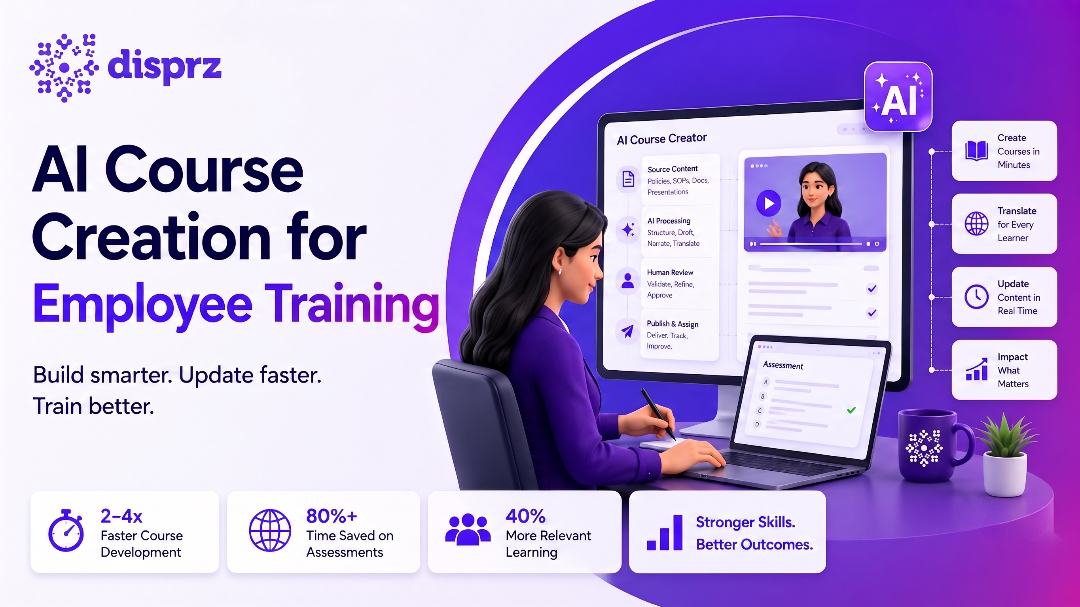
Simple. AI course creation is the process of turning source material you already own, such as SOPs, policy documents, product decks and recorded sessions, into structured learning: modules, narrated video, scenarios, assessments and full pathways, with a human reviewing before anything publishes.
The important word in that definition is own. This is not a generic AI writing a course about negotiation skills from public data. That version exists and it produces exactly what you would expect: content that sounds correct and teaches nothing specific to your business.
Enterprise AI course creation works the other way around. You feed it the twenty-two page distribution policy, the new claims process, the updated store SOP. The system reads it, structures a learning flow, drafts the module, generates narration, builds the knowledge checks and maps the output to the skills the role needs.
The shift is subtle but it matters for how you staff the function. Your instructional designers stop being producers and start being editors, subject matter reviewers and curriculum architects. The work does not disappear. It moves up a level.
What are the main ways AI is used in employee training?
Six production jobs, and they line up with where a content team actually spends its week: drafting, video, scenarios, assessments, localisation and updates. Most published lists stop at the first four. The last two are where enterprise teams find the money.
Six ways AI is used in employee training
- Drafting and structuring. Feed in the policy, SOP or product deck and the system returns a structured module with learning objectives, sequenced sections, summaries and slide-ready layouts. For factual, document-backed content the draft is usable after a single review pass.
- Narrated video with AI presenters. A script becomes a talking-head video with synthetic voiceover. No studio, no crew, and no reshoot when one line changes. Good for the explainer layer of onboarding, and a poor substitute for a leadership message that needs a real face.
- Scenario and role play simulation. Branching conversations where someone practises an objection, a de-escalation or a compliance judgement call and gets feedback on the choice they made. Strongest in sales enablement and customer support, where practice volume matters more than production polish.
- Assessment generation. Knowledge checks, multi-level question banks and rubrics built from the same source text as the module, which keeps every question tied to what was actually taught. Teams consistently name this as the largest single time saving.
- Localisation. One master module becomes twelve language versions with adapted examples and multilingual voiceover inside the same production run, rather than a separate project per market.
- Refresh and versioning. The one almost nobody puts on a list. When the underlying policy changes you regenerate from the revised document instead of re-scoping a build. Update cost, not build cost, is what quietly consumes an L&D budget over three years.
Notice what is absent from all six: deciding what to train, judging whether the output fits how your business actually operates, and proving any of it changed performance. Those stay human, which is why the next question matters more than the tool choice.
Why is your training content backlog no longer a capacity problem?
Because the demand side broke before the supply side did. Skills are now changing faster than any production schedule can absorb, so adding designers no longer closes the gap.
For a decade the honest answer to "why is training late" was headcount. One designer, four business units, a fixed number of hours in a quarter. That explanation has stopped holding.
Against that rate of change, a content library built on a two-year refresh cycle is stale before it is finished. The same Josh Bersin research also found that early adopters of AI-native learning platforms are seeing 40% to 50% reductions in internal L&D spend.
Market. A 2026 research report by Egle Vinauskaite and Donald H Taylor, The Transformation Triangle, makes the uncomfortable version of this argument plainly: AI can now generate learning content quickly, cheaply and at good-enough quality, which means content production is no longer where L&D's value sits. Business units are already building their own material without waiting. The teams that stay relevant own skills data, internal expertise and performance diagnosis instead.
Read that as a warning about positioning, not about tooling. If the only thing your function is known for is producing courses, AI course creation is a threat. If your function is known for closing capability gaps, it is the largest capacity increase you will get this decade.
What can AI course creation do well, and where does it still need a human?
AI is dependable wherever a documented source of truth exists, and unreliable wherever the answer depends on judgement, local context or legal exposure. Vendor demos tend to blur that line. Buyers should not.
| Content type | AI output quality today | What the human still owns |
|---|---|---|
| Product and feature updates | Strong. Source docs are structured and factual. | Confirming the release actually shipped as documented |
| SOP and process training | Strong. Step logic converts cleanly to modules. | Local operating exceptions the SOP does not capture |
| Onboarding and role induction | Strong for the standard 80%. | Team culture, manager expectations, informal norms |
| Compliance and regulatory | Usable draft, never a final. | Legal sign-off, jurisdiction differences, audit language |
| Sales enablement | Good for scenarios and role plays. | Real objections from the last quarter, competitive nuance |
| Leadership and behavioural change | Weakest category. | Facilitation design, cohort dynamics, coaching structure |
Two patterns show up repeatedly in enterprise deployments. First, the further content sits from a documented source of truth, the more human input it needs. Second, the risk is rarely that AI produces something wrong. It is that AI produces something plausible, generic and unaccountable, which passes review because nobody was assigned to challenge it.
Mistake. The most common failure is treating AI course creation as a publishing pipeline instead of a drafting pipeline. Teams that generate a hundred modules in a month and route them straight to learners end up with a library nobody trusts and completion rates that collapse by the second quarter. One named reviewer per module, with authority to reject, is the cheapest quality control you will ever implement.
Internal course creation vs external course creation: which one should you choose?
Build internally when the content will change, outsource when production value or external sign-off is the actual product. AI moved that line significantly. It did not erase it.
Before AI, the trade-off was straightforward. Internal meant cheaper per course but slower and constrained by designer bandwidth. External meant faster to a polished output but expensive, with a long specification cycle and a dependency you renewed every year. AI removes the bandwidth constraint from the internal column, and that single change reverses the default for most content categories.
| Factor | Internal, AI-assisted | External vendor |
|---|---|---|
| Time to first draft | Hours to days | 2 to 6 weeks after brief sign-off |
| Cost model | Platform cost, largely fixed | Per course or per finished hour, scales with volume |
| Context accuracy | High. Your documents, your terminology, your process. | Depends entirely on brief quality and SME availability |
| Update cycle | Same day. Regenerate from the revised source. | New scope, new quote, new timeline |
| Production polish | Good and improving. Adequate for most workforce training. | Higher for flagship video and bespoke interactivity |
| Institutional knowledge | Stays inside | Leaves with the contract |
| Best suited to | Volume, velocity and anything that changes | Flagship, regulated, or high-production one-offs |
Where internal course creation now wins
This is the larger half of the decision, and it is where the backlog actually lives.
- Product and process training: It changes every release cycle, which is precisely the content a per-course vendor contract handles worst.
- Onboarding and role induction: Your highest-volume, most-repeated content, and the standard 80% of it already exists in a document somewhere internally.
- SOPs, refreshers and policy re-issues: The recurring cost is never the first build. It is the eleventh update, and internal regeneration makes that close to free.
- Localisation: One master module, every market you operate in, produced in the same run instead of quoted separately per language.
- Assessment and question bank refreshes: Question banks go stale faster than the modules they test, and rewriting them was never worth raising a vendor brief for.
- The long tail of role-specific content: The store manager module, the regional claims variation, the one team of forty people. Vendors never prioritised these because the per-course economics did not work. That constraint has gone.
Where external still wins
A short list, and it is meant to be short. These are the few programmes a year where facilitation, liability or production value is the actual product.
- Flagship leadership programmes for senior cohorts
- Content needing external accreditation or legal sign-off
- Brand films and executive messaging
- Specialist domains where you have no internal SME
Compare the two lists by volume rather than by line count. External covers a handful of programmes a year. Internal covers the weekly flow, which is the part that has been backing up.
If a course will need to change within twelve months, build it internally. Update cost, not build cost, is what makes outsourced libraries expensive.
How do you run AI course creation internally without losing quality?
Pick one content class, fix the source documents behind it, set format rules, name a reviewer with authority to reject, then map every output to a skill. Teams that get this right rarely start with the tool. They start with the boundaries.
Five steps to bring AI course creation in-house
The order matters more than the speed. Each step removes a failure mode the next one would otherwise inherit.
- Pick one content class, not one department Choose a category with a clean source of truth and high change frequency. Product updates and SOP training are the usual starting points. Avoid compliance for a pilot, because the sign-off chain will mask whether the production model itself works.
- Fix the source of truth before you generate anything AI course creation inherits the quality of the document it reads. If three versions of the onboarding SOP exist across two drives, you will generate three contradictory courses very efficiently. Most of the real work in a first deployment is document hygiene, and teams consistently underestimate it.
- Set format and length rules before you scale volume AI will happily generate a forty minute module from a forty page document, and nobody will finish it. Most enterprise teams land between five and ten minutes per module, split by task rather than by chapter. A tighter output brief also improves generation quality, because it forces the system to prioritise instead of summarising everything it read.
- Build the review gate before the volume arrives Name a reviewer per content class. Define what they are checking, which is accuracy, applicability and tone, not grammar. Set a service level for review turnaround, because a two-day generation cycle behind a three-week review queue delivers nothing.
- Connect output to skills, not to a content library A course that is not mapped to a role and a skill is a file. Mapping every generated module to a competency framework is what turns production speed into capability data, and capability data is the only thing that survives a budget review.
- Start with one content class that has a clean source of truth, never a whole department
- Clean the source documents first. Three versions of an SOP will produce three contradictory courses, very efficiently
- Cap module length at five to ten minutes and split by task
- One named reviewer per content class, with the authority to reject, and a published turnaround time
- Map every output to a role and a skill at the point of creation, not afterwards
How do you know if AI course creation is actually working?
Track four things: time from request to published course, review cycles per module, content refresh latency, and skill movement in the roles the content serves.
Completion rates will not answer this. They measure whether people finished, not whether the model works.
- Time from request to published course. The single clearest signal. If it has not moved from weeks to days, the bottleneck is your review or approval layer, not your tooling.
- Review cycles per module. Should fall over the first two quarters as prompts, templates and source documents improve. If it climbs, source quality is the problem.
- Content refresh latency, meaning how long an update takes to reach a learner after the underlying policy or product changes. This is where AI course creation delivers its most defensible ROI, and it is almost never measured.
- Skill score and time-to-productivity movement for the roles the content serves. Slower to read, and the only number a CFO will accept as impact.
Track vendor spend displaced alongside these. Not as a cost-cutting story, but as evidence of where internal capacity is now stronger than a purchased alternative.
Why does a unified platform beat a stack of separate AI course creation tools?
Because content generated outside your learning platform arrives with no skill mapping, no learner context and no line of sight to performance.
Most teams start with point tools: one for slides, one for AI video, another for quizzes, then a separate LMS to host it all. The output looks fine. The system underneath does not hold. You get faster production and the same reporting problem you had before, now with more files.
Disprz approaches AI course creation as part of the learning platform rather than a tool bolted alongside it. Turo, the agentic AI layer for L&D, reads existing policies, compliance manuals, SOPs and product decks and generates structured learning from them: explainer modules, narrated video, simulations, scenario-based assessments and complete pathways.
Three things matter more than the generation speed itself.
- Skills mapping happens at creation: Generated content maps to the role and competency framework as it is produced, so production volume becomes skills intelligence rather than an unsorted library.
- Localisation is part of the run, not a second project: Multilingual output with culturally adapted examples matters for teams operating across India, the Gulf and Southeast Asia, where the same SOP has to land with a store associate in Riyadh and one in Jakarta.
- It stays portable: SCORM and xAPI export mean content is not trapped, which removes the usual objection to authoring inside a learning platform.
The outcomes show up on the workforce side rather than the production side. Wellness Forever, a pharmacy retail chain running 400+ stores, cut onboarding time by 50% and reached a 92% learning adoption rate after replacing manual, classroom-heavy frontline training.
That is the difference worth holding onto. Fast course production is now widely available. Course production that changes a business metric is not.
Where should L&D leaders start with AI course creation?
Start with the content class that changes most often and has the cleanest source of truth, then build the review discipline around it before you scale volume.
AI course creation has settled a question L&D teams argued about for years. Production capacity is no longer the constraint, and it is not going to be the differentiator either. Every competitor will have the same generation speed within eighteen months.
What separates functions from here is judgement: knowing which content deserves internal ownership, which still belongs with a vendor, who reviews what, and whether any of it moves a skill your business actually needs.
Do those five things properly and the backlog clears as a side effect, which is a better outcome than clearing it as a goal.
Frequently Asked Questions
What L&D leaders ask most often about AI course creation.
What is AI course creation?
AI course creation is the process of turning existing company documents into structured training courses using AI, with human review before publishing. In an enterprise setting the input is usually an SOP, policy or product deck, and the output includes modules, narration, assessments and full learning pathways mapped to job roles.
Can AI create employee training courses?
Yes. AI can produce complete draft courses from source documents, including video, quizzes and scenarios. Quality holds up well for product, process, SOP and onboarding content. Compliance and leadership development still need substantial human design and sign-off before anything reaches learners.
How long does it take to create a course with AI?
Hours to days, against 2 to 4 weeks in-house or 4 to 8 weeks with a vendor. Review turnaround, not generation, is what usually sets the real timeline, which is why teams that skip the review gate see no improvement in time to publish.
Should we create courses internally or outsource them?
Build internally when content changes within twelve months, outsource when production value or external sign-off is the point. Product updates, SOPs, onboarding and refreshers belong in-house now. Flagship leadership programmes, accredited compliance and brand video still justify a vendor.
Is AI course creation cheaper than using an external vendor?
Usually, because the cost model changes from per course to largely fixed. Josh Bersin's 2026 research reports 40% to 50% reductions in internal L&D spend among early adopters of AI-native platforms. The larger saving is in updates, which vendors re-scope and internal teams simply regenerate.
What are the risks of using AI to build training content?
The main risk is plausible but generic content passing review unchallenged. Others include contradictory source documents producing conflicting courses, missing local operating exceptions, and skipping legal sign-off on regulated material. A named reviewer per content class with authority to reject addresses most of it.
Does AI course creation work with our existing LMS?
Yes, if the output exports to SCORM or xAPI. That keeps content portable across platforms. The trade-off is that externally generated content usually arrives without skill mapping or learner context, so reporting stays weaker than content authored inside the learning platform.
How long should an AI-generated training module be?
Five to ten minutes, split by task rather than by chapter. Longer modules are where completion rates fall, particularly for frontline and field roles who train between shifts. A tighter length cap also improves generation quality, because it forces the system to prioritise instead of summarising the whole source document.
What are the best practices for implementing AI course creation?
Start with one content class, clean the source documents, cap module length, assign a named reviewer, and map output to skills. The order matters. Teams that buy the tool before setting these boundaries usually generate volume they later have to withdraw.
Who should review AI-generated training content?
A named subject matter expert for the content class, not the instructional designer who generated it. Reviewers check accuracy, applicability to local operations and tone. Regulated content adds a legal or compliance sign-off step before publishing.
Will AI replace instructional designers?
No, though the role changes materially. Drafting and production shrink. Curriculum architecture, review governance, skills mapping and performance diagnosis grow. Teams that reposition around capability outcomes rather than content output are the ones adding designers, not cutting them.
About the authors


Shobhit Mathur
Chief Customer Officer
Shobhit Mathur is a senior customer experience and business leader with extensive experience helping enterprises drive learning, skilling, adoption, and workforce transformation through technology....
Reviewed for accuracy on 03 Sep 2026