
On this page
Change management training builds the capability to adopt, lead and sustain an organisational change. It covers frameworks, communication, resistance and reinforcement, and it is a separate discipline from project management training, which covers delivering the change itself.
Almost every guide on the subject opens with the same figure: 70 per cent of change initiatives fail. Before anyone builds a business case on it, it is worth knowing where it came from.
Michael Hammer and James Champy described their own 1993 estimate as unscientific. Michael Beer and Nitin Nohria asserted in 2000 that about 70 per cent of change initiatives fail, offering no data and no citation. In 2011 Mark Hughes reviewed five high-profile uses of the claim in the Journal of Change Management and found no valid or reliable empirical evidence behind any of them. Revisiting the question eleven years later in the same journal, he reported that he still had not found any.
The number survives because it is useful to whoever is selling the remedy. What it does not survive is contact with its own sources.
TL;DR. Change management training builds the capability to adopt and sustain a change, not just awareness that one is coming. The failure statistic most guides open with has no empirical source. What the current research does show is an adaptability gap that leaders recognise and have not closed. Programmes break at the manager layer, and they break because they measure willingness and assume ability.
Key highlights
- The famous change failure statistic has no traceable empirical source, and the case for training does not need it
- Change reaches four distinct populations, and one curriculum serves none of them well
- Managers are the transmission mechanism for any change, and currently the most depleted layer in these markets
- Readiness surveys measure willingness, skill assessment measures ability, and ability is what breaks at go-live
Why industries invest in change management training
Industries invest in change management training because the technical delivery of a change and its adoption by people are two different projects, and usually only one of them is staffed.
A core banking platform can go live on schedule, on budget, with every migration test passed, and still fail commercially because branch staff have quietly built workarounds. The system works. The change did not happen. Training is what closes the distance between installed and used, and it is the only line item that addresses that distance directly.
Simple version. Project management gets the new system in on time. Change management training gets people using it correctly and still using it six months later. Doing the first without the second is how organisations end up owning software nobody works in.
What the change is varies sharply by sector, and so does the cost of getting it wrong.
BFSI carries core platform migrations and regulatory changes with an audit trail attached, where an adoption failure becomes a compliance exception. Manufacturing deals with new lines, shop-floor automation and safety regimes that change how a job is physically performed, where the failure mode is an incident. Healthcare runs clinical system rollouts and accreditation cycles with a patient at the end of every error. Retail and hospitality push point-of-sale and omnichannel shifts across hundreds of sites staffed by people who may have joined last month. IT services change delivery models in ways that alter what a billable role even means.
Different stakes, one common factor. The people furthest from the decision are the ones who absorb it, and they are usually the last to be trained.
Why change affects your organisation differently by role
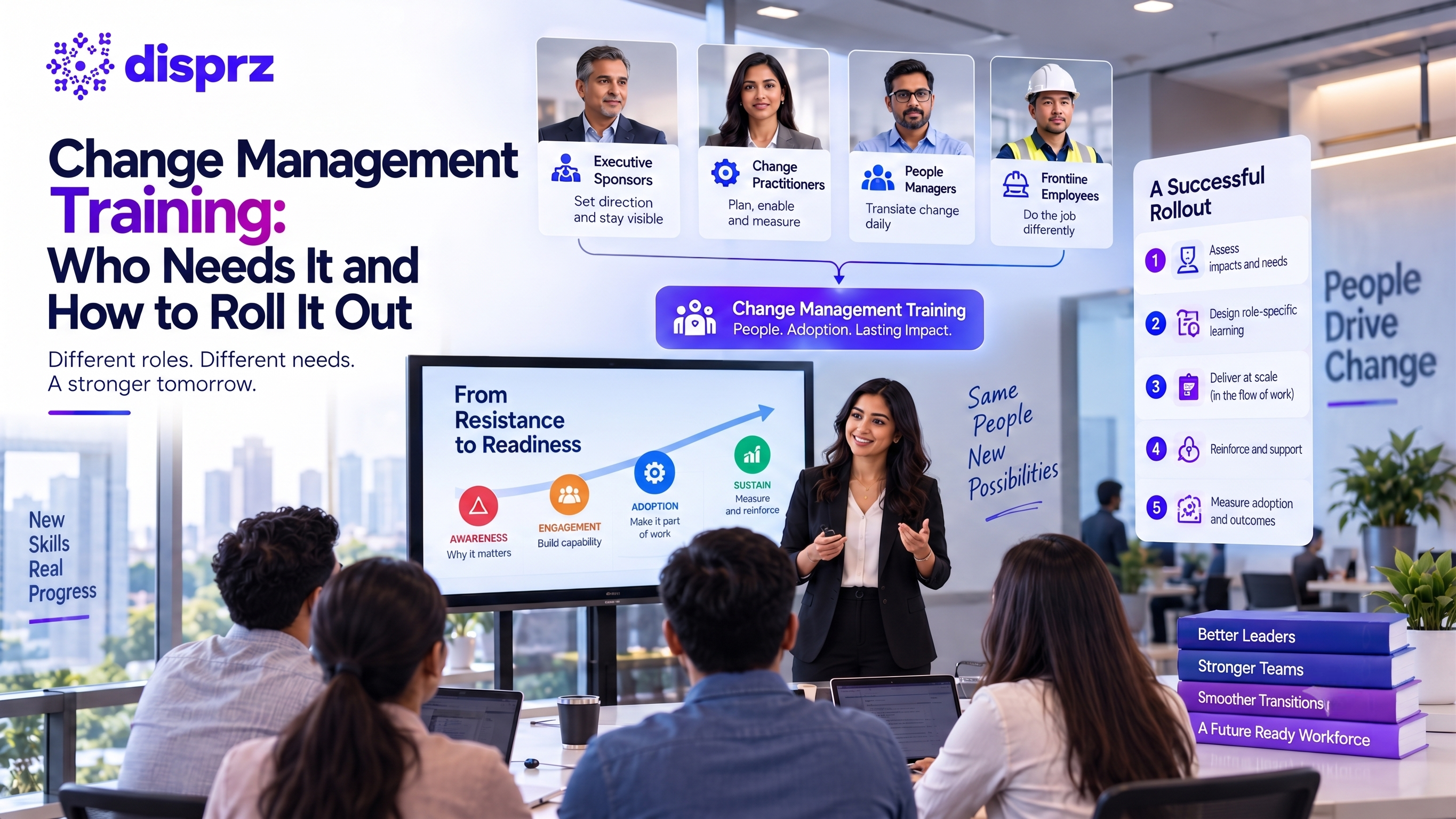
Change reaches four distinct populations, each asked to do a different job with it, and a single training deck cannot serve four different jobs. A sponsor has to defend a decision in a board meeting. A supervisor has to answer a frightened question in a corridor. A branch officer has to process an exception correctly on Monday morning.
| Layer | What the change asks of them | What training has to build | Common failure |
|---|---|---|---|
| Executive sponsors | Fund it, defend it, stay visible past go-live | Ability to hold the line when the first problems surface | Visible at launch, gone by week six |
| Change practitioners and project leads | Plan, assess impact, coordinate measurement | Framework fluency, impact assessment, adoption measurement | Strong on plan, thin on people milestones |
| People managers and supervisors | Translate the change daily, absorb the resistance | Confidence to answer role questions honestly, coaching capability | Trained last, or not at all |
| Frontline employees and end users | Do the job differently and correctly from day one | Task-level capability, in their language, on their device | Sent awareness content when they needed task training |
The third row is where most programmes break, and the 2026 data explains why.
Gallup attributes at least 70 per cent of the variance in team engagement to the manager, which makes the manager the transmission mechanism for any change. Whatever leadership intends, employees receive the version their manager gives them. That mechanism is currently in poor repair: global manager engagement fell to 22 per cent in 2025 from 31 per cent in 2022. In India it dropped from 39 per cent to 30 per cent inside a single year, and South Asia posted an eight-point fall, the largest of any region in the world (Gallup).
The layer being asked to carry the change has the least left to carry it with. Handing an over-spanned, disengaged manager a communication toolkit and asking her to generate enthusiasm is not a training strategy.
Worth noting what the same research found on the other side: manager engagement runs at 79 per cent inside the organisations Gallup classes as best practice. The variable is not the calibre of the individuals. It is whether anyone trained and supported them.
Steps to make change management training easy to adopt
Adoption is a sequencing problem more than a curriculum problem. The content in most change programmes is adequate. The order is what fails.
- Measure ability, not just willingness Readiness surveys tell you how people feel about the change. They do not tell you whether anyone can perform the future-state role, which is what actually breaks at cutover. ADKAR separates Desire from Ability for precisely this reason, yet most programmes instrument only the first. A training needs analysis run against roles as they will exist after the change gives you the second number.
- Prepare managers four to six weeks ahead of their teams They need to process their own resistance before handling anyone else's, and they need scripts for the questions they will actually get. What happens to my role. What happens to my team. What if I cannot learn this fast enough.
- Build role tracks, not one deck The four layers above are your cohort structure. A sponsor briefing runs ninety minutes; a frontline task module runs eight and arrives on a phone. Skill mapping is what assigns people to tracks.
- Time delivery to the change, not the training calendar Task-level capability delivered three months early has evaporated by go-live. Awareness early, capability close, job aids at the moment of use.
- Reach deskless populations where they are Mobile, offline-capable, local language, short. If the change touches branch, store, field or shop-floor staff and your delivery assumes a laptop, the rollout has a hole in it before it starts.
- Reinforce after launch and measure behaviour Adoption is decided in the four to eight weeks after go-live, not at go-live. Track error rates, rework, usage patterns and time-to-proficiency, and rebuild content when the process shifts mid-rollout, which it will.
Challenges and struggles you will face in change management training
None of the recurring problems is a content problem. Most of them are a consequence of volume: Deloitte found one third of surveyed workers had absorbed 15 major changes in a single year, with the effects showing up in wellbeing, clarity, engagement and workload. Any new programme lands on people already carrying fourteen others.
| Challenge | Why it happens | What it looks like | What helps |
|---|---|---|---|
| Change saturation | The programme lands on people already absorbing many others | Low attendance, apathy, "not this again" | Audit concurrent change load before scheduling; stagger by population |
| Manager readiness gap | Managers trained last, or with the same deck as their teams | Improvised answers; wide regional variation in adoption | Manager cohort four to six weeks ahead, with scripts |
| Completion read as adoption | Completion is easy to report, adoption is not | Green dashboards, red operational metrics | Track operational data alongside completion |
| Content going stale mid-rollout | The process changes faster than courses can be rebuilt | People trained on a workflow that no longer exists | Rapid authoring from current SOPs, not course rebuilds |
| Frontline exclusion | Delivery designed for desk-based staff | Adoption collapses at site level | Mobile-first, offline, local language |
| Sponsor drop-off | Go-live treated as the finish line | Support evaporates when problems surface | Commit sponsors to a named post-launch cadence |
One challenge sits outside that table because it is newer and most programmes are not addressing it at all.
Where the change involves AI or automation, the question people are actually asking is not how the tool works. Deloitte found 42 per cent of workers saying their organisation is not evaluating AI's impact on people. Gallup's Q1 2026 survey found 18 per cent of employees expecting their job to be eliminated within five years because of technology, rising to 23 per cent inside organisations that have already implemented AI and 32 per cent in finance and insurance.
Those are the exact populations enterprise L&D teams across India, the Middle East and Southeast Asia are serving. Tool training delivered into an unanswered question about job security does not land, however well built it is. Someone with the standing to answer the role question has to answer it first.
The mistake that produces the most confident wrong answer. A 96 per cent completion rate on an awareness module tells you people opened a file. It says nothing about whether a branch officer can process an exception, whether a supervisor can answer a role question without inventing one, or whether anybody will still be following the new process in November. Completion is an input. Behaviour is the outcome, and the two diverge most sharply in exactly the rollouts that look healthiest on the dashboard.
Possible solutions for change management training in a corporate setting
Corporate change management training resolves into four delivery routes, and any enterprise running a real rollout needs more than one. Choosing between them is less a question of quality than of which population each route can actually reach.
| Route | What it delivers | Who it reaches | Where it stops |
|---|---|---|---|
| External certification | Accredited practitioner capability in an established methodology | A handful of change leads, project managers and HR practitioners | Does not scale to the population who have to work differently |
| Consultant-led programme | Methodology plus hands-on delivery for one specific transformation | The programme team and sponsors, for the length of the engagement | Capability tends to leave when the engagement ends |
| Internal workshops and a change champion network | Facilitated sessions and peer support built on your own material | Managers, supervisors and site-level champions | Facilitator time caps the number of cohorts, and content ages fast |
| Platform-delivered training on an LMS or LXP | Role-based tracks, task-level modules and job aids, assigned and measured | The whole affected population, including deskless staff | Needs someone with methodology grounding to design what goes into it |
The first three routes build practitioners. The fourth reaches the population. Most rollouts need capability in both places, which makes the real question not which route is better but how the two divide the work.
Training course or LMS tool: which does your industry actually need?
A training course and a learning platform answer different questions. A course builds one person's capability once, on a fixed date. A platform delivers, updates and measures capability across a whole population continuously. Confusing the two is how organisations end up with certified change leads and an unchanged workforce.
| Training course | LMS or LXP platform | |
|---|---|---|
| What it produces | An individual holding a framework and a credential | A population working the new way, with evidence |
| Unit of delivery | A scheduled cohort | A role, on demand |
| Shelf life | Fixed at the date it was delivered | Updated whenever the process changes |
| Realistic reach | Tens of people | Thousands, including deskless staff |
| What it can prove | Attendance and a credential | Proficiency, behaviour and operational outcome |
| Who owns the outcome | The individual's development plan | The programme and the business |
The two questions that settle it
How many people have to do something differently, and how often will the process keep changing after go-live?
A small, stable change inside a change-literate team is well served by courses alone. A large population, a deskless population, or a process that will keep moving for the next two years cannot be reached by cohorts at all, whatever the quality of the facilitation. Scale and volatility are the variables, not budget or preference.
How that lands by industry
| Industry | Typical change | Weighting it needs | Why |
|---|---|---|---|
| BFSI | Core platform migrations, regulatory change | Platform-led, with certified practitioners designing | Thousands of branch staff, an audit trail requirement, and regulatory change that never stops |
| Manufacturing | New lines, shop-floor automation, revised safety regimes | Platform-led, mobile and offline | Shift patterns and no desks; task-level training has to reach the line itself |
| Healthcare | Clinical system rollouts, accreditation cycles | Platform-led with competency records per role | Rostered clinical staff cannot attend fixed cohorts, and evidence of competence is not optional |
| Retail and hospitality | Point-of-sale and omnichannel shifts | Platform-led, short modules in local languages | Hundreds of sites and high turnover mean retraining is permanent, not a project |
| IT services | Delivery model and tooling changes | Both, weighted toward courses | A change-literate workforce where project and delivery leads get real value from formal certification |
| Small or single-site change teams | One-off restructures | Course-led | The affected population is small enough that facilitated cohorts genuinely reach everyone |
Two of those six do not need a platform, which is worth saying plainly. If your change touches forty people in one building and the process will be stable afterwards, buy the training and skip the tooling conversation.
For the enterprises this article is written for, the answer is a ratio rather than a choice: formal capability for the small group who design the change, platform delivery for the large group who have to execute it, both pointing at the same role definitions so the two halves do not drift apart.
How Disprz helps make the shift easier with change management training
Everything above needs four things in one place: a measurement of ability against the future-state role, role-based journeys rather than one curriculum, content that can be rebuilt at the speed the process changes, and adoption data that goes past completion. Assembling that from a compliance LMS, a content library and a separate skills tool is where most programmes lose the thread, because the signal sits in the joins.
Skills intelligence defines proficiency per role and assesses against it, producing a pre-rollout ability baseline rather than a sentiment score, with readiness reports for the learner and the manager so a development conversation starts from a shared document. The LMS carries the mandatory and compliance-bound portion with the audit trail regulated rollouts require.
Turo turns existing SOPs and internal documents into microlearning and cuts authoring time by 80 to 90 per cent. In a change programme that is not a convenience. When the process shifts in week three of a twelve-week rollout, it decides whether you retrain people on the current workflow or the one you designed six months ago. The Content Hub supplies the leadership and coaching material the manager layer needs, so change-leadership content is not one more thing to build from scratch, and licensed catalogue content including a synced LinkedIn Learning library sits alongside internally authored microlearning rather than in a separate system.
For branch, store, field and shop-floor teams, frontline enablement is mobile-first, offline-capable and delivers nudges over WhatsApp, sustaining completion above 45 per cent against an industry average below 30 per cent. Learning analytics ships off the shelf on PowerBI and connects skills to performance KPIs rather than stopping at who finished what, which is how a rollout tells you adoption is slipping in week two instead of in the post-mortem.
ROSHN attributed 15 per cent annual business growth to its Disprz-powered programme, which is the kind of figure a change sponsor can take to a board.
Behind that sit ten years of on-the-ground deployment across India, Southeast Asia and the Middle East, more than 500 enterprises and over 3.5 million learners. For a change programme that matters less as a credential than as evidence that the rollout patterns in this article have been run before, in these markets, at this scale.
Where Disprz differs from the alternatives is less a feature checklist than a question of where the capability sits. Compliance, personalised journeys, skills assessment and rapid authoring run in one stack, which is what lets a programme measure ability before cutover and rebuild content during it.
The alternatives divide that work differently, and the division matters most in rollout weeks. Suite-based platforms such as SAP SuccessFactors hold learning inside a wider HCM stack, so change reporting tends to surface through performance review cycles rather than in the fortnight when adoption is being decided. Established enterprise LMS platforms such as Cornerstone OnDemand carry strong compliance heritage, which serves the mandatory portion of a change well, though administrators commonly describe the reporting layer as complex to configure when what they need is a fast cut by role and region. Focused products such as Litmos handle assigned training and scheduled dashboards capably without a capability layer beneath them, which leaves no pre-rollout ability baseline to work from.
If you are scoping a rollout now, the cheapest useful thing available this week is to separate two questions most programmes collapse into one. Do our people want this change, and can our people do this job after it.
The first is a survey. The second is an assessment against the roles as they will exist, and it is the one that predicts what happens in go-live week. Run it on the manager layer first.
Change management training FAQs
What HR and L&D leaders ask most often about change management training.
What is change management training?
Change management training builds the capability to adopt, lead and sustain an organisational change. Curricula usually cover frameworks such as ADKAR or Kotter's eight steps, impact assessment, communication planning, resistance handling and post-launch reinforcement, differentiated by whether the learner sponsors, plans, leads or performs the change.
Do 70 per cent of change initiatives really fail?
The 70 per cent failure figure has no traceable empirical source. Reviewing five high-profile uses of the claim in the Journal of Change Management, Mark Hughes found no valid or reliable evidence behind any, tracing it to a 1993 estimate its own authors called unscientific and a 2000 assertion made without citation.
Who needs change management training?
Everyone affected by a change needs preparation, but depth should match the role. Sponsors need to fund and defend the change, practitioners need planning and measurement skills, people managers need coaching and resistance handling, and frontline employees need task-level training in the new process. One curriculum serves none of them well.
How far ahead of a rollout should change management training start?
Change management training works in stages rather than a single window. Awareness content can run months ahead, manager preparation four to six weeks ahead of employees, and task-level capability close to cutover so it is still retained. Reinforcement continues four to eight weeks past go-live, when adoption is actually decided.
About the authors


Shobhit Mathur
Chief Customer Officer
Shobhit Mathur is a senior customer experience and business leader with extensive experience helping enterprises drive learning, skilling, adoption, and workforce transformation through technology....
Reviewed for accuracy on 08 Sep 2026