
On this page
Quiet cracking describes an employee who keeps meeting expectations while quietly detaching from the work. Output holds, deadlines are met, compliance training is finished on time, and the person has already stopped investing anything beyond the minimum the job requires.
That combination is what makes it hard to catch. Every system an enterprise uses to spot a people problem is looking for a change in output, a resignation letter, or a bad survey score. Quiet cracking produces none of the three until late.
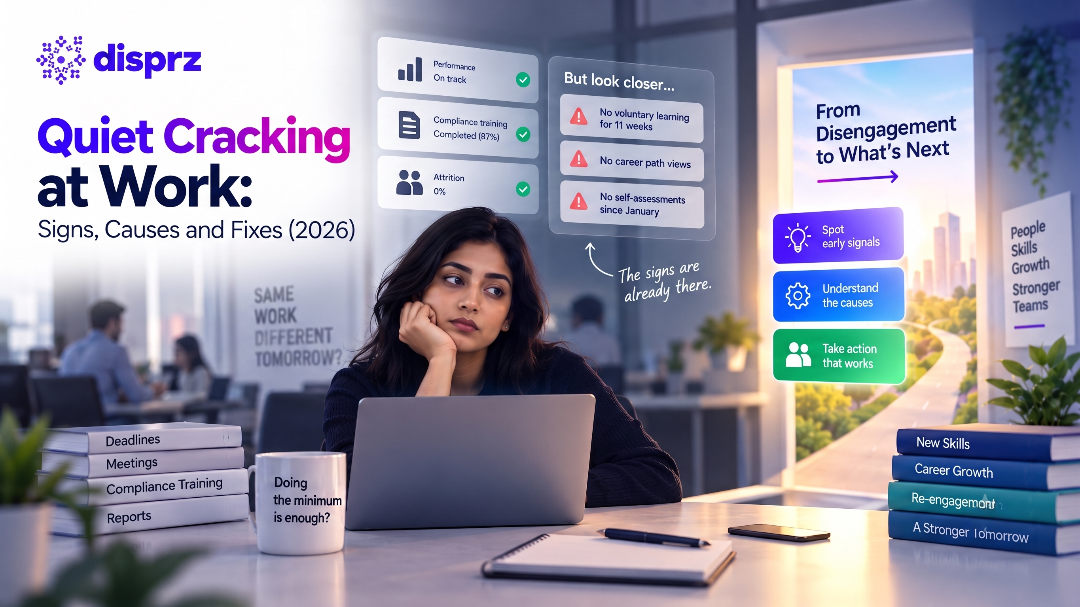
Picture a Q2 learning review at a large Indian insurer. Mandatory compliance sits at 97 per cent. Attrition in the regional operations group is zero for two quarters. The dashboard is green. What nobody pulls up is the elective side of the same report: on one nine-person team, voluntary course enrolments have been at zero for eleven weeks, nobody has opened a career path, and the last self-assessment anyone completed was in January. Two quarters later, four of those nine resign inside a single quarter, and the exit interviews all say a version of the same thing.
Nothing in that story required a new survey. The signal was already in the learning system. It was sitting in a column nobody reports on.
TL;DR. Quiet cracking is sustained disengagement without a drop in output, which makes it invisible to performance data, attrition data and annual surveys until people leave. Gallup's 2026 figures show India's engaged share falling from 30 per cent to 23 per cent in a single year while active disengagement held steady, meaning the movement was into quiet detachment rather than open resistance. For L&D leaders, the earliest reliable signal is voluntary learning behaviour, because it is the one work activity with no penalty for stopping. Split your reporting between mandated and elective learning, fix the manager layer first, and make the next role visible before you commission another engagement survey.
Key highlights
- Definition: quiet cracking is prolonged workplace disengagement in which performance stays flat and psychological investment does not
- Not the same as quiet quitting: quiet quitting is a deliberate decision to do less, quiet cracking is exhaustion and stalled growth without a change in effort
- The India picture: 23 per cent of Indian employees were engaged in 2025, a four-year low, with 59 per cent not engaged and active disengagement flat at 18 per cent
- Managers are worst hit: engagement among Indian managers fell nine points in one year, from 39 per cent to 30 per cent
- The L&D signal: elective enrolment, self-assessment completion and career-path views drop before performance does
- The governance line: learning data indicates workload and growth pressure at team level, and should never be used to infer anything about an individual's mental health
What is quiet cracking, and how do you find it in the workplace?
Quiet cracking is a state of prolonged workplace unhappiness in which an employee continues to perform to standard while withdrawing effort, curiosity and any interest in their own progression. The person has not decided to coast. They have run out of reasons to do more than the job description asks.
The distinction from its better-known cousin matters, because the fix is different.
Simple version. Quiet quitting is a choice to stop going beyond the role. Quiet cracking is what happens when someone keeps going and nothing comes back. One is a boundary. The other is attrition in slow motion.
Burnout is a third thing again. Burnout eventually shows up in output, absence and error rates. Quiet cracking, by design, does not. The person is holding the line precisely because they cannot afford to be seen slipping.
The four places it surfaces before performance moves
Curiosity goes first. Requests change shape. Instead of asking why a process works the way it does, people ask only what they need to do. Gallup's engagement framework treats this as foundational rather than peripheral, with "this last year, I have had opportunities at work to learn and grow" sitting among the twelve items it uses to measure engagement.
Voluntary learning stops. Mandatory training completion holds at or near 100 per cent, because it is mandatory. Elective enrolments, optional certifications, skill self-assessments and career-path views fall to zero. This is the single most useful early indicator most enterprises already collect and almost none report on separately.
Forward-looking conversations end. Nobody asks about the next role, the next band, or what a promotion would require. The absence is easy to miss, because an absence never appears in a report.
Recognition stops registering. Praise lands flat. An award is received politely and changes nothing.
Why the detection problem is structural
Read together, those four signals share a property: each is the disappearance of something voluntary. That is exactly why the standard instruments miss quiet cracking.
Performance data measures the mandated layer, and the mandated layer is intact. Attrition data measures departures, and nobody has departed. An annual engagement survey measures sentiment once, months after the shift began, through a channel the person has already concluded does not lead to change.
The voluntary layer moves first because it is the only part of work where stopping carries no consequence.
Those three figures come from Gallup's State of the Global Workplace: 2026 report and are worth reading as a set rather than as headlines. India's engaged share fell from 30 per cent to 23 per cent between 2024 and 2025. Active disengagement did not rise. It sat at 18 per cent, where it has been for three years. The not-engaged share absorbed almost the entire drop, climbing from 52 per cent to 59 per cent.
That is the pattern quiet cracking predicts. People did not become resentful or start acting against their employer. They moved into the middle and stayed there. Gallup puts the annual cost of India's disengagement at 351 billion dollars, roughly 32.7 trillion rupees, or about 9 per cent of national GDP.
Ways employees end up quiet cracking in the workplace
Nobody arrives at quiet cracking through a single bad quarter. It accumulates, and in the enterprises Disprz works with across BFSI, retail, manufacturing, healthcare, hospitality and IT services, the accumulation usually runs along five tracks.
Growth stopped being visible. The employee is still learning things, but none of it connects to a next step they can name. Deloitte's 2026 Global Human Capital Trends, drawn from around 9,000 business and HR leaders, found 85 per cent of leaders describing the ability to adapt at today's speed as critical while only 7 per cent said they were leading in helping their workforce continuously grow and adapt. That gap between stated priority and delivered growth is what an employee experiences as a career going nowhere.
Change arrived faster than support for it. In the same research, one third of surveyed workers had been through 15 major changes in a single year, with the effects showing up in wellbeing, clarity, engagement and workload. Only 27 per cent of leaders said their organisation manages change well. Sustained change without support is the mechanism, not the mood.
The management layer thinned. Gallup found that the percentage of managers in South Asia declined, which points to employers cutting management roles, and that manager engagement in the region fell by eight points, the largest drop anywhere in the world. Gallup's related work on span of control found manager engagement falls as team sizes grow, though talented and well-supported managers can lead much larger teams without that drop. The variable is capability and support, not headcount alone.
The learning diet became entirely compulsory. When every assignment in someone's queue is a regulatory refresher, the platform stops being a place where anything good happens. In regulated sectors this is close to universal, and it is fixable without touching a single compliance control.
Role anxiety went unanswered. Gallup's Q1 2026 workforce survey found 18 per cent of US employees saying it was likely their job would be eliminated within five years because of technology, rising to 23 per cent inside organisations that have implemented AI, and higher still in finance and insurance at 32 per cent each and technology at 31 per cent. Deloitte found 42 per cent of workers saying their organisation is not evaluating AI's impact on people. Employees are doing that assessment themselves, and silence from the employer is itself an answer.
Frontline teams were never in scope. Store staff, field agents, branch teams, shop-floor operators and hospital support staff often sit outside the systems that carry career pathways at all. Their entire relationship with L&D is compliance.
Market context. Global engagement fell to 20 per cent in 2025, its second consecutive annual decline and the lowest reading since 2020. No region improved, and South Asia posted the largest drop at five points. This is not a single-employer story, which cuts both ways: the pressure is systemic, and so is the opportunity, because Gallup found manager engagement running at 79 per cent inside best-practice organisations against a 22 per cent global average.
Steps to stop quiet cracking before it booms
The order below matters more than the individual actions. Most programmes fail because they start at step five.
- Split your learning reporting in two Report mandated completion and elective activity as separate lines, by team, monthly. Elective activity covers optional enrolments, self-assessments, career-path views and any content nobody was told to open. A team at 100 per cent mandated and zero elective for two months is the pattern worth a conversation. This is a reporting configuration change, not a new system.
- Baseline capability rather than sentiment A training needs analysis that measures current skill against the role people actually hold gives you something a pulse survey cannot: a specific, non-judgmental reason to talk to someone about their development. Nobody feels surveilled by a skills assessment tied to their own role.
- Make the next role visible and specific Not "we support internal mobility" but: here is the role, here are the skills it needs, here is your current standing against them, here is what closes the gap. Skill mapping turns a vague promise into a route someone can see themselves on.
- Fix the manager layer before the employee layer Gallup's research attributes at least 70 per cent of the variance in team engagement to managers, and the 2026 Indian data shows managers detaching faster than the people they lead. Sending disengaged managers to run engagement conversations does not work. Give them capability building of their own, and coaching prompts that arrive with the performance data rather than in an annual cycle.
- Rebalance the diet For every compulsory assignment, make sure something in the queue exists because the employee chose it. In regulated environments, cut administrative duplication and consolidate overlapping mandatory courses rather than reducing controls. The goal is to remove friction, not oversight.
- Close the loop out loud If people raise a workload or growth issue and nothing visibly changes, the next round of quiet cracking is faster and deeper. Report back on what was raised and what was done, even when the answer is not yet.
The mistake to avoid. Learning data is a team-level indicator of workload and growth pressure. Treating it as a way to identify individuals who might be struggling personally is both unreliable and a serious trust and data-protection problem, particularly where works councils or employee data regimes apply. Someone's elective activity can drop because they had a hard quarter at home. Use the signal to ask a team what is getting in the way. Never use it to label a person, and never treat a platform metric as an indication of anyone's mental health. Quiet cracking is an engagement pattern, not a clinical condition, and employees showing signs of genuine distress need access to proper support rather than a learning intervention.
What is the possibility your employees have quiet cracking?
The honest answer for most large enterprises in these markets is that some proportion already are, and the useful question is which groups carry the highest probability. Four risk profiles come out of the 2026 data.
Middle managers, especially where layers were removed. This is now the highest-probability group in South Asia. Indian manager engagement fell from 39 per cent to 30 per cent in a year, against a five-point fall for individual contributors, and the manager population itself shrank. Larger spans, fewer peers, same accountability.
Senior specialists and long-tenured experts. Gallup found that leaders report higher engagement and life evaluations than individual contributors while also being substantially more likely to report a lot of stress, anger, sadness and loneliness the previous day (Gallup). Good numbers on the reflective measures, worse days on the experienced ones. That gap is where quiet cracking lives.
Frontline and branch teams with no visible pathway. Compliance-only relationships with L&D, limited internal mobility, and in Southeast Asia a job market employees now read as the most favourable in the world, which shortens the distance between detachment and exit.
Employees in roles facing visible automation pressure. Gallup's 2026 figures put job-elimination expectations highest in finance, insurance and technology, which maps directly onto the BFSI and IT services populations most enterprise L&D teams in this region are serving.
| Group | Why the risk is elevated | What it looks like first | Where it ends if untouched |
|---|---|---|---|
| Middle managers | Flattening, larger spans, unchanged accountability | Stops volunteering for anything beyond own team | Resignation, often with a direct report following |
| Senior specialists | Repetitive high-stakes work, thin progression | Withdraws from mentoring and knowledge sharing | Institutional knowledge walks out |
| Frontline and branch teams | Compliance-only learning, no visible next role | Elective activity at zero, mandatory at 100 per cent | Attrition spikes, customer experience degrades |
| Roles under automation pressure | Unanswered questions about the role's future | Resistance to new tools and processes | Capability gap widens as reskilling is refused |
The through line is capability. An employee who detaches stops learning, and a workforce that stops learning cannot absorb the volume of change Deloitte is measuring. It falls behind, which makes the next role harder to reach, which deepens the detachment. That loop is why quiet cracking is an L&D problem and not only an HR one.
A team that has stopped learning voluntarily has already told you something. Most reporting is not built to hear it.
How Disprz will safeguard your workplace against quiet cracking
Everything above resolves into four capabilities that need to sit in one place: separating voluntary learning from mandated learning in your reporting, measuring capability against the role rather than sentiment, showing an employee a specific next step, and giving managers coaching prompts tied to real performance data rather than an annual cycle.
Most enterprises try to assemble that from a compliance LMS, a content platform and a separate skills tool, then discover the signal they need lives in the joins. Disprz delivers the chain natively. Skills intelligence defines proficiency per role and assesses against it, so a readiness score exists before anyone needs an intervention. Role readiness scoring produces reports for both the learner and the manager, which turns a development conversation into a shared document rather than an evaluation. Learning analytics can be cut by assignment type, so the elective line is visible instead of buried inside an aggregate completion figure. KPI-triggered coaching lets a manager receive a prompt when performance data moves, not at review time. And Turo converts existing SOPs and internal documents into microlearning, which is what makes rebalancing the learning diet practical rather than aspirational.
For frontline populations, the frontline enablement variant is mobile-first, works offline and delivers nudges over WhatsApp. Frontline programmes on Disprz sustain completion above 45 per cent against an industry average below 30 per cent, which matters here because a frontline worker who never opens the platform generates no signal at all.
Where platforms differ on the capabilities that matter here
| Capability | Disprz | Cornerstone OnDemand | SAP SuccessFactors | Litmos |
|---|---|---|---|---|
| Elective activity reported separately from mandated | Journey and usage reporting split by assignment type, with off-the-shelf analytics | Reporting available, commonly described by administrators as complex to configure | Learning reporting sits inside the wider HCM suite | Dashboards and scheduled reports, no capability layer |
| Role readiness scoring per employee | Role readiness scores with learner and manager reports | Skills graph maps skills to learning, readiness scoring not equivalent | Competency data tied to performance cycles | Not offered |
| Employee-visible career pathways | Career path discovery informed by stated aspiration | Career mobility module available | Career development module within the suite | Learning paths rather than career paths |
| Manager coaching triggered by performance data | Asynchronous manager coaching on KPI triggers | Not offered | Periodic review cycles | Not offered |
| Internal documents to microlearning | Turo agentic AI authoring | Built-in course authoring | Limited | AI-assisted authoring |
| Frontline reach | Mobile-first, offline capable, WhatsApp nudges | Desk-first design | Desk-bound HR workflows | Mobile responsive |
Key takeaways
- Quiet cracking is disengagement without a performance drop, which is why performance data, attrition data and annual surveys all miss it.
- The 2026 Gallup India data shows the fall in engagement moving into "not engaged" while active disengagement held flat, the signature of people staying and detaching.
- Voluntary learning activity is the earliest signal most enterprises already collect and rarely report on separately.
- Managers are the highest-risk group in South Asia right now, so any programme that starts with the employee layer is starting in the wrong place.
- Learning data is a team-level indicator. Using it to draw conclusions about individuals is unreliable and a trust problem.
Pull one report before you commission anything: elective learning activity by team for the last two quarters, next to mandated completion for the same teams. Most L&D functions have never looked at those two columns side by side, and the teams where one is at 100 per cent while the other is at zero are your list.
That takes an afternoon. It tells you where to have the conversation, which is a better starting position than an engagement score that arrives in March and tells you how everyone felt in November.
Quiet cracking FAQs
What HR and L&D leaders ask most often about quiet cracking.
What is quiet cracking?
Quiet cracking describes prolonged workplace disengagement in which an employee continues to meet performance expectations while withdrawing effort, curiosity and interest in their own progression. The pattern is difficult to detect because output holds steady, which means performance reviews, attrition reports and annual engagement surveys all register the person as fine.
What is the difference between quiet cracking and quiet quitting?
Quiet quitting is a deliberate decision to stop working beyond the formal role, and the employee generally knows they have made it. Quiet cracking involves someone who is still trying, still delivering, and running on empty because effort has stopped producing recognition or progression. One is a boundary, the other is unaddressed strain.
What are the early signs of quiet cracking?
Early signs of quiet cracking cluster in voluntary behaviour rather than output. Elective course enrolments stop while mandatory completion holds, career-path views and self-assessments fall to zero, questions about promotion or development disappear, and recognition stops registering emotionally. Each is the absence of something optional, which is why reports rarely surface them.
How common is quiet cracking in India?
India recorded 23 per cent employee engagement in 2025, a four-year low, with 59 per cent of employees classified as not engaged and active disengagement flat at 18 per cent, according to Gallup's 2026 report. Because the decline moved into the not-engaged middle rather than into active disengagement, the data is consistent with widespread quiet detachment.
Can an LMS detect quiet cracking?
Learning platforms surface useful team-level signals, particularly the gap between mandated completion and elective activity, and drops in self-assessment or career-path engagement. These indicate workload and growth pressure worth investigating. Learning data should never be used to draw conclusions about an individual's wellbeing or mental health, which it cannot reliably indicate.
How do you prevent quiet cracking?
Prevention starts with reporting elective learning separately from mandated learning, baselining capability against each role, and making the next role specific enough for an employee to work toward. Manager capability comes first, since managers account for most of the variance in team engagement and are currently detaching faster than their teams.
About the authors


Madhu Karunakaran
Vice President - People & Culture
Madhu Karunakaran is a senior HR and Learning & Development (L&D) leader with 20+ years of experience spanning people strategy, organizational development (OD), talent management, leadershi...
Reviewed for accuracy on 08 Sep 2026