
On this page
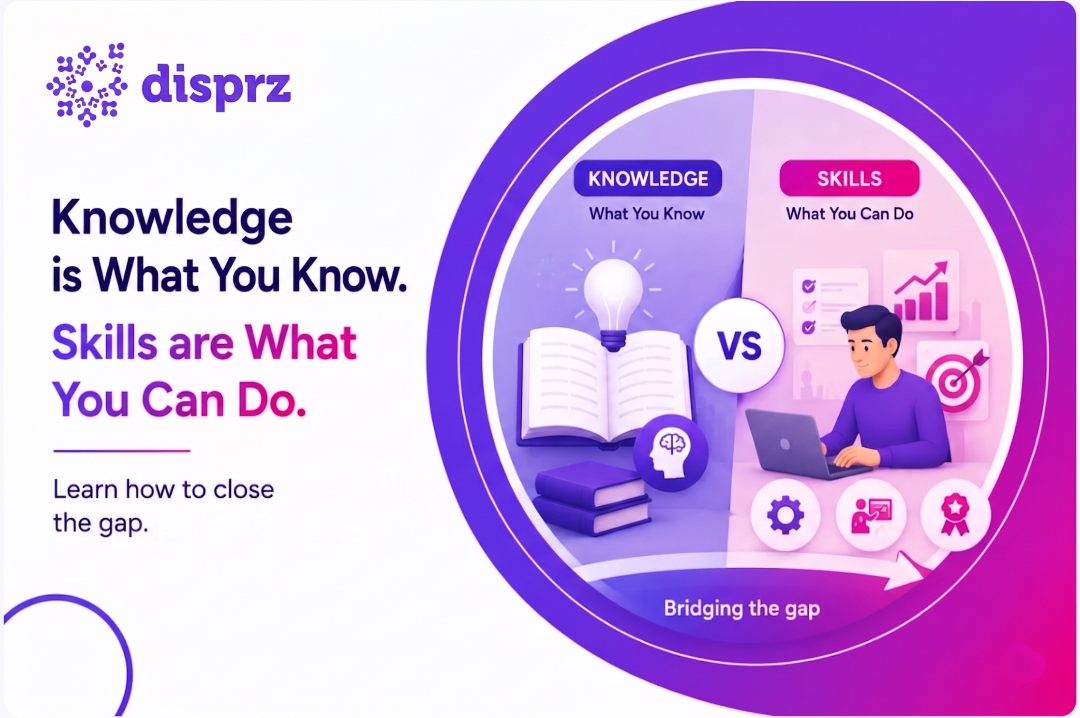
Knowledge is what people know. Skills are what they can do. Learn how to close the gap.
TL;DR
- Knowledge is theoretical understanding. A skill is the proven ability to apply that understanding to real work. Knowing is not doing.
- Most enterprise training builds knowledge and assumes skill will follow. It rarely does. That gap is where onboarding stalls, ROI disappears, and skill inventories go stale.
- The fix is a learning approach that moves people through four stages: Identify the skills a role needs, assess where each person stands, build capability with personalized practice, and then measure impact on the business.
- Who should read this: L&D Heads, L&D Managers, and L&D Directors at 500+ employee enterprises who are tired of completion rates that do not translate into performance.
- Expected outcome: A clear model for turning knowledge into demonstrated skill, and the platform capabilities that make it work at scale.
Your team finished the training. The completion dashboard is green. Then a new hire freezes on their first live call, a frontline agent misconfigures the process they were "trained" on, and a manager quietly tells you the program did not change anything on the floor.
This is the most expensive gap in corporate learning, and it hides in plain sight. Organizations spend heavily to transfer knowledge, then act surprised when knowledge does not show up as capability.
The confusion between skills and knowledge is not academic. It decides how you design training, what you measure, and whether leadership sees learning as an investment or a cost. Brandon Hall research has long flagged that most organizations cannot link L&D to business outcomes, and the World Economic Forum estimates that a majority of the global workforce needs reskilling this decade. You cannot solve either problem if you treat "knowing" and "doing" as the same thing.
This article is written for one reader: the L&D leader who owns capability at scale and needs to stop shipping knowledge and start producing skill.
“Skills vs Knowledge: Knowledge is the theoretical understanding of facts, concepts, and information, whereas a skill is the practical ability to apply that knowledge to perform a task.”
Why does knowing something not mean employees can do it?
Every enterprise learning function, in every industry, runs into the same wall. Knowledge transfers fast. Skill does not.
You can hand someone a policy document, a compliance module, or a product deck and their knowledge rises in an afternoon. Skill works differently. It is built through practice, feedback, and repetition, which means it takes time and it needs structure. When training programs ignore that difference, three things happen: people pass the quiz but stall on the job, managers lose trust in L&D, and leadership questions the budget.
The cost is not evenly spread. It shows up differently depending on the kind of workforce you are trying to enable, and that is where most one-size programs break. Before you can fix it, you need to see exactly where knowing stops and doing fails, which is the job of a proper skills gap analysis.
“Market: LinkedIn's 2026 Talent Velocity Advantage Report found that while 90% of leaders want clear visibility into their workforce's skills, only 14% of organizations can actually see a gap and mobilize to close it in real time. That visibility gap is the root cause behind stalled programs.”
For knowledge workers and corporate teams
A finance analyst can recite every rule in the accounting standard and still misconfigure a live model under a deadline. A new sales rep can name every feature and still fail to run a real discovery call. Knowledge is the entry ticket. The skill is execution under pressure, and that only comes from doing the work in a safe, guided way before doing it for real.
For frontline and field teams
Retail associates, bank branch staff, and field agents rarely sit at a desk. Push them a long knowledge module and completion drops below the industry norm. What they need is short, applied, mobile practice tied to the exact task in front of them. Product knowledge is worthless at the counter if the associate cannot use it in a 30-second customer interaction.
For regulated and safety-critical roles
In BFSI, pharma, healthcare, and manufacturing, the gap between knowing and doing carries real risk. An employee can pass a written compliance test and still miss the practical step that matters during an audit or on the plant floor. Here, demonstrated skill is not a nice-to-have. It is the difference between a clean audit and a liability.
“Mistake: Measuring course completions and treating that number as proof of capability. Completion tells you someone consumed content. It says nothing about whether they can perform.”
What is the difference between knowledge and skills at work?
Before the framework, get the distinction crisp, because your whole program design flows from it.
| Dimension | Knowledge | Skill |
|---|---|---|
| What it is | Facts, concepts, and understanding held in the mind | The proven ability to apply that understanding to a task |
| How it is built | Reading, watching, listening, studying | Practice, repetition, feedback, real application |
| How you test it | Quiz, exam, verbal explanation | Performance, demonstration, observed execution |
| How fast it forms | Quickly | Over time, through deliberate practice |
| How you measure it | "Can they explain it?" | "Can they do it, reliably, under pressure?" |
This is also why "knowledge gaps" and "skill gaps" are not the same problem, and why treating them identically is one of the most common design errors in enterprise L&D. Detecting them accurately, from real behavior rather than self-reported quizzes, is where AI powered skill gap analysis changes the picture.
How do you turn employee knowledge into demonstrated skill?
Closing the gap is not about buying more content. It is about running learning as a connected system. The most effective approach breaks capability building into four stages, moving a person from what they know to what they can reliably do, then proving the impact.
Step 1: Identify the skills the role actually needs
You cannot build skills you have not defined. Start by mapping the specific skills each role requires, broken into functional skills, leadership skills, digital tools, and mindsets. Most roles resolve to roughly 10 to 12 skills, each with a target proficiency level and a clarity on how critical it is.
This is where knowledge and skill separate at the design stage. A role definition that lists only "knowledge of X" produces training that stops at knowing. A role definition built around demonstrable skills at target proficiency produces training that aims at doing.
Step 2: Assess where each person actually stands
Once the skills are defined, measure the real gap per person. Self-assessment gives a baseline. Adding manager and peer input gives a fuller, more honest picture at the individual, team, and department level. The output is a role fitment score that tells you exactly where someone sits today against where the role needs them, skill by skill.
This step is what most programs skip. Without it, everyone gets the same training regardless of whether they are at 30 out of 100 or 70 out of 100 on a given skill. That is how you waste time and lose learners.
Step 3: Build capability with personalized, applied practice
This is where knowledge becomes skill, and where the design has to change. Two things matter here.
First, personalization. Two people in the same role with different gaps should get different learning. One needs to move from level three to level four on a functional skill. The other needs foundational practice. A system that adapts the pathway to the individual gap, rather than pushing identical content to everyone, is what actually shifts capability.
Second, application. Practice has to feel like the job. That means scenario-based exercises, on-the-job action plans, role plays, and assessments where the learner performs rather than reads. For a sales team, that can mean AI-driven roleplay where reps rehearse real conversations and get feedback before they face a customer. For frontline teams, it means short, mobile-first practice delivered in the flow of work, offline where needed, with nudges that reach people on the channels they already use.
Simple: Knowledge lives in the module. Skill is built in practice. Design for the second, not just the first.
Step 4: Measure the impact on the business
The final step is what earns L&D its seat at the table. Move past completion rates to skill progression and business impact. Dashboards should show how proficiency improves over time, per person, per team, per skill, and connect that improvement to the metrics leadership cares about: time to productivity, sales conversion, retention, compliance readiness.
This is the answer to the CHRO and CEO question, "What did learning actually change?" ROSHN, for example, attributed a 15% boost in business outcomes to their skilling program, alongside 91% platform adoption and a 50% reduction in manual work. That is the kind of proof that turns learning from a cost line into a growth lever.
“Market: The shift underway across enterprise L&D is from measuring activity, meaning hours and completions, to measuring capability and business outcomes. Skills intelligence, the practice of tracking real proficiency across the workforce, is how leading teams are making that shift.”
Why does a unified learning platform close the gap faster?
The four steps only work if they run as one connected system. This is the practical problem with stitching together separate tools. Many organizations end up running a compliance LMS for mandatory training, a separate experience platform for discovery, and yet another tool for skills, with learner data fragmented across all three. The result is exactly the gap this article is about: knowledge in one system, skill development in another, and no single view of whether capability actually improved.
Disprz was built to run all four stages natively in one stack. It combines an AI-powered LMS, a learning experience platform, and skills intelligence, so skill identification, assessment, personalized building, and impact measurement happen in one place, on one set of data. Behavioral AI adapts each learner's journey in real time based on role, gaps, and behavior, rather than pushing the same path to everyone. For content, Turo converts existing SOPs and internal documents into microlearning content far faster than manual authoring, so the knowledge your organization already has becomes practice-ready quickly.
It also treats the frontline as a first-class use case rather than a retrofit, with a purpose-built, mobile-first, offline-capable frontline solution. That matters because deskless workers are exactly the group where the knowing-doing gap is widest and where generic platforms tend to fail.
None of this replaces the discipline of the framework. It removes the friction of running it.
Conclusion
The distinction between skills and knowledge looks simple, and that is why it gets ignored. But every stalled onboarding, every green dashboard that does not translate to performance, and every hard conversation with leadership about L&D's value traces back to the same root cause: programs that build knowledge and hope skill follows.
It does not follow on its own. Skill is produced deliberately, by defining what a role needs, measuring where people stand, giving them personalized and applied practice, and proving the impact on the business. Run continuous upskilling that way and knowing turns into doing, at scale.
If your programs are strong on knowledge transfer but weak on demonstrated capability, that is the gap to close first. See how Disprz helps enterprises move their workforce from knowing to doing, with measurable business impact. [Book a demo]
FAQs
1. What is the difference between skills and knowledge?
Knowledge is theoretical understanding of facts and concepts. A skill is the proven ability to apply that knowledge to perform a real task effectively.
2. Is knowledge or skill more important in the workplace?
Neither wins alone. Knowledge is the foundation and skill is the execution. Business results come from applying knowledge as demonstrated skill.
3. How do you turn knowledge into skill?
Turning knowledge into skill takes deliberate practice, feedback, and real application. Personalized, scenario-based training moves a person from knowing to reliably doing.
4. Why do employees pass training but still fail on the job?
This usually happens because training builds knowledge without building skill. Passing a quiz proves recall, not the ability to perform the task under real conditions.
5. What is a skill gap versus a knowledge gap?
A knowledge gap is missing information. A skill gap is the inability to apply what is known. Each needs a different fix, so treating them the same wastes effort.
6. How can L&D measure skill instead of course completions?
L&D can measure skill through proficiency scores, observed performance, and progression over time, then link that improvement to business metrics such as productivity and retention.
About the authors


Madhu Karunakaran
Vice President - People & Culture
Madhu Karunakaran is a senior HR and Learning & Development (L&D) leader with 20+ years of experience spanning people strategy, organizational development (OD), talent management, leadershi...
Reviewed for accuracy on 16 Sep 2026