

On this page
Talent retention in BFSI has become a critical business risk in India. You’re seeing employee attrition rise just as demand grows for relationship managers (RMs), risk and compliance managers, and data-led advisory roles. Pay hikes and titles alone no longer secure employee retention in banking or long-term workforce stability.
With India’s HNI (High-net-worth Individual) population growing steadily and RM attrition in double digits annually, the gap between talent demand and available skills is widening fast. According to the EY Future of Pay 2026 report, India’s financial services sector reported the highest attrition rate at 24%, with the sharpest churn across relationship management, sales, and digital roles. This directly impacts client continuity, AUM (Assets Under Management) growth, and customer trust; making talent retention in financial services a board-level priority, not just an HR metric.
The shift you need is clear: move from reactive retention strategies in the BFSI sector to a skills-first approach. By aligning learning, career pathways, and performance outcomes, you can reduce attrition, strengthen employee engagement, and make talent management measurable, sustainable, and future-ready.
Introduction
India’s BFSI sector is evolving faster than ever; and so are the expectations of your workforce. Regulatory intensity is increasing, digital-first competitors are raising the bar on customer experience, and specialized skills in AI, data analytics, risk, and compliance are no longer “nice to have.” In this environment, talent retention in BFSI has shifted from an HR challenge to a strategic business imperative.
You’re seeing this most clearly with relationship managers. As wealth management accelerates and HNI portfolios become more complex, experienced RMs are under constant pressure to deliver advisory-led value; not just transactional service. At the same time, they’re navigating compliance overload, frequent regulatory updates, and growing expectations to use AI-driven insights in client conversations. The result? Burnout, frustration, and rising attrition.
For many BFSI organizations, employee retention in banking is further complicated by the pace of change. AI-powered onboarding, risk profiling, remote advisory, and automated compliance checks are reshaping roles faster than traditional training models can keep up. When employees don’t see clear skill progression or future-ready career paths, retention of relationship managers and specialist talent becomes increasingly difficult.
This is why leading institutions are rethinking talent management in BFSI altogether. Instead of relying solely on compensation or titles, they’re focusing on skills: how quickly employees can build them, apply them, and see them translate into career growth. In a sector defined by trust, continuity, and expertise, a skills-first mindset is quickly becoming the foundation for sustainable banking workforce retention.
Why Talent Retention Is a Strategic Risk for India’s BFSI Sector
When talent walks out of the door in BFSI, it doesn’t just create a vacancy; it disrupts revenue, customer trust, and regulatory continuity. That’s why talent retention in BFSI has become a material risk for banks, NBFCs (Non-Banking Financial Company), insurers, and wealth firms operating in India’s high-growth but high-pressure environment.
The Wealth Boom and RM Attrition Crisis
India’s rapid wealth creation has transformed the advisory landscape. As HNI and affluent segments expand, demand for experienced relationship managers has surged across private banks, wealth firms, and fintech-led advisory platforms. RMs today are expected to do far more than manage relationships; they must understand portfolio risk, interpret data-driven insights, explain complex products, and stay compliant in every interaction.
This has intensified competition for RM talent and made retention of relationship managers increasingly difficult. When skilled RMs move, they often take client relationships with them, directly impacting AUM growth and long-term client value. Add to this the growing need for niche capabilities in risk analytics, compliance technology, fraud detection, and digital advisory, and you’re looking at a widening skills gap that traditional hiring alone can’t close.
Business Impact of Attrition in BFSI
High attrition has a cascading effect across the organization. Replacing experienced talent is expensive, time-consuming, and disruptive; especially in regulated environments where onboarding and certification cycles are long. Productivity drops as teams stretch to cover gaps, and customer experience suffers when continuity is broken.
For leadership teams, reducing attrition in banking is no longer just about cost control. It’s about protecting revenue, ensuring regulatory confidence, and sustaining growth. Poor banking workforce retention can stall digital transformation initiatives, weaken compliance readiness, and erode employee engagement in the banking sector; making talent retention in financial services a strategic priority that directly influences business outcomes.
Why Traditional Retention Strategies in BFSI Fall Short
Despite increasing investments in retention programs, many BFSI organizations are still struggling with employee attrition in banking. The reason is simple: most traditional retention strategies in the banking sector are tactical, short-term, and disconnected from how roles are actually evolving.
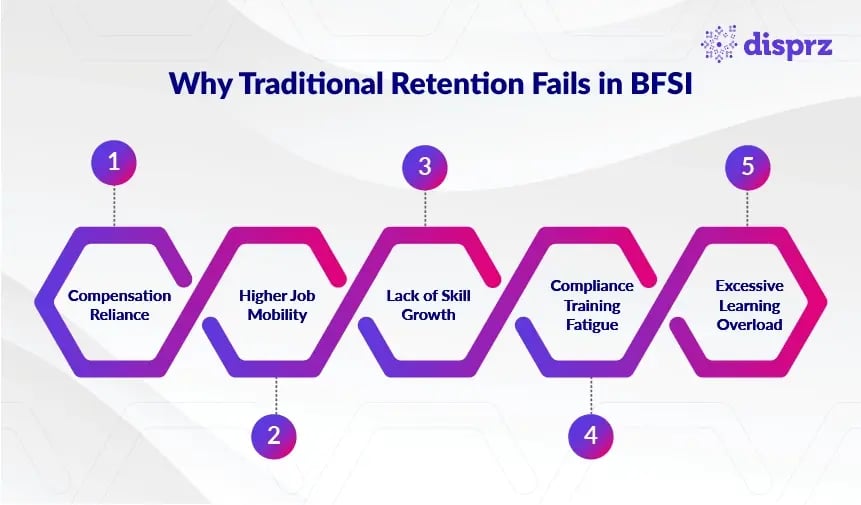
Compensation Isn’t Enough
Pay hikes and incentives may slow exits temporarily, but they rarely build long-term loyalty. In a competitive market, compensation is easily matched (and often surpassed) by the next employer. When employees don’t see meaningful skill growth or future opportunities, higher pay alone won’t solve talent retention in BFSI. Over time, this approach becomes expensive and unsustainable, without delivering real improvements in banking workforce retention.
Job Mobility as a Cultural Trend
Job hopping is no longer viewed as a risk, especially among Gen Y and Gen Z professionals. Frequent role changes are often seen as the fastest way to gain new skills, exposure, and career acceleration. For BFSI organizations, this shift has made employee retention in banking far more complex. If internal growth feels slower than external opportunities, attrition becomes the default outcome.
Limited Focus on Skill Growth
One of the biggest drivers of churn is the absence of clear, structured learning pathways. Many employees struggle to see how today’s role connects to tomorrow’s opportunities; whether in wealth advisory, risk analytics, digital onboarding, or leadership. Without visible skill progression, talent management in BFSI becomes reactive, and high performers are the first to leave.
Compliance Fatigue and Learning Overload
Regulatory training is unavoidable in BFSI; but how it’s delivered often creates fatigue. Annual, box-ticking programs overwhelm employees without helping them apply learning on the job. This constant compliance load, combined with limited time for career-focused learning, directly impacts employee engagement in the banking sector and accelerates attrition.
In short, traditional approaches focus on retention as an outcome. What’s missing is a focus on skills as the driver; making it harder to achieve sustainable talent retention in financial services.
A Skills-First Talent Retention Framework for BFSI
If you want to make talent retention in BFSI sustainable, you need to shift the conversation from “How do we stop people from leaving?” to “How do we help people grow here?” A skills-first framework does exactly that by aligning business priorities, role evolution, and employee aspirations into a single, measurable system. This mirrors a structured capability building model where skills are mapped to performance outcomes and future-ready roles.
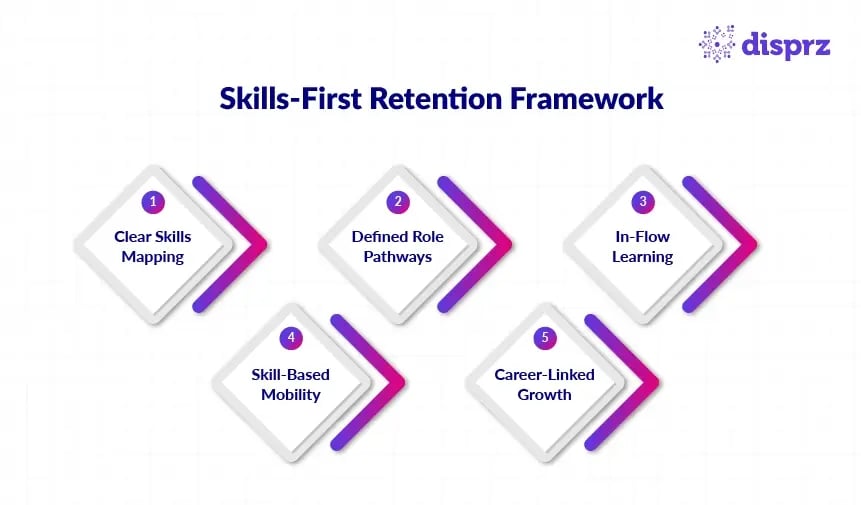
Skills Mapping and Future Role Pathways
Start by identifying the skills that will define success in the next 2–3 years; not just today’s job descriptions. For BFSI, this includes capabilities across wealth advisory, risk analytics, digital onboarding, and compliance automation. By mapping these skills to current and future roles, you give employees visibility into what growth actually looks like.
When employees understand which skills move them from RM to senior advisor, from operations to risk, or from compliance to analytics, employee retention in banking improves naturally. Clear pathways turn uncertainty into intent; and intent into loyalty. Over time, this structured growth builds learning agility, the ability to adapt, reskill, and take on evolving roles across wealth, risk, and digital functions, which is essential for long-term retention in a rapidly changing BFSI landscape.
Continuous, In-Flow Learning
Traditional classroom programs can’t keep pace with how fast BFSI roles are changing. What works better is continuous, in-flow learning, often delivered through microlearning modules that are short, contextual, and embedded into daily workflows. This could be product refreshers before client meetings, compliance nudges during onboarding workflows, or data insights training aligned with live portfolios.
By integrating learning into work, you reduce friction, improve application, and strengthen employee engagement in the banking sector; without adding to learning fatigue.
Internal Mobility and Career Pathing
One of the most effective ways of reducing attrition in banking is enabling employees to grow without leaving. Transparent, skill-based internal career mobility allows talent to move across functions (wealth advisory, risk, digital, or operations) based on capability, not tenure.
When internal roles are clearly linked to skills, employees see long-term careers instead of short-term jobs. This directly supports retention of relationship managers, strengthens banking workforce retention, and builds a resilient internal talent pipeline.
A skills-first framework doesn’t just improve learning outcomes; it transforms talent management in BFSI into a strategic growth engine.
What Leading BFSI Organizations Are Doing Differently
Across India’s BFSI landscape, forward-looking organizations are rethinking how they approach talent retention in BFSI. Instead of relying on reactive fixes, they’re building systems that connect skills, performance, and business outcomes; making employee retention in banking both intentional and measurable.
One clear shift is toward data-driven talent planning. Leading banks and financial institutions are using skills and attrition data together to identify high-risk roles (especially relationship managers and compliance specialists) and proactively invest in targeted upskilling. This helps protect AUM growth by reducing RM churn and improving client continuity.
Another differentiator is manager-led coaching. High-performing BFSI organizations recognize that managers play a critical role in banking workforce retention. By equipping managers with visibility into team skills, learning progress, and performance gaps, they enable more meaningful career conversations. This directly improves employee engagement in the banking sector and strengthens retention of relationship managers.
You’re also seeing a move toward blended learning ecosystems. Instead of fragmented training programs, learning is delivered through a mix of digital modules, micro-upskilling, peer learning, and on-the-job application. These programs are often tied to real outcomes such as improving RM productivity, strengthening regulatory reporting accuracy, or accelerating digital onboarding.
Finally, learning is being linked to performance reviews through structured learning analytics metrics, allowing leaders to measure how skill development impacts RM productivity, compliance accuracy, and client retention.
Micro-upskilling aligned with specific business metrics (client retention, compliance scores, or advisory effectiveness) helps employees see the direct value of skill development. This approach reinforces talent management in BFSI by showing how growth drives both individual success and organizational performance.
Together, these practices are redefining retention strategies in the banking sector; shifting the focus from preventing exits to enabling long-term value creation.
A 90-Day Talent Retention Action Plan for BFSI Leaders
If talent retention in BFSI feels overwhelming, the solution isn’t a multi-year overhaul; it’s focused, phased action. A 90-day plan helps you move quickly from insight to impact, while building momentum across leadership, managers, and employees.
| Timeline | Key Focus | What You Do | Business Outcome |
|---|---|---|---|
| Days 1–30 | Audit skills & attrition | - Analyze attrition by role, tenure, and performance. - Map current skills across RMs, compliance, risk, and digital teams. - Identify high-risk roles and critical gaps. |
Clear visibility into attrition drivers and priority skill shortages impacting revenue and compliance. |
| Days 30–60 | Define role pathways & gaps | - Create future-ready role pathways for wealth advisory, risk analytics, digital onboarding, and compliance automation. - Align skills to each role and level. |
Stronger employee retention in banking through transparent growth and mobility paths. |
| Days 60–90 | Deploy embedded learning & manager enablement | - Launch role-based, in-flow learning. - Equip managers with skill and progress dashboards. - Enable coaching and career conversations. |
Improved RM productivity, higher engagement, and measurable reduction in attrition risk. |
Enabling Skills-Led Retention Through Enterprise Learning Systems
A skills-first retention strategy only works when it’s supported by the right systems. Without visibility, measurement, and manager enablement, even the best-designed frameworks struggle to scale. This is where enterprise learning systems play a critical role in strengthening talent retention in BFSI; not as content libraries, but as capability engines.
Modern learning platforms such as Disprz help you move beyond fragmented training to a unified view of skills, roles, and performance. Instead of treating learning as an isolated activity, these systems connect skill development directly to business outcomes.
Here’s how system enablement makes a difference:
1) Skills visibility across the organization
You gain a clear view of current and future skills across relationship managers, risk teams, compliance, and digital roles. This transparency supports better talent management in BFSI and enables informed decisions around internal mobility and succession planning.
2) Manager dashboards that drive action
Managers can see skill gaps, learning progress, and on-the-job application at a team level. This empowers them to coach effectively, improving employee engagement in the banking sector and strengthening banking workforce retention.
3) Learning linked to performance outcomes
When learning is tied to real metrics (RM productivity, client retention, regulatory accuracy), it becomes relevant and measurable. Employees see how skill growth accelerates careers, while leaders see how it supports reducing attrition in banking.
Most importantly, enterprise learning systems help shift retention from reactive firefighting to proactive capability building. By embedding skills into daily workflows and career conversations, you create an environment where employees don’t just stay; they grow, perform, and contribute long-term.
If you’re evaluating options, here’s a detailed guide on how to choose the right LMS for your organization.
Key Takeaways
1) Retention is a skill challenge, not just a pay problem. Sustainable talent retention in BFSI depends on how well employees can build future-ready skills; not only on compensation adjustments.
2) Continuous learning drives engagement and loyalty. In-flow, role-relevant learning strengthens employee engagement in the banking sector while improving performance on the job.
3) Skills visibility enables real career pathways. When employees see how skills translate into roles and growth, employee retention in banking improves naturally.
4) Internal mobility reduces attrition risk. Skill-based movement across wealth, risk, digital, and compliance roles supports long-term banking workforce retention.
5) Managers are critical to retention success. Manager-led coaching and data-backed conversations play a major role in retention of relationship managers and specialists.
6) Learning must be linked to business outcomes. Tying upskilling to RM productivity, client retention, and regulatory outcomes makes talent management in BFSI measurable and credible.
7) Skills-first systems make retention scalable. Enterprise learning platforms help operationalize retention strategies in the banking sector at scale.
Conclusion
For India’s BFSI leaders, talent retention can no longer be treated as a short-term HR intervention. In a sector defined by trust, continuity, and expertise, talent retention in BFSI directly influences revenue stability, regulatory confidence, and long-term competitiveness.
As roles evolve across wealth management, risk, compliance, and digital advisory, employees are looking for more than job security; they want clarity, growth, and relevance. Organizations that continue to rely on compensation-heavy approaches will struggle with employee retention in banking, while those that invest in skills-led development will build deeper loyalty and stronger performance.
A skills-first strategy transforms retention from a defensive tactic into a growth lever. By improving skills visibility, enabling internal mobility, and embedding learning into daily work, you create an environment where people choose to stay because they see a future. In doing so, BFSI organizations can reduce attrition in banking, strengthen employee engagement in the banking sector, and build a resilient, future-ready workforce.
For a broader view on building sustainable employee retention programs across industries, explore our comprehensive guide on employee retention strategies.
The message is clear: retention isn’t about holding talent back; it’s about helping talent move forward with you.
The next step is turning this skills-first strategy into an operational reality, with the right systems, visibility, and leadership enablement in place.
FAQs Related to Talent Retention in India's BFSI Sector
1) Why is talent retention a strategic issue for BFSI now?
Talent retention in BFSI has become critical because the sector is facing simultaneous pressures such as rapid wealth creation, rising regulatory complexity, and accelerated digital adoption. Roles such as relationship managers, risk analysts, and compliance specialists are harder to replace, and high attrition directly impacts client continuity, AUM growth, and regulatory confidence. This makes employee retention in banking a business risk, not just an HR concern.
2) How do skills and learning influence retention?
Skills and learning give employees a reason to stay. When people can clearly see how developing new capabilities leads to better roles, performance, and career progression, engagement improves. Structured, continuous learning reduces uncertainty, strengthens employee engagement in the banking sector, and supports long-term talent retention in financial services.
3) Can L&D alone solve retention challenges?
No. While learning is a powerful lever, retention requires alignment across managers, career pathways, performance systems, and leadership intent. L&D works best when it enables skills visibility, supports internal mobility, and equips managers to coach; making talent management in BFSI a shared responsibility.
4) What should BFSI leaders measure to track retention success?
Beyond attrition rates, leaders should track skill readiness for critical roles, internal mobility rates, RM productivity, client retention, and learning application on the job. These metrics help link learning investments to outcomes such as reducing attrition in banking and improving business performance.
5) What role do managers play in improving talent retention in BFSI?
Managers are central to retention. They shape daily experience, provide career guidance, and reinforce learning applications. When managers have visibility into skills and progress, they can hold better development conversations; directly improving retention of relationship managers and overall banking workforce retention.
6) How does internal mobility reduce talent churn in BFSI?
Internal mobility allows employees to grow without leaving the organization. Skill-based movement across wealth advisory, risk, digital, or compliance roles keeps careers dynamic and relevant, significantly improving employee retention in banking and lowering external hiring dependency.
7) How can BFSI organizations balance regulatory training with employee career growth?
The key is integration, not separation. Compliance learning should be contextual, role-based, and embedded into workflows, while career-focused upskilling runs in parallel. This balance reduces learning fatigue, improves employee engagement in the banking sector, and supports sustainable talent retention in BFSI.