
On this page
An AI learning assistant is software that uses artificial intelligence to help an employee learn while they work. An AI learning assistant answers questions from approved company content, explains processes in plain language, generates practice and assessment, and recommends what the employee should learn next. In an enterprise, an AI learning assistant supports a learning platform rather than replacing it.
Search results for this term are still dominated by classroom tutors built for students. The enterprise version of the same idea solves a different problem. It is not there to help someone pass an exam. It is there to help a claims processor, a store manager, or a relationship manager do the task correctly on a Tuesday afternoon.
Key points
- An AI learning assistant sits inside the work, not beside it in a separate portal.
- The value of an AI learning assistant depends entirely on which sources it is allowed to answer from.
- In an enterprise, an AI learning assistant supplements a system of record rather than replacing one.
- AI learning assistants for employee training answer questions in the flow of work, generate practice, and personalise what comes next. They are a delivery and support layer, not a system of record.
- There are five practical types: embedded workflow assistants, practice and role play simulators, adaptive learning engines, technical mentors, and content generation assistants for L&D teams.
- The AI learning assistants vs LMS question is not either or. The LMS holds the record, the standard, and the audit trail. The assistant improves how learning reaches people. Replacing one with the other creates a compliance gap.
- Most enterprise failures are governance failures, not model failures. IBM found the average organisation logs 54 AI agent incidents a year requiring human correction, with 17% triggering compliance issues.
- Expected outcome: A clear taxonomy of what these tools actually do, an evaluation checklist you can take to a vendor, and a view of where agentic AI goes further than an assistant.
Why are AI learning assistants suddenly on every L&D roadmap?
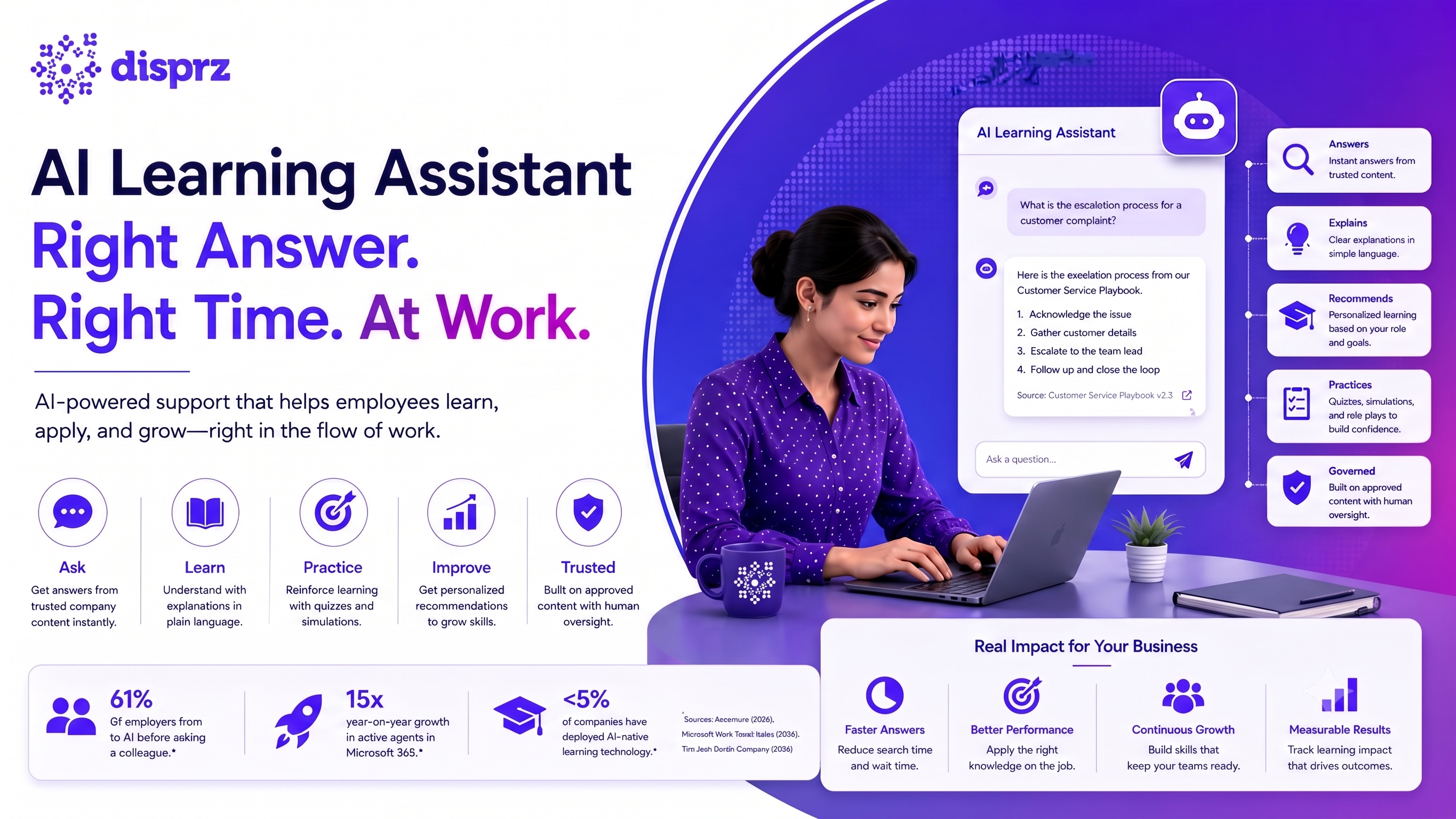
AI learning assistants are on every L&D roadmap in 2026 because employees adopted general purpose AI faster than L&D governed it. Accenture found 61% of employees now turn to AI before asking a colleague, while the Josh Bersin Company found fewer than 5% of companies have deployed AI native learning technology.
Because employees already adopted them, with or without approval.
Accenture's Pulse of Change research, published in July 2026, found that 61% of employees now turn to AI before they turn to a colleague. Gartner's May 2026 survey of 12,004 employees and managers across 40 countries found that 88% of employees with enterprise AI access also use personal AI tools alongside it.
Read those two numbers together and the implication for L&D is uncomfortable. Your workforce has already replaced the intranet search box and the "quick question" to a supervisor with a general purpose chatbot that has never read your standard operating procedures.
Volume on the tooling side is moving just as fast. Microsoft's 2026 Work Trend Index, published in May 2026, reported 15 times year on year growth in active agents inside Microsoft 365, rising to 18 times in large enterprises.
L&D functions, meanwhile, are barely in the game. The Josh Bersin Company's February 2026 research on the $400 billion corporate training market found that fewer than 5% of companies have deployed AI native learning technology and fewer than 10% have any strategy for applying AI in L&D. In the same research, 74% of senior leaders said their companies lack the skills to compete, and 75% still treat learning as a task separate from work.
So the question facing a Head of L&D in 2026 is not whether to allow AI into learning. It is whether the version employees use will be governed by you or by nobody.
Simple: Employees are already asking AI for help at work. An AI learning assistant is how you make sure the answer comes from your approved material.
What is an AI learning assistant, and how does it work?
An AI learning assistant works in four steps. It retrieves relevant content from an approved source set, generates a plain language answer with a citation, logs the interaction, and then assigns practice or updates the employee's skill record. Accuracy depends on source control, not on the model.
An AI learning assistant is a layer of AI that supports an employee through the learning cycle: understanding a concept, practising it, being assessed on it, and being pointed at what to do next.
Mechanically, most enterprise deployments follow the same sequence. The assistant is connected to a defined body of approved content. When an employee asks a question, it retrieves the relevant passage and generates a plain language answer with a citation back to the source. It logs the interaction. Where it is integrated with a learning platform, it can assign a short module, generate a practice question, or update a skill record.
The part that determines whether it works has nothing to do with the model. It is source control. An assistant pointed at a curated, versioned, owned content set behaves like a knowledgeable colleague. The same assistant pointed at an unsorted shared drive confidently repeats a policy that was retired eighteen months ago.
The four mechanics that decide whether it works
- Retrieval. The assistant looks up your approved content before answering, rather than answering from general training data.
- Grounding. Responses are restricted to a defined source set, so the assistant cannot improvise beyond your documentation.
- Citation. Every answer shows which document and version it came from, so an employee can verify it and an auditor can trace it.
- Refusal. The assistant says it does not know rather than guessing. This is a feature, not a defect, and it is the single most important behaviour to test in a regulated function.
Alongside those four, one governance concept matters more than any technical setting. Human in the loop means a named person approves AI generated content before a learner sees it. It is also the point where an assistant differs from agentic AI, which executes whole workflows and therefore needs the review gate designed into the process rather than added afterwards.
Mistake: Judging an AI learning assistant on how fluent its answers sound. Fluency is free in 2026. What you are buying is whether it refuses to answer when your documentation does not cover the question.
What are the types of AI learning assistants for employee training?
There are five types of AI learning assistants for employee training: embedded workflow assistants that answer task questions in the flow of work, practice and role play simulators, adaptive learning engines that sequence what an employee learns next, technical and process mentors, and content generation assistants used by L&D teams.
The category is broader than a chat window. These five types solve different problems, sit with different budget owners, and carry different risk profiles.
1. Embedded workflow assistants
An embedded workflow assistant lives inside the tools employees already use and answers task level questions at the moment. "What is the escalation path for a disputed transaction?" "Which form does a customer need for an address change?"
Best for: Reducing repeat questions to supervisors and cutting search time.
Main risk: Answer accuracy, since employees act on the response immediately.
2. Practice and role play simulators
A practice simulator plays a customer, a patient, an auditor, or a difficult stakeholder, and the employee rehearses the conversation. Post session analysis scores what happened and recommends what to work on.
Best for: Customer facing and judgment heavy roles where the real world cost of practising on a live person is high.
Main risk: Scoring that measures fluency rather than compliance with your actual process.
3. Adaptive learning engines
An adaptive learning engine decides what an employee should learn next based on assessment results, role, and observed performance, then reshapes the pathway continuously.
Best for: Large populations in the same role at very different capability levels.
Main risk: A recommendation engine with no role standard behind it optimises for engagement instead of readiness.
4. Technical and process mentors
A technical mentor explains a system, a codebase, or a piece of equipment while the employee is working on it, and teaches the reasoning rather than just supplying the fix.
Best for: IT, engineering, and operations teams onboarding onto complex internal systems.
Main risk: Drifting out of date faster than any other type, because the underlying system changes weekly.
5. Content generation assistants for L&D teams
The user here is not the learner. It is your team. A content generation assistant converts existing SOPs, product documents, and policy files into structured learning, assessments, and video, compressing a build cycle that used to run for weeks.
Best for: L&D functions with more source material than production capacity.
Main risk: Publishing at machine speed without a human review gate.
Market: Accenture's July 2026 research found 49% of companies are piloting or deploying AI agents, while the share reporting widespread, sustained business value from AI fell to 23% from 32% earlier in the year. Deployment is outrunning results, which is a strong argument for starting with type five, where the output is reviewed before anyone learns from it.
AI learning assistants vs LMS: what is the actual difference?
An LMS is the system of record that assigns learning, tracks completion, and produces audit evidence. An AI learning assistant is an interaction layer that explains, generates practice, and recommends what to learn next. An LMS proves training happened. An AI learning assistant makes learning easier to reach. Enterprises need both.
This is the question that derails most evaluations, usually because a vendor has framed it as a replacement decision. It is not one.
| Dimension | Learning management system | AI learning assistant |
|---|---|---|
| Primary job | Record, assign, certify, and prove | Explain, practise, generate, and recommend |
| Unit of work | The course, the curriculum, the compliance cycle | The question, the task, the individual gap |
| Where the employee meets it | A platform they log into | The tool or moment they are already in |
| Output | Completion records, certification status, audit evidence | Answers, practice sessions, generated content, next best action |
| Governance model | Version controlled, permissioned, auditable by design | Only as governed as its source set and review gates |
| What breaks without it | You cannot prove anyone was trained | Learning is available but slow to reach and slow to build |
The practical answer for an enterprise is that the assistant should be a capability of the platform, not a parallel tool beside it. When the two are separate, three problems appear quickly. Interactions do not reach the employee record, so the assistant's usage tells you nothing about capability. The assistant answers from a content set nobody reconciled with the compliance library. And your auditors are shown a completion report that has no relationship to where the learning actually happened.
This is why most serious evaluations now converge on an AI LMS rather than a standalone assistant. The record and the interaction layer need to share one source of truth.
Mistake: Treating an assistant as an LMS replacement because it is cheaper and staff prefer it. You will discover the gap during your next audit, when there is no dated evidence that a named individual was trained on a specific version of a policy.
What can AI learning assistants do for employee learning?
AI learning assistants for employee learning support onboarding, just in time process help, practice before live customer exposure, assessment generation, personalised learning sequences, content production from existing documents, and training needs analysis drawn from what employees actually ask.
Across the learning lifecycle, these are the applications with the clearest return.
Applications with the clearest return
- Onboarding support: New hires ask the questions they are reluctant to ask a manager twice, and get a consistent answer every time. This is where high turnover populations see the fastest return, since the assistant absorbs the repetitive load that currently sits with supervisors.
- Just in time process help: The employee is mid task and needs one specific step. Serving that step is worth more than serving a course about the process.
- Practice before live exposure: Sales conversations, service recovery, and compliance conversations get rehearsed against a simulated counterpart, with feedback, before the employee faces a real customer.
- Assessment generation: Turning policy and product material into quizzes and scenarios removes the constraint that usually limits how often you can assess anyone.
- Personalised sequencing: Assessment results and role data decide what the employee sees next, so two people in the same job at different levels do not receive an identical journey. This works only where a skill gap analysis has established what the role actually requires.
- Content production at L&D speed: Existing documentation becomes structured learning in hours rather than weeks, which matters more than any other item on this list when your team is smaller than your backlog.
- Demand signal for L&D: The aggregated question log is the most honest training needs analysis your function will ever get. When 300 people ask the same thing in a month, that is not an AI insight, it is a broken process you can now see.
What are the benefits of AI learning assistants for employee training?
The benefits of AI learning assistants for employee training fall into three groups: speed and cost, through faster content production and lower supervisor load; quality and consistency, through one approved answer delivered identically everywhere; and visibility, through question data that shows what the workforce does not understand.
Only the first group is usually quantified before purchase.
1. Speed and cost
- Faster content production, which converts L&D from a bottleneck into a service.
- Lower supervisor load, since repeat questions are answered without interrupting a senior person.
- Shorter time to productivity, because support arrives at the moment of need instead of at the next scheduled session.
2. Quality and consistency
- One approved answer, delivered identically across every location and shift.
- Practice at volume, so employees rehearse difficult situations more than once a year.
- Immediate policy propagation. Update the source document and the guidance changes everywhere at once.
3. Visibility
- A live view of what the workforce does not understand, drawn from real questions rather than a survey.
- Practice and assessment data that shows capability movement, which matters given that ATD's 2026 State of the Industry report found fewer than a quarter of organisations measure whether training achieved its organisational goals at all.
There is a strategic benefit too, though it needs care. Bersin's 2026 research found AI first learning organisations were six times more likely to exceed financial targets. That correlation reflects organisational maturity as much as tooling. Buying the software does not import maturity.
Where do AI learning assistants fail in enterprise deployments?
AI learning assistants fail for four reasons: ungoverned source content, no named owner for the content set, deployment as a separate portal instead of inside the workflow, and untrained managers. IBM found 77% of technology leaders say AI adoption is outpacing their governance capability.
Almost never in the model. Each failure mode has an early warning sign you can look for.
- Ungoverned sources. The assistant is pointed at everything, so it answers from superseded documents. The signal is employees quoting guidance nobody recognises. McKinsey's State of AI trust research, published in March 2026, found 74% of organisations identify inaccuracy as a highly relevant risk, and nearly two thirds cite security and risk concerns as the top barrier to scaling agentic AI.
- No ownership. Nobody is accountable for the content set, so it decays. IBM's June 2026 study found two thirds of CIOs and CTOs are accountable for AI systems they do not fully control, and 77% say adoption is outpacing their governance capability. The same study puts the average at 54 agent incidents a year requiring human correction, with 37% resulting in data exposure and 17% triggering compliance issues.
- No design for how people work. The assistant is deployed as another portal, and adoption stalls. Deloitte's 2026 Global Human Capital Trends research found only 6% of leaders report progress in designing human and AI interactions, and 42% of workers say their organisation is not evaluating AI's impact on people at all.
- No manager layer. Managers do not know how to use it or how to coach with its output. Gartner's March 2026 survey found 46% of managers are experimenting with AI against 26% of employees, but only 14% of managers say they face no challenges driving effective use across their teams. Accenture found that 36% of both C-suite leaders and employees identify middle management as the single largest AI capability gap in the organisation.
The fifth, quieter failure. Gartner found only 7% of organisations provide any guidance on what employees should do with the time AI saves them. Time released with no plan attached does not show up as productivity in any report.
How should you evaluate AI learning assistants before you buy?
Evaluate an AI learning assistant on nine criteria: source control and update speed, refusal behaviour, citation of source versions, whether your data trains the vendor's models, security certifications, human review gates, integration with existing tools and the learning record, analytics and audit logging, and frontline usability on mobile.
Take this to the vendor. The answers separate a governed enterprise tool from a demo.
- Source control. Which content can it answer from, who approves that set, and how quickly does an update propagate? Ask to see the behaviour when a document is superseded.
- Refusal behaviour. What does it do when your material does not cover the question? A tool that always produces an answer is a liability in a regulated environment.
- Citation. Does every answer show its source document and version, so an employee can verify and an auditor can trace?
- Data handling. Will your proprietary content or employee interaction data be used to train the vendor's models? Get this in writing rather than in a slide.
- Certifications. Confirm the specific standards rather than accepting "enterprise grade". ISO 27001, SOC 2, and the privacy regimes that apply in your markets.
- Human review gates. For any generated content, where does a named human approve before publication? Machine speed publishing without a gate is how a wrong policy reaches 5,000 people in an afternoon.
- Integration. Does it work inside the tools your workforce already opens, and does it write back to the employee learning record?
- Analytics. Can you see aggregated question trends, individual capability movement, and an audit log of what the assistant told people?
- Frontline reality. If a large part of your workforce is deskless, does it work on a personal phone, in the local language, on an unreliable connection?
One question separates the serious vendors. Ask them to show you the audit log of what their assistant has told employees. If that log does not exist, you cannot deploy the tool in a regulated function, whatever the demo looked like.
Why do regulated industries need stricter controls on AI learning assistants?
Regulated industries need stricter controls because a confident wrong answer becomes a regulatory finding rather than a poor learning experience. Banking, insurance, healthcare, manufacturing, and retail all require that answers be grounded in current policy, that the assistant escalates high risk questions, and that every interaction is logged and traceable to a document version.
What each regulated sector demands
- Banking and financial services. The assistant must be grounded in current policy on suitability, KYC, and anti money laundering, and must refuse rather than interpret. Version control matters as much as accuracy, since the question at audit is what the employee was told on a specific date.
- Insurance. Claims and underwriting guidance changes often and varies by product and jurisdiction. An assistant that blends two product rules into one plausible answer creates mis-selling exposure.
- Healthcare and pharma. Clinical and privacy questions need a hard boundary between what the assistant explains and what it must escalate to a qualified person. Practice simulation is valuable here precisely because live practice is not an option.
- Manufacturing. Safety procedure retrieval at the machine is a strong use case, and also the one with the least tolerance for error. Grounding must be exact and the assistant should point to the controlling document, not summarise it loosely.
- Retail and hospitality. The pressure is turnover rather than regulation, though age restricted sales and food safety carry real legal exposure. Consistency across shifts and locations is the whole value.
The common requirement across all five is evidentiary. A regulator generally wants to see that a named individual was trained and assessed on a specific version of a rule at a specific time. An assistant on its own cannot produce that. The platform behind it has to.
Regional context makes this sharper. Deloitte's March 2026 research on Indian enterprises found 40% of Indian respondents reporting significant or full AI usage against a global average of around 28%, with 61% building capability through upskilling and reskilling programmes. In the same research, regulatory and compliance requirements were named the single biggest AI integration challenge at 39%. Adoption is ahead of the global curve and governance is the constraint, not appetite.
Simple: In a regulated function, the useful test is not what the assistant knows. It is whether you can prove afterwards what it said.
How do you roll out an AI learning assistant without losing control?
Roll out an AI learning assistant in six steps: pick one bounded use case, curate and version the source content before connecting anything, define the escalation boundary, pilot against a control group for 60 to 90 days, enable managers, then instrument and scale. Curating the source set first is the step that decides the outcome.
- Pick one painful, bounded use case One role, one process, one question set. Onboarding for a high volume role or a single compliance topic works well.
- Curate and version the source set before anything is connected Decide what is authoritative, retire what is not, and name an owner for that library. This step is unglamorous and it determines the outcome.
- Define the escalation boundary Write down which questions the assistant answers and which it must hand to a human. Make refusal an explicit success criterion, not an edge case.
- Pilot against a control group Run 60 to 90 days with a comparison population still using the current approach. Track accuracy, time to competency, and error rates rather than satisfaction alone.
- Enable managers deliberately Given that middle management is the acknowledged capability gap, brief managers on how to read the assistant's output and coach from it before you roll out to their teams.
- Instrument, then scale Review the question log monthly, fix the underlying process the questions expose, and expand only into use cases where you have a governed source set ready.
The case for the discipline. IBM's June 2026 data found organisations with embedded controls deployed 16 times more agents while recording 25% fewer incidents. Governance is not the brake on scale, it is the thing that permits it.
What should you measure to prove an AI learning assistant works?
Measure four things: answer accuracy and appropriate escalation rate, time to productivity against a control group, applied performance such as error rates or conversion in the population using the assistant, and content build time per learning hour. Usage volume proves nothing on its own.
The four measures that matter
- Accuracy and containment: Percentage of answers verified correct on sampling, percentage escalated appropriately, and the rate of answers traced to a superseded source. Sample this continuously, not once at go live.
- Speed to capability: Time to productivity for new hires in the pilot population against the control group, and reduction in supervisor time spent on repeat questions.
- Applied performance: Error rates, quality scores, first contact resolution, sales conversion, or safety incidents in the population using the assistant. This is the number that funds year two.
- Content throughput: Build time per learning hour, and the age of your oldest live module. If the assistant is doing its job on the production side, the average age of your content should be falling.
Two cautions on interpretation. Gartner found 19% of employees reported no time saved at all with AI, and only 20% of executives believe their workforce is genuinely AI ready. And PwC's 2026 Global CEO Survey, covering 4,454 CEOs across 95 countries, found only 12% saying AI has delivered both cost and revenue benefits while 56% report no significant financial benefit yet. Averages hide wide variance. Measure your own deployment rather than assuming the case is proven.
Southeast Asia is a useful counterweight to that caution. Microsoft's regional 2026 Work Trend Index cuts found 33% of Indonesian workers and 24% of Malaysian workers qualifying as Frontier Professionals against 16% globally, with 93% of Indonesian and 92% of Malaysian AI users treating AI output as a starting point rather than a final answer. In the Gulf, PwC's Middle East CEO findings from January 2026 show 82% of regional CEOs saying their culture enables AI adoption and 70% holding a defined AI roadmap. Workforce readiness for these tools is stronger in your markets than the global averages suggest.
Which platforms support AI powered learning at enterprise scale?
Enterprises generally want AI capability inside the platform that already holds the role standard and compliance record. Disprz, Cornerstone OnDemand, SAP SuccessFactors, Litmos, and TalentLMS each address different parts of that need, and the differentiator is whether the AI is grounded in your content, human reviewed before publication, and recorded against the employee profile.
Standalone assistants are easy to buy and hard to govern. The table below maps established AI learning platforms to what each is strongest at, based on how these products are positioned in the market today.
| Platform | Strongest AI capability | Best fit use case | Benefit for L&D leaders |
|---|---|---|---|
| Disprz | Agentic AI content production through Turo, AI powered roleplay and coaching through Sales Coach, AI curated pathways, and AI powered quiz authoring, all inside one LMS, LXP, and skills stack | Enterprises that need to produce role specific learning fast and reach desk, retail, and field populations, particularly in India, the Middle East, and Southeast Asia | Content built in hours with human review at every step, and AI output that lands in the same platform as the skill and compliance record |
| Cornerstone OnDemand | Skills intelligence and talent mobility AI within a broad talent management suite | Very large, complex organisations connecting learning to performance and career workflows | Deep talent suite breadth and mature global compliance reporting |
| SAP SuccessFactors | AI assistance surfaced through the wider SAP and Microsoft ecosystem | Enterprises already standardised on SAP for core HR | Native SAP connectivity and strong workforce governance |
| Litmos | AI assistant, AI generated playlists, AI content authoring, and video assessment | Extended enterprise training across employees, partners, and customers | Fast rollout with a large off the shelf catalogue alongside the AI features |
| TalentLMS | Straightforward automation and a low friction learner experience | Smaller teams and business units with generic training needs | Simple administration and accessible pricing |
Every option there serves a genuine need. The differentiator for an AI first programme is narrower than a feature list: whether the AI is grounded in your content, reviewed by a human before publication, and recorded against the same employee profile your auditors will ask about.
How does agentic AI differ from an AI learning assistant?
An AI learning assistant responds to a request. Agentic AI executes a multi step workflow independently, for example taking an L&D outcome and building, quality checking, and publishing a complete learning experience, with human review at defined gates.
The distinction is doing real work in the market, and Disprz sits deliberately on one side of it. Disprz makes that contrast explicit in its own positioning of Turo, describing it as an agentic AI that builds learning content rather than an assistive tool that answers questions or recommends content.
In practice that looks like this.
What agentic AI looks like in practice
- Content production: You define the L&D outcome. Turo determines the formats, builds the experience, runs an automated quality review, and publishes across the stack. Disprz states 4X faster than traditional production, with roughly four minutes of work per minute of finished content including human review, across 12+ languages with cultural adaptation and 6+ auto generated learning formats. It is described as platform neutral, so it can publish into an existing LMS.
- Human in the loop by design: Disprz describes human review at every stage, which is the control most relevant to the IBM finding on incidents. The gate is in the workflow rather than bolted on after a problem.
- Practice and coaching: Sales Coach, the practice layer built on Turo, generates a realistic AI customer for a two way roleplay with no script, then produces post session analysis covering missed moments, talk ratios, and filler words, plus a personalised coaching plan. Managers see score trends and readiness data without sitting in on every session.
- Personalisation against a role standard: AI curated journeys adapt to each person's gaps, mapped against a skill based taxonomy tied to job roles, which is what stops recommendation from drifting into engagement for its own sake.
- Enterprise controls: Disprz lists ISO 9001, ISO 27001:2022, SOC 2, GDPR, and CCPA, with role based access controls and SAML 2.0 and OAuth 2.0 for authentication, plus pre built connectors for HRIS, HCM, SSO, and collaboration tools including Teams, Slack, Zoom, Meet, and Okta.
For enterprises in India, the Middle East, and Southeast Asia, regional depth is worth weighing alongside capability, since global vendors often have limited local reference cases. Disprz reports 500+ enterprise customers, 3.5 million learners, and presence across 25+ countries. Treat that as one input to your evaluation rather than a conclusion, and run the checklist above on any vendor including this one.
Conclusion
AI learning assistants are useful, and they are not the decision most L&D teams think they are facing. Employees have already adopted general purpose AI for work questions. The real choice is whether the answers they get are grounded in your approved material, logged, and connected to the record that proves competence.
That reframes the buying question. Instead of asking which assistant is smartest, ask which one you can govern: what it is allowed to read, what it does when it does not know, who approves what it generates, and whether its output lands on the employee record.
The 2026 evidence is consistent that governance, not capability, is where these programmes succeed or fail. Adoption is outpacing control, middle managers are the acknowledged gap, and organisations with embedded controls scale further with fewer incidents.
If you are early in this, start with one bounded use case, curate the source set before you connect anything, and instrument the pilot properly. The question log alone will tell you more about your training gaps than your last needs analysis did.
Frequently asked questions
What are AI learning assistants?
AI learning assistants are software tools that use artificial intelligence to help employees learn while they work. They answer questions from approved company content, explain processes in plain language, generate practice and assessment, and recommend what to learn next.
What is an AI learning assistant in simple terms?
An AI learning assistant is a digital coach for work. Instead of sending an employee to a course, it answers the specific question they have right now, using the company's own approved documents, and then offers a short piece of practice.
How do AI learning assistants work?
An AI learning assistant retrieves relevant content from an approved source set, generates a plain language answer with a citation to the source document, logs the interaction, and where integrated with a learning platform, assigns practice or updates the employee's skill record.
What are the types of AI learning assistants?
There are five types: embedded workflow assistants that answer task questions inside daily tools, practice and role play simulators, adaptive learning engines that sequence what to learn next, technical and process mentors, and content generation assistants used by L&D teams.
What is the difference between AI learning assistants and an LMS?
An LMS is the system of record that assigns training, tracks completion, and produces audit evidence. An AI learning assistant is an interaction layer that explains, generates practice, and recommends. An LMS proves training happened. An assistant makes learning easier to reach.
Can an AI learning assistant replace an LMS?
No. An AI learning assistant cannot produce the dated, per individual completion and certification evidence that regulators and auditors require. Replacing an LMS with an assistant removes the audit trail while keeping the training obligation.
About the authors


Madhu Karunakaran
Vice President - People & Culture
Madhu Karunakaran is a senior HR and Learning & Development (L&D) leader with 20+ years of experience spanning people strategy, organizational development (OD), talent management, leadershi...
Reviewed for accuracy on 14 Sep 2026