

On this page
Think about the last time a sales rep lost a deal they should have won. The issue was probably not product knowledge. They knew the pitch, completed the certifications, and could present the deck flawlessly. The breakdown happened in the conversation itself.
Perhaps the buyer pushed back with, "We've tried something like this before and it didn't work." Or challenged the business case. Or raised an unexpected objection. In those moments, success depends on judgment, confidence, and the ability to navigate uncertainty in real time.
Those skills are rarely built through traditional training. They develop through repeated practice in realistic scenarios, followed by immediate, actionable feedback. Until recently, delivering that kind of coaching at scale required dedicated managers, packed calendars, and a level of consistency most sales organisations struggled to sustain.
That is beginning to change. The rise of Agentic AI is making high-quality sales coaching available on demand, creating an environment where reps can practise critical conversations, receive contextual feedback, and improve through continuous simulation. Instead of waiting for a manager's availability, they can build confidence through repeated, realistic interactions whenever they need to.
In this blog, we explore how Sales Coach by Turo uses Agentic AI to make that possible, how it works, and why L&D teams are uniquely positioned to lead this shift.
Why Coaching Doesn't Scale — and What That Actually Costs
The data on coaching frequency makes the case clearly. Reps who receive weekly coaching attain 76% of quota; those coached quarterly land at 47%. That 29-point gap doesn't come from talent or motivation — it comes from how often a rep gets meaningful feedback on their conversations.
Most sales managers understand this. The reality is that running a genuine, skill-focused coaching session with twelve direct reports every week is not operationally possible alongside everything else the role demands. So what happens instead is call reviews, pipeline check-ins, and the occasional deal debrief - a rhythm designed for deal management, not skill development.
L&D has tried to bridge this gap with e-learning modules, competency frameworks, and LMS-based reinforcement. These interventions do a good job of building product knowledge and sales methodology. What they cannot do is replicate the experience of being in a conversation with a skeptical buyer and having to think on your feet. That capability only comes from practice and until recently, there was no way to deliver it at scale.
Introducing Sales Coach by Turo
Sales Coach is a purpose-built AI coaching agent within Turo, Disprz's practice and coaching layer. It puts every sales rep inside realistic, voice-led buyer simulations built from your own product knowledge and sales playbook and delivers detailed, moment-by-moment feedback on every conversation.
The gap it closes is not a knowledge gap. It is a repetitions gap: the difference between a rep who has been told how to handle a skeptical CFO and one who has done it twenty times in a safe environment before walking into that room. Sales Coach creates those repetitions without depending on a manager's availability, a training calendar, or a live deal to practice on.
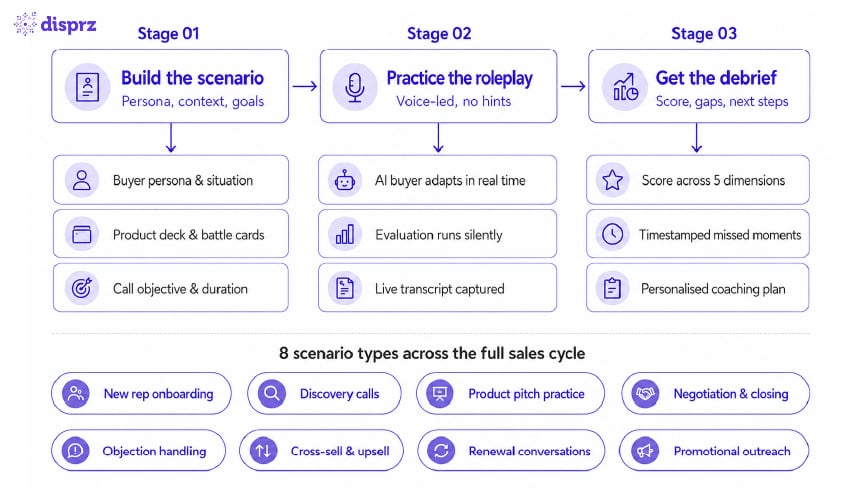
The workflow runs in three stages.
Stage 1: Build the scenario
Before any session begins, you configure the simulation. This is where the specificity lives and it's what separates Sales Coach from generic AI roleplay tools.
You define the buyer persona at the level of detail that actually makes the simulation useful: name, title, buyer type, seniority, decision role, emotional state at the start of the call, prior knowledge of your category, and decision-making style. A quick-setup mode gets you running in minutes; a full customisation flow lets you write the buyer's backstory, set what they already know about your company, and define exactly what success looks like for this specific conversation.
Alongside the persona, you set the context- industry, deal stage, call objective, and duration, and upload your product deck, competitive battle cards, and SOPs. Sales Coach uses that material to calibrate the AI buyer, so the simulation is grounded in your actual product positioning and your real competitive landscape, not a generic sales scenario someone else built.
Stage 2: Practice the roleplay
The rep enters a two-way, voice-based simulation with the AI buyer with no hints, no scripts, no safety net. The rep plays themselves; the AI plays the customer and adapts dynamically to everything the rep actually says.
If the rep builds rapport and asks good discovery questions, the buyer opens up. If the rep pitches too early or handles an objection defensively, the buyer gets more resistant. The AI doesn't follow a fixed path; it behaves the way a real buyer would, which is what makes the practice meaningful.
One deliberate design decision worth noting: the AI evaluation runs entirely silently. No scores appear mid-call, no hints surface during the conversation, no prompts tell the rep they're losing ground. The rep only sees their full debrief after the call ends exactly the way a real conversation works. Many roleplay tools break the simulation by surfacing real-time feedback mid-session, which turns practice into a guided exercise rather than a genuine test of readiness. Sales Coach doesn't. You find out how you did when it's over, which is what makes the improvement loop meaningful.
Sales Coach covers eight scenario types across the full sales cycle: new rep onboarding, discovery calls, product pitch practice, negotiation and closing, objection handling, cross-sell and upsell, renewal conversations, and promotional outreach, each configurable against your buyer profiles and your specific product context.
Stage 3: Get the post-session debrief
This is where the coaching infrastructure lives.
After every session, the rep receives a full post-call analysis: an overall score against their target, a breakdown across discovery quality, needs uncovering, solution positioning, objection handling, and closing discipline, and a replay of the call with timestamped annotations flagging the exact moments where the conversation succeeded or broke down.
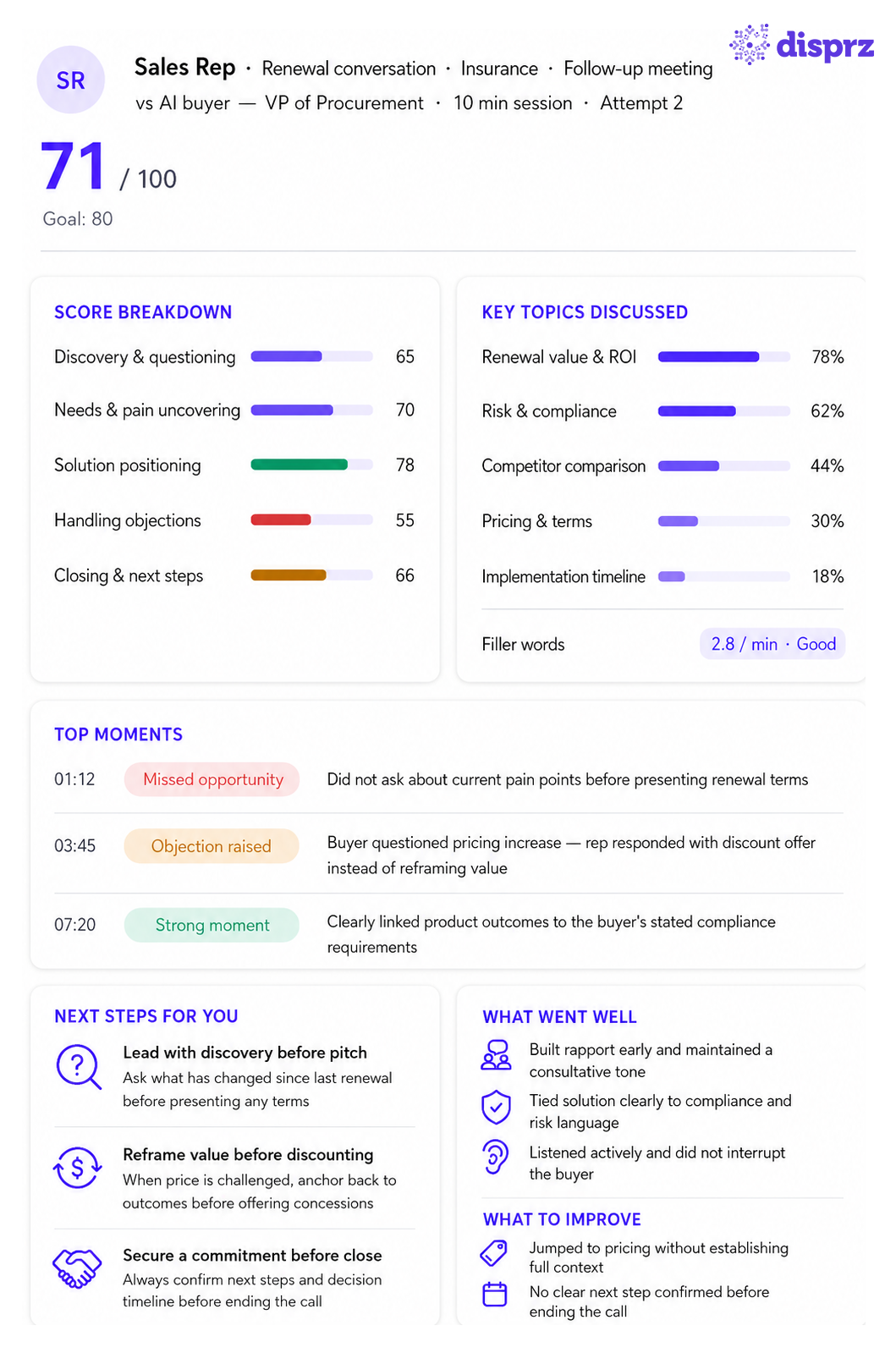
The rep also gets a set of next steps derived from their specific performance in that session — not generic coaching advice, but a personalized development direction based on what they actually did. For L&D leaders, this means every rep leaves every session knowing what to work on next, rather than walking away with a completion certificate and no clear sense of where they fell short.
What Makes Sales Coach Different
A lot of AI roleplay tools exist. Most of them put a conversational AI in front of a rep and call it practice. Sales Coach is built differently in three specific ways that matter to enterprise L&D and enablement teams.
Built on sales methodology, not general conversation. Sales Coach is trained on BANT, SPIN, and Challenger frameworks, which means it understands that a discovery call and a closing call have fundamentally different objectives, and scores them differently. A rep who qualifies well but closes defensively gets different feedback than one who pitches confidently but never uncovers the real pain. That methodological specificity is what makes the coaching actionable rather than generic.
Platform-neutral by design. Sales Coach works across any LMS or LXP; it sits on top of your existing learning stack without requiring a platform migration or a rip-and-replace. You get the full practice and analytics layer regardless of what system your team already runs on. For teams on Disprz, practice data connects directly into the skill framework and learning journeys, closing the loop between what a rep practised and what they're assigned to work on next.
Enterprise-grade quality controls built in. A built-in quality agent continuously reviews, validates, and refines the AI buyer's outputs throughout every session, minimising the risk of hallucination and ensuring the simulation stays grounded in the product knowledge and playbooks you uploaded. For enterprise L&D teams putting AI in front of hundreds of reps, that reliability layer matters as much as the feature set.
What This Looks Like in Practice
Consider a sales enablement leader preparing a cohort of new reps for their first enterprise discovery calls. Traditionally, this means a few days of onboarding, a product walkthrough, some shadowing, and then the reps are live- learning by doing, on real accounts.
With Sales Coach, the preparation looks different. The enablement team builds a buyer persona for a typical enterprise prospect in their target segment: a Head of Operations at a mid-sized company, analytical decision style, cautious about past software rollouts, moderate prior knowledge of the product category. They set the call objective such as qualify the opportunity and establish a clear next step, and upload the product deck and competitive context. The cohort of reps each runs the simulation independently, receives their individual scorecard, reviews their missed moments, and can run the scenario again before their first live call.
The first real discovery call still matters. But the rep arrives having already had that conversation twenty times, already knowing where they tend to lose the thread, already having worked on it. That changes the outcome.
What Changes for L&D and Sales Enablement
Coaching scales without adding headcount. A rep can run a discovery simulation before their first enterprise call, get scored, review the gaps, and run it again, without waiting for anyone's calendar. L&D can deploy the same scenario to a cohort of 200 reps simultaneously and receive performance data across the entire group.
Readiness becomes measurable, not assumed. Most L&D functions can tell you which reps completed the onboarding programme. Sales Coach tells you which reps can actually handle a renewal conversation with a skeptical buyer, and which ones can't, before that conversation happens on a real account.
Ramp time compresses where it matters. The first ninety days of a new rep's tenure are the highest-risk, highest-cost period in their development. With Sales Coach, new reps practice every scenario type against realistic buyer personas before their first live calls, and arrive with a clear picture of where their gaps are.
Why L&D Should Own This
Sales readiness has always sat just outside L&D's reach. L&D could build the training, but had no way to close the gap between what a rep learned and how they performed in a real conversation. Sales Coach changes that. For the first time, L&D can design the practice environment, set the scenarios, define what good looks like at each stage of the sales cycle, and measure whether reps are actually improving, not just completing. Practice performance feeds directly into the skill framework, so a rep with a consistent gap in objection handling gets routed into a targeted learning journey automatically. Sales readiness stops being something L&D hands off to the sales manager and starts being something L&D can measurably own.
How to Think About This for Your Team
The question worth asking before your next sales QBR is a simple one: when did your reps last practice a difficult conversation before it happened on a real account? Not shadow a call, not watch a recording but actually practice, get specific feedback, and improve before the stakes were live. If the honest answer is rarely or never, that is the gap Sales Coach is built to close. Pick one scenario your team consistently struggles with, run a cohort through it, and let the post-session data show you what your current coaching cadence has never been able to surface.
Not ready for a demo yet? Explore how Sales Coach works →
Frequently Asked Questions
Is Sales Coach only for sales teams, or can it be used for other customer-facing roles?
Sales Coach is built primarily for revenue teams, but the simulation framework applies to any role involving complex conversations like account management, customer success, collections, and service. The context setup supports Sales, Service, and Collections modes natively.
How does the AI buyer stay realistic across different industries and deal types?
The AI buyer is calibrated from the context you define including industry, deal stage, buyer persona attributes, and the product knowledge and playbooks you upload. It doesn't draw from generic scenarios; it behaves according to the specific situation you've configured, which is what makes it credible across segments and sale types.
Does Sales Coach replace live coaching with managers?
No, it changes what managers spend their coaching time on. When reps arrive at a coaching conversation having already run the scenario and reviewed their scorecard, the manager's time goes toward qualitative guidance like mindset, relationship strategy, deal nuance, rather than diagnosing basic skill gaps. The practice layer handles the high-frequency work that managers currently can't keep up with at scale.
How does Sales Coach integrate with our existing LMS or LXP?
Sales Coach operates as part of Turo, which is platform-neutral by design. It functions independently of your LMS or LXP, and practice data can be connected into your broader learning architecture. Teams on Disprz natively get deeper integration across the skill framework and learning journeys.
How quickly can a team deploy their first scenario?
Most teams configure and launch their first simulation within a single session. The context setup takes minutes once your buyer persona and product materials are ready.
How does Sales Coach handle accuracy — does the AI buyer ever say something wrong about our product?
The AI buyer is grounded in the product knowledge and playbooks you upload, not general internet data. A built-in quality layer validates the simulation against your source material before it runs, and L&D teams retain full review and editing control at every stage.