

On this page
Over the past two years, enterprises have significantly upgraded their learning infrastructure. AI-enabled content production, integrated skills frameworks, and personalized delivery models are now standard components of the L&D stack. Yet a recent survey by McKinsey shows that while a larger share of organizations report using AI, most enterprise deployments still sit in experimentation or pilot stages, with limited evidence of value-driven outcomes.
This creates a clear reflection point for L&D. As a function historically treated as a cost center, leaders must remain highly cognizant of every investment they make and the value it delivers to the business. That reality is precisely why the function now needs to rethink how it operates, shifting from running periodic training programs to actively influencing performance outcomes.
Capability must now be managed as an operational lever, not a periodic training initiative. This means linking business KPIs directly to role-specific skills, defining clear trigger points for L&D action, and deploying targeted reinforcement within the systems where work happens.
When those trigger points appear, learning should activate inside the flow of work through role-based simulations, decision support, and manager coaching prompts within the tools employees already use. The same KPI then confirms whether performance has improved.
This shift is becoming a core mandate for L&D leaders and is increasingly defined as Autonomous Enablement.
The Structural Flaw in Today’s L&D Design
Even when L&D leaders recognize the shift in the operating model, many will still struggle to translate that understanding into results.
They might invest heavily, modernize platforms, and redesign frameworks. And yet, capability outcomes would remain inconsistent unless five structural issues are addressed.
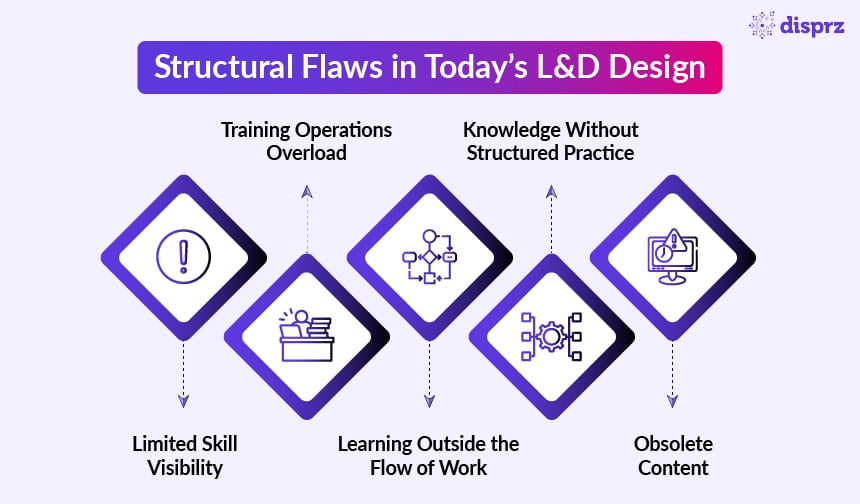
1. Limited Skill Visibility
Most organisations rely on large competency frameworks to describe workforce capability, but very few have a system for continuous capability building tied directly to real performance signals. What they lack is a clear, real-time view of how those skills show up in performance. When skill gaps are visible only after results decline, intervention is reactive. By the time action begins, performance gap has already widened.
2. Training Operations Overload
Large, distributed classroom models and centralized program design create cost, coordination burden, and rollout delays. Standardization across regions becomes difficult. Thus, capability improvement depends on scheduled interventions. In fast-moving environments, that delay weakens impact and limits scalability.
3. Learning Outside the Flow of Work
Training typically takes place outside the systems where work is executed — outside the CRM, ticketing platform, sales console, or compliance workflow. When employees return to live tasks, there is no structured prompt, feedback, or corrective signal embedded in those tools.
Application depends on individual recall and manager follow-up rather than system reinforcement. Over time, teams develop their own interpretations of standards, resulting in uneven execution across regions and functions.
4. Knowledge Without Structured Practice
Courses improve conceptual understanding, but consistent performance requires structured rehearsal under realistic conditions. In many organizations, that rehearsal layer is either informal or entirely absent. Employees may understand standards and processes, yet they are not required to apply them repeatedly in controlled, feedback-rich environments.
Without deliberate practice mechanisms such as simulations, scenario-based decision exercises, and contextual coaching, capability does not solidify. As a result, execution quality varies across teams and situations, even when participation in training is high.
5. Content Becomes Obsolete
As products, policies, and workflows change, static courses quickly become outdated. Field teams adapt in real time, but formal training materials do not keep pace. Over time, what is documented in courses no longer reflects how work is actually performed. When that gap widens, training stops shaping behavior and becomes a reference archive rather than a performance lever.
How Can AI Address These Issues?
AI has entered the learning function with speed, but in most enterprises it has been assigned a modest role. Mostly as a faster content factory, a smarter search bar, a more efficient recommendation engine.
That version of AI will not solve the structural disruptions we have outlined above. The wall breaks only when AI moves from generating content to actively shaping performance in execution. Many organizations are now evaluating how an AI-powered LMS can move beyond content delivery and actively connect learning to workforce performance signals.
Let’s check what it does if deployed the right way.
1. Disrupting the One-Size-Fits-All Model
The one-size-fits-all model of L&D endured because it was the only scalable structure available before AI matured. Organizations built expansive content catalogs, licensed industry taxonomies, mapped roles to generic competency frameworks, and relied on periodic assessments to demonstrate coverage and compliance.
With AI leveraged properly, organizations can build dynamic skills intelligence that continuously maps execution data to skill indicators. This shift often builds on the foundations of an adaptive learning platform, where training adjusts continuously based on employee performance signals.
By integrating with systems such as CRM, performance management, quality dashboards, and collaboration tools, AI models analyse conversion trends, product penetration, compliance patterns, escalation data, and interaction behaviour to detect emerging capability gaps.
In parallel, generative AI replaces static libraries by creating or updating contextual, role-specific learning assets aligned to current products, policies, and workflows.
2. Dismantling the Static Course- Based Learning
Most courses that were developed in the pre-AI era by L&D teams were linear, information-heavy, and assessment-light in any meaningful sense. Employees moved through slides, watched recorded explanations, answered predictable questions, and returned to work.
AI now enables immersive, practice-based learning at enterprise scale by removing the dependency on trainers and static modules. Instead of relying on slide-based courses, organizations can use generative AI to create realistic, role-specific scenarios aligned to current products, policies, and workflows.
Employees engage in simulated customer conversations, compliance decisions, or operational tasks that mirror real conditions, and their responses are analysed instantly for judgment and accuracy.
3. Closing the Gap Between Learning and Work
Traditional learning was all about employees stepping out of CRM, service platforms, or collaboration tools, complete assigned modules in an LMS, and return to execution.
With AI integrated into enterprise systems, reinforcement can be triggered inside the workflow itself. Within CRM platforms, collaboration tools, enterprise GPTs, or messaging channels, AI can surface product positioning prompts before a sales call, facilitate compliance decision guidance during a transaction, or activate short scenario-based exercises when performance indicators dip.
How L&D Can Move from Isolated Interventions to Autonomous Enablement?
As AI begins to address personalization gaps, replace static courses with simulations, and embed reinforcement inside the workflow, a deeper shift starts to take shape. These capabilities are powerful on their own, but their real impact emerges when they are connected across systems such as Salesforce, Workday, ServiceNow, and Microsoft Teams. Execution data flows continuously, skills intelligence updates in real time, and targeted support is triggered inside the flow of work before performance visibly declines.
What begins as smarter interventions gradually evolves into a self-adjusting capability layer — one that monitors signals, interprets emerging gaps, and strengthens execution without waiting for quarterly reviews or manual escalation. That is where enablement moves beyond intervention and becomes autonomous.
What is autonomous enablement in learning?
Autonomous Enablement is an operating model where learning continuously responds to how work is actually being performed. Instead of waiting for scheduled training programs, the system reads performance signals from business platforms, detects emerging capability gaps, and delivers targeted support directly inside the tools employees use. Learning systems are gradually evolving from content platforms into performance infrastructure.
Inside an Autonomous Enablement System
| Operating Sequence | What Happens Across the Organization | How the System Acts Autonomously |
|---|---|---|
| Performance signals are captured | Performance data from sales, service, operations, compliance, and talent systems is continuously captured. | The system integrates and scans live business signals without waiting for manual reporting cycles. |
| Capability gaps are detected | Changes in outcomes are linked to specific roles or teams. | Behavioral and outcome patterns are analyzed to identify skill gaps as they emerge. |
| Contextual practice is generated | Targeted simulations, prompts, and decision exercises are created for affected roles. | Reinforcement is generated automatically based on predefined performance thresholds and skill definitions. |
| Support appears inside workflow | Guidance appears inside CRM, QA tools, ticketing systems, and manager review routines. | Support is delivered within execution environments rather than through separate training events. |
| Impact is measured against live KPIs | The same business metric that triggered support is monitored to confirm movement. | The system continuously tracks KPI shifts and connects them to the timing and type of intervention. |
| The system refines itself | Over time, intervention precision increases and unnecessary reinforcement reduces. | Based on performance outcomes, thresholds, prioritization rules, and reinforcement intensity are refined automatically, making future operations more accurate and efficient. |
We have outlined what enablement looks like when it operates autonomously; performance signals identified early, support activated within workflow, and impact measured against live business metrics. That is the behavior of a self-correcting system.
But that behavior does not appear simply because AI is introduced. It depends on how the learning ecosystem is designed. If the underlying platform is still built around course catalogs, scheduled programs, and annual planning cycles, it will remain reactive even with advanced AI layered on top.
Autonomy requires more than features. It requires infrastructure that connects performance data, skill insight, and intervention logic in a single, responsive system.
The Architecture Required to Power Autonomous Enablement
To support that shift, the underlying architecture must be built on three structural foundations:
- One layer that continuously interprets enterprise performance data and translates it into skill-level intelligence across roles.
- One layer that can generate structured, role-specific practice and reinforcement in response to identified gaps.
- And one layer that activates that reinforcement directly inside the environments where employees execute work.
The Next Generation of Learning Platform Infrastructure
| Platform Layer | What It Includes | What It Enables for L&D |
|---|---|---|
| 1. Performance & Skills Intelligence Layer |
|
Enables L&D to see emerging skill gaps as they form, clearly identify the affected roles and teams, and replace static competency assumptions with continuous, data-backed capability diagnostics tied to business outcomes. |
| 2. Practice & Coaching Layer |
|
Shifts learning from course completion to applied practice. Enables structured rehearsal and targeted manager coaching aligned to actual performance gaps. |
| 3. Embedded Delivery Layer |
|
Allows business applications and workplace tools to fetch relevant learning content, simulations, and guidance from the learning platform and surface it directly within the workflow. |
Are You Ready for Autonomous Enablement?
Before attempting this shift, assess whether your organization is structurally ready. Autonomous enablement depends on operational discipline, not just technology.
If you answer “no” to more than two of the following, scaling this model will be difficult:
- Are performance thresholds clearly defined so the system knows when to intervene?
- Is your skills framework specific enough to diagnose issues at a behavioral level, not just at a course level?
- Do business leaders accept shared ownership of performance correction, alongside L&D?
- Are operational KPIs directly mapped to role-based skill standards?
- Can reinforcement be updated quickly when business conditions change?
If these foundations are unclear, the ambition to move faster will outrun organizational readiness.
You can benchmark your current state using a structured diagnostic here:
👉 https://disprz.ai/digital-maturity-assessment
Clarity on maturity prevents investing in sophistication before the basics are stable.
When Autonomy Is Built Without Guardrails
- You will generate sharp performance insights but lack predefined triggers to act on them.
- You will build contextual simulations yet deploy them outside the systems where work actually happens.
- You will identify skill gaps early but delay correction because ownership is unclear.
- You will accelerate content and practice creation without achieving consistent performance improvement.
- The system will appear intelligent in design but remain manual in execution.
Autonomous enablement should not begin with an enterprise-wide rollout. It should start with a focused, measurable pilot; one function, one critical KPI, clearly defined intervention thresholds, and explicit business ownership. Therefore, first you will need to ensure that the system can detect issues, trigger action, and stabilize performance within defined guardrails before scaling further.
Final Thoughts
Most organizations will continue modernizing their learning stack. The few that redesign their operating model will see issues corrected before they become missed targets.
If you want to explore what autonomous enablement could look like inside your organization, and how it can be implemented without disrupting existing systems, book a conversation with our team.
👉 Book a personalized demo to see how Disprz enables autonomous enablement by connecting workforce skills, performance signals, and AI-driven learning interventions.