


On this page
Hiring a sales rep is the easy part. Getting them to quota is where the money leaks out. A new rep signs, sits through onboarding, completes certification, shadows a few sales calls, and then spends months as an expensive line item who isn't yet contributing to the pipeline. The clock on their quota is running the whole time.
The problem is getting worse, not better. Sales rep ramp time typically ranges from 3 to 9 months, depending on role complexity, industry requirements, product portfolio, and the level of experience expected. In India's BFSI and insurance sectors, where sales teams run into the thousands and turnover is brutal, the practical ramp window for a frontline advisor often lands closer to nine months. Every one of those months is revenue you planned for and didn't get.
Here's the uncomfortable truth most onboarding and sales training programs won't admit: the bottleneck isn't knowledge. New reps learn the product, the pitch, and the process fairly quickly. What takes months is the confidence and competence to run a real conversation: asking the right discovery question, reading a buying signal, managing complex customer interactions, and navigating objection handling without freezing. That capability doesn't come from presentations or content libraries. It comes from deliberate practice and continuous skill development. And practice has always been the one thing onboarding couldn't scale.
This playbook changes that. The question it answers is a blunt one: what would it take to move the ramp from nine months toward ninety days? The answer is artificial intelligence-powered coaching, specifically AI sales roleplay that allows sales reps to practice real-world buyer conversations hundreds of times before those conversations impact revenue. Modern sales coach platforms can simulate realistic scenarios, measure readiness, and provide actionable insights that help reps improve faster.
Many organizations are now turning to the best AI sales coaching tools to accelerate onboarding, improve rep performance, and help new hires build confidence before engaging with customers. Below is the full framework, the onboarding best practices that still matter, and a 90-day plan you can run.
Why Sales Rep Ramp Time Keeps Getting Longer
Ramp has gotten slower even as technology has gotten better. A few forces are pulling in the wrong direction at once.
Buyers are harder. Deals involve more stakeholders, more research, and more skepticism than they did five years ago. A rep can't coast on product knowledge; they have to navigate a committee. That requires judgment, adaptability, and the ability to apply different sales methodologies in real time. Those skills develop through repetition, and new hires simply don't have enough practice yet.
Coaching has thinned out. According to Gartner's Workforce Survey, six in ten employees say they aren't getting the on-the-job coaching they need. The people responsible for developing new reps (the sales managers and the sales leaders) are stretched across larger teams and more responsibilities than ever. As a result, coaching sessions become less frequent and less personalized. New hires get less hands-on guidance precisely when they need it most.
Knowledge decays fast. Roughly 70% of what's taught in a training session is forgotten within a week without reinforcement. The traditional one-size fits-all onboarding model fails twice: it overloads reps with information they can't yet apply, and most of that information disappears before they ever use it in a customer conversation.
Top performers practice differently. The highest-performing sales professionals don't simply consume training content; they rehearse critical conversations repeatedly, receive feedback, and refine their approach. Unfortunately, most onboarding programs struggle to replicate this level of coaching at scale across large sales organizations.
The cost of getting it wrong has risen. According to Ebsta’s State of GTM Report, 78% of sales representatives failed to achieve their quota targets in 2025. When that many reps miss, slow ramp isn't a side issue; it's a direct line to the number. This is why organizations are increasingly adopting data driven coaching solutions that use key features such as conversation simulations, personalized feedback, and performance analytics to improve readiness before reps ever engage in live sales calls.
For sales leaders looking to improve ramp efficiency, the challenge is no longer delivering information. It's creating enough meaningful practice opportunities for sales reps to develop real-world selling skills faster. That's where AI-powered coaching and roleplay are changing the equation.
The Hidden Cost of Slow Ramp
Most leaders underprice slow ramps because the cost is spread out and invisible. Make it visible and the urgency becomes obvious. Consider an illustrative team of 50 reps with a $500,000 annual quota and a six-month ramp.
| Cost Driver | What It Looks Like | Illustrative Impact |
|---|---|---|
| Lost productive selling time | Each rep contributes little for ~6 months | ~$250,000 of foregone quota per rep, per ramp cycle |
| Over-hiring to compensate | Teams hire 15–20% more reps to cover the ramp lag | Higher headcount cost for the same coverage |
| Attrition during ramp | Reps who struggle early often leave before producing | Full re-hire and re-ramp cost, repeated |
| Burned pipeline | New reps practice on live customers and lose winnable deals | Relationships and revenue gone before skills arrive |
| Manager drag | Managers pulled into repetitive coaching instead of strategy | Opportunity cost across the whole team |
The takeaway: ramp time is not an HR or L&D metric buried in an onboarding report. It's a revenue metric. Cutting a six-month ramp to three months on a 50-rep team doesn't just speed things up; it recovers quarters of selling time that were previously written off.
See how fast your reps could ramp with AI coaching → Request a Demo
What "Ramp-Ready" Actually Means (And Why Completion Isn't It)
Here's the measurement trap nearly every onboarding program falls into: it tracks completion, not readiness.
Completion tells you a rep finished the modules, passed the quiz, and attended the workshop. It says nothing about whether they can actually hold the conversation. A rep can ace every assessment and still fall apart on a live discovery call. Completion data is why L&D and sales so often disagree about whether onboarding "works"; L&D sees green dashboards, and sales sees reps who aren't ready.
Ramp-ready means something specific and observable. A ramp-ready rep can run a discovery conversation that surfaces real pain, position the product against a buyer's actual situation, handle the three or four objections they'll hear most often, and close with a clear next step; under pressure, without a script in front of them.
The shift that accelerates the ramp is moving your finish line from "completed the training" to "demonstrated the behavior." You can't get there with quizzes. You get there by watching reps perform the conversation and scoring what they actually do. That's exactly what AI coaching makes possible at scale.
Why Traditional Onboarding Stalls at the Practice Gap
Walk through a typical onboarding program and you'll find it does the first half well and the second half barely at all.
The knowledge transfer half (product training, process, CRM, pitch decks, e-learning) is well covered. Most L&D teams have this dialed in. The application half (actually practicing the conversation until it's muscle memory) is where everything stalls. This is the practice gap, and it's where ramp time goes to die.
Manager-led roleplay is the traditional fix, and it doesn't scale. A manager can sit through a handful of roleplays a week. With a cohort of new hires, most reps get one or two practice reps before they're put in front of customers. Worse, manager roleplay is performed for the manager, not practiced for the rep; it's infrequent, high-pressure, and inconsistent from one evaluator to the next.
So what actually happens is that the customer becomes the practice partner. The new rep's first real reps come on live calls with real prospects. They learn by losing winnable deals. That's the most expensive training method ever invented, and it's the default for most sales teams.
| Onboarding Phase | Traditional Approach | Where It Breaks |
|---|---|---|
| Knowledge | E-learning, decks, workshops | Overloaded, front-loaded, forgotten within a week |
| Practice | Occasional manager roleplay | Doesn't scale past a handful of reps; inconsistent |
| Live readiness | "Sink or swim" on real calls | Burns pipeline; readiness discovered after deals are lost |
| Feedback | Manager debrief, if time allows | Subjective, delayed, and rarely repeated |
Close the practice gap and ramp compresses. That's the entire thesis of the playbook below.
The AI Coaching Ramp Playbook: A 5-Stage Framework
This is a repeatable framework for compressing ramps by attacking the practice gap directly. Each stage builds on the one before it.
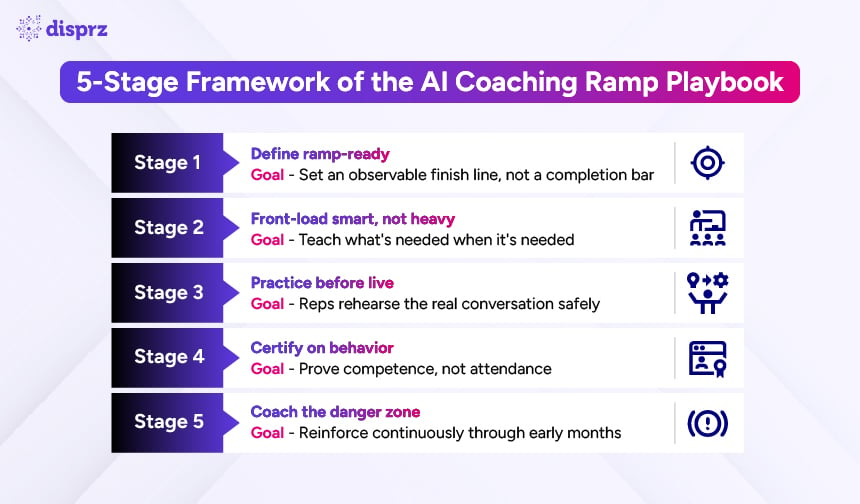
Stage 1: Define ramp-ready
Write down what a ready rep can do, in behavioral terms, before you build anything else. Map it to the conversations they'll actually have: discovery, product pitch, objection handling, negotiation, closing. This becomes the rubric everything else is measured against.
How AI coaching enables it: Readiness criteria scored against sales frameworks (BANT, SPIN, Challenger).
Stage 2: Front-load smart, not heavy
Replace the firehose with a personalized path. Sequence learning to the rep's role and skill gaps so they get the right content at the right moment, not all of it on day one. This respects how memory actually works and reduces the decay problem.
How AI coaching enables it: Personalized learning paths sequenced to role and skill gaps.
Stage 3: Practice before live
This is the stage that breaks the ramp curve. Put every rep inside realistic, voice-led buyer simulations where an AI plays the customer and the rep plays themselves: no script, no hints. They practice cold outreach, discovery, objection handling, and closing as many times as they need, in private, before they ever touch a real prospect.
How AI coaching enables it: Voice-led AI roleplay with adaptive buyer personas.
Stage 4: Certify on behavior
Run the roleplay as a certification gate. The rep doesn't advance to live calls until they hit a defined readiness score across the conversation skills that matter. Scoring is objective and consistent; the same rubric for every rep, in every geography, every time.
How AI coaching enables it: Objective readiness scores and timestamped feedback.
Stage 5: Coach the danger zone
Ramp doesn't end at the first live call. The first 90 days are the danger zone where habits are set. Keep reps in a weekly practice and coaching rhythm, with a personalized action plan after each session that tells them exactly what to work on next.
How AI coaching enables it: Personalized coaching plans after every session.
Build your ramp playbook on a platform designed for it → See Disprz Sales Coach
How AI Roleplay Compresses Each Phase of Ramp
The mechanism behind faster ramp is simple: AI roleplay removes every constraint that makes practice scarce.
Practice becomes unlimited. A rep can run twenty discovery calls in a week against twenty different buyer personas. The volume of reps that used to take months of live calls to accumulate happens in days, in a safe environment.
Feedback becomes instant and objective. Instead of waiting for a manager debrief that may never come, the rep gets a post-session breakdown immediately: a readiness score, timestamped missed moments, talk-to-listen ratio, filler-word count, and a deal-likelihood read. The feedback is the same standard for everyone, so it's fair and comparable across a whole cohort.
Psychological safety unlocks experimentation. Reps practicing privately with an AI take more risks than they would with a manager watching. They try the harder objection response, fumble it, and try again; which is exactly how skill develops. The data still rolls up to managers, but the practice itself carries no social cost.
This isn't a fringe approach anymore. According to Allego's 2025 research, 43% of revenue enablement leaders now use AI-powered roleplay to enhance coaching, and teams using AI in coaching are roughly 20% more likely to improve revenue outcomes than those that don't. The leaders are already ramping reps this way.
Sales Onboarding Best Practices for an AI-Accelerated Program
AI doesn't replace good onboarding fundamentals; it amplifies them. The best practices below still hold; AI coaching just makes them executable at scale.
| Best Practice | Why It Matters | How AI Coaching Strengthens It |
|---|---|---|
| Set a 30/60/90 readiness plan | Gives reps and managers a shared map | Readiness scores make each milestone measurable, not subjective |
| Personalize the path | Reps arrive with different gaps | Learning paths adapt to role and skill profile |
| Practice early and often | Skill comes from reps, not slides | Unlimited roleplay from week one, no manager bottleneck |
| Use real scenarios | Generic practice doesn't transfer | Scenarios built from your own product, personas, and objections |
| Certify before live calls | Protects pipeline from unready reps | Behavioral certification gate, not a quiz |
| Coach continuously | Knowledge decays without reinforcement | Personalized action plan after every session |
| Connect learning to readiness data | Sales and L&D need one source of truth | Readiness scores link completion to actual capability |
The thread running through all of these: stop treating onboarding as an event and start treating it as a measurable, practice-driven system that runs through a rep's first 90 days and beyond.
The India Angle: Ramping Frontline Sales Forces at Scale
Nowhere is the ramp problem more acute than in India's frontline-heavy sectors. Insurance and BFSI run the largest distributed sales forces in the world (tens of thousands of agents and advisors spread across hundreds of cities) and they face a compounding challenge: ramp is slow and attrition is severe.
Annual agent attrition in India's insurance sector runs between 40% and 60%. That means a meaningful share of the workforce is on the ramp at any given moment. If ramp takes nine months and the agent leaves inside a year, the company may never see a productive return on that hire. Compressing ramps isn't an efficient play here; it's survival economics.
There's a quality dimension too. An agent in a Tier-2 city needs the same pitch quality and compliance discipline as a top performer in Mumbai, but manager coaching is wildly inconsistent across geographies. IRDAI mandates pre-licensing training, but mandatory training is a compliance checkbox, not proof of readiness. AI roleplay turns that mandatory training into demonstrated capability; every new agent practices the real conversation and is scored the same way, regardless of where they sit.
The market is already moving this direction. More than 550,000 frontline sales reps in India are using AI-powered sales enablement tools, which tells you buyers are ready. The opportunity is to layer structured practice on top of the learning these teams already do; closing the gap between completing a journey and being ready for the field.
A 90-Day Ramp Plan You Can Run
Here's a concrete sequence that puts the playbook into practice for a new-hire cohort.
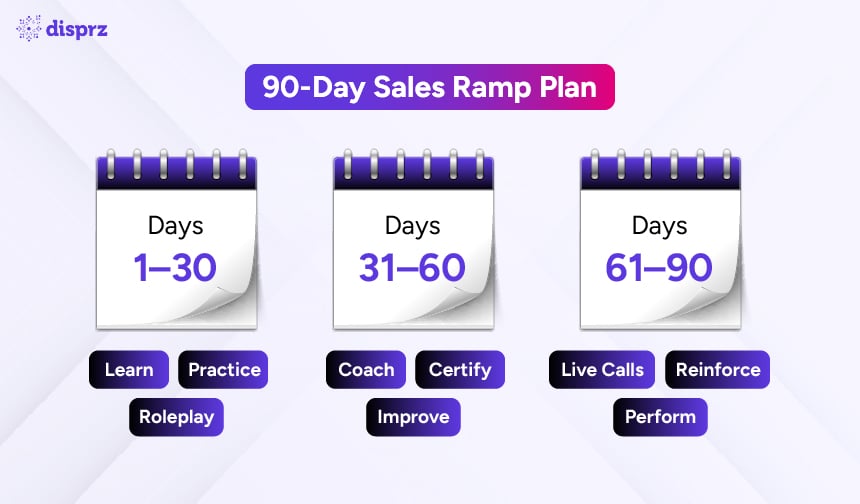
Days 1–30: Foundation and first reps. Deliver core product and process learning through a personalized path rather than a one-week firehose. Define the readiness rubric. By the end of week two, every rep is running their first AI roleplays (discovery and product pitch) and getting scored. The goal isn't mastery yet; it's getting reps comfortable performing the conversation.
Days 31–60: Practice depth and certification. Reps drill the conversations that matter most: objection handling, multi-stakeholder discovery, and the two or three scenarios specific to your buyers. Each rep works their personalized coaching plan between sessions. By the end of day 60, reps must hit the defined readiness score to certify for live calls.
Days 61–90: Supervised live calls plus continued practice. Certified reps start real conversations, but practice doesn't stop. They keep a weekly roleplay rhythm to reinforce skills and prepare for new scenarios as they hit them in the field. Managers coach against readiness data instead of guessing who needs help.
By day 90, the goal is a rep who is genuinely call-ready; not one who has merely completed onboarding. That's how a nine-month effective ramp compresses toward ninety days.
How to Measure Whether Ramp Is Actually Improving
If you can't measure the ramp, you can't compress it. Track these and you'll know whether the playbook is working.
| Metric | What It Tells You | What Good Looks Like |
|---|---|---|
| Time to first deal | How fast reps reach their first close | Trending down cohort over cohort |
| Time to full quota | The true ramp number | Compressing toward your 90-day target |
| Readiness score at certification | Whether reps are actually ready for live calls | Consistent threshold met before going live |
| Practice volume per rep | Whether reps are getting enough reps | Dozens of roleplays in the first 90 days |
| Early-tenure attrition | Whether struggling reps are leaving | Falling as confidence rises |
| Manager coaching hours saved | Bandwidth freed for strategy | Significant reduction in repetitive roleplay time |
A note on promised numbers: be skeptical of any platform that guarantees a specific ramp reduction sight unseen. The right way to prove it is to baseline your current time-to-quota, run a pilot cohort through the playbook, and compare. Define two or three of these metrics up front and measure them against them.
Common Mistakes That Keep Ramp Long
- Measuring completion instead of readiness. Green dashboards that don't predict live-call performance are the single most common reason ramp stays long.
- Front-loading everything into a boot camp. Overloading week one guarantees most of it is forgotten before it's used.
- Treating roleplay as a one-time event. Practice done once at kickoff doesn't build muscle memory. It has to be a rhythm.
- Letting reps learn on live customers. The most expensive practice method there is; and the default when there's no scalable alternative.
- Inconsistent coaching across managers and regions. When every manager scores differently, readiness becomes a lottery.
- Disconnecting L&D from sales outcomes. When learning data and readiness data live in separate systems, no one trusts the number.
Why Enterprises Choose Disprz to Accelerate Sales Ramp
Disprz Sales Coach is a purpose-built AI coaching agent that puts every new rep inside realistic, voice-led buyer simulations with deep, moment-by-moment feedback; the practice infrastructure that compresses ramp. What sets it apart is the combination most vendors can't offer: serious AI roleplay built on a proven enterprise learning platform, so practice lives where learning already happens.
- Voice-led, adaptive roleplay: New reps practice the real conversation out loud, with an AI buyer that responds dynamically and never follows a script.
- Hyper-realistic, custom personas: Define buyer type, seniority, decision style, and emotional state; the simulation sounds like your buyers, configured in minutes.
- Built from your own context: Upload product decks, battle cards, and SOPs so ramp scenarios reflect your actual product and objections.
- Sales-framework scoring: Trained on BANT, SPIN, and Challenger, with scoring across discovery, needs uncovering, positioning, objection handling, and closing.
- Behavioral certification gate: Set a readiness threshold reps must hit before they touch live calls, with objective, consistent scoring for every rep.
- Moment-by-moment feedback: Timestamped missed moments, talk ratios, filler words, and deal-likelihood reads after every session.
- Personalized coaching plans: Every rep leaves each session with a prescribed next step for the danger-zone months.
- Personalized learning paths: AI-sequenced journeys front-load knowledge by role and skill gap instead of overwhelming day one.
- Frontline-ready and platform-neutral: Operates across LMS and LXP ecosystems with mobile-first, offline-capable delivery, and deeper native intelligence inside Disprz.
- Backed by a proven L&D platform: 3.5M learners across 500+ organisations in 25+ countries, with BFSI proof points including HDFC Ergo and AIA Singapore, and recognition by the Josh Bersin Company as an HR Tech AI Trailblazer 2025.
Cut your ramp time with practice that scales → Request a Demo
Key Takeaways
- Ramp is a revenue metric, not an L&D metric. Average ramp has stretched to ~6 months (and closer to 9 in India BFSI), and every extra month is a foregone quota.
- The bottleneck is the practice gap, not knowledge. Reps learn the product fast; what takes months is the confidence to run a real conversation under pressure.
- Measure readiness, not completion. A rep who passed every quiz can still freeze on a live call. Certification of demonstrated behavior.
- AI roleplay compresses ramps by making practice unlimited, feedback instant, and experimentation safe. This is why 43% of revenue enablement leaders now use it.
- Run the playbook as a 90-day system, not a one-week boot camp, and baseline your time-to-quota so you can prove the improvement.
Conclusion
Slow ramp is one of the most expensive problems in sales, and it has persisted for one reason: practice has never scaled. Knowledge transfer was solved long ago, but the leap from knowing the pitch to delivering it under pressure could only happen through reps; and reps were rationed by manager bandwidth. So new hires learned on live customers and lost winnable deals while they figured it out.
AI coaching removes that constraint. When every rep can practice the real conversation hundreds of times before it counts, the practice gap closes and ramp compresses. The playbook is straightforward: define what ready means, personalize the learning, practice before live, certify on behavior, and coach through the danger-zone months. Done well, a ramp that used to take the better part of a year can be measured in weeks.
The teams that win the next few years won't be the ones with the biggest training budgets. They'll be the ones whose reps are ready faster; and stay ready longer.
Frequently Asked Questions
1) What is the sales rep ramp time?
Sales rep ramp time is how long it takes a new hire to reach full productivity, usually measured as time to consistently hitting quota. Industry averages have stretched to roughly six months, and longer in sectors with large frontline sales forces like insurance and BFSI.
2) How can I reduce sales rep ramp time?
Attack the practice gap. Most onboarding handles knowledge transfer well but stalls on application. Giving every rep scalable, realistic practice through AI roleplay (plus personalized learning paths and behavioral certification before live calls) is the fastest way to compress ramp.
3) What are the most important sales onboarding best practices?
Set a 30/60/90 readiness plan, personalize the learning path, have reps practice early and often with real scenarios, certify on demonstrated behavior rather than completion, and coach continuously through the first 90 days.
4) Why is measuring completion not enough for onboarding?
Completion shows a rep finished the modules; it doesn't show they can hold the conversation. Reps can pass every assessment and still freeze on a live call. Readiness scoring (watching and scoring the actual conversation) is what predicts live-call performance.
5) How does AI roleplay reduce ramp time specifically?
It makes practice unlimited, feedback instant and objective, and experimentation psychologically safe. Reps accumulate in days the volume of practice conversations that used to take months of live calls, so they reach competence far sooner.
6) How quickly can a team start using AI sales coaching for ramp?
A purpose-built platform can be live with your first custom scenarios in days, not months. You define a persona and objective, upload your product context, and new reps can begin practicing right away; without a multi-quarter implementation project.
7) Does AI coaching work for frontline and field sales ramp, not just SaaS?
Yes. It's especially valuable for high-volume frontline forces (insurance agents, bank relationship managers, field reps) where ramp is slow, attrition is high, and consistent manager coaching across geographies is nearly impossible.
8) How do I prove that ramp time actually improved?
Baseline your current time-to-first-deal and time-to-quota, run a pilot cohort through the playbook, and compare against a prior cohort. Track readiness scores, practice volume, and early-tenure attrition alongside the ramp numbers.
9) How does AI coaching connect to our existing L&D platform?
The strongest implementations sit alongside your learning platform so reps practice in the same environment where they learn. That links completion data to live-call readiness, giving L&D the outcome evidence sales leaders ask for and giving sales a readiness signal they can trust.