
On this page
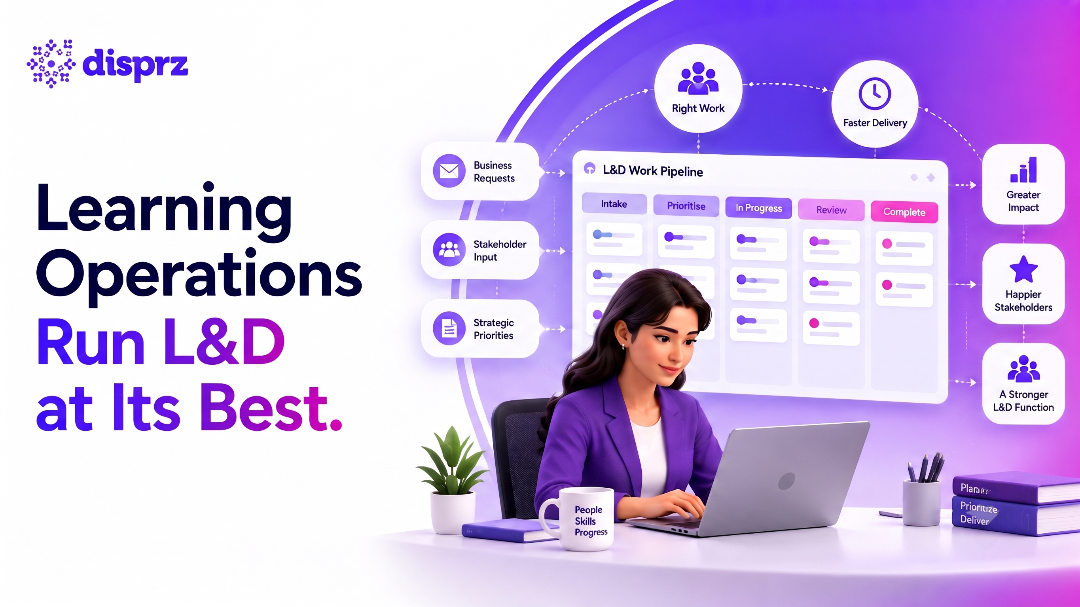
Learning operations is how the L&D team itself runs: how requests come in, how work gets prioritised, who owns what, and how long anything takes. It is the plumbing rather than the programmes. Most teams have never designed it deliberately, which is why the same team can produce excellent training and still be seen as slow.
- Learning operations is about the function, not the content. It governs intake, capacity, ownership and cycle time, and it is invisible until it breaks.
- The clearest symptom is not backlog. It is being asked for a course when you should have been asked about a problem.
- Four maturity stages cover almost every L&D team. Most sit at stage two and think they are at stage three.
- Almost every published LearnOps framework assumes a team large enough to justify a dedicated operations platform. Most enterprise L&D teams are three to eight people, and that changes what is realistic.
- One change moves more teams up a stage than any other, and it takes about a week to make.
- Written for L&D leaders who deliver good work and still get treated as a service desk.
What learning operations actually means
The term covers everything that determines how work reaches your team, how it moves through, and what happens to it afterwards. Requests, prioritisation, resourcing, handoffs, sign-off, and the measurement of the function itself rather than the learners in it.
Simple. Learning operations, sometimes called LearnOps, is the set of processes a learning team uses to decide what to build, resource it, ship it and measure it. An LMS delivers training to learners. Learning operations governs everything that happens before the training exists.
Four components sit underneath it, and they are worth separating because teams usually have one or two working well and the rest by accident.
Intake is how work arrives. For most teams that is a mix of email, corridor conversations and a manager mentioning something in a meeting.
Capacity is knowing what your team can absorb before you agree to a date. Very few teams can answer this in a number.
Governance is who owns which stage and who signs off. This is the one that quietly costs the most, because unclear sign-off is where projects sit still.
Measurement here means the function, not the learning. Cycle time, intake quality, capacity utilisation, budget variance. Learner outcomes matter enormously and belong in a different conversation.
The tell that you have a learning operations problem
It is not the backlog. Backlogs are normal and often healthy.
The tell is what people ask you for. A team with sound learning operations gets asked whether the climbing error rate in returns processing is something L&D can look at. A team without one gets asked to build a two-hour course on returns processing by the fifteenth.
The second request has already made three decisions before it reaches you: that training is the answer, what format it takes, and when it lands. You have been handed a specification rather than a problem, and every subsequent conversation is about delivery rather than outcome.
Three other symptoms usually travel with it.
- Nobody can tell you how long a project takes. Ask five people for the average time from request to launch and you will get five answers, all guesses, all optimistic. This is the single most reliable indicator of an ungoverned workflow, because a team that measures cycle time inevitably starts managing it.
- The loudest stakeholder gets served first. Not the most urgent, not the most valuable. Priority is set by who escalates hardest, which trains everyone to escalate.
- Work restarts. A project gets to review, a senior stakeholder sees it for the first time, and the scope changes. That is a governance failure disguised as a feedback loop.
None of these is a competence problem. They are all structural, which is the good news, because structure is fixable in weeks rather than years.
Is L&D part of HR, and does it change how operations work?
Usually yes on paper, and it matters less than the reporting line suggests.
In most organisations L&D sits inside HR, reporting through a CHRO or people director. In some it reports into operations or a business unit, and in a few it stands alone. The structure influences budget and access, but it does not determine whether learning operations works.
What determines that is where the demand comes from. An L&D team inside HR that takes its requests from business unit leaders operates very differently from one that takes them from HR programmes, even though the org chart looks identical.
The practical implication is worth stating, because it gets missed. HR operations and learning operations are not the same discipline. HR operations handles employee lifecycle transactions at scale: onboarding paperwork, payroll queries, benefits administration. Its measure is transaction accuracy and speed. Learning operations handles a project pipeline with variable scope, creative work and subject matter dependencies. Its measure is throughput against business priority. Running a project pipeline with a ticketing mindset is a common and expensive mistake, and it happens most often when L&D reports into an HR shared services structure.
The four stages of learning operations maturity
Most teams recognise themselves immediately. The useful part is not the label, it is that each stage has a single specific constraint.
| Stage | How work arrives | How priority is set | What the team can answer | The one constraint |
|---|---|---|---|---|
| 1. Reactive | Email, chat, corridor | Whoever asked most recently or loudly | Nothing about timelines | No front door |
| 2. Organised | A shared inbox or form exists | Team judgement, case by case | Roughly what is in flight | Cannot see capacity |
| 3. Governed | Structured intake with required fields | Against stated business priorities | Cycle time and workload | Cannot prove function value |
| 4. Strategic | Business leaders bring problems, not specs | Jointly, against a capability plan | Impact and cost of delay | Keeping it as people change |
Two honest observations about this model.
Most teams sit at stage two and believe they are at stage three. The test is simple: if you have a request form but people still bypass it by messaging you directly, and that works, you are at stage two. A front door only counts if it is the only door.
And stage four is not the goal for everyone. A five-person team supporting a stable business may be perfectly served at stage three and would waste effort chasing the fourth. Maturity models invite the assumption that the top is always correct. It is not.
Moving from reactive to organised: fix the front door
One change, and it is the highest-return move in this entire article.
Create a single intake form and make it the only route in. Five fields, no more, because a long form gets bypassed and a bypassed form is worse than none.
- The business outcome What business outcome are you trying to change?
- The audience Who specifically needs to do something differently?
- The cost of inaction What happens if we do nothing?
- The deadline When do you need it, and what makes that date real?
- The check How will we know in thirty days whether it worked?
Question three does most of the work. It is the one that stops low-value requests without you having to refuse them, because a requester who cannot answer it usually withdraws the request themselves. Question four separates a genuine deadline from a preference. A structured training needs analysis is the longer version of the same conversation, for requests that survive intake.
The part everyone gets wrong. Introducing the form is easy. Holding the line is not. For the first month people will keep messaging you directly, and if you accept those requests the form dies quietly. The response that works is not refusal, it is redirection: acknowledge the request warmly, send the form link, and start the clock when it arrives. Two or three rounds of that and behaviour changes.
A front door only counts if it is the only door. A form people can route around is a form people will route around.
Moving from organised to governed: see capacity before you commit
The constraint at stage two is that you agree to dates without knowing what you already owe.
Fixing it does not require a capacity planning platform, which is what most guidance assumes. It requires one shared view of committed work, updated weekly, with three columns: what is in flight, who owns it, and what week it lands. A spreadsheet does this adequately for a team under ten.
What makes it work is the discipline attached to it. Before any new date is agreed, the person agreeing looks at that view. That is the entire mechanism, and it is why teams that buy a capacity tool without the habit stay at stage two with better dashboards.
Two things to add once the basic view is holding.
Name an owner per stage, not per project. Scoping, build, review and publish each need a single named person. Projects stall at handoffs far more often than they stall inside a stage, and unowned handoffs are invisible until you look for them.
Cap concurrent projects. Most small L&D teams run too many things at once, which feels productive and lengthens every individual timeline. A team of four running twelve projects finishes fewer of them in a quarter than the same team running six. This is uncomfortable to accept and reliably true.
Moving from governed to strategic: measure the function, not the courses
At stage three you can see the work. What you still cannot do is prove the function's value in terms a business leader recognises, which is what keeps L&D in a service posture.
Four operational measures change that conversation. None of them is about learners.
- Cycle time from request to launch. The number executives actually feel. Track the median, not the average, because one nine-month project distorts the mean and hides real improvement.
- Intake quality. The share of requests arriving with a stated business outcome rather than a course specification. This rising is the clearest evidence that the relationship with the business is changing.
- Capacity utilisation against strategic work. What proportion of your team's time goes to work tied to a named business priority, versus ad hoc requests. If that figure is below half, you have found your argument for headcount.
- Cost of delay. When a request is deprioritised, record what the requester said would happen. Revisit in six months. This is the least comfortable measure and the most persuasive one, because it makes the consequence of under-resourcing visible with the business's own words.
The shift these produce is subtle and significant. You stop reporting on what L&D delivered and start reporting on how the L&D function is performing as a business unit, which is the conversation that gets budget approved. Learner-side learning analytics answers a different and equally necessary question, and the two reports should not be merged.
What skills does learning operations need?
Four, and only one of them is a learning skill.
- Demand triage and stakeholder negotiation
- Capacity and resource planning
- Process design and documentation
- Data literacy for operational reporting
- Vendor and budget management
- Enough instructional design to size work
That last one is the point. A learning operations lead does not need to be the strongest instructional designer on the team. They need enough understanding to know that a compliance refresh is not the same size of job as a leadership simulation, and enough operational instinct to protect the people doing the building.
In practice this is rarely a dedicated role below a team of about eight. It is usually a hat worn by the L&D lead, and worn badly, because it competes with the design work they are also doing. Naming it as an explicit part of someone's role, with time protected for it, is often the whole intervention.
Learning operations, training operations, and L&D strategy
Three terms used loosely and often interchangeably. They are not the same thing, and buying against the wrong one wastes money.
| Aspect | L&D strategy | Learning operations | Training operations |
|---|---|---|---|
| Question it answers | What capability should we build? | How does this team decide and ship? | How does this session run? |
| Time horizon | Annual and multi-year | Weekly and quarterly | Daily |
| Typical artefact | A capability plan | An intake and capacity system | A schedule and a room booking |
| Owned by | L&D leader with the business | L&D leader or ops lead | Training coordinator |
| Fails as | A document nobody reads | A backlog nobody can explain | A trainer without a room |
An L&D strategy without operations produces a good plan that ships late. Operations without strategy produces a fast team building the wrong things efficiently. Training operations sits inside both and is the one most likely to already be working, because logistics failures are visible immediately while operational failures are not.
Where the platform layer helps, and where it does not
Honestly: less than the category's marketing implies, and in a narrower place.
No platform fixes stage one. Intake discipline, prioritisation criteria and named ownership are decisions rather than features, and a team that has not made them will produce the same chaos inside a better interface. Anyone selling you a tool as the answer to stage one is selling you a stage two problem you do not have yet.
Where platform capability genuinely reduces operational load is further along, in three specific places.
Production throughput: A large share of L&D cycle time is content build, and AI content authoring with Turo compresses that materially. Disprz uses Turo to convert existing SOPs, policies and product documents into structured modules, which removes the single longest stage in most projects rather than reorganising it.
Assignment without administration: When roles map to competencies, the training that follows a detected gap is assigned by rule rather than by an administrator working through a list. That is operational time returned, and it is the difference between a system and a person with a spreadsheet.
Reporting that answers the operational question: Most learning reporting answers what learners did. Skill data by role, department and organisation answers what the function has changed, which is the evidence stage four needs. This is the operating shift Disprz calls autonomous enablement.
What a platform does not do is decide what deserves building. That stays a judgement call, and a team at stage three with a spreadsheet will out-perform a team at stage one with any platform on the market.
If your team is three people, start here
Most learning operations guidance is written for teams that could staff an operations function. If yours cannot, the advice still applies, in a shorter form.
Do one thing: put in the five-question intake form and hold the line on it for a month. Nothing else on this list matters until requests arrive as problems rather than specifications, and the change costs you an afternoon of setup and some mild social discomfort.
Then measure one thing: median days from request to launch. Not to build a dashboard, but so that in six months you can say a number out loud in a budget conversation.
Everything else, the capacity view, the stage owners, the concurrency cap, becomes obvious once those two are in place. Teams that try to install all of it at once generally install none of it, which is the same failure pattern the article opened with, applied to L&D's own operations rather than to the training it builds.
Frequently Asked Questions
What L&D leaders ask most often about learning operations.
What is learning operations?
Learning operations, or LearnOps, is how an L&D team manages its own work rather than what it teaches. It covers intake, capacity planning, project governance and measurement of the function's own throughput. It sits upstream of any learning platform, and it is usually the reason a capable team is still seen as slow.
What is the difference between learning operations and an LMS?
An LMS delivers and tracks training for learners. Learning operations governs everything before that: how requests arrive, how they are prioritised, who owns each stage, and how long projects take. One is the delivery layer, the other is the management layer above it, and no LMS purchase will repair a broken request queue.
Is L&D part of HR?
Usually yes, reporting through a CHRO or people director. Some organisations place it under operations or a business unit instead. The reporting line affects budget and access more than it affects how learning operations actually works. What matters far more is where demand comes from, and whether it arrives as a business problem or a finished course specification.
What is the difference between learning operations and HR operations?
HR operations handles high-volume lifecycle transactions like onboarding paperwork and payroll queries. It is measured on accuracy and speed. Learning operations manages a project pipeline with variable scope and creative work, measured on throughput against business priority. Running the second like the first is a common and costly mistake, and it happens most often inside HR shared services structures.
What is the difference between learning operations and training operations?
Training operations is logistics: scheduling sessions, booking rooms, assigning trainers, managing registration. Learning operations is the wider layer covering intake, prioritisation, resourcing and measurement of the whole function. Training operations sits inside it rather than beside it, and is usually the part already working, because a logistics failure shows the same day while an operational one does not.
What skills are needed in learning operations?
Demand triage, capacity planning, process design, and data literacy for operational reporting. Enough instructional design to size work accurately matters too, but deep design skill is not the requirement. The role is about protecting and directing the team that builds, which is one reason it rarely suits the strongest instructional designer you have.
How do you measure learning operations?
Four measures cover it. Median cycle time from request to launch, intake quality, the share of capacity going to strategic work, and the cost of delay on deprioritised requests. These describe the function rather than the learners, which is what makes them useful in a budget conversation rather than a learning review.
What is a learning operations manager?
The person accountable for how the L&D team runs. That means triaging requests, planning capacity, owning the workflow and reporting on throughput. Below roughly eight people it is rarely a dedicated role, and it works best when named explicitly as part of someone's job, with time protected for it rather than absorbed into an already full week.
Do you need a LearnOps platform?
Not to start. Intake discipline, prioritisation criteria and named ownership are decisions, not features, and no platform supplies them. Tooling helps once those habits hold, mainly by compressing content production and automating assignment rather than by organising the work. A team with a spreadsheet and clear rules beats a team with a platform and neither.
How do you start improving learning operations?
Introduce a five-question intake form as the only route in, and hold the line when people bypass it. Then measure median days from request to launch. Those two changes move more teams up a maturity stage than anything else, and both cost almost nothing beyond the discomfort of redirecting the first few people who try to bypass the form.
What is the LearnOps maturity model?
A four-stage progression from reactive to strategic. At stage one work arrives ad hoc; at stage four business leaders bring problems rather than course specifications. Most teams sit at stage two and believe they are at stage three, and the difference is whether people bypass the intake process and get away with it.
Is learning operations the same as machine learning operations?
No, and the two are unrelated. Machine learning operations, or MLOps, is a data engineering discipline covering model deployment, monitoring and retraining. Learning operations concerns how a corporate L&D function manages its own work: intake, prioritisation and throughput. The two share words rather than meaning, and search engines group them for that reason alone.
About the authors


Shobhit Mathur
Chief Customer Officer
Shobhit Mathur is a senior customer experience and business leader with extensive experience helping enterprises drive learning, skilling, adoption, and workforce transformation through technology....
Reviewed for accuracy on 05 Sep 2026