

On this page
If you’re in manufacturing, your LMS can’t be generic; it needs to match the pace, complexity, and safety demands of your shop floor. Here you’ll learn what features actually matter: mobile-first learning for frontline workers, offline access, role-based skilling, compliance tracking, and real-time analytics.
We’ll also walk you through the key trends shaping 2026: AI-driven personalization, skill-based workforce planning, and learning in the flow of work. If you want to reduce downtime, improve safety, and upskill faster, this will help you choose and use an LMS that actually delivers outcomes.
Introduction
Manufacturing today isn’t slowing down; and neither can your workforce. You’re dealing with faster production cycles, stricter safety and compliance requirements, and a growing need to upskill frontline teams at scale. In this environment, a generic LMS won’t cut it. You need a system that works on the shop floor, supports real-time learning, and directly impacts productivity. To solve this, manufacturers are increasingly adopting LMS platforms designed for frontline and shop floor training.
Let’s check out what a modern LMS for manufacturing should actually deliver: from must-have features such as mobile and offline learning to trends shaping 2026 such as AI-driven skilling and learning in the flow of work. We’ll let you know exactly how to choose an LMS that helps you reduce downtime, improve safety, and build a future-ready workforce.
Why Manufacturing Needs a Modern LMS
Manufacturing isn’t just evolving; it’s accelerating. You’re managing complex machinery, tighter compliance requirements, and constant pressure to improve productivity. In this environment, training can’t be manual, inconsistent, or slow. You need a modern LMS that works where your workforce actually operates.
Here’s why it matters:
1) Ensuring Compliance and Safety
You can’t afford gaps in EHS training. A modern LMS helps you deliver standardized, up-to-date training while automating tracking and audit readiness.
2) Closing Skill Gaps Faster
With automation rising and experienced workers retiring, you need continuous upskilling. An LMS lets you deliver targeted, role-based learning at scale.
3) Reducing Downtime on the Shop Floor
Training delays impact production. With mobile and on-demand learning, your teams can learn without disrupting operations.
4) Faster, More Effective Onboarding
New hires need to become productive quickly. A structured LMS helps you onboard consistently and reduces time to competency.
5) Standardizing Training Across Locations
If you operate across plants, consistency is key. An LMS ensures every worker receives the same quality of training, everywhere.
6) Driving Measurable Productivity Gains
With real-time insights, you can track progress, identify gaps, and continuously improve training outcomes that impact performance.
8 Key Features to Look for in a Manufacturing LMS
Choosing the right LMS for manufacturing requires a clear focus on the features that matter most. As operations grow more complex, a purpose-built LMS becomes critical to maintaining compliance, improving efficiency, and continuously upskilling the workforce. The right platform can streamline EHS training, integrate seamlessly with ERP and MES systems, and deliver blended learning experiences tailored to the needs of frontline teams.
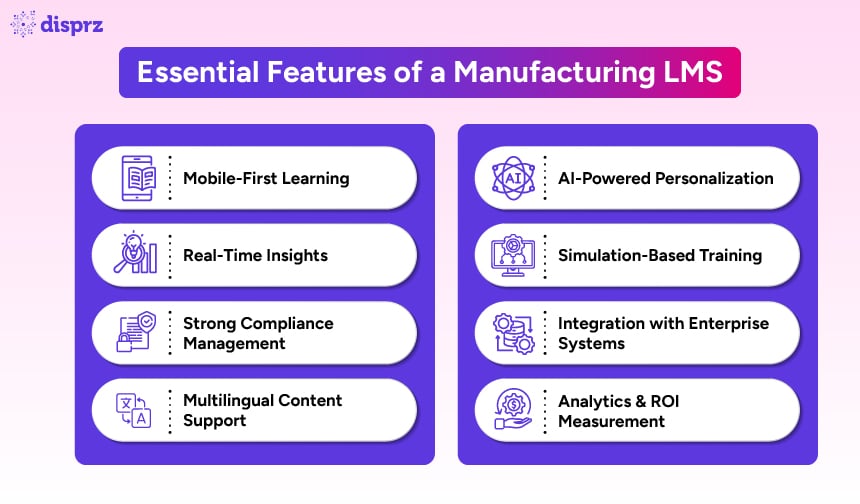
Here are the key capabilities to prioritize:
1. Mobile-First Learning for Frontline Workers
Manufacturing workforces are largely deskless. A robust LMS must deliver seamless mobile access, enabling workers to learn on the shop floor, on the move, and even offline. Microlearning formats, multilingual support, and intuitive UX are critical to drive adoption.
2. AI-Powered Personalization
Modern LMS platforms should go beyond static learning paths. AI should dynamically recommend content, simulations, and practice based on role, skill gaps, and real-time performance; ensuring every worker gets relevant, targeted learning.
3. Real-Time Skill Gap Analysis
Manufacturers need continuous visibility into workforce capabilities. The LMS should map skills to roles, track proficiency levels, and identify skill gaps in real time; especially for critical operations, compliance, and safety.
4. Simulation & Practice-Based Learning
In manufacturing, learning by doing is essential. Look for platforms that enable scenario-based simulations, virtual practice environments, and assessments that mirror real-world tasks; reducing errors and improving job readiness.
5. Strong Compliance & Certification Management
From safety protocols to regulatory standards, compliance is non-negotiable. The LMS should automate training assignments, track certifications, send renewal alerts, and maintain audit-ready records with minimal manual effort.
6. Integration with Shop Floor & Enterprise Systems
An effective manufacturing LMS should integrate with systems such as ERP, MES, HRMS, and IoT platforms. This allows learning to be triggered by real operational data; such as machine downtime, quality issues, or process changes.
7. Multilingual & Multi-Format Content Support
Global manufacturing teams require content that is accessible across languages and formats: videos, SOPs, PDFs, and interactive modules. The LMS should support easy localization and content standardization across geographies.
8. Advanced Analytics & ROI Measurement
Beyond completion rates, the LMS should provide insights into skill progression, productivity impact, error reduction, and training effectiveness. Strong LMS analytics help L&D teams demonstrate tangible business outcomes and ROI.
Looking for an LMS that actually works on the shop floor?
See how Disprz enables mobile-first training, compliance tracking, and real-time skill insights.
Best LMS for Manufacturing (2026): Top Platforms Compared
If you’re evaluating LMS platforms for manufacturing, it’s not just about “features”; it’s also about shopfloor readiness, compliance tracking, scalability, and ease of adoption.
Here’s a quick side-by-side comparison of best LMS platforms to help you cut through the noise:
| Platform | Best For | Key Strength | Deployment Speed |
|---|---|---|---|
| Disprz | Frontline & skill-based learning | Skill-first, mobile-first, strong adoption | Fast |
| Absorb LMS | Compliance-heavy enterprises | Advanced reporting & compliance tracking | Medium |
| TalentLMS | SMBs / quick rollout | Easy setup, intuitive UI | Fast |
| SAP Litmos | Global compliance training | Pre-built content, fast deployment | Fast |
| 360Learning | Collaborative learning orgs | Peer-driven content creation | Medium |
1. Disprz
If you’re interested in skilling your frontline workforce at scale, Disprz stands out. It’s built around a skill-first approach, not just content delivery; so you can map roles, track capabilities, and drive real business outcomes. The mobile-first experience makes it especially effective for shopfloor and distributed teams, where adoption is usually the biggest challenge.
Explore how this works in practice with a frontline training platform built for manufacturing environments.
2. Absorb LMS
If your primary focus is compliance and audit readiness, Absorb is a strong contender. It’s known for deep reporting, certification tracking, and automated compliance workflows, which are critical in regulated manufacturing environments.
3. TalentLMS
If you want to get started quickly without heavy IT involvement, TalentLMS is one of the easiest platforms to deploy. It’s intuitive, supports standard formats such as SCORM/xAPI, and works well for basic training programs; but may fall short as your operations scale.
4. SAP Litmos
If you need rapid deployment with built-in content, SAP Litmos is a reliable option. It offers pre-built compliance libraries, strong integrations, and global scalability, making it suitable for standardized training across large manufacturing teams.
5. 360Learning
If your organization values collaborative, peer-driven learning, 360Learning brings a different approach. It enables employees to create and improve content together; but it’s better suited for knowledge-sharing cultures than structured shopfloor training.
Bottom line: If you’re optimizing for frontline performance, skill-building, and adoption on the shopfloor, you’ll likely lean toward Disprz. If your priority is compliance or quick deployment, the others can fit; but with trade-offs depending on your scale and complexity.
Choosing the right LMS can directly impact productivity, safety, and downtime.
See how Disprz helps leading manufacturers train and upskill frontline teams at scale.

How to Choose the Right LMS for Manufacturing?
Choosing the right LMS for your manufacturing workforce isn’t just a technology decision; it’s an operational one. You need a platform that fits your shop floor realities, supports compliance, and drives measurable productivity gains. From onboarding new hires to upskilling experienced operators, your LMS should enable learning without disrupting operations. The challenge is that most platforms look similar on the surface but differ significantly in execution. That’s why you need a structured approach; one that aligns your training goals with real business outcomes such as reduced downtime, improved safety, and faster skill development across locations.
Follow these steps to make the right choice:
1) Define Clear Training Objectives
Start by identifying what you want your LMS to achieve. Are you focused on compliance, reducing downtime, improving productivity, or enabling multi-skilling? Be specific. When your objectives are clear, you can evaluate platforms based on outcomes; not just features. This also helps align stakeholders across HR, L&D, and operations teams.
2) Map Role-Based Skill Requirements
In manufacturing, one-size-fits-all training doesn’t work. You need to map skills to specific roles: operators, supervisors, maintenance teams, and more. This ensures your LMS supports structured, role-based learning paths that directly impact job performance rather than generic course completion.
3) Evaluate Shop Floor Readiness
Your LMS must work where your workforce is. Look for mobile-first design, offline access, and multilingual support. If your teams can’t access learning easily during or between shifts, adoption will suffer; no matter how powerful the platform is.
4) Check Compliance and Certification Capabilities
Compliance is non-negotiable in manufacturing. Ensure the LMS can automate EHS training, certification tracking, reminders, and audit-ready reporting. This reduces manual effort and ensures you’re always prepared for inspections without last-minute scrambling.
5) Assess Integration with Existing Systems
Your LMS should integrate seamlessly with systems such as ERP, MES, and HRMS. This allows for better data flow, accurate user management, and alignment between training and operations. Without integration, you’ll end up with siloed data and inefficiencies.
6) Prioritize Ease of Use and Adoption
Even the most feature-rich LMS will fail if your workforce doesn’t use it. Choose a platform with an intuitive interface, simple navigation, and minimal learning curve. Adoption is especially critical for frontline workers who may not be tech-savvy.
7) Look for Real-Time Analytics and Insights
You need visibility into what’s working and what’s not. A strong LMS should provide real-time dashboards on training progress, skill gaps, and performance impact. This helps you take corrective action quickly and continuously improve your programs.
8) Evaluate Scalability Across Locations
If you operate multiple plants or plan to expand, your LMS should scale with you. It should support centralized control with localized flexibility; so you can standardize training while adapting to regional needs.
9) Review Content Flexibility and Delivery Formats
Manufacturing training isn’t just theory; it’s practical. Ensure the LMS supports videos, simulations, microlearning, and SOP-based training. The ability to deliver engaging, bite-sized content improves retention and application on the job.
10) Test with a Real Use Case (Not Just a Demo)
Don’t rely on generic demos. Ask for a pilot or use-case-based walkthrough aligned to your workflows; such as onboarding a machine operator or rolling out safety training. This gives you a realistic view of how the LMS performs in your environment.
Choosing the right LMS is about finding a platform that fits your operations, not just your checklist. When done right, it becomes a strategic lever; helping you build a safer, more skilled, and highly productive manufacturing workforce.
If you're evaluating LMS platforms, it’s worth seeing how Disprz handles manufacturing-specific use cases like EHS training, skill tracking, and ERP integrations.
Benefits of LMS for Manufacturing Organizations
In manufacturing, where precision, safety, and efficiency are critical, you need a learning system that keeps your workforce aligned, skilled, and compliant; without slowing down operations.
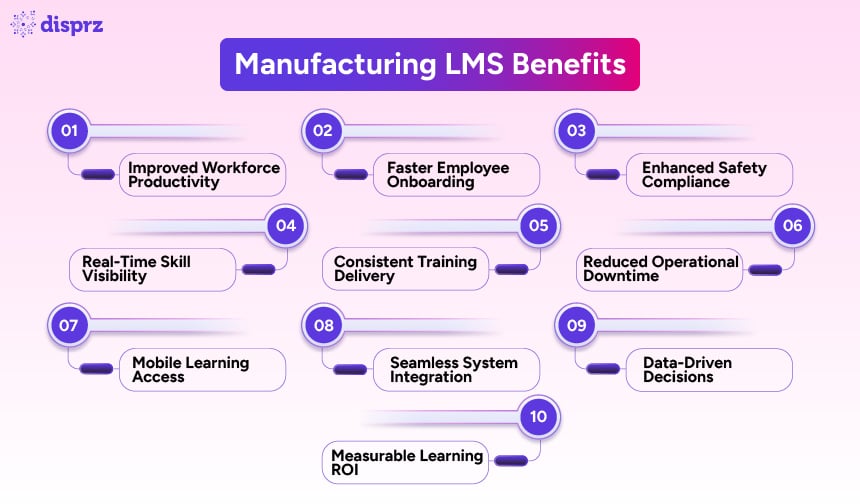
1. Improved Workforce Productivity
You enable your workforce to perform tasks more efficiently with role-specific training, reducing errors, rework, and downtime while ensuring consistent execution across shifts, plants, and production lines.
2. Faster Onboarding for Frontline Workers
You can accelerate onboarding with structured, easy-to-access learning paths that help new hires become job-ready faster, reducing dependency on supervisors and minimizing early-stage operational risks.
3. Enhanced Safety and Compliance
You ensure employees stay up to date with safety protocols and regulatory requirements through automated training, certifications, and alerts; helping you reduce incidents and stay audit-ready at all times.
4. Real-Time Skill Gap Visibility
You gain clear visibility into workforce capabilities by mapping skills to roles and tracking proficiency, enabling you to identify and address gaps before they impact production or quality outcomes.
5. Consistent Training Across Locations
You standardize training delivery across multiple plants and geographies, ensuring every employee receives the same quality of learning, regardless of location, language, or shift timing.
6. Reduced Downtime Through Just-in-Time Learning
You empower workers with on-demand access to training and SOPs, allowing them to quickly resolve issues on the shop floor and reduce machine downtime or production delays.
7. Better Adoption with Mobile Learning
You reach deskless workers effectively through mobile-first learning experiences, enabling them to access content anytime, anywhere (even in low-connectivity environments); driving higher engagement and completion rates.
8. Seamless Integration with Operational Systems
You can connect your LMS with ERP, MES, and other systems, allowing learning to be triggered by real-time operational data such as quality issues, equipment failures, or process changes.
9. Data-Driven Decision Making
You move beyond guesswork with actionable insights into training effectiveness, skill progression, and performance impact; helping you make informed decisions that align learning with business outcomes.
10. Measurable ROI on Learning
You can clearly link learning initiatives to business metrics such as productivity, quality, and safety, helping you demonstrate tangible ROI and justify continued investment in workforce development.
An LMS helps you build a safer, more skilled, and future-ready workforce; while directly impacting productivity, quality, and operational efficiency.
5 Manufacturing LMS Trends in 2026: What’s Next?
The future of learning management systems for manufacturing is shaped by innovation and evolving workforce demands. As manufacturers face increasing pressure to maintain compliance, upskill their workforce, and improve operational efficiency, the top LMS platforms are rapidly evolving to meet these needs. Emerging technologies and advanced analytics are transforming how training is delivered and monitored.
Here are five emerging trends to watch in 2026 for manufacturing LMS:
1) AI-Powered Personalized Learning
Artificial Intelligence will drive personalized learning experiences, tailoring content to individual learner needs and performance patterns. By analyzing user data, an AI LMS can deliver relevant training content, recommend upskilling opportunities, and identify knowledge gaps, enhancing both engagement and learning outcomes.
2) Microlearning for Faster Skill Acquisition
Short, focused learning modules will become the norm, allowing manufacturers to deliver bite-sized training that enhances retention and minimizes downtime. This approach caters to busy schedules and allows workers to learn and apply new skills quickly without disrupting daily operations.
3) Virtual Reality (VR) for Hands-On Training
VR simulations will provide immersive, risk-free environments for training on complex machinery and safety protocols. This technology enables realistic practice scenarios, reducing on-the-job errors while improving the speed and effectiveness of technical training and safety compliance.
4) Stronger ERP & MES Integrations
Enhanced integration capabilities will streamline data sharing, ensuring training aligns closely with operational processes and quality standards. These deeper integrations allow for real-time tracking of learning outcomes, improved workflow automation, and better synchronization between training programs and production goals.
5) Continuous Compliance Monitoring
Automated compliance monitoring will ensure real-time tracking of certifications and adherence to regulatory changes, reducing manual oversight. This proactive approach allows manufacturers to maintain compliance effortlessly, minimize regulatory risks, and streamline audit preparation across multiple facilities.
How Disprz LMS Reduces Risks in the Manufacturing Industry
In manufacturing, risk isn’t limited to safety incidents; it extends to compliance gaps, skill shortages, and operational inefficiencies. If your workforce isn’t consistently trained and up to date, even small gaps can lead to costly errors. That’s where Disprz LMS helps you stay ahead.
With Disprz, you can standardize and automate compliance training across locations, ensuring every employee receives the right EHS training at the right time. Automated certifications, reminders, and audit-ready reports reduce manual effort and help you stay fully prepared for inspections without last-minute stress.
Beyond compliance, Disprz enables you to identify and close skill gaps proactively. Through role-based learning paths, real-time analytics, and skill tracking, you can ensure your workforce is always equipped to handle evolving machinery, processes, and technologies; reducing the risk of errors and downtime.
Most importantly, Disprz brings learning into the flow of work. With mobile-first, on-demand access, your teams can learn on the shop floor without disrupting operations. This means faster onboarding, better knowledge retention, and a safer, more productive workforce; helping you minimize risks while maximizing performance.
Want to see how this works for your manufacturing workforce?
Key Takeaways
- A manufacturing LMS must support productivity, safety, compliance, and continuous skill development on shopfloors.
- Mobile-first and offline learning ensure your frontline workforce accesses training anytime without disrupting operations.
- Role-based learning paths deliver targeted training, helping employees build skills required for specific job functions.
- Real-time analytics help you track progress, identify skill gaps early, and improve training effectiveness.
- Seamless ERP, MES, and HR integrations ensure training aligns closely with workflows and business performance.
Conclusion
A modern LMS for manufacturing isn’t just about delivering training; it’s about enabling performance at scale. You need a platform that helps you stay compliant, close skill gaps faster, and improve operational efficiency without disrupting production. When you choose an LMS with capabilities such as EHS training, blended learning, and seamless ERP & MES integration, you’re not just solving today’s challenges; you’re preparing your workforce for what’s next.
More importantly, the right LMS helps you create consistency across plants while still adapting to local needs. You can standardize training, ensure safety practices are followed everywhere, and give your teams access to learning that keeps pace with evolving technologies. With strong analytics, you gain visibility into performance, spot skill gaps early, and deliver targeted, on-demand training that drives real outcomes on the shop floor.
As manufacturing continues to evolve, your approach to workforce development needs to evolve with it. Investing in the right LMS isn’t optional; it’s a strategic decision that directly impacts productivity, safety, and long-term growth.
The right LMS doesn’t just train your workforce, it improves safety, reduces downtime, and drives measurable productivity gains.
If you're ready to transform manufacturing training at scale, it’s time to see Disprz in action.
FAQs on LMS for Manufacturing
1) What is an LMS for manufacturing?
An LMS for manufacturing is a platform designed to deliver, manage, and track training for frontline and operational teams. It helps you ensure compliance, build critical skills, and improve workforce productivity in a structured, scalable way.
2) Why is an LMS important for manufacturing organizations?
It helps you maintain compliance, reduce safety risks, and standardize training across locations. At the same time, it enables faster upskilling, minimizes operational disruption, and ensures your workforce stays aligned with evolving technologies and processes.
3) What features should you look for in a manufacturing LMS?
You should prioritize mobile access, offline learning, compliance tracking, role-based learning paths, real-time analytics, and seamless integration with systems such as ERP, MES, and HRMS to ensure training aligns closely with operational workflows.
4) How does an LMS improve shop floor productivity?
By enabling on-demand, role-specific training, an LMS reduces errors, shortens onboarding time, and ensures employees can quickly apply what they learn, leading to smoother operations, fewer disruptions, and improved overall efficiency on the shop floor.
5) Can an LMS help with compliance and safety training?
Yes, an LMS ensures consistent EHS training delivery, automates certification tracking, sends timely reminders, and maintains audit-ready records, helping you stay compliant with regulations while significantly reducing manual effort and risk of non-compliance.
6) How does an LMS support workforce upskilling?
It allows you to create structured, role-based learning journeys, deliver continuous training, and rapidly deploy new content. This ensures your workforce can adapt to new technologies, processes, and business demands without impacting ongoing operations.
7) Is an LMS suitable for multi-location manufacturing organizations?
Absolutely. An LMS helps you standardize training across multiple plants while allowing flexibility for local customization. This ensures consistent skill development, compliance adherence, and operational alignment across geographically distributed manufacturing teams.