

On this page
LMS pricing in 2027: quick answer
Learning Management System (LMS) pricing typically ranges from $3 to $20 per user per month for SaaS models, or $3,000 to $100,000+ per year depending on organization size, active user count, and deployment depth.
Main LMS pricing models
- Per-user (per-seat) pricing: a flat rate for every registered user, whether they log in daily or once a year (typically $3 to $15 per user per month).
- Pay-per-active-user: you are charged only for learners who actually log in or engage during a billing cycle (typically $5 to $20+ per active user per month).
- Tiered and subscription plans: flat monthly or annual fees for a fixed bucket of features, branches, or AI credits (for example, TalentLMS starts around $119 per month and Tutor LMS from $199 per year).
- Open-source and free-core: the software is free to download or use in basic form, but you pay for hosting, maintenance, or enterprise scaling (for example, Moodle).
- Perpetual and on-premise license: a large upfront fee for permanent ownership, plus recurring maintenance and server hosting costs.
Average cost by organization size
- Small (under 500 learners): $3,000 to $15,000 per year. Pay-per-active-user or entry-level cloud plans offer the best value.
- Mid-size (500 to 2,000 learners): $15,000 to $50,000 per year, usually including HRIS integrations and richer reporting.
- Large enterprise (2,000+ learners): $50,000 to $200,000+ per year, with custom multi-year agreements, dedicated support, and enterprise features.
Common hidden costs to watch for
- Implementation and onboarding: setup, initial configuration, and admin training fees.
- Data migration: transferring legacy courses and user records.
- Content creation and add-ons: third-party course libraries (such as OpenSesame), e-commerce modules, or extra AI and translation credits.
- Integrations: connecting the LMS to your HRIS, CRM, or single sign-on (SSO) tools. See our guide to how much an LMS costs.
In 2027, LMS pricing is no longer just a procurement decision; it’s a strategic investment tied directly to workforce capability, compliance risk, and long-term scalability.
To help you evaluate your options clearly, here are the key considerations at a glance:
- There’s no single answer to “how much does an LMS cost?” Pricing varies widely based on users, features, deployment type, support levels, and contract terms.
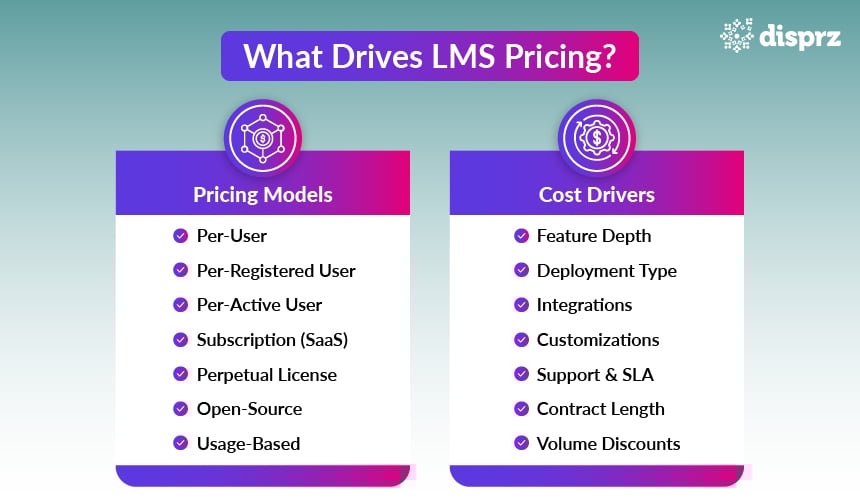
- The most common LMS pricing models include per-user, per-active user, subscription (SaaS), perpetual license, open-source, and usage-based pricing.
- Your actual learning management system pricing will depend on factors such as integrations, AI capabilities, analytics depth, mobile access, and implementation support.
- Most buyers underestimate LMS hidden costs such as onboarding fees, custom branding, data migration, advanced reporting, or storage overages.
- Enterprise LMS pricing often includes volume discounts but may come with longer contracts and tiered support structures.
- A smart LMS pricing comparison should focus on total cost of ownership (TCO), not just the base subscription fee.
In this guide, we’ll break down every major LMS cost component, compare common pricing approaches, highlight hidden fees, and help you choose the right model for your organization in 2027.
Scroll down for detailed breakdowns, pricing benchmarks, examples, and a practical checklist you can use during vendor conversations.
What Determines LMS Pricing in 2027?
If you’ve started requesting quotes, you’ve probably noticed something: Two vendors can quote wildly different numbers for what sounds like the same solution.
That’s because LMS pricing is built on two core layers:
- The pricing model (how you’re charged)
- The cost drivers (what influences the final amount)
Let’s break both down clearly.
Factors That Influence Cost
Beyond the pricing model, several variables shape your final learning management system pricing.
1. Feature Depth
The more advanced your platform, the higher the cost. Common add-ons include:
- Built-in authoring tools
- Advanced analytics and BI dashboards
- AI-driven personalization
- Skills frameworks
- Mobile apps
- eCommerce functionality
Basic LMS platforms are cheaper. Skills-based or AI-enabled systems, such as a modern AI-based LMS typically increase enterprise LMS pricing but deliver deeper capability tracking and adaptive learning.
2. Deployment Type
SaaS (cloud-based):
- Lower upfront cost
- Subscription model
- Vendor-managed updates
On-premise:
- Higher upfront infrastructure investment
- Internal IT management
- Security and maintenance overhead
3. Integrations & Customizations
Do you need integrations with:
- HRIS
- CRM
- Payroll
- SSO providers
- BI tools
Custom APIs, workflows, and branding often increase your LMS cost. Evaluating the depth of LMS integration capabilities early helps prevent unexpected implementation costs later in the buying process.
4. Support Levels and SLA
Standard support may be included. However, premium SLAs (24/7 support, dedicated success manager, faster response times) usually increase cost; especially in enterprise LMS pricing.
5. Contract Length & Discounts
Vendors often offer:
- Annual contracts
- Multi-year agreements (discounted)
- Volume-based user pricing
Longer commitments usually reduce per-user cost; but increase contractual rigidity.
At this stage, you can already see why LMS pricing comparison isn’t straightforward.
Two vendors may both say “$X per user,” but the total cost differs once you factor in integrations, AI modules, support tiers, and implementation fees.
Breakdown of LMS Pricing Models in 2027
Now let’s get practical.
In this section, we’ll break down the most common LMS pricing models, explain how they actually work in real buying scenarios, and share benchmark ranges you’ll typically see in the market in 2027.
Per-User Pricing
How It Works:
You’re charged for every registered user in the system; whether they log in once a year or every day.
Typical benchmark range (SaaS):
- ~$3 to $15 per user per month
- Enterprise deals often negotiated annually
Example:
If you have 1,000 employees and pay $6 per user/month:
1,000 × $6 × 12 = $72,000 annually.
When It’s Ideal:
- Mandatory compliance training
- Consistent organization-wide learning
- Stable workforce size
Drawbacks:
- You pay for inactive accounts
- Seasonal training programs become inefficient
- Extended enterprise (partners/customers) becomes expensive
This model makes learning management system pricing predictable; but not always optimized.
Deeper dive: list prices usually sit between $3 and $15 per user per month and fall as seat volume rises, so negotiate a price break at your next headcount tier.
Per-Active User Pricing
How It Works:
You’re only charged for users who meet a defined “activity” threshold during a billing cycle.
Activity may mean:
- Logged in once
- Completed a course
- Spent X minutes learning
- Consumed paid content
Typical benchmark range:
- ~$5 to $20 per active user per month
- Often comes with minimum billing thresholds
Example:
You have 2,000 registered users but only 600 active in a month:
600 × $10 × 12 = $72,000 annually.
Who Benefits Most:
- Organizations with optional learning
- External/customer academies
- Sales or partner training programs
Risks:
- “Active” definitions vary
- Budget forecasting can fluctuate
- Sudden adoption spikes can increase LMS cost
This model is often attractive in enterprise LMS pricing when engagement levels vary widely.
Deeper dive: expect $5 to $20+ per active user per month, and always confirm how the vendor defines active, since a single login and a completed course can be priced very differently.
Subscription & Tiered Pricing
This is the most common structure in 2027.
How It Works:
- You pay a flat monthly or annual subscription
- Based on user bands (e.g., 1–500, 501–2,000, etc.)
- With feature-based tiers (Basic, Pro, Enterprise)
Typical annual SaaS ranges:
- Small teams: $3,000–$15,000/year
- Mid-market: $15,000–$60,000/year
- Enterprise: $60,000–$250,000+ per year
Higher tiers typically include:
- Advanced analytics
- AI recommendations
- API integrations
- Dedicated success support
Monthly vs Yearly
Annual contracts usually:
- Offer 10–25% discounts
- Lock pricing stability
This structure simplifies LMS subscription pricing, but feature gating can increase long-term spend.
Deeper dive: tiers commonly start near $119 per month and scale to custom enterprise contracts, with branches, AI credits, and integrations gated to higher plans.
Perpetual License Fee
Less common today, but still relevant in regulated industries.
How It Works:
- One-time upfront license fee
- Annual maintenance fee (15–25% of license cost)
- Infrastructure handled internally
Example structure:
- $150,000 upfront license
- $30,000 annual maintenance
- Additional IT hosting costs
When It Makes Sense:
- Strict data control requirements
- On-premise IT environments
- Long-term stable usage
Drawbacks:
- High initial capital expense
- Slower innovation cycles
- Significant internal resource requirements
In most modern scenarios, SaaS subscription models reduce total learning management system pricing complexity.
Deeper dive: the upfront licence is only part of it, so budget 15 to 25% of the licence each year for maintenance, plus your own hosting and upgrade costs.
Open-Source LMS
At first glance, it appears “free.” But real-world LMS cost includes:
- Cloud hosting
- Security hardening
- Custom development
- Ongoing upgrades
- Internal IT staffing
Typical annual operational costs can range:
- $20,000–$100,000+ depending on complexity
When It Works:
- Strong in-house development teams
- Highly customized requirements
- Long-term technical ownership strategy
Most organizations underestimate the LMS hidden costs of open-source solutions.
Deeper dive: the licence is free, but hosting, development, security patching, and IT time routinely push total cost above an equivalent SaaS plan.
Pay-As-You-Go & Hybrid Models
How It Works:
You pay based on:
- Course enrollments
- Transactions
- Storage usage
- External learner volume
Sometimes combined with a base subscription.
Best Fit For:
- Short-term certification programs
- Seasonal workforce training
- Pilot initiatives
Watch-Out:
- Harder to predict annual budgets
- Costs scale rapidly with success
This model can lower initial LMS pricing, but forecasting requires careful planning.
Deeper dive: set usage alerts and a monthly cap, because completion, storage, or bandwidth spikes during campaigns can make this the hardest model to forecast.
Quick Practical Comparison
Here’s how these models compare at a high level:
| Model | Predictability | Scalability | Budget Control | Best For |
|---|---|---|---|---|
| Per User | High | Moderate | Strong | Compliance-heavy orgs |
| Per Active User | Medium | High | Variable | Optional learning |
| Subscription Tiered | High | High | Strong | Growing organizations |
| Perpetual License | High | Low | Strong (long-term) | On-premise enterprises |
| Open Source | Variable | High | Complex | Tech-heavy teams |
| Pay-As-You-Go | Low | Very High | Variable | Campaign-based training |
The key takeaway?
There is no universally “best” model. The right LMS pricing model depends entirely on:
- Your user behavior
- Your learning frequency
- Your feature requirements
- Your growth trajectory
Why LMS Pricing Feels Confusing (And How to Decode It)
Let’s be honest; LMS pricing can feel frustratingly opaque.
You ask, “How much does an LMS cost?”
The answer you get is often, “It depends.”
And technically, that’s true. But it doesn’t make your buying decision any easier.
Why Buyers Feel Confused
Here’s what usually creates friction during a learning management system pricing discussion:
1. Different definitions of “user.”
One vendor charges per registered user. Another one charges per active user. A third bundles usage into tiers.
2. Feature bundling varies widely.
AI, advanced analytics, mobile apps, integrations, or eCommerce may be included in one quote; and add-ons in another.
3. Implementation isn’t always disclosed upfront.
Onboarding, data migration, integrations, and custom branding often appear later in the conversation as separate line items, increasing your total LMS cost.
4. Enterprise discounts are negotiable.
Especially in enterprise LMS pricing, list prices rarely reflect final contract value. Multi-year deals, user volumes, and growth projections influence the final number.
5. Activity-based pricing lacks standardization.
“Active user” can mean:
- Logged in once per month
- Completed a course
- Consumed X minutes of content
- Per transaction
Without clarity, your projected LMS subscription pricing may not match your actual invoice.
The Real Issue: Comparing Apples to Oranges
When you run an LMS pricing comparison, you’re not just comparing software; you’re comparing:
- Pricing models
- Packaging strategy
- Product maturity
- Support philosophy
- Scalability roadmap
Two platforms priced similarly may differ drastically in long-term total cost of ownership (TCO).
For example:
- A lower base subscription may require costly integrations.
- A higher upfront quote may include implementation, AI modules, and premium support.
- An open-source option may eliminate license fees but increase long-term maintenance costs.
How to Decode LMS Pricing (Without Getting Overwhelmed)
Here’s a practical approach you can use during vendor conversations:
1. Normalize the User Metric
Ask every vendor:
- Is pricing per registered or active user?
- How is “active” defined?
- What happens if users scale by 20%?
2. Separate Base vs Add-Ons
Break the quote into:
- Core platform cost
- Implementation/onboarding
- Integrations
- AI features
- Analytics modules
- Support tiers
This immediately reveals LMS hidden costs.
3. Ask for 3-Year Projections
Instead of Year 1 pricing, request:
- Year 1
- Year 2 (with projected growth)
- Year 3
Enterprise buyers often underestimate the scaling impact on enterprise LMS pricing.
4. Calculate Cost Per Learner Per Year
Divide total annual cost by:
- Total users
- Or active users
This makes cross-vendor comparison far clearer.
A Note on Transparency
As buyers become more sophisticated in 2027, pricing transparency is becoming a differentiator.
Modern LMS vendors (including Disprz) increasingly focus on:
- Clear definitions of user metrics
- Upfront disclosure of implementation scope
- Predictable scaling models
- Modular packaging instead of surprise add-ons
Because ultimately, pricing shouldn’t feel like a puzzle.
It should align clearly with:
- Your use cases
- Your growth plans
- Your internal capabilities
- And the long-term value you expect from your learning ecosystem
Now that we’ve decoded why pricing feels complicated, let’s go deeper into each LMS pricing model with practical benchmarks and examples.
Additional Cost Considerations
Here’s where most buyers underestimate their total LMS cost.
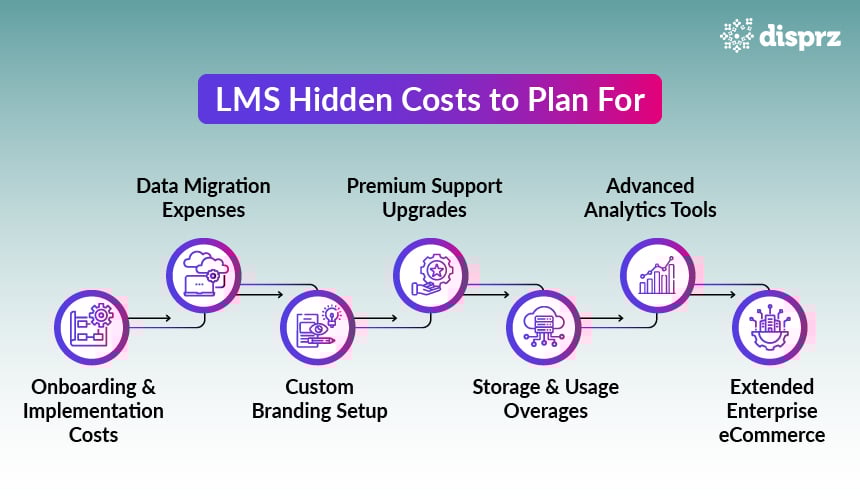
The base subscription is only part of your learning management system pricing. What often shifts your real investment are the additional components layered around implementation, customization, and scale.
Let’s unpack the most common LMS hidden costs you should plan for in 2027.
1. Onboarding & Implementation Fees
Most vendors charge a one-time implementation fee.
This may include:
- Platform configuration
- Admin training
- Workflow setup
- Initial integrations
- Go-live support
Typical range:
- SMB: $2,000–$10,000
- Mid-market: $10,000–$40,000
- Enterprise: $40,000–$150,000+
In complex enterprise LMS pricing, implementation can sometimes equal 20–50% of the first-year subscription.
Always clarify:
- What’s included?
- How many integration hours are covered?
- Is data migration part of the package?
2. Data Migration Costs
If you’re switching platforms, you may need to migrate:
- User records
- Historical completion data
- Certifications
- Course libraries
Vendors may:
- Include basic migration
- Charge per data object
- Or bill hourly for custom mapping
Underestimating migration complexity can significantly increase your overall LMS pricing.
3. Setup & Custom Branding
White-labeling and branding often matter; especially for:
- External academies
- Partner portals
- Customer education platforms
Potential charges may apply for:
- Custom domain
- Themed UI
- Multi-portal architecture
- Language localization
Some platforms include this in higher tiers; others treat it as an add-on.
4. Support & Dedicated SLA Costs
Standard support usually covers:
- Email or ticket-based assistance
- Business-hour response
Premium SLAs may include:
- 24/7 support
- Dedicated account manager
- Faster response guarantees
- Strategic success reviews
In enterprise LMS pricing, premium support can add 10–25% to annual subscription cost.
5. Storage or Usage Overage Fees
Watch for limits around:
- File storage
- Video bandwidth
- Active user caps
- API calls
Exceeding usage thresholds can increase your LMS subscription pricing unexpectedly; especially in high-content environments.
6. Advanced Analytics & BI Tools
Basic reporting is usually included. But advanced capabilities (such as those listed below) may require higher pricing tiers.
- Skills intelligence dashboards
- Predictive analytics
- Custom BI connectors
- Data warehouse exports
If learning analytics drives your strategy, factor this into your LMS pricing comparison early.
7. eCommerce & Extended Enterprise Functionality
If you plan to monetize training, look for additional fees related to:
- Payment gateway integrations
- Revenue tracking
- Tax handling
- Multi-tenant architecture
External training almost always changes your cost structure. Organizations expanding into partner or customer academies should evaluate their broader enterprise learning management strategy to ensure pricing scales sustainably across audiences.
The Real Question: What’s Your Total Cost of Ownership (TCO)?
Instead of asking only: “How much does an LMS cost?”
Ask: “What will this cost us over 3 years including growth, integrations, and support?”
Your true enterprise LMS pricing includes:
- Base Subscription
- Implementation
- Integrations
- Migration
- Support
- Scaling Costs
- Add-On Modules
That’s the number your CFO actually cares about.
LMS Pricing by Organization Type & Size
One of the biggest mistakes buyers make is asking,
“What’s the average LMS pricing?”
The better question is:
“What does LMS pricing look like for an organization like ours?”
Your size, structure, and training strategy dramatically influence your learning management system pricing. Let’s break this down by organization type.
Startups & Small Businesses (Up to 250 Employees)
Typical Annual LMS Cost:
- $3,000 – $15,000 per year
- Often subscription-based SaaS
- Limited implementation fees
What Drives Pricing Here:
- Basic onboarding & compliance training
- Minimal integrations
- Standard reporting
- Simple admin workflows
For smaller teams, LMS subscription pricing is usually packaged into tiered plans based on user bands.
Best pricing model:
- Tiered subscription
- Per-user pricing
Watch out for:
- Paying for advanced features you don’t need
- Minimum user thresholds that inflate costs
If training is occasional, per-active-user models may reduce overall LMS cost.
Mid-Market Organizations (250–5,000 Employees)
Typical Annual LMS Pricing:
- $15,000 – $80,000 per year
- Implementation: $10,000 – $40,000
What Changes at This Stage:
- HRIS and SSO integrations
- More structured learning paths
- Role-based permissions
- Growing reporting complexity
- Manager dashboards
Mid-market organizations often begin evaluating enterprise LMS pricing tiers because:
- They need scalability
- Compliance requirements increase
- Skills tracking becomes important
Best pricing model:
- Subscription tiered pricing
- Per-active user if engagement varies
This is where a thoughtful LMS pricing comparison becomes essential; feature differences start meaningfully impacting cost.
Large Enterprises (5,000+ Employees)
Typical Annual Enterprise LMS Pricing:
- $80,000 – $500,000+ per year
- Implementation: $40,000 – $150,000+
What Drives Enterprise LMS Cost:
- Global multi-language support
- Complex integrations (HRIS, CRM, ERP)
- Advanced analytics & skills frameworks
- AI-powered personalization
- Dedicated success & SLA
- Extended enterprise portals
At this scale, pricing negotiations become more strategic:
- Multi-year contracts
- Volume discounts
- Custom feature bundling
Enterprise LMS pricing is rarely “off-the-shelf.”
It’s tailored around usage volume, integrations, and long-term roadmap alignment.
Internal vs External Training Models
Your audience also impacts how much an LMS costs.
Internal Training (Employees Only)
- More predictable user count
- Easier budgeting
- Per-user or subscription pricing works well
External / Extended Enterprise (Partners, Customers, Franchisees)
- User volumes fluctuate
- Growth can be unpredictable
- eCommerce functionality may be needed
In these cases:
- Per-active user pricing
- Usage-based pricing
- Or hybrid models
Often provide better cost control.
Quick Pricing Snapshot by Size
| Organization Type | Annual LMS Pricing Range | Common Model |
|---|---|---|
| Startup / SMB | $3K – $15K | Tiered subscription |
| Mid-Market | $15K – $80K | Tiered or active-user |
| Enterprise | $80K – $500K+ | Custom enterprise pricing |
| Extended Enterprise | Variable | Active-user / hybrid |
Want a detailed cost breakdown based on your team size and use case? Explore Disprz Pricing
Comparing LMS Pricing Across Popular Vendors
When you run an LMS pricing comparison, you’ll quickly notice something: Most enterprise vendors don’t publish exact numbers.
Instead, pricing is:
- Quote-based
- Tiered by user volume
- Bundled by feature depth
- Negotiated based on contract length
Still, we can compare pricing structures, transparency levels, and positioning across well-known vendors to help you frame conversations better. For a broader feature and capability comparison beyond pricing, you may also explore our guide to the best LMS platforms in 2027 before narrowing your shortlist.
Below is a structural comparison (not fixed list pricing, since most enterprise quotes are customized).
Pricing Structure Comparison (2027 Snapshot)
| Vendor | Pricing Model | Transparency | Best For | Enterprise Focus |
|---|---|---|---|---|
| Disprz | Tiered + enterprise custom | Quote-based | Skills-driven enterprises | High |
| 360Learning | Per-user tiered SaaS | Partial public guidance | Collaborative learning orgs | High |
| Absorb LMS | Tiered enterprise pricing | Quote-based | Mid-market & enterprise | High |
| TalentLMS | Published tiered plans | Transparent for SMB | Small to mid-sized teams | Moderate |
| LearnUpon | Per-user / tiered SaaS | Quote-based | Customer & partner training | High |
How to read this snapshot:
- Most enterprise LMS vendors price by quote, so published rates are rare above the entry tier and a demo plus a custom quote is usually needed to compare like for like.
- Transparency is the real differentiator here: published per-user rates make budgeting easy, while quote-only pricing trades speed for discounts you have to negotiate.
- Match the model to engagement, since per-registered-user pricing suits mandatory compliance while per-active-user pricing suits optional, partner, or customer training.
- Watch the total, not the headline rate, because implementation, integrations, and add-ons often move the real cost more than the per-user price.
- Disprz pairs tiered and enterprise-custom pricing with skills and frontline depth, which is where a per-user price turns into measurable outcomes.
Disprz
Disprz typically positions its enterprise LMS pricing around:
- Skills-based learning architecture
- AI-driven recommendations
- Deep analytics and workforce capability tracking
- Large-scale deployments
Pricing is usually:
- Tiered by user bands
- Influenced by feature modules (skills, analytics, AI)
- Customized for enterprise environments
For a detailed breakdown of features, plans, and enterprise pricing structure, explore the Disprz pricing page.
Best suited for:
- Mid-to-large enterprises
- Organizations prioritizing workforce capability development over basic compliance
360Learning
360Learning focuses heavily on collaborative learning.
Their LMS pricing models typically include:
- Per-user SaaS pricing
- Tiered feature packaging
- Enterprise customization
Strengths:
- Strong peer learning workflows
- Collaborative authoring
Considerations:
- Per-user pricing may increase LMS cost in large distributed teams
Absorb LMS
Absorb positions itself strongly in mid-market and enterprise segments.
Common pricing traits:
- Tiered SaaS model
- Enterprise-based customization
- Add-ons for advanced analytics and integrations
Strengths:
- Strong reporting
- Extended enterprise capabilities
Potential cost drivers:
- Premium support tiers
- Advanced feature modules
TalentLMS
TalentLMS is known for:
- Transparent pricing tiers
- Published subscription plans
- Clear user-band pricing
Best for:
- SMBs
- Smaller mid-market organizations
Because of published tiers, LMS subscription pricing is more predictable; though enterprise-level customization may be limited.
LearnUpon
LearnUpon focuses heavily on:
- Customer education
- Partner enablement
- Multi-portal architecture
Pricing characteristics:
- Per-user tiered structure
- Strong extended enterprise support
Strength:
- External training environments
Cost consideration:
- External user volume can increase overall learning management system pricing significantly.
Key Observations from Vendor Comparison
- Most enterprise vendors are quote-based. Transparent list pricing is more common in SMB-focused platforms.
- Per-user remains dominant, but “active user” variations are increasingly common.
- Feature gating significantly impacts total LMS cost. AI, advanced analytics, and integrations are often tier-dependent.
- Implementation and SLA are major differentiators in enterprise LMS pricing.
- The lowest base price rarely equals the lowest total cost of ownership.
What This Means for You
Instead of asking vendors:
- “What’s your price per user?”
Ask:
- What’s included in your base tier?
- Which features are add-ons?
- How does pricing scale if we grow 20% annually?
- What are the 3-year projected costs?
That’s how you move from a surface-level LMS pricing comparison to a strategic buying decision.
How to Choose the Right Pricing Model for You
Choosing the right LMS pricing model isn’t about picking the cheapest option; it’s about aligning pricing with how you actually train.
Here’s a simple framework to guide your decision:
1. Start with Your Use Case
Ask yourself:
- Is training mandatory for all employees?
- Is it optional or campaign-based?
- Are you training partners or customers too?
Best fit examples:
- Organization-wide compliance: Per-user or tiered subscription
- Variable engagement: Per-active user
- External academies: Hybrid or usage-based models
Your use case should shape your projected learning management system pricing.
2. Understand Your Real User Activity
Don’t just count the total headcount. Estimate:
- How many will log in monthly?
- How many need certifications?
- How many are occasional learners?
If only 60% of users are active, per-active-user pricing may reduce your overall LMS cost.
3. Match Pricing to Training Frequency
- Continuous learning culture would match subscription tiered pricing
- Quarterly or seasonal training would match active-user or hybrid models
Engagement patterns directly influence sustainable LMS pricing.
4. Separate Must-Have from Nice-to-Have
Feature creep increases enterprise LMS pricing fast.
Define:
- Core requirements (reporting, integrations, mobile)
- Strategic add-ons (AI, skills, advanced analytics)
- Optional extras
Pay for what drives measurable outcomes.
5. Think 3 Years, Not 1
Ask vendors for:
- Year 1 cost
- Growth scenario (+20% users)
- Add-on activation impact
This avoids surprises in your LMS subscription pricing later.
The right model is the one that balances predictability, scalability, and total long-term value; not just the lowest upfront number.
If you want a tailored estimate based on your projected users, integrations, and feature requirements, you can book a personalized demo to review pricing in the context of your specific use case.

How to Budget for an LMS
Budgeting for LMS pricing isn’t just about the subscription fee. It’s about forecasting your total investment; and the value you’ll generate from it.
Strategy for Estimating Your Costs
Start with your base LMS subscription pricing, then layer in:
- Implementation & onboarding
- Integrations (HRIS, SSO, CRM)
- Data migration
- Premium support / SLA
- Add-on modules (AI, analytics, eCommerce)
Then factor in:
- 10–20% user growth annually
- Increased storage or usage
- Feature expansion over time
Always model 1-year and 3-year projections to understand your true learning management system pricing.
LMS ROI: Measuring Value Beyond Cost
Don’t evaluate only on LMS cost. Measure impact.
Look at:
- Admin time saved through automation
- Compliance risk reduction
- Faster onboarding cycles
- Improved learner engagement
- Scalability without adding headcount
When positioned correctly, enterprise LMS pricing becomes an investment in workforce capability; not just software expense.
LMS Pricing Transparency Checklist
Before you sign any contract, run through this checklist.
It will help you uncover LMS hidden costs, clarify assumptions, and make your LMS pricing comparison truly apples-to-apples.
User & Billing Clarity
- Is pricing per registered user or per active user?
- How exactly is “active” defined?
- Is there a minimum billing threshold?
- What happens if users scale by 20% next year?
This directly impacts your long-term learning management system pricing.
Feature Inclusion
- Are integrations included or billed separately?
- Is AI functionality built-in or an add-on?
- Are advanced analytics part of the base plan?
- Does mobile access cost extra?
Feature gating often increases enterprise LMS pricing over time.
Implementation & Support
- Is onboarding included in the base quote?
- Are data migration services covered?
- Is support tiered (standard vs premium SLA)?
- Is a dedicated success manager included?
Implementation can significantly affect first-year LMS cost.
Usage & Overages
- Are there storage limits?
- Are API calls capped?
- Are there bandwidth or content hosting fees?
- What are the penalties for exceeding limits?
Unexpected overages can inflate your LMS subscription pricing.
Contract Terms
- Is pricing locked for multi-year agreements?
- Are renewal increases capped?
- Are there early exit clauses?
- Are discounts tied to volume commitments?
This protects you from year-over-year pricing surprises.
The bottom line: Transparent vendors will answer these clearly; without vague qualifiers. When evaluating LMS pricing, clarity equals control.
Conclusion
When evaluating LMS pricing, the real question isn’t just how much does an LMS cost; it’s whether the pricing model aligns with your long-term learning strategy. The right learning management system pricing should scale with your workforce, support both internal and external training needs, include the features that drive measurable outcomes, and remain predictable over a multi-year horizon.
In 2027, organizations are looking beyond the lowest quote and focusing instead on total cost of ownership, transparency, and strategic fit. A structured LMS pricing comparison, clear understanding of user definitions, and 3-year cost projections can help you make a confident decision. Ultimately, the best LMS investment strengthens workforce capability, improves compliance visibility, and supports sustainable growth; making enterprise LMS pricing a strategic business enabler rather than just a software expense.
If you’d like a pricing walkthrough tailored to your user volume, integration needs, and feature priorities, you can book a demo to explore a customized cost structure aligned with your organization’s growth plans.
About the authors

Shobhit Mathur
Chief Customer Officer
Shobhit Mathur is a senior customer experience and business leader with extensive experience helping enterprises drive learning, skilling, adoption, and workforce transformation through technology....