

On this page
Enterprise data is easier to collect than ever, but finding the right answer still takes far too much work. Conversational analytics eliminates that complexity by turning natural language questions into instant, accurate business insights. The result is faster decisions, fewer manual reporting tasks, and direct access to the information teams need every day.
In this blog, we'll explore why traditional LMS reporting falls short, how conversational analytics changes the way enterprises interact with learning data, and the role the Disprz MCP Server plays in securely delivering that experience.
Why Traditional LMS Reporting Fails Enterprise L&D Teams
Most enterprise LMSs contain all the learning data an organization needs. The challenge isn't collecting it; it's finding the specific answer you're looking for. When the question doesn't match a predefined report, L&D teams are left filtering, exporting, and manually stitching together data before they can act.
Questions like these come up every day:
- Which branch has stopped completing its compliance training this quarter?
- Which onboarding cohort is likely to miss its 30-day milestone?
- Which customer accounts have seen a drop in learner activity since the last QBR?
- Which assessment question is causing the highest failure rate?
These aren't unusual requests. They're operational questions that require timely answers.
In most learning platforms, answering them means navigating multiple screens, applying filters, exporting reports, combining spreadsheets, and often repeating the process across different tenants or systems. The data exists, but it isn't readily accessible.
The impact of this extends beyond just reporting. McKinsey estimates that knowledge workers spend nearly 20% of their workweek; about one day every week, searching for and gathering information instead of acting on it. At enterprise scale, every manual reporting request slows decisions, delays customer conversations, and consumes time that should be spent improving business outcomes.
From Static Dashboards to Conversational Analytics: What's Changing
The fix isn't a better dashboard. It's removing the requirement to know where the answer lives in the first place.
Instead of learning report structures, filter logic, and export formats, a user should be able to type a plain-language question and get a grounded answer back, no SQL, no navigation, no reconciling three exports. This is the model consumer AI tools have already normalized outside of work. It's now arriving inside enterprise platforms, and learning data is one of the clearest places it applies.
What Is Conversational Analytics?
Conversational analytics is a way of interacting with enterprise data using natural language. Instead of navigating dashboards, applying filters, or building reports, users simply ask a business question and receive an accurate, contextual answer drawn from connected enterprise systems. For example, a Customer Success Manager can ask, "Which customer accounts have seen learner engagement decline since the last QBR?" and get the answer instantly, without exporting reports or reconciling spreadsheets.
Conversational analytics is the experience users interact with. Behind that experience is a technology layer that securely connects AI assistants to live learning data. At Disprz, that technology is the Disprz MCP Server, which enables AI assistants to securely retrieve live learning data and return accurate answers in real time.
What Makes This Possible: MCP, in Plain Terms
Model Context Protocol (MCP) is a secure way for AI assistants to connect with enterprise systems and access live data. It does this without exposing the underlying database or requiring custom integrations.
Think of it as a secure door between an AI assistant and a platform's data. The AI assistant understands the user's question, while the MCP Server securely retrieves only the data needed to answer it. The assistant never gets a copy of your database. It asks a specific, permissioned question, the platform responds through its APIs, and the AI presents the answer in a format that's easy to understand. Every response is grounded in live learning data.
Here's what that looks like in practice, applied to a learning platform:
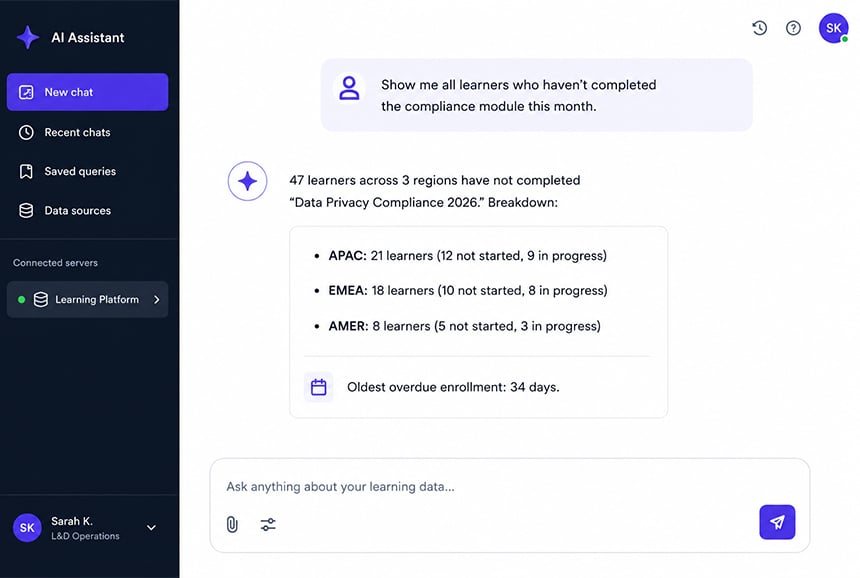
No dashboard was opened. No report was exported. No filters were set by hand. The question went in, the system did the work behind the scenes, and a usable answer came back in the time it takes to type it.
How Disprz Delivers Conversational Analytics for Enterprise Learning
When a user asks a question, the AI assistant uses the Disprz MCP Server to securely retrieve the relevant data from the platform and present a clear, accurate answer in seconds. The MCP Server securely accesses the same enrollment, completion, assessment, attendance, and survey data that already exists in Disprz, making it available through natural-language conversations instead of dashboards and reports.
In simple terms, you no longer have to log into the platform, navigate multiple dashboards, or export reports to find an answer. You simply ask your question from wherever you're already working, and the answer comes to you. That's the real value of conversational analytics. It helps CSMs, L&D administrators, HR business partners, and other stakeholders get the information they need without the usual reporting detour.
For Customer Success Managers
- QBR prep in minutes, not hours — pull a unified completion view across self-paced, classroom, and MOOC content for an account before a call, instead of compiling three separate exports.
- Early churn signals — ask which accounts show declining login frequency or a growing inactive-learner ratio, and flag disengagement before it shows up in a renewal conversation.
- Content hygiene talking points — identify stale or outdated modules in an account's catalogue as a proactive discussion point in a review, not a surprise the customer raises first.
For L&D Administrators
- Overdue learner reports on demand — ask who hasn't completed a mandatory module past a given date, with status and last-accessed date, instead of exporting and filtering manually.
- Assessment quality checks — ask for the pass/fail distribution on a compliance quiz to confirm it's calibrated correctly, or drill into which specific question is causing repeated failures across a cohort.
- Attendance reconciliation — pull session-level ILT attendance for HR or compliance submission without a manual cross-check between the roster and the platform.
For HR Business Partners and L&D Leaders
- Org-wide compliance rollups — ask which business units or regions are behind on a mandatory program, instead of waiting on L&D to compile a cross-team report for a leadership review.
- Workforce capability snapshots — ask which learning journeys are live, archived, or in draft across the organization, to support a broader skills or capability conversation without pulling a separate catalogue export.
Every one of these replaces a multi-step, multi-screen task with a single question. The underlying data doesn't change. What changes is how long it takes a person to reach it.
The Business Cost of Manual LMS Reporting in 2026
This isn't a future risk to plan around. It's already showing up on the balance sheet this year:
- The reporting gap is already a competitive gap. Analyst coverage of the BI and analytics market already points to a shift past static dashboards toward agentic, self-service workflows where AI handles data prep, analysis, and reporting on the user's behalf. Platforms still built around fixed reports don't just look outdated; they're already structurally slower than the ones your buyers are comparing you against right now.
- Every audit, incident, and QBR is already harder than it needs to be. Teams that still rely on manual exports aren't just behind on convenience; they're behind on response time in exactly the moments, a compliance audit, a churn-risk conversation, an escalation, where speed determines the outcome.
- The talent and adoption cost is compounding now. New CSMs and admins already expect to work the way they do outside of work, asking a system a question, not learning its menu structure. A platform that can't meet that expectation is adding friction to onboarding and daily use today, quietly pushing users toward workarounds or disengagement.
- The data debt becomes permanent. The volume of learning data: modules, cohorts, journeys, assessments only grows. Every year without an intent-based way to query it adds another layer that a future retrofit has to account for. What's a manageable gap today becomes a much larger one to close later.
None of this is a hypothetical risk. It's the direct extension of a trend already underway: enterprise software is moving from systems people have to learn to systems that answer what people actually ask. The organizations that adopt this early aren't just saving time today; they're avoiding a much larger integration and adoption problem down the line.
Why This Is an Imperative for L&D Leaders Now
This isn't a nice-to-have reporting upgrade. A few reasons it belongs on the priority list this year, not next:
- Compliance exposure compounds quietly. Overdue compliance training doesn't announce itself; it surfaces during an audit, when it's already a liability. Faster detection is risk mitigation, not just convenience.
- CSM capacity is finite. Time spent compiling reports is time not spent on the strategic parts of the account relationship; the conversations that actually protect renewals.
- Reporting debt scales with your platform's growth. Every new tenant, module, and cohort adds more places data can hide. The gap between "the data exists" and "someone can act on it" only widens as the platform scales, unless the retrieval model changes with it.
- Expectations have already shifted. People now expect to ask a system a direct question and get a direct answer; that's the norm they carry in from every other tool they use. An L&D platform that still requires report navigation reads as dated by comparison.
Key Takeaways
-
The biggest bottleneck in enterprise L&D isn't collecting learning data; it's accessing it quickly enough to act on it.
-
Dashboards remain valuable for recurring metrics, but they can't anticipate every business question.
-
Conversational analytics changes how users access learning data, letting them ask questions in natural language instead of navigating reports.
-
The Disprz MCP Server powers this experience by securely connecting AI assistants to live learning data and returning accurate, permission-aware answers.
-
Organizations that reduce the time between question → insight → action will outperform those still relying on manual reporting workflows.
Conclusion
The platforms winning the next few years of enterprise buying decisions won't be the ones with the most dashboards. They'll be the ones where a CSM, an L&D admin, or an HR business partner can ask a direct question and trust the answer that comes back, grounded in live data, not a static export from last week.
Conversational analytics changes how enterprise teams interact with learning data. Instead of navigating reports, they simply ask questions and receive trusted answers instantly. Behind that experience, the Disprz MCP Server securely connects AI assistants to live learning data, making conversational access possible without changing how data is stored or governed. If your team is still exporting reports to answer questions your platform already has the data to answer, that's the gap worth closing first.
Frequently Asked Questions
What is conversational analytics in L&D?
Conversational analytics in L&D lets you ask learning and workforce questions in plain English and get instant answers from your learning data. Instead of navigating dashboards or exporting reports, you simply ask questions like, "Which onboarding cohort is falling behind?" and get the answer in seconds.
How does conversational analytics differ from learning analytics?
Learning analytics tells you what happened through dashboards, reports, and metrics. Conversational analytics changes how you access those insights. Rather than searching for the right report, you ask a question in natural language and get the specific answer you need immediately.
What does an MCP Server actually do?
An MCP Server powers conversational analytics by securely connecting AI assistants to enterprise systems. When a user asks a question, it retrieves the right information from the Disprz platform and returns it to the AI assistant. The MCP Server doesn't generate answers or make decisions on its own; it simply provides secure, permission-aware access to enterprise data, while the AI assistant interprets and presents the response.
Does an MCP Server replace dashboards and reports?
No. Dashboards remain the best way to track recurring metrics and predefined KPIs. An MCP Server complements them by answering the ad hoc operational questions that arise during audits, QBRs, compliance reviews, and day-to-day decision-making—without requiring users to navigate reports or export data.
How is an MCP Server different from an AI chatbot?
An AI chatbot generates responses based on its underlying model. An MCP Server connects the AI to live enterprise systems, allowing it to retrieve permission-aware information in real time. The result is grounded answers based on current platform data, not generated assumptions.
Is the data secure when accessed through an MCP Server?
Yes. An MCP Server respects the application's existing authentication and permission model. Users can retrieve only the information they are already authorized to access, ensuring enterprise data remains secure and governed by existing access controls.
Can an MCP Server update records or perform actions?
Not necessarily. Most enterprise implementations begin with read-only access, allowing users to retrieve and analyze live data through natural language. Organizations can then decide if and when they want to introduce write actions or workflow automation.
Who benefits most from an MCP-enabled learning platform?
Anyone who regularly relies on learning data to make decisions. L&D teams, Customer Success Managers, HR business partners, compliance teams, and business leaders can all retrieve operational insights in seconds instead of depending on manual reports or specialist support.
How quickly can an organization start using conversational access to learning data?
With a platform like Disprz, most organizations can begin asking natural-language questions as soon as the MCP Server is connected to their learning environment. Because it works on top of existing APIs, teams can realize value quickly without redesigning reports, rebuilding dashboards, or changing how learning data is managed.