

On this page
TL;DR
- A performance improvement plan (PIP) template gives HR teams a consistent, legally defensible structure for addressing underperformance.
- The strongest templates pair clear baseline data and SMART goals with real support, not just a paper trail toward exit.
- Industry context changes what you measure: compliance accuracy in BFSI, defect rates in manufacturing, patient documentation in healthcare.
- A PIP fails when the "support" section is empty. Improvement needs targeted skilling, not a warning letter.
- This guide includes a full employee PIP template, a 30 day performance improvement plan variant, and a PIP letter format you can adapt today.
If your PIPs keep ending in exits instead of turnarounds, the gap is usually capability, not effort. That is where a skilling layer changes the outcome.
Most performance conversations start too late and end too vaguely. By the time a manager decides to formalise a plan, the underperformance has already affected team output, and the employee often has no clear picture of what "better" looks like in numbers.
A performance improvement plan template solves the structure problem. It forces objectivity, sets a fair timeline, and documents the support the organisation commits to providing. What it cannot solve on its own is the capability gap underneath the performance gap. In 2026 that distinction matters more than it used to, because skills expectations are shifting faster than most annual review cycles can track.
According to the LinkedIn 2025 Workplace Learning Report, skill sets for jobs have been changing rapidly, and organisations increasingly expect internal development to close those gaps rather than backfilling through hiring. Heading into 2026, a PIP that identifies a problem but offers no real path to build the missing skill is just a countdown clock.
This guide gives you a complete, adaptable template, an industry-by-industry view of what to measure, and a practical way to make sure the "support" section actually delivers improvement.
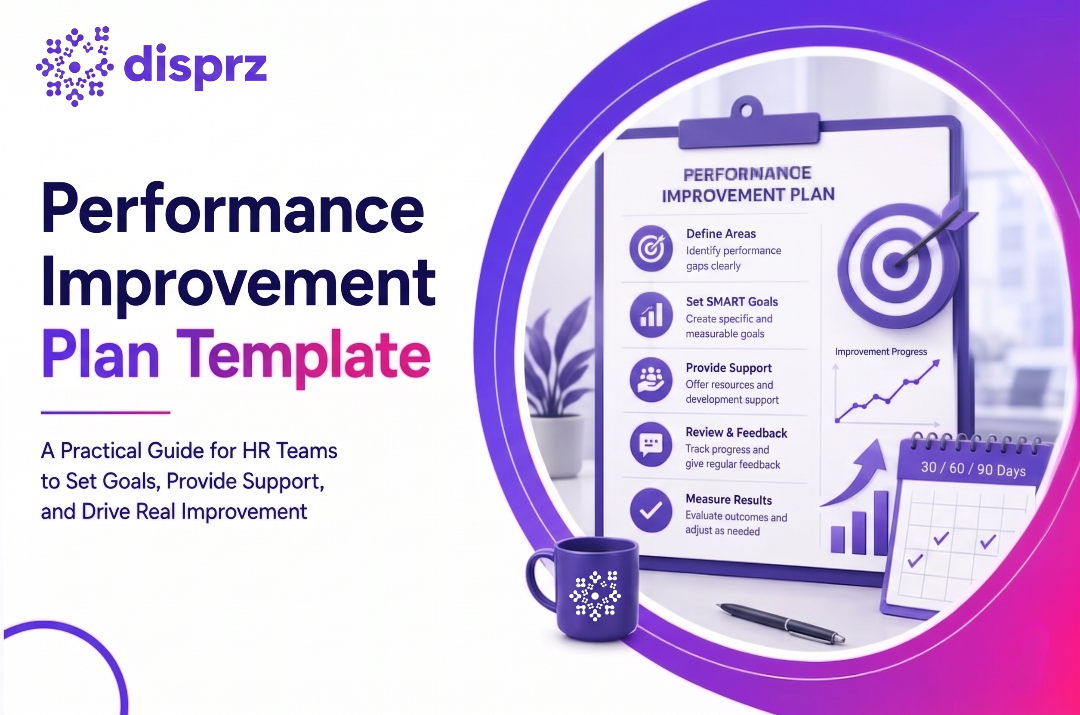
“What is PIP: A performance improvement plan (PIP) is a formal document that flags where an employee is falling short, sets measurable goals, and defines a timeline (usually 30, 60, or 90 days). It helps managers give structured support to improve performance.”
Why Do Performance Improvement Plans Matter More in 2026?
Underperformance is expensive in ways that rarely show up on a single line item. There is the direct cost of missed output, the drag on team morale when others cover the gap, and the far larger cost of replacement if the plan fails and you rehire.
A structured PIP protects against all three. It creates a documented, consistent process that treats every employee the same way, which matters for fairness and for legal defensibility if separation eventually becomes necessary. It also gives the employee something they often lack: a precise, numeric definition of success.
The shift worth noting is why plans fail. In most enterprise settings, employees on a PIP are not lazy. They are missing a specific, teachable capability, whether that is a compliance procedure, a product knowledge gap, or a process they were never properly trained on. A plan that assumes effort is the only variable will keep producing the same result.
“Market: LinkedIn's workplace learning research consistently shows that internal skill building is now a primary retention and performance lever, with talent developers increasingly tasked with tying learning directly to business performance rather than course completion.”
Who Uses a PIP Template, and Does It Change by Company Size?
A performance improvement plan template is used across company sizes, but implementation and intent differ.
Enterprise (500+ employees)
At enterprise scale, PIPs are standardised, documented, and often audited by HR and legal. Timelines are strict, and the process is integrated into wider performance and talent systems. The priority is consistency and risk mitigation across large, distributed teams.
Mid-market and growing teams
Here the emphasis leans toward retention. Replacing a trained employee is costly, so plans tend to be more hands-on, with genuine coaching built in. The template still needs rigour, but the goal is turnaround, not documentation for exit.
Frontline and deskless teams
This is the segment most templates ignore. Retail associates, manufacturing operators, field agents, and hospitality staff cannot sit at a desk to complete retraining. Their PIP support has to reach them where they work, on mobile, in short formats, and often in their preferred language. A plan that assumes desktop access simply will not execute for a large share of the enterprise workforce.
“Mistake: The most common PIP failure is a strong "problem" section and an empty "support" section. Listing what an employee did wrong, then providing no real training or resources, turns the plan into an unfair trap. It damages morale, raises legal risk, and rarely produces improvement.”
What Should an Employee PIP Template Include?
Below is a complete employee performance improvement plan template. Use it as your base and adjust the metrics to the role.
1. Employee and Plan Details
- Employee Name:
- Job Title:
- Department:
- Manager Name:
- HR Contact:
- Plan Start Date:
- Plan End Date: (typically 30, 60, or 90 days)
2. Purpose Statement
This plan formally notes that recent performance has fallen below the standard required for the role. Its goal is to help you close the identified gaps, meet role expectations, and return to a position of strength within the team.
3. Performance Gaps and Observations
For each area, document objectively:
- Role Expectation: the specific standard or metric required
- Observed Performance: the current shortfall, described factually
- Specific Examples: dated instances, error rates, or missed targets
- Business Impact: how the gap affects the team, customers, or output
4. SMART Goals and Success Metrics
Every goal must be specific, measurable, and time-bound. A reader with no context should be able to tell whether the employee passed.
- Objective 1: (metric, checkpoint, due date)
- Objective 2: (metric, checkpoint, due date)
- Objective 3: (metric, checkpoint, due date)
5. Support and Resources Provided
This section decides whether the plan is fair. Specify:
- Coaching or 1:1 cadence with the manager
- Targeted training mapped to the exact skill gap
- Tools, access, or mentorship being provided
6. Timeline and Review Schedule
- Weekly check-ins: (day and time)
- Mid-point review: (date)
- Final evaluation: (date)
7. Outcomes and Acknowledgement
State outcomes plainly. Meeting all objectives closes the plan successfully. Failure to meet them may lead to further action, up to and including separation, per company policy.
Signature lines for Employee, Manager, and HR Representative confirm the expectations and consequences were discussed and understood.
How Do You Write a PIP Letter for an Employee?
If you need a shorter PIP letter format for an employee rather than a full plan document, the same logic compresses into four clear statements:
- The gap: Over the past [period], your [specific metric or task] fell below the required standard of [number].
- The goal: Starting [date], you are expected to achieve [exact target] for the next [30 days].
- The support: We will meet every [day] to review progress, and you will have access to [specific training or resource].
- The outcome: Meeting this standard closes the plan. Not meeting it may lead to further action per policy.
Keep the tone neutral and factual. The letter is a record, not a reprimand.
What Does a 30 Day Performance Improvement Plan Look Like?
A 30 day performance improvement plan works best for a single, well-defined issue where fast feedback is possible. Use a 60 or 90 day plan when the gap involves a broader skill that takes longer to build.
Example (Retail store associate):
- Gap: Achieved 50% of the monthly sales target for the last two months.
- Goal: Reach 95% of the monthly store sales target and maintain a 4.5/5 customer service rating across the 30 days.
- Support: Twice-weekly coaching with the store manager, plus a mobile-delivered product knowledge and objection-handling refresher.
- Review: Weekly progress checks; final evaluation on day 30.
The 30 day window only works when the support is immediate. If the associate is missing product knowledge, that training has to be available on their phone during shifts, not booked into a classroom three weeks out.
How Should a PIP Change by Industry?
Underperformance looks different in every sector, so the metrics in your template must change with it. The structure stays the same. What you measure does not.
- Banking and Financial Services (BFSI):
Focus on compliance, accuracy, and risk. Example goal: 100% adherence to KYC and AML procedures with zero critical audit findings across the next 50 files by day 30. - Retail and Ecommerce:
Focus on sales conversion, service quality, and attendance reliability. Example goal: meet 95% of the monthly sales target and maintain a 4.5/5 customer rating. - Insurance:
Focus on claims processing speed and documentation accuracy. Example goal: process 15 claims per day at 98%+ accuracy over 30 days. - IT and ITeS:
Focus on delivery and quality. Example goal: complete 100% of assigned sprint tasks on time for three consecutive sprints, keeping post-release defects under 2%. - Manufacturing and Automotive:
Focus on output, safety, and defects. Example goal: meet the daily production quota with a defect rate below 0.5% and zero safety-protocol violations over four weeks. - Pharma and Healthcare:
Focus on patient safety and documentation. Example goal: complete all patient records accurately by end of shift with zero missing fields for 60 days. - Food Services and Hospitality:
Focus on guest experience and service speed. Example goal: keep average check-in under 3 minutes and record zero negative guest-survey mentions for 30 days.
“Simple: The rule across every industry is the same. Regulated sectors (BFSI, insurance, healthcare) center on accuracy and compliance. Shift-based sectors (retail, hospitality, manufacturing) center on output and reliability. Change the metric, keep the structure.”
What Makes a Strong PIP Template?
Before you finalise any template, check it against these seven points. Missing any one raises legal risk or reduces the chance of real improvement.
| S.No | Criterion | What it means |
|---|---|---|
| 1 | Clear baseline data | Specific dates, metrics, and error rates, not general impressions. |
| 2 | Unambiguous SMART goals | Numeric and time-bound, never "work harder" or "improve attitude." |
| 3 | Explicit, real support | Named coaching, tools, and training mapped to the actual gap. |
| 4 | A fixed timeline with milestones | A defined duration with weekly checks and a mid-point review. |
| 5 | Transparent consequences | Plainly stated, with no surprises at the end. |
| 6 | Role-specific customisation | Metrics tuned to the department and industry. |
| 7 | A three-way signature block | Employee, manager, and HR, for fairness and record-keeping. |
Why Do Most PIPs Fail, and How Do You Fix the Support Gap?
Six of the seven criteria above are about documentation. The one that decides the outcome is the third: real support.
This is where most performance improvement plans quietly fail. The plan correctly identifies that an employee is missing a compliance procedure, a product knowledge area, or a process skill, then commits to "training and coaching" without any mechanism to deliver it at the pace the timeline demands. The manager runs out of hours, the training never gets curated, and the plan becomes a countdown to separation.
Closing that gap means treating the support section as a skilling problem, not a paperwork line. Three things have to happen quickly:
1. Pinpoint the real skill gap.
The performance gap is a symptom. Assessments mapped to the specific role identify the underlying capability that is actually missing, so the plan targets the cause rather than the surface complaint.
2. Deliver targeted training fast.
A 30 day plan cannot wait on a classroom schedule. The employee needs relevant, bite-sized modules and SOPs pushed directly to them, in the flow of work, from day one.
3. Track progress objectively.
Weekly check-ins are far more useful when the manager can see actual learning progress and assessment scores, not just ask "how's it going?"
This is the practical case for connecting your PIP process to an AI-powered skilling platform. Disprz maps skills to specific job roles, uses assessments to pinpoint the exact capability gap behind the performance issue, and builds a personalised path to close it, with progress a manager can actually see week to week.
For HR leaders, this changes what a PIP is worth. It shifts the plan from a documented path toward exit into a route back to performance, which protects retention and the cost of rehiring. The impact shows up in real deployments: Wellness Forever cut onboarding time so new employees became productive within 30 days across 400+ stores, and ROSHN reached 91% platform adoption. For frontline and deskless teams, Disprz's mobile-first, offline-capable Frontline Enablement solution delivers training where retail, manufacturing, and field staff actually work, with completion rates above 95% against an industry average below 30%.
Conclusion
A performance improvement plan template gives HR leaders the structure, fairness, and documentation that serious performance management requires. The template itself is the easy part. Any of the formats in this guide targeted training will hold up.
The difference between a PIP that ends in a turnaround and one that ends in an exit is almost always the support section. When the plan pinpoints the real skill gap, delivers targeted training fast, and tracks genuine progress, underperformers get a real path back to standard. When it does not, the plan is just a well-documented countdown.
If your organisation wants PIPs that actually improve performance rather than simply record its decline, the missing layer is usually skilling. Building that capability directly into your performance process is how you turn a compliance exercise into a retention and productivity win.
Frequently Asked Questions
1. What is a performance improvement plan template?
A performance improvement plan template is a structured document that helps managers identify underperformance, set measurable goals, define a timeline, and outline the support provided to help an employee improve.
2. How long should a performance improvement plan be?
Most plans run 30, 60, or 90 days. A 30 day performance improvement plan suits a single, well-defined issue, while broader skill gaps need 60 or 90 days to close.
3. What should a PIP letter for an employee include?
A PIP letter for an employee includes the performance gap, a specific measurable goal, the support provided, the review cadence, and the outcome if goals are not met.
4. What makes a PIP fail?
A PIP usually fails when the support section is empty. Documenting the problem without delivering targeted training or coaching gives the employee no real path to improve.
5. Does a PIP always lead to termination?
No. A PIP is designed to help an employee succeed. With clear goals and genuine support, many employees complete the plan and return to full performance.
6. Can a PIP work for frontline or deskless employees?
Yes. Frontline employees need mobile-first, bite-sized training delivered where they work, so the support in their plan reaches them without requiring desktop access.