

On this page
Malaysia's workforce faces a growing skills challenge. According to the Malaysia Critical Occupations List (MyCOL), there are more than 66 critical occupations facing talent shortages across industries. Organisations are struggling to find people with the right skills. At the same time, technology is changing jobs faster than ever.
Artificial intelligence (AI), automation, and digital tools are reshaping how work gets done. Some routine tasks are disappearing. The pace of change is accelerating. Recent estimates suggest that 81% of Malaysian employers struggle to find people with the AI skills they need, while the country currently has only around 3,000 AI professionals despite needing an estimated 30,000 by 2030. This growing AI talent gap highlights why workforce development can no longer be treated as a future initiative. It is a current business priority.
New roles are emerging. Existing jobs now require new skills. While AI can improve productivity, it cannot solve a skills gap on its own. Organisations still need employees who know how to use these tools, make decisions, solve problems, and adapt to change.
This is why the conversation around the skills gap in Malaysia has become a business priority. From manufacturing and financial services to retail and customer-facing industries, leaders are feeling the impact. The growing talent shortage in Malaysia is slowing business growth, increasing hiring costs, and putting pressure on workforce performance.
For L&D leaders, this creates an important question: should you keep hiring for scarce skills, or should you build them internally?
The answer often lies in a smarter approach to upskilling and long-term workforce development in Malaysia. Organisations that invest in skill-building can respond faster to market changes and create a more future-ready workforce.
Here we will explore the scale of the challenge, explain why hiring alone is not enough, and share a practical three-step framework that shows how to close the skills gap in Malaysia. If you lead learning, talent, or workforce transformation initiatives, this framework can help you turn skills shortages into a competitive advantage.
Understanding the Scale of Malaysia's Skills Gap
The discussion around Malaysia's skills gap is no longer limited to HR and L&D teams. It has become a business challenge that affects growth, productivity, and competitiveness. While organisations continue to invest in digital transformation and AI, many struggle to find employees with the skills needed to support these initiatives.
The result is a widening gap between the skills businesses need and the skills available in the workforce. This gap is affecting hiring decisions, workforce planning, and business performance across sectors.
Recent findings from the World Bank's Malaysia Economic Monitor highlight a deeper structural challenge. While Malaysia has steadily expanded tertiary education, the growth of high-productivity and high-skill jobs has not kept pace. As a result, a growing share of degree holders are working in roles below their qualification level.
The Numbers Behind the Shortage
Malaysia's labour market is changing quickly. New technologies, evolving customer expectations, and economic shifts are creating demand for new capabilities. However, skill development is not always keeping pace with these changes.
Many organisations report difficulties filling critical roles, especially those requiring digital, technical, and specialised industry knowledge. The challenge is becoming even more pronounced in AI-related roles. Research indicates that 68% of businesses struggle to hire workers with the skills required for AI initiatives, while demand for AI capabilities continues to grow across industries. As organisations accelerate digital transformation, the shortage of AI-ready talent is emerging as one of the biggest barriers to productivity and innovation. In fact, a Hays survey found that 64% of organisations in Malaysia experienced moderate to extreme skill shortages, highlighting how widespread the issue has become.
The challenge extends beyond hiring. Although Malaysia's unemployment rate remains relatively low, skills mismatches continue to affect the labour market. Government data shows that more than one-third of tertiary-educated Malaysians remain in skills-related underemployment. Even though Malaysia's unemployment rate remains relatively low, many graduates are working in semi-skilled or low-skilled roles that do not fully utilize their education and capabilities. This suggests that the challenge is not simply a lack of jobs, but a mismatch between workforce skills and available opportunities.
Malaysia simultaneously faces skills shortages and talent underutilisation. While many educated workers are employed below their qualification level, employers continue to report difficulties finding people with emerging digital and AI capabilities. The issue is not simply the supply of talent. It is the alignment between workforce skills and future business needs.
The economic impact is significant. According to the World Bank, tertiary-educated workers employed below their skill level earn nearly 49.3% less than peers in skill-matched roles. When skills are underutilised, productivity suffers, wage growth slows, and organisations struggle to maximise the value of their human capital investments.
As AI becomes more common in workplaces, employees are also expected to develop new skills around data, digital tools, problem-solving, and decision-making. Organisations are increasingly seeking employees who can work alongside AI rather than compete with it.
This challenge becomes even more important as AI adoption accelerates. The World Bank notes that Malaysia's workforce challenge is no longer simply about producing more graduates. It is about ensuring workers have the right skills for emerging, high-value roles. As AI reshapes jobs and workflows, organisations need employees who can combine technical knowledge with critical thinking, problem-solving, adaptability, and digital fluency.
This challenge is contributing to the growing talent shortage in Malaysia. Organisations often compete for the same limited talent pool, leading to longer hiring cycles and higher recruitment costs.
The situation highlights why L&D in Malaysia is becoming a strategic function rather than a support function. Organisations can no longer rely only on external hiring. They must focus on continuous learning, upskilling in Malaysia, and building skills from within.
The Three Sectors Feeling It Most
While the skills challenge affects almost every industry, some sectors are experiencing greater pressure than others.
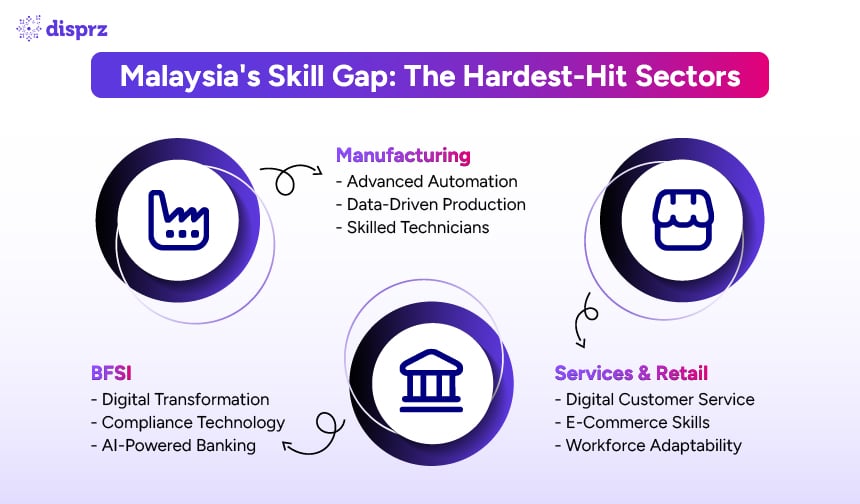
Manufacturing (E&E and Semiconductor)
Malaysia's manufacturing sector, particularly electronics and semiconductor industries, remains a major contributor to economic growth. However, many employers face a growing manufacturing skills shortage in Malaysia.
Factories are becoming more automated and technology-driven. Employees now need skills in automation, data analysis, advanced machinery, quality management, and AI-assisted operations. Yet many organisations struggle to find workers with these capabilities.
As global demand for semiconductor production increases, the competition for skilled talent is becoming even stronger. This makes reskilling the workforce in Malaysia a critical priority for manufacturers.
BFSI (Digital Banking and Islamic Fintech)
The banking, financial services, and insurance sector is undergoing rapid digital transformation. Digital banking platforms, AI-powered customer experiences, cybersecurity requirements, and the growth of Islamic fintech are changing workforce needs.
Financial institutions now require employees with skills in data analytics, digital products, compliance technology, AI applications, and customer engagement. Traditional banking skills alone are often not enough.
The sector's ability to innovate depends heavily on continuous learning and targeted workforce development initiatives.
Services and Retail
The services and retail sectors are also experiencing significant change. E-commerce growth, digital payments, customer experience technologies, and AI-powered service models are creating new skill requirements.
Frontline employees increasingly need digital literacy, communication skills, problem-solving abilities, and the confidence to work alongside AI tools.
Many organisations in these sectors face challenges finding workers who can adapt quickly to changing customer expectations. This makes workforce development in Malaysia an ongoing business requirement rather than a one-time project.
Across all three sectors, the message is clear: the skills gap is not a future problem. It is a current business challenge that requires immediate action.
Upskill vs. Hire: The Business Case L&D Leaders Need to Make
When organisations face a skills shortage, the first response is often to hire new talent. On paper, this seems like the fastest solution. However, in today's market, hiring alone is becoming more expensive, slower, and less sustainable.
For L&D leaders, the stronger business case is often a combination of strategic hiring and continuous skill development. The organisations that succeed are usually the ones that build skills internally while filling only the most critical talent gaps externally.
Why Hiring Alone Won't Solve It
The growing talent shortage in Malaysia means that many organisations are competing for the same skilled professionals. As demand rises, recruitment costs increase and hiring timelines become longer.
In fact, Malaysia is simultaneously experiencing talent shortages and talent underutilisation. Despite producing more educated workers than ever before, many organisations still report difficulties finding job-ready talent. This highlights a core workforce challenge: developing skills that align with evolving business needs rather than relying solely on academic qualifications.
Even when organisations successfully hire experienced employees, the challenge does not end there. Technology continues to evolve. AI tools, automation platforms, and digital systems are changing job requirements every year. Skills that are valuable today may need updating within months.
This is one reason why hiring alone cannot solve the skills gap in Malaysia.
A new employee may fill an immediate vacancy, but they also need continuous learning to stay effective. Without a structured learning strategy, organisations risk facing the same skills shortages again in the future.
Internal talent development offers several advantages:
- Faster access to needed skills
- Lower recruitment costs
- Better employee retention
- Stronger workforce agility
- Improved business continuity
Most importantly, existing employees already understand your culture, customers, and business processes. Building new skills on top of that foundation is often more effective than searching endlessly for external talent.
As AI adoption grows, this becomes even more important. AI can automate certain tasks, but it cannot replace human judgement, leadership, creativity, relationship-building, or complex decision-making. Employees need new capabilities to work effectively alongside AI, making upskilling in Malaysia a long-term business necessity.
The HRD Corp Opportunity Most L&D Leaders Are Missing
Many organisations talk about workforce transformation but fail to fully use the resources already available to support it.
One of the biggest opportunities is the is the HRD Corp training levy in Malaysia, and how to use it strategically for workforce development.
Employers contribute to the levy to support employee learning and development. Yet many organisations focus only on claiming training expenses rather than using the fund as part of a broader workforce strategy.
Forward-thinking L&D leaders take a different approach.
Instead of viewing the levy as a compliance requirement, they use it to support long-term workforce development in Malaysia. They align learning investments with business priorities, future skill requirements, and workforce planning goals.
This creates an opportunity to:
- Accelerate digital skill development
- Support AI readiness programmes
- Build leadership pipelines
- Strengthen technical capabilities
- Drive organisation-wide reskilling initiatives
The organisations making the greatest progress are not simply spending their learning budgets. They are investing strategically in capabilities that support future growth.
For leaders focused on how to close the skills gap in Malaysia, the question should not be whether to use the HRD Corp levy. The question should be how to use it to build a stronger, more adaptable, and more future-ready workforce.
The next step is creating a structured approach that identifies skill gaps, prioritises the most critical needs, and measures real business impact.
A 3-Step Framework for Closing Malaysia's Skills Gap
Many organisations recognise that a skills gap exists. Fewer know exactly how to address it.
The problem is not a lack of training programmes. Most organisations already offer learning opportunities. The challenge is that learning is often disconnected from business priorities and workforce needs.
To successfully address the skills gap in Malaysia, L&D leaders need a structured approach. The goal is not to deliver more training. The goal is to build the right skills at the right time.
This three-step framework can help you create a more focused and measurable strategy for workforce development in Malaysia.
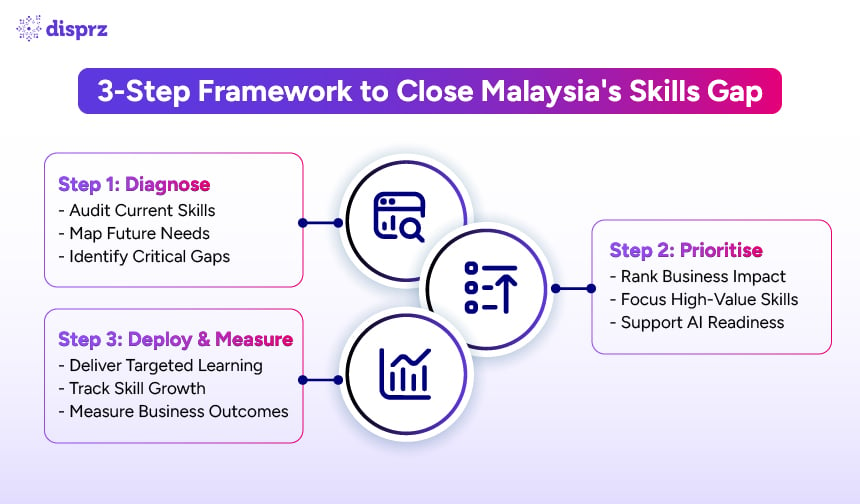
Step 1 (Diagnose): Map Your Skill Inventory Against Business Needs
You cannot close a skills gap if you do not know where it exists.
AI-powered skill gap analysis gives L&D teams the data-driven visibility they need.
Start by creating a clear view of the skills currently available across your workforce. Identify the technical, functional, leadership, and digital skills employees possess today.
Next, compare those skills against future business requirements.
Ask questions such as:
- What capabilities will our business need in the next 12 to 24 months?
- Which roles will be most affected by AI and automation?
- Which skills are becoming more important?
- Which skills are becoming less relevant?
This step is particularly important as organisations increase their use of AI. While AI can automate repetitive work, employees still need skills in critical thinking, decision-making, data interpretation, collaboration, and customer engagement.
The output should be a clear picture of current capabilities, future requirements, and the gaps between them.
Without this diagnosis, upskilling in Malaysia becomes guesswork rather than strategy.
Step 2 (Prioritise): Not All Gaps Are Created Equal
Once you identify skill gaps, the next challenge is deciding where to focus.
Many organisations make the mistake of trying to solve every gap at once. This spreads budgets, resources, and attention too thin.
Instead, prioritise skill gaps based on business impact. A structured capability building model helps prioritise what moves the business forward.
Focus first on skills that:
- Directly affect revenue growth
- Support digital transformation initiatives
- Improve operational efficiency
- Strengthen customer experience
- Enable AI adoption and innovation
For example, a manufacturer facing a manufacturing skills shortage in Malaysia may prioritise automation, quality control, and data analysis skills before addressing less urgent needs.
Similarly, a financial institution may focus on cybersecurity, digital banking capabilities, and AI literacy.
Not every skill gap creates the same level of business risk. Prioritisation helps ensure learning investments generate measurable outcomes.
This is also where L&D in Malaysia can move from being a training function to becoming a strategic business partner.
Step 3 (Deploy and Measure): Close the Gap, Don't Just Fill the Calendar
Many learning programmes are measured by activity.
How many courses were completed?
How many training hours were delivered?
How many employees attended workshops?
While these metrics are useful, they do not show whether skills actually improved.
The goal should be skill development, not training completion.
Deploy targeted learning pathways that align with the priority skills identified in earlier steps. Combine different learning methods such as:
- Digital learning
- Instructor-led programmes
- On-the-job practice
- Coaching and mentoring
- AI-powered learning recommendations
Most importantly, measure outcomes — not just completions.
Tracking the right L&D KPIs is what separates strategic learning functions from administrative ones.
Track indicators such as:
- Skill proficiency improvements
- Internal mobility rates
- Productivity gains
- Performance improvements
- Reduced hiring dependency
- Readiness for future roles
This approach is especially important for reskilling the workforce in Malaysia. As AI reshapes jobs, employees must continuously build new capabilities rather than rely on existing expertise.
The organisations making the greatest progress understand a simple truth: AI does not eliminate the need for skills. In many cases, it increases it.
Employees need new knowledge to work effectively with AI tools, interpret AI-generated insights, make informed decisions, and create value that technology alone cannot provide.
When learning programmes are tied directly to business outcomes, organisations can build a stronger, more adaptable, and more future-ready workforce; one that is prepared not only for today's challenges but also for tomorrow's opportunities.
The Role of a Modern Learning Platform in Closing the Gap
Identifying skill gaps is only the first step. The real challenge is managing skills development at scale.
Many organisations still rely on spreadsheets, manual assessments, and disconnected learning systems to track workforce capabilities. While these methods may work for small teams, they quickly become difficult to manage as business needs evolve.
A modern learning platform in Malaysia helps L&D leaders move beyond training administration and focus on building capabilities that support business growth.
This becomes even more important as organisations accelerate AI adoption and digital transformation initiatives. Skills requirements change faster than ever, making continuous visibility into workforce capabilities essential.
From Spreadsheets to Skills Intelligence
Traditional learning management often focuses on courses. Modern workforce development focuses on skills.
Instead of simply tracking training completions, leading organisations track capability growth across roles, teams, and business functions.
A skills-driven learning platform helps organisations:
- Build a central skills inventory
- Identify current and emerging skill gaps
- Map skills to business goals
- Personalise learning pathways
- Support internal talent mobility
- Measure workforce readiness
This shift creates what many organisations call skills intelligence.
Rather than making assumptions about workforce capabilities, leaders gain data-driven visibility into where strengths exist and where development is needed.
For organisations focused on how to close the skills gap in Malaysia, this visibility is critical. It helps learning investments target the areas that create the greatest business impact.
It also supports more effective upskilling in Malaysia by ensuring employees receive learning opportunities aligned with their roles, career aspirations, and future business needs.
As AI continues to reshape jobs, skills-intelligence becomes even more valuable. New capabilities emerge rapidly, while others lose relevance. Organisations need systems that can adapt alongside these changes.
What Good Looks Like in 12 Months
Closing the skills gap in Malaysia is not an overnight project. However, organisations can make significant progress within a year when they combine a clear skills strategy with the right technology.
After 12 months, successful organisations often see:
- Greater visibility into workforce capabilities
- Faster identification of critical skill gaps
- Increased participation in learning programmes
- Improved employee readiness for new roles
- Reduced dependence on external hiring
- Better utilisation of the HRD Corp training levy in Malaysia
- Stronger alignment between learning and business goals
Most importantly, they begin building a sustainable approach to reskilling the workforce in Malaysia.
The benefits extend beyond L&D metrics. Business leaders gain greater confidence that their workforce can support future growth, technology adoption, and market changes.
A modern learning platform does not eliminate the challenges created by the talent shortage in Malaysia. However, it gives organisations the visibility, structure, and agility needed to respond faster than competitors.
That is how organisations move closer to creating a truly future-ready workforce; one where skills development is continuous, measurable, and directly connected to business success.
Key Takeaways
- Malaysia's skills gap demands strategic workforce planning, not just increased hiring efforts alone.
- AI changes job requirements, making continuous upskilling and reskilling more important than ever.
- Prioritising high-impact skill gaps delivers stronger business outcomes and better learning investments.
- HRD Corp funding can accelerate workforce development when aligned with business goals.
- Modern learning platforms provide skills visibility needed to build a future-ready workforce.
Conclusion: The Skills Gap Is a Solvable Problem
Malaysia's skills challenge is real, but it is not impossible to solve.
The growing skills gap in Malaysia, combined with rapid advances in AI and automation, is changing how organisations think about talent. Businesses can no longer depend solely on external hiring to meet evolving skill requirements. The competition for qualified talent is simply too intense, and the pace of change is too fast.
The organisations that succeed will be those that treat skills as a strategic asset. They will invest in creating a continuous learning culture, targeted development programmes, and long-term workforce planning. They will focus on building capabilities from within while preparing employees for future roles.
For L&D leaders, this creates an opportunity to play a much bigger role in business success. By diagnosing skill gaps, prioritising critical capabilities, and measuring outcomes, you can directly influence organisational growth and resilience.
AI will continue to transform jobs, but it will not remove the need for skilled employees. In many cases, it will increase demand for people who can work effectively with technology, adapt to change, and solve complex business problems.
The data suggests that Malaysia does not simply need more graduates. It needs stronger alignment between education, workforce development, and industry demand. Without that alignment, organisations risk facing a situation where talent continues to grow, but productivity and business outcomes fail to keep pace.
The path forward is clear. Organisations must embrace upskilling, strengthen workforce development, and create structured approaches to reskilling the workforce in Malaysia.
The organisations that act today will be better positioned to overcome the talent shortage in Malaysia, respond to future disruptions, and build a stronger, more future-ready workforce for years to come.
Frequently Asked Questions
1) What is the skills gap in Malaysia and which industries are most affected?
The skills gap in Malaysia refers to the mismatch between employer needs and available workforce skills. Manufacturing, BFSI, retail, technology, and service sectors are among the industries experiencing the greatest shortages.
2) How can L&D leaders address Malaysia's talent shortage in their organisations?
L&D leaders can identify critical skill gaps, prioritise high-impact capabilities, implement targeted learning programmes, and measure outcomes. Continuous upskilling in Malaysia helps reduce dependence on external hiring and supports growth.
3) What is HRD Corp and how does it help with workforce upskilling in Malaysia?
HRD Corp supports employee development through the HRD Corp training levy in Malaysia. Eligible employers can use these funds to invest in training, reskilling, and workforce capability-building initiatives.
4) What is the difference between reskilling and upskilling, and which does Malaysia need more of?
Upskilling helps employees improve existing capabilities, while reskilling prepares them for different roles. Malaysia needs both approaches to address evolving business needs and support long-term workforce transformation.
5) How can an LMS help close the skills gap in Malaysian organisations?
A modern LMS helps organisations identify skill gaps, personalise learning journeys, track progress, and measure outcomes. It enables more effective workforce development in Malaysia through data-driven learning decisions.
6) What are the most in-demand skills in Malaysia for 2025 and 2026?
Digital literacy, AI skills, data analytics, cybersecurity, automation, leadership, problem-solving, communication, and customer experience capabilities are expected to remain among Malaysia's most sought-after workforce skills.
7) Is Malaysia's skills gap getting better or worse?
Many industries continue to report growing talent shortages as technology evolves rapidly. Without stronger investments in learning and development, the skills gap in Malaysia is likely to remain a significant challenge.