

On this page
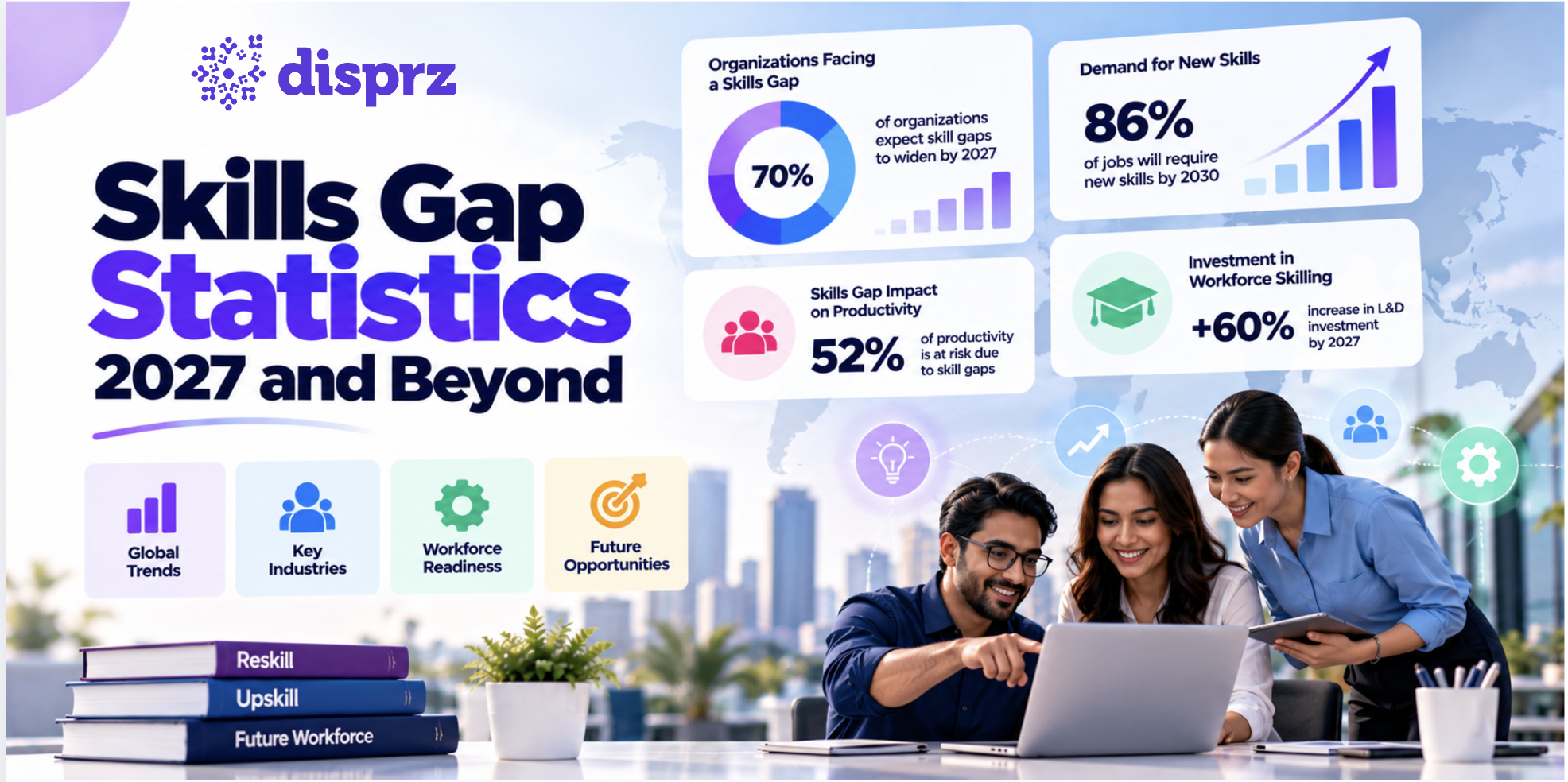
- The skills gap is now the single biggest barrier employers name to business transformation: 63% cite it (WEF, 2025).
- Two thirds of organisations say recent hires are not fully prepared (Deloitte, 2025), and in high-growth markets like India only about half of graduates are assessed as employable.
- The gap is widest in AI and digital skills, and it persists because learning is often not aligned to what the business needs and frontline and non-manager staff get the least access.
- Read forward, the pressure does not ease: the World Economic Forum frames its skills-change and reskilling numbers to 2030, with around 40% of core skills changing over that window, so 2027 sits inside the reskilling period, not after it, and the gap is still opening rather than peaking.
- For an L&D leader the question is no longer whether a gap exists but how fast you can close it: enterprises running skills-first programmes on Disprz report 50% faster onboarding and a 10% skills improvement, with median 88% course completion across 47 deployments.
Short answer: Heading into 2027, the skills gap is the top barrier to business transformation for 63% of employers (WEF, 2025), and 66% of organisations say recent hires are not fully prepared (Deloitte, 2025). With around 40% of core skills changing by 2030, 2027 sits inside the reskilling window, so the gap is still widening rather than closing.
Where the skills gap hurts most: by size, industry, and role
The pressure is universal, but its shape changes with who you are. Read this first: it maps where the skills gap actually bites by company size, by industry, and by the leader who owns it, each line anchored to a verified figure from this page.
The pattern underneath is consistent. Smaller organisations are starved of budget and structure, larger ones fight scale, fragmentation, and the demand to prove return, and every segment runs into the same manager bottleneck.
By company size
| Segment | The core pain | Backed by data |
|---|---|---|
| Small business | Least resourced, most exposed. With no dedicated L&D function, closing a gap stays ad hoc and the people furthest from HQ get the least access. | Only 51% of non-managers have the L&D resources they need against 72% of senior executives, and that access gap is widest where there is no dedicated L&D team (PwC 2025). |
| Mid-market | Enterprise-scale skills pressure without the enterprise operating model. Growth outpaces the way learning is aligned and targeted, so the gap opens faster than it closes. | 84% of organisations fail to deliver learning aligned to the skills the business needs (Josh Bersin Company 2025), while the skills gap is the top barrier to transformation for 63% of employers (WEF 2025). |
| Enterprise | Not budget, but scale, fragmentation, and proof. Onboarding thousands to role-ready and evidencing capability, not attendance, are the hard questions. | 66% say recent hires are not fully prepared (Deloitte 2025), and only about 1% of the workforce holds advanced AI skills while roughly 25% are already exposed to generative AI (OECD 2026), so capability trails exposure at scale. |
Note: hard size-segmented gap data is thin across public sources, so the size read above interprets organisation-wide figures rather than claiming each is measured by company size.
By industry
| Industry | The core pain | Backed by data |
|---|---|---|
| BFSI | People finish the learning but do not yet live it, so a compliance-driven gap looks closed on paper while capability lags. | Completion is strong once structured (banking 85%, insurance 92%), but adoption trails (financial services 75%, insurance 78%), the sign of a gap that is finished but not lived in (Disprz Skills Impact Index 2026). |
| Retail | Closing the gap fast enough against constant churn, for a workforce that is almost entirely deskless. | Retail reaches 90% completion and 90% adoption when learning is mobile-first (Disprz Skills Impact Index 2026), against a frontline WEF projects has the highest-volume job growth by 2030 (WEF 2025). |
| Healthcare | The highest stakes with the thinnest time, so gap-closing learning has to live inside the workflow. | Healthcare posts the highest completion in the dataset at 97% with 93% adoption, achievable only with micro and in-workflow learning (Disprz Skills Impact Index 2026). |
| IT and ITeS | Skills half-life: content is stale before it ships, so the gap reopens faster than a course calendar can close it. | About 40% of core skills change by 2030 (WEF 2025); in the dataset IT and ITeS shows high adoption at 93% but lower completion at 80%, the profile of a fast-moving field outrunning its content (Disprz Skills Impact Index 2026). |
| Food services and frontline-heavy | The deskless reach gap: those who start do finish, but most of the workforce never gets onto the programme. | Food services reaches 97% completion but only 70% adoption, and frontline completion sits below 30% industry-wide against 45%+ on a fit-for-frontline platform (Disprz Skills Impact Index 2026, WEF 2025). |
By role: who feels the pain
The same numbers land on different desks as different problems. Each pain below has its matching move in Takeaways by role further down.
- CEO or enterprise business owner: growth is blocked by capability. 63% of employers name the skills gap the top barrier to business transformation and about 40% of core skills change by 2030, so strategy stalls because the workforce cannot execute it (WEF 2025).
- CXO (COO or CIO): execution and AI readiness are the operational risk. 66% say recent hires are not fully prepared (Deloitte 2025), and only about 1% of the workforce holds advanced AI skills while roughly 25% are already exposed to generative AI (OECD 2026), so the operating layer is asked to do more with less readiness.
- CHRO or people leader: a hire-your-way-out strategy will not scale. Where only about 51% of graduates in fast-growing markets such as India are assessed as employable (India Skills Report 2024), role-readiness has to be built in, and the development you offer is what holds onto the people you grow.
- L&D manager: mandate without alignment. 66% of hires arrive under-prepared (Deloitte 2025), yet 84% of learning is not aligned to business needs (Josh Bersin Company 2025), so onboarding and the frontline majority, not a broad catalogue, are where to point first.
- CFO or finance leader: the gap is a cost already on the books. The 63% who call the gap their top barrier to transformation (WEF 2025) means spend is already leaking into stalled programmes and external hiring, so a skills budget is a redirect, and re-measured capability, not attendance, is what makes it defensible.
So what for your plan. Wherever you sit, the pain resolves to the same three moves: map the skills gap before you buy content, equip managers as the multiplier, and reach the deskless majority. The rest of this page is the evidence for each.
Top skills gap statistics for 2027 and beyond
The numbers that frame the skills gap heading into 2027 and beyond, each with a one-line read for an L&D or HR leader. Every stat keeps its real source and year, so you can quote it directly, and the forward figures are the published projections, not invented forecasts. Full sources with links and years are in the Sources list.
- 63% of employers name the skills gap as the number one barrier to business transformation (WEF, Future of Jobs Report 2025). Treat capability building as part of every transformation programme, not a separate line item.
- 66% of organisations say recent hires are not fully prepared for their roles (Deloitte, 2025 Global Human Capital Trends). Onboarding speed, not the job advert, is the lever you control.
- Around 40% of workers' core skills will change by 2030 (WEF, 2025). Budget for continuous reskilling against a moving target, not one-off courses.
- 59 of every 100 workers will need reskilling or upskilling by 2030, and 11 are unlikely to get it (WEF, 2025). Widen access early, because the people most at risk are the ones programmes usually miss.
- About 1% of the workforce holds advanced AI skills, while roughly 25% of workers are already exposed to generative AI (OECD, Skills in the AI Age, 2026). Exposure has run ahead of capability, so weight spend towards AI and digital fluency.
- 84% of organisations fail to deliver learning aligned to the skills the business needs (Josh Bersin Company, 2025). Map training to a live skills taxonomy, not a course catalogue.
- 51% of India's graduates are assessed as employable (India Skills Report 2024). If you scale in emerging markets, plan to build role-readiness in rather than assume you can hire it.
- 77% of employers already plan to upskill their workforce by 2030 (WEF, Future of Jobs Report 2025). Intent is near universal, so through 2027 the differentiator is speed of delivery, not ambition.
- The World Economic Forum expects 22% job churn by 2030 (WEF, 2025). The makeup of work keeps shifting even where headcount holds, so plan for a moving target rather than a one-off fix.
How wide is the skills gap heading into 2027?
Three independent measures point the same way. Employers say the gap is now their biggest obstacle to change, they say the people they hire arrive under-prepared, and in fast-growing talent markets only about half of new graduates clear an employability bar.
For an enterprise L&D leader that is the difference between treating the gap as a recruitment problem (hire your way out) and treating it as a capability problem you have to build your way out of.
What it means for you. When two thirds of hires arrive under-prepared, onboarding and internal capability building carry more weight than the job advert. The lever you control is how quickly you can lift a new joiner or an existing employee to role-ready, which is why time-to-competence, not headcount, is the number to plan around.
Skills gap benchmarks at a glance
Use this as your benchmark snapshot: the three headline reads on how wide the gap is, from three independent sources. They are the numbers to set your own workforce against before you fix a 2027 target. Each is copy-ready with its source and year attached.
Benchmark sources: World Economic Forum, Future of Jobs Report 2025; Deloitte, 2025 Global Human Capital Trends; India Skills Report 2024 (Wheebox),
So what for your plan. Treat these three as your outside-in reference. The 63% barrier and 66% readiness gap set the enterprise stakes, and the 51% employability read is the planning number for anyone scaling in emerging markets. The distance between them and your own baseline is the gap you actually own.
Where is the skills gap widest?
The gap is not spread evenly. It concentrates around the skills that are changing fastest, and around AI in particular. The World Economic Forum projects that around 40% of workers' core skills will change by 2030, and the OECD shows why that stings: advanced AI skills sit with roughly 1% of the workforce even as about a quarter of all workers are already exposed to generative AI. In other words, exposure has run far ahead of capability.
- AI and digital skills: only about 1% of the workforce holds advanced AI skills, while around 25% of workers are exposed to generative AI (OECD, 2026), and 72% of vacancies in high-AI-exposure occupations also demand a management skill.
- Core-skill churn: around 40% of core skills change by 2030, so even experienced staff face a moving target (WEF, 2025).
- Management capability: 36% of managers say they are insufficiently prepared to be people managers (Deloitte, 2025), a soft-skills gap that compounds every other one.
- Emerging-market entry talent: in India, about 51% of graduates are assessed as employable (India Skills Report 2024), a structural gap for any employer scaling there.
For workforce planning this tells you where to point the budget first. A broad, thin training spread rarely moves a gap this concentrated; a targeted programme aimed at the AI, digital, and management capabilities that are actually short will. This is where a structured skill gap assessment earns its place, because it tells you which of these gaps is real in your own workforce rather than in the market average.
How does the gap differ by sector?
The market averages hide how differently the gap closes from one industry to the next. The first-party Disprz Skills Impact dataset (47 enterprise deployments) breaks two of the levers that matter most, course completion and platform adoption, down by sector. Read side by side they show whether a sector's real constraint is finishing the learning or getting people onto the programme in the first place.
Table 1: gap-closing traction by sector (Disprz Skills Impact, 2026)
| Sector | Course completion | Platform adoption | What the split signals |
|---|---|---|---|
| Healthcare | 97% | 93% | Both high: the gap closes evenly once a programme lands |
| Telecom | 92% | 97% | Reach is strong, so the focus can move to depth of skill |
| Retail | 90% | 90% | Balanced, a base to widen the skills covered |
| Banking | 85% | 85% | Balanced, with the most headroom on both levers |
| Insurance | 92% | 78% | Finishers outrun sign-ups: the constraint is reach |
| Financial services | 91% | 75% | Strong completion, adoption is the gap to close first |
| IT and ITeS | 80% | 93% | High adoption, completion is where to push |
| Food services | 97% | 70% | Those who start finish, but reach is the widest gap |
The reading for a budget owner is to diagnose which lever is short in your own sector before you spend. Where adoption trails completion, as in food services, financial services, and insurance, the gap is a reach problem and the money belongs in access, reminders, and manager-led nudges.
Where both levers already sit high, as in healthcare and telecom, the next move is to widen the range of skills a programme covers rather than to chase participation. These are first-party medians from the Disprz Skills Impact dataset, so read them as a benchmark to beat, not a ceiling.
How urgent is the reskilling mandate?
The gap has a deadline attached. The World Economic Forum frames the rest of the decade as a reskilling mandate: most of the workforce will need to learn something new by 2030, most employers say they intend to help, and a stubborn minority will be left behind if nothing changes. The chart below is the mandate in four numbers.
The 77% of employers who plan to upskill is the encouraging half. The gap between intent and delivery is the hard half, and it is exactly where the numbers in the next section live. Read alongside our reskilling and upskilling statistics for the full mandate and the cost of inaction.
Why does the skills gap persist?
If most employers plan to upskill, why does the gap stay open? Three recurring reasons show up in the data, and none of them is a shortage of good intentions.
Table 2: why the skills gap persists, and what it means for L&D
| Reason the gap persists | The evidence | What it means for how you train |
|---|---|---|
| Learning is not aligned to business skills | 84% of organisations fail to deliver learning aligned to the skills the business needs (Josh Bersin Company, 2025, pending source check) | Map training to a live skills taxonomy, not a course catalogue |
| Access is uneven | Only 51% of non-managers have the L&D resources they need, against 72% of senior execs (PwC, 2025, pending source check) | Design for the frontline and non-manager majority first, not HQ |
| Learning time is falling | Formal learning fell to 13.7 hours per employee in 2024, down from 17.4 in 2023 (ATD, 2025) | Shorter, in-the-flow learning that fits a shrinking time budget |
| Leaders sense the gap but few own it | 49% of L&D pros say execs worry staff lack the right skills, yet only 36% are career-development champions (LinkedIn, 2025) | Give managers the tools and mandate to develop their teams |
The pattern is consistent: the gap persists less because organisations do not train, and more because the training is not aimed at the right skills, does not reach the right people, and competes for a falling share of the working week. Fixing alignment and reach usually moves the number faster than adding volume.
What does leaving the gap open cost?
A skills gap is not a neutral state, it carries a running cost. The World Economic Forum puts 11 of every 100 workers, roughly 120 million people, at medium-term risk because they are unlikely to get the reskilling they need.
At the level of a single enterprise, an unclosed gap shows up as slower time to competence, roles that stay vacant because internal talent is not ready, and transformation programmes that stall on the 63% barrier employers already name.
- Vacancies you cannot fill from within: when 66% of hires arrive under-prepared, an open internal gap means paying to recruit rather than promoting from the bench.
- Transformation that stalls: the skills gap is the top barrier to change for 63% of employers, so every digital or AI initiative inherits the gap as a delivery risk.
- People left behind: the 11% unlikely to be reskilled become an attrition and morale cost, not just a statistic.
The point for a business case is that the gap is already costing money in slower delivery and external hiring; the choice is whether to keep paying that cost or redirect it into closing the gap.
Trends: what is moving through 2027 and beyond
The skills gap does not have a clean year-on-year series the way training spend does, so the honest way to read its direction is through the one movement that is measured and the projections the major sources publish to 2030. Read together they point one way: the gap is still widening into 2027, not closing.
- Firm AI adoption roughly tripled, from about 7% to 20% across OECD countries between 2021 and 2025 (OECD, 2026). This is the one clean movement in the data, and it drags the gap upward because capability has not kept pace with uptake.
- Around 40% of core skills change by 2030, and the WEF expects 22% job churn over the same period (WEF, 2025). The middle years of the decade are when that change concentrates, so 2027 sits inside the fastest-moving window, not after it.
- 59 of every 100 workers will need reskilling or upskilling by 2030, and 11 are unlikely to get it (WEF, 2025). The reskilling deadline tightens each year, which is why the gap compounds rather than resets.
- Middle-skill and lower-skill roles shrink while high-skill, high-wage roles expand (OECD, 2026). The gap migrates upward, so the scarce capability keeps shifting toward directing and checking AI-assisted work.
There is no verified 2027 figure to quote here, and this page invents none. The trend line is the forward horizon the World Economic Forum and OECD already publish, read honestly as a gap that keeps opening through 2027 and beyond rather than one that has peaked.
What does the skills gap look like through 2027 and beyond?
None of the pressure behind the gap eases in the near term. The World Economic Forum frames its numbers to 2030, which puts 2027 squarely inside the reskilling window rather than after it.
If around 40% of core skills change by 2030 and the Forum expects 22% job churn over the same period, the middle years are when that change is most concentrated, not when it slows. Planning for 2027 means planning for a gap that is still opening, not one that has peaked.
The OECD points to where it opens. Its structural read is that middle-skill and lower-skill roles shrink while high-skill, high-wage roles expand, and that firm AI uptake roughly tripled to about 20% between 2021 and 2025.
So the gap does not just persist, it migrates upward: the scarce capability shifts from doing a task to directing, checking, and combining AI-assisted work, which is why 72% of vacancies in high-AI-exposure occupations already ask for a management skill. Through 2027 the safest assumption is that AI, digital, and the human skills that sit on top of them stay the widest part of the gap.
Planning signal. Build a programme now that assumes the gap is still opening through 2027 and beyond. A skills taxonomy you can update as roles change, rather than a fixed course list, is what keeps a plan valid across a refresh of the underlying data. The Future of Jobs Report runs on a roughly two-year cycle, so the next read lands around early 2027; a plan anchored to a live taxonomy absorbs that update without a rebuild.
How fast can enterprises actually close the gap?
The market averages describe the problem. First-party programme data describes what closing it looks like in practice. Across 47 enterprise deployments, learning programmes on Disprz reach a median 88% course completion and 85% platform adoption, with documented outcomes that speak directly to the speed of closing a gap.
Those numbers matter for gap closing specifically. Onboarding 50% faster shrinks the window in which a new hire counts as under-prepared, a direct answer to the 66% readiness figure.
A 45%+ frontline completion rate, against an industry average below 30%, is what stops a reskilling programme stalling before it reaches the non-manager majority the PwC data flagged. And a measured 10% skills improvement is the difference between reporting attendance and reporting capability.
Disprz Skills Impact. These are aggregates from the first-party Disprz Skills Impact dataset (47 enterprise deployments): median 88% course completion, 85% adoption, 50% faster onboarding, a 10% skills improvement, and 45%+ frontline completion against an industry average below 30%. Turo, the agentic authoring layer, also converts existing playbooks into microlearning 80% to 90% faster, so a gap-closing curriculum stands up in days rather than a quarter. See the full, sourced dataset for the method and the per-industry cuts.
How do you measure your own skills gap?
The statistics on this page describe the market. To act, you need the gap in your own workforce, measured the same way twice so you can prove movement. Four steps turn the headline into a plan.
- Define the skills that matter: build a taxonomy of the capabilities each role needs, weighted to the AI, digital, and management skills where the gap is widest.
- Baseline the gap: run a skill gap assessment by role, team, and region, so the average does not hide the pockets that are furthest behind.
- Find the root cause: use how to identify knowledge and skill gaps to separate a knowledge gap from a practice or motivation gap, because each needs a different intervention.
- Re-measure and report: repeat the assessment after the programme and report the change in capability, not just completions, so the gap becomes a number you can move on a slide.
Benchmark to hold. Treat the market figures here as your outside-in reference and your own baseline as the inside-out truth. The distance between them is the gap you actually own, and the only one your budget can close.
How do you turn skills-gap data into a plan?
A statistic only earns its place in a plan when it drives a decision. This table turns the headline figures on this page into the budget and design calls an L&D or HR leader has to make for 2027 and beyond.
Table 3: from skills-gap figure to 2027 decision
| The figure | What it tells a budget owner | The 2027 decision it drives |
|---|---|---|
| 63% call the gap the top barrier (WEF, 2025) | Every transformation carries skills risk | Fund capability building inside each transformation programme, not as a separate line |
| 66% of hires under-prepared (Deloitte, 2025) | Onboarding is the gap's front door | Invest in time-to-competence and hold onboarding to the 50% faster benchmark |
| 1% hold advanced AI skills, 25% exposed (OECD, 2026) | Exposure has run ahead of capability | Weight the budget to AI and digital fluency over a broad catalogue |
| 13.7 learning hours, down from 17.4 (ATD, 2025) | The time budget for learning is shrinking | Shift to short, in-the-flow learning that fits a smaller week |
| 51% of non-managers have the resources they need (PwC, 2025, pending check) | Access is uneven below management | Budget for frontline and non-manager reach before adding HQ content |
| 45%+ frontline completion vs under 30% (Disprz, 2026) | Frontline reach is achievable, not aspirational | Set a frontline completion target above the 30% industry baseline and measure it |
Cite these skills-gap figures
You are welcome to cite these figures. Please attribute each statistic to its original source (listed below) and, where you draw on the compiled view or the Disprz first-party benchmarks, credit this page.
Suggested citation. Disprz. (2026). Skills Gap Statistics 2027 and Beyond. Disprz Blog. Retrieved from disprz.ai/blog/skills-gap-statistics To reference a specific number, cite the primary source named beside it, for example: "63% of employers name the skills gap as the top barrier to transformation (World Economic Forum, Future of Jobs Report 2025)." First-party benchmarks should be cited as the Disprz Skills Impact dataset, 2026 (disprz.ai/skills-impact).
Key takeaways
- The skills gap is the top barrier to transformation for 63% of employers, and 66% say recent hires are not fully prepared.
- The gap is widest in AI, digital, and management skills, where exposure has run ahead of capability.
- It persists because learning is often misaligned, unevenly accessed, and squeezed into falling learning time.
- An open gap already costs money in external hiring and stalled transformation, so closing it is a redirect, not a new spend.
- Enterprises close gaps fastest by baselining, targeting the widest gaps, and re-measuring capability: on Disprz that means 50% faster onboarding and a measured 10% skills improvement.
Where should your first move on the gap go?
The width of the gap is settled; the useful question is speed. Pick the one function where an unclosed gap costs you most, baseline it with a proper assessment, aim the programme at the AI, digital, or management skills that are genuinely short, and re-measure capability rather than attendance. That is how a market statistic becomes a number you can move, and prove you moved.
Takeaways by role
The same numbers read differently depending on the chair you sit in. Here is what the headline skills-gap figures on this page mean for each decision-maker planning for 2027 and beyond.
- For the CEO or enterprise business owner: with 63% of employers naming the skills gap the top barrier to business transformation (WEF, 2025), treat capability building as a growth lever through 2027, not a support cost. The competitors who close the gap fastest are the ones who ship transformation on time.
- For the CXO (COO or CIO): 66% of organisations say recent hires are not fully prepared (Deloitte, 2025), so your execution and AI readiness rest on how quickly you can lift people to role-ready. Plan time-to-competence as an operational risk, not an HR metric.
- For the CHRO or people leader: where only about 51% of graduates in fast-growing markets such as India are assessed as employable (India Skills Report 2024), a hire-your-way-out talent strategy will not scale. Build role-readiness in, and use the development you offer to hold onto the people you grow.
- For the L&D manager: the 66% under-prepared read (Deloitte, 2025) tells you where to point first, onboarding and internal capability building. Prioritise time-to-competence and design for the frontline and non-manager majority rather than a broad catalogue.
- For the CFO or finance leader: the 63% who call the gap their top barrier to transformation (WEF, 2025) is a cost already on the books in stalled programmes and external hiring, so a skills budget is a redirect of existing spend. Re-measured capability, not attendance, is what makes that spend defensible.
Key terms defined
The words that recur across this page, defined once so a figure means the same thing wherever you quote it.
- Skills gap: The distance between the capabilities a role needs and the capabilities the workforce actually holds. On this page it is the top barrier to transformation for 63% of employers (WEF 2025).
- Reskilling and upskilling: Reskilling builds the capability for a different role; upskilling deepens capability in the current one. The WEF projects 59 of every 100 workers will need one or the other by 2030.
- Adoption and completion: Adoption is the share of people who get onto a programme; completion is the share who finish it. A gap can be a reach problem (low adoption) or a follow-through problem (low completion), and the two need different fixes.
- Frontline or deskless workforce: Employees who work away from a desk or shared computer, such as retail, care, and food-service staff. They are the hardest to reach: industry-wide frontline completion sits below 30% against 45%+ on a fit-for-frontline platform (Disprz Skills Impact Index 2026).
- Time-to-competence: How long it takes to lift a new or moving employee to role-ready. It is the lever that answers the 66% of hires who arrive not fully prepared (Deloitte 2025).
- Skills taxonomy: A living map of the capabilities each role requires, used to target learning at real gaps rather than a fixed course catalogue, and updated as roles change against the roughly 40% of core skills that turn over by 2030 (WEF 2025).
Related statistics. Reskilling and upskilling statistics, AI in L&D statistics, Leadership development statistics, and the L&D statistics hub.
Reviewed for accuracy on 28 Sep 2026.
Skills gap statistics FAQs
The questions L&D and HR leaders ask most about the 2026 skills gap.
How wide is the skills gap heading into 2027?
Three measures frame it. 63% of employers name the skills gap as the top barrier to business transformation (WEF, Future of Jobs Report 2025), 66% of organisations say recent hires are not fully prepared (Deloitte, 2025), and in India about 51% of graduates are assessed as employable (India Skills Report 2024). Together they show a gap that is now a capability problem, not just a hiring one.
Which skills have the biggest gap?
AI and digital skills lead: only around 1% of the workforce holds advanced AI skills while about 25% of workers are already exposed to generative AI (OECD, 2026). Management capability is close behind, with 36% of managers saying they are insufficiently prepared to be people managers (Deloitte, 2025). Around 40% of all core skills change by 2030 (WEF, 2025), so the target keeps moving.
Why does the skills gap persist if employers plan to upskill?
Because intent outruns delivery. An estimated 84% of organisations fail to deliver learning aligned to the skills the business needs (Josh Bersin Company, 2025, pending source check), only 51% of non-managers have the L&D resources they need against 72% of execs (PwC, 2025, pending source check), and formal learning time fell to 13.7 hours per employee in 2024 from 17.4 in 2023 (ATD, 2025). Alignment and reach, not effort, are usually the constraint.
What does an unclosed skills gap cost a business?
It shows up as vacancies you cannot fill from within, transformation programmes that stall (the gap is the top barrier for 63% of employers), and people left behind: the WEF estimates 11 of every 100 workers, roughly 120 million, are unlikely to get the reskilling they need. The gap is already costing money in external hiring and slower delivery, so closing it is largely a redirect of existing cost.
How fast can an enterprise close its skills gap?
Fast enough to matter within a year when the programme is targeted and reinforced. Across 47 enterprise deployments on Disprz, programmes reach a median 88% course completion and 85% adoption, with 50% faster onboarding, a measured 10% skills improvement, and 45%+ frontline completion against an industry average below 30%. See the Disprz Skills Impact dataset for the method and per-industry cuts.
How do I measure the skills gap in my own workforce?
Define the skills each role needs, baseline them with a skill gap assessment by role, team, and region, use a structured method to identify knowledge and skill gaps to find the root cause, then re-measure after training and report the change in capability rather than completions. The market figures on this page are your outside-in reference; your own baseline is the gap you can actually move.
Which industries have the widest skills gap?
It varies by lever. The WEF projects the highest-volume job growth by 2030 in frontline roles such as care, delivery, construction, and food processing, so those sectors face the largest reach challenge (WEF, 2025). First-party Disprz data shows the same split: in food services, financial services, and insurance, platform adoption trails course completion, so the constraint is getting people onto the programme, while healthcare and telecom close gaps evenly once learning lands (Disprz Skills Impact, 2026).
Will the skills gap close by 2027?
More likely to shift than to close. The WEF frames its numbers to 2030 and expects 22% job churn, so 2027 sits inside the period of fastest change, not after it. The OECD adds that middle and lower-skill roles shrink while high-skill roles expand, so the gap migrates toward AI, digital, and the management skills that sit on top of them (OECD, Skills in the AI Age, 2026). Plan for a gap that is still opening in 2027.
How should the skills gap shape my L&D budget for 2027 and beyond?
Let the widest gaps set the weighting. Put AI and digital fluency ahead of a broad catalogue, because exposure (about 25% of workers) has outrun capability (about 1% with advanced AI skills) (OECD, 2026). Protect frontline and non-manager access, since only 51% of non-managers have the resources they need against 72% of execs (PwC, 2025, pending check). And favour short, in-the-flow learning, because formal learning time fell to 13.7 hours per employee in 2024 (ATD, 2025).
Sources
- World Economic Forum. Future of Jobs Report 2025. January 2025. Skills gap as top barrier (63%), around 40% of core skills change by 2030, 59% need reskilling or upskilling, 77% of employers plan to upskill, 11% unlikely to be reskilled. weforum.org
- Deloitte. 2025 Global Human Capital Trends. March 2025. 66% say recent hires are not fully prepared; 36% of managers insufficiently prepared to be people managers. deloitte.com
- OECD. Skills in the AI Age (AI Papers No. 60). 2026. Advanced AI skills around 1% of the workforce; roughly 25% of workers exposed to generative AI; 72% of high-AI-exposure vacancies demand a management skill. oecd.org
- LinkedIn. 2025 Workplace Learning Report. 2025. 49% of L&D pros say execs worry staff lack the right skills; only 36% are career-development champions. learning.linkedin.com
- ATD. 2025 State of the Industry. May 2025 (2024 data). Formal learning fell to 13.7 hours per employee, from 17.4 in 2023. td.org
- Disprz. Disprz Skills Impact Dataset, 2026. First-party learning and skills outcomes from 47 enterprise deployments: median 88% completion, 85% adoption, 50% faster onboarding, 10% skills improvement, 45%+ frontline completion vs under 30% industry average, Turo authoring 80-90% faster. disprz.ai/skills-impact
Related reading
More data and how-to from the L&D hub.
- Skill gap assessment: how to run one at scale
- How to identify knowledge and skill gaps
- Reskilling and upskilling statistics 2027 and beyond
- L&D statistics 2027 and beyond: the state of corporate learning