
On this page
An internal talent marketplace is a platform that matches employees to internal opportunities, including projects, short-term gigs, stretch assignments and open roles, using skills data rather than manager referrals. Managers post what they need, and employees are surfaced by capability instead of by who happens to know them.
That is the promise. Why it moved up the CHRO agenda this year has less to do with employee experience than with structural damage.
Gartner's HR practice put it bluntly in May 2026: AI will produce more job gains than losses, but in the process it is going to break down millions of careers. Their survey of HR leaders found that 40% of organisations had already eliminated outdated roles to align with changing business needs, and nearly half had redesigned team structures to be more cross functional or agile. Rungs are being removed from ladders people were standing on.
The effect shows up in retention data that looks calm and is not. Gartner's first-quarter 2026 survey of 11,838 employees found intent to stay down 19% over two years, even as actual attrition stayed low. People are sitting still because the external market is hard, not because they can see a future where they are.
That is the gap an internal talent marketplace is bought to close. What follows is how one works, how to implement it, why so many stall, and what to do instead.
Key points
- Gartner expects AI to create more jobs than it eliminates from 2028, and concludes that robust internal talent pipelines will be critical to meeting that demand
- Role and structure change is already widespread: 40% of organisations have eliminated outdated roles and nearly half have redesigned teams to be cross functional or agile
- Intent to stay fell 19% over two years while attrition stayed low, so current retention numbers understate the risk
- Gartner's prescription is a shift from experience-based progression to skills-based advancement, because performance at one level no longer indicates readiness for the next
- The most common implementation failure is matching on skills employees claim rather than skills the organisation has verified
- The second is the near-miss dead end, where employees who are close to ready are filtered out with no path to close the gap
- In retail, manufacturing and hospitality, marketplaces built for desk workers reach a minority of headcount
- Internal fill rate and time-to-staff are the metrics that matter. Logins and profile completion are not
How an internal talent marketplace works in real time
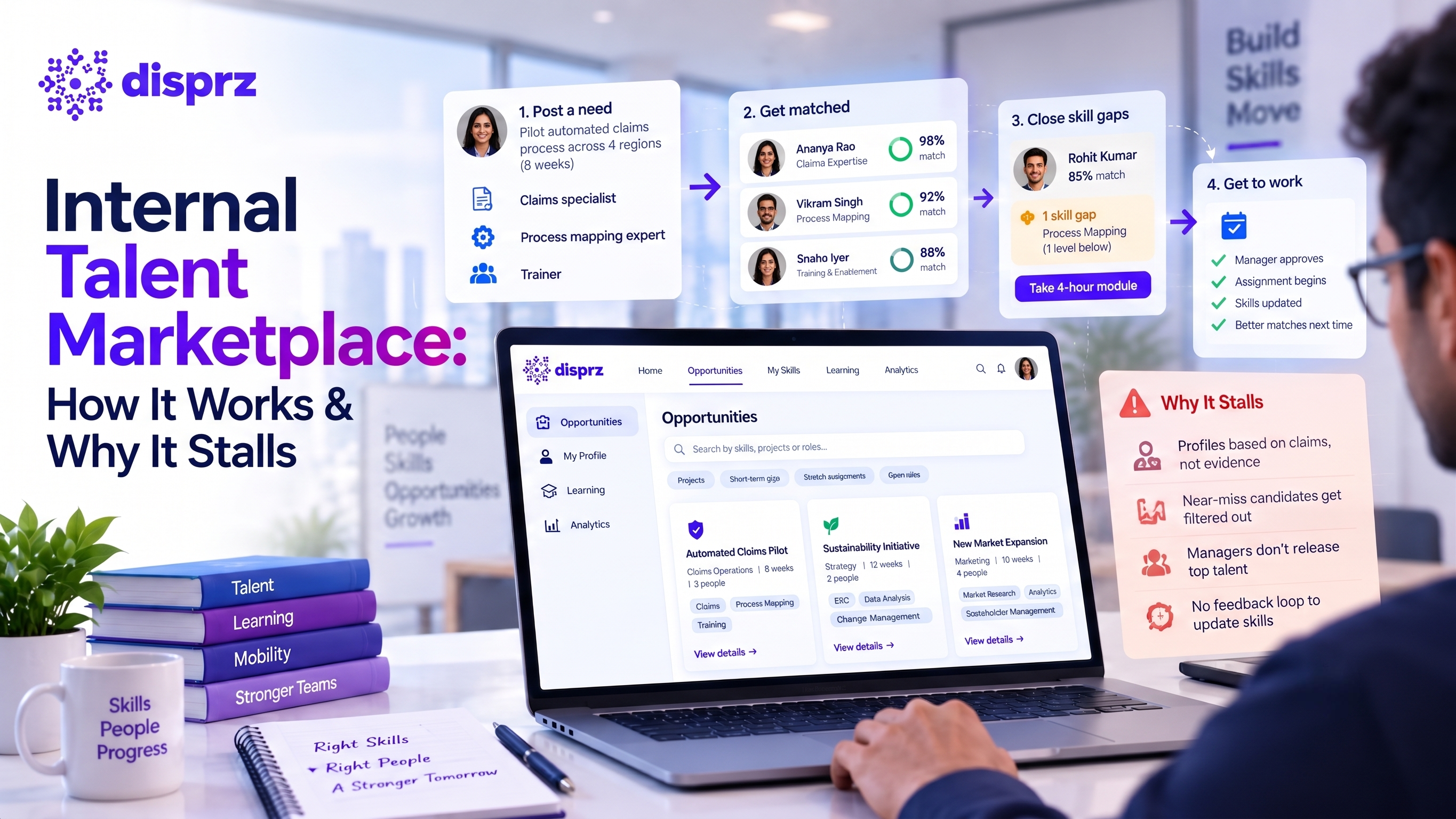
Picture a Monday morning inside a 6,000-person general insurer. The claims operations head has eight weeks to pilot an automated first-notice-of-loss process across four regions. She needs three people: someone who understands claims adjudication rules, someone who can handle process mapping, and someone who can train branch staff on the new flow.
Her options without a marketplace are the ones every talent leader recognises. Ask her own managers, who will protect their best people. Ask HR to open three requisitions, which takes six to ten weeks and a budget conversation. Or call the two colleagues she trusts and take whoever they can spare.
What a working marketplace does instead happens in a single sequence, and the speed comes from the fact that several things run at once.
She posts the requirement as three short assignments with the skills each one needs and the time commitment, roughly two days a week for eight weeks. The platform matches those skill requirements against the organisation's skills inventory, which holds proficiency levels for every employee. Within minutes she has a shortlist, ranked by readiness, drawn from business units she has never worked with.
The part that matters most is what happens to the people who are close but not there. A branch trainer in Coimbatore matches on training delivery and claims knowledge but sits one level below the required proficiency in process mapping. Rather than filtering him out, the system shows him the gap and the specific learning that closes it. He can take a four-hour module, get reassessed, and re-enter the pool.
His manager sees the request, sees the time commitment, and approves or declines inside the same workflow rather than in a side conversation. When the assignment ends, his verified proficiency in process mapping updates. The next match is better because this one happened.
That last loop is the whole mechanism. A marketplace that does not feed completed work back into the skills record is a search engine over stale data, and it degrades every quarter.
Simple. An internal job board lists vacancies. An internal talent marketplace matches people to opportunities using verified skills data, attaches learning to the gaps, and updates the skills record when the work is done.
The distinction matters because most enterprises already have the job board. Adding a search box to it is not the same as building a talent development platform where capability data drives the match.
Steps to implement an internal talent marketplace in the workplace
The organisations that get this working narrow the scope before they widen it. The ones that stall try to launch across the whole enterprise on day one. The sequence below is deliberately ordered, because three of these steps fail if the one before them was skipped.
- Pick one business problem, not a platform rollout Choose the pain that already has a number attached to it. Project staffing that takes six weeks. Attrition in a critical role family. Contractor spend in one function. A marketplace scoped to three job families with a named business outcome gets executive attention and a budget owner. One scoped to the whole enterprise gets a communications plan.
- Build the skills taxonomy for those families only A full enterprise taxonomy is a twelve-month project, and attempting it first is a common reason marketplaces never launch at all. Define only the skills that your chosen job families and the opportunities you intend to post actually require, at the proficiency levels you will match on. The taxonomy grows as the marketplace grows.
- Get proficiency verified, not declared Most implementations shortcut this step, and it is the one that decides whether managers ever trust the shortlist. Self-rated profiles produce matches that fall apart on first contact, and the credibility rarely recovers. Assessments, manager validation and 360 input give you a baseline you can defend to a business unit head who is being asked to hand over two days a week of someone's time.
- Solve the supply side before you launch to employees Employees will look once. If the marketplace is empty, they will not look again, and no amount of internal marketing brings them back. Get real opportunities posted before go-live, then make posting the default rather than the exception. A rule that every project longer than four weeks is posted internally before any external resourcing request is approved does more for adoption than an awareness campaign.
- Connect matching to learning inside the same system A match that produces a shortlist is a recruiting tool. A match that produces a shortlist plus a development plan for the people who came close is a mobility engine. Without that connection, the marketplace can only redistribute capability you already have, and the population it was built to serve stays invisible.
- Fix the plumbing Role changes, reporting lines and exits have to flow from your HRIS into the marketplace, or the data goes stale within a quarter and the matches degrade with it. Enterprises across India, the Middle East and Southeast Asia are typically running Darwinbox, SAP SuccessFactors, Workday or a local system of record, sometimes two at once, and this integration is where implementation timelines are genuinely spent. Confirm the integration path during evaluation rather than in month three.
- Measure fill rate, not engagement Report three numbers: internal fill rate for the target job families, time to staff an assignment, and retention among employees who took an internal opportunity. Profile completion and monthly active users will tell you the launch went well. They will not tell you the marketplace is working, and the difference usually surfaces two quarters after the renewal.
Market. In Gartner's survey of HR leaders, 40% had already eliminated outdated roles and nearly half had redesigned team structures to be more cross functional or agile. The org chart most mobility programmes were designed around has already changed underneath them.
Where internal talent marketplaces fail inside enterprises
Enterprises are investing in mobility while employees still report no clear route to advancement. That gap has causes, and most of them are structural rather than cultural. The pattern below is a composite of what enterprise talent teams consistently describe, not one customer's story.
Matching runs on claims, not evidence. Employees fill in a profile. Some overstate, most leave it half done, and the people who need visibility most are often the ones who never update it. Managers try the shortlist twice, find the matches unconvincing, and go back to their own networks. Gartner's 2026 research sharpens why the usual substitute fails too. Performance at one level is no longer a proxy for readiness for more senior roles, because with AI support employees can hit their current goals without building the depth of expertise a harder role needs. Neither a self-rated profile nor a strong appraisal tells you whether someone is ready.
The near-miss dead end. This is the failure with the largest hidden cost. Match on required proficiency alone and you surface only employees who are already ready, which in most enterprises is a thin population. Everyone at 70% readiness stays invisible, and they are exactly the group internal mobility exists to serve. Gartner's guidance for 2026 says the opposite of what most marketplaces do by default: create advancement opportunities based on skills rather than roles, and identify employees who have the foundational capability, learning agility and adaptability to succeed at a higher level even when they do not match the historical role criteria. Doing that requires somewhere for the gap to be closed. A marketplace with no learning attached cannot act on a near-miss, so it filters them out instead.
Managers hold on, and they have reasons. Talent hoarding gets discussed as a culture problem, which understates it. Gartner found in 2026 that 47% of managers say more is expected of them and they have to work harder than a year earlier. Deloitte's 2026 Global Human Capital Trends reports that a third of workers absorbed 15 major changes in a single year, while only 27% of respondents believe their organisation manages change effectively. Releasing a strong performer for two days a week is a real cost to a manager already stretched thin and already managing disruption. Neither software nor a values statement fixes that. Making internal posting the default, and giving managers credit for talent they develop and release, changes the incentive.
Nothing to apply for. A marketplace with rich profiles and eleven open gigs is dead. Demand-side supply is a governance problem, not a product one, and it needs a rule with teeth behind it.
The frontline is outside the system. In retail, manufacturing, hospitality and healthcare, most of the workforce has no laptop, no corporate email and no daily desk time. A marketplace designed around a browser session reaches perhaps a fifth of headcount in these organisations, while the mobility opportunity in store, plant and branch networks is substantial. Reaching it requires mobile-first frontline enablement, not a responsive layout.
The wrong scoreboard. Adoption metrics make a stalled marketplace look healthy for two quarters. By the time anyone asks what internal fill rate did, the renewal is already signed.
Mistakes. The most expensive assumption is that a marketplace is a matching problem. Matching is the easy half. The hard half is having verified skills data to match on, and a way to close the gap for people who are nearly ready.
What are the solutions for implementing an internal talent marketplace
Each failure above has a specific fix, and they are worth stating as design requirements rather than best practices.
Replace self-declared profiles with assessed proficiency, using skills assessments and manager validation so the shortlist survives contact with a sceptical business head. Attach learning to every gap the match exposes, so a 70% match becomes a development plan instead of a rejection. Make internal posting mandatory before external resourcing, which fixes supply without a campaign. Extend the marketplace to mobile and offline access so store, plant and branch populations are inside it. Sync with the HRIS so the data does not decay. Report internal fill rate and time-to-staff from month one.
Underneath those requirements sits an architecture decision, and it is the one that determines whether the fixes are even possible. Enterprises buy this capability three ways.
| Approach | Strongest at | Where it struggles | Best fit |
|---|---|---|---|
| Capability platform with a native marketplace layer (Disprz) | Skills inventory, assessed proficiency, matching and the learning that closes gaps all run in one system, so a near-miss becomes a plan without a second vendor. Mobile-first and offline access for frontline populations. Implementation depth across India, the Middle East and Southeast Asia | Not a full HCM. Payroll, core HR and recruiting stay in your system of record and connect by integration. Smaller marketplace-specific install base than the purpose-built vendors | Enterprises where mobility is blocked by capability readiness rather than visibility, and where a large share of the workforce is frontline or distributed |
| Purpose-built talent marketplace (Gloat, Fuel50, Eightfold AI, Phenom) | Depth of matching, skills ontology governance and workforce intelligence. Proven at very large scale, including deployments above 100,000 employees | Learning is connected rather than native. These platforms surface courses from your existing LMS or from third-party content partners, so closing a skill gap runs through a second system. Positioned at large enterprise scale, with published guidance typically starting at 1,000 to 2,000 employees | Large enterprises with a single clean system of record and a separate, mature learning stack already in place |
| HCM suite module (SAP SuccessFactors Opportunity Marketplace, Cornerstone, Workday Talent Marketplace) | Native to the system of record, so org data and role changes stay in sync without integration work. The suite's learning catalogue is already connected to the marketplace | Usually a separately licensed module with prerequisites. SAP's Opportunity Marketplace, for instance, requires either Job Profile Builder or Talent Intelligence Hub enabled first. Cross-module reporting is a recurring complaint in enterprise reviews, and implementation cycles are long | Organisations already committed to the suite, where process integration and a single vendor relationship outweigh matching depth |
| Regional learning platform | Competency frameworks, localised content and language coverage for the market | Most learning-first vendors in these markets have no opportunity matching or internal career surface at all, so mobility stays a manual HR process alongside the platform | Organisations solving a learning delivery problem rather than a mobility one |
| Internal job board or spreadsheet | Cheap, fast, no procurement | No skills layer, no learning connection, no readiness view. Reproduces the referral network with extra steps | A first step, not a destination |
Two things about that table are worth stating plainly, because they cut against how this category is usually sold.
The purpose-built platforms are genuinely the strongest matchers, and their own documentation is clear that learning sits elsewhere. Gloat's marketplace connects your existing LXP and LMS so learning appears alongside opportunities. Fuel50 works the same way, pushing course titles and links from your LMS into the marketplace experience. That is a sensible architecture if you already run a mature learning platform. If you do not, or if your learning platform cannot assess proficiency, the gap-closing half of the mobility loop has no owner.
The suite modules have the opposite profile. Learning is already in the building, which shortens the path from a visible gap to a course. What you trade is depth of matching and speed of deployment, and the module is rarely included in what you already licensed.
Vendor capabilities in this category change quickly. Treat the table as a starting frame and verify current functionality, licensing prerequisites and minimum scale directly during evaluation.
The question underneath the whole table is where the gap-closing capability lives. Matching tells an employee they are one proficiency level short. Something then has to assess that level, deliver the learning, and re-verify it, and every approach above answers that differently. A learning experience platform with skills intelligence built into it behaves differently from a marketplace that hands the question to whatever learning system you happen to own.
Why enterprises choose Disprz for internal talent marketplace
Disprz approaches the marketplace as the visible surface of a capability system rather than as a standalone product. The skills inventory, the assessments that populate it, the upskilling and reskilling journeys that close gaps, and the matching engine that surfaces opportunities all run in one platform, which is what makes the near-miss case work. When an employee matches at 70%, the specific skill gap is identified and the exact courses, assessments or coaching needed to close it are assigned, so the path forward is a plan rather than a rejection.
Managers post short-term gigs and project needs, and matching runs on existing verified skills, stated interests and availability, without waiting for a full role transfer. Managers get access to talent across the business instead of only their own team, and employees build capability inside their current job.
Three things matter for enterprises in this region specifically.
Frontline reach is native rather than retrofitted. For a retail chain, a hospital group or a manufacturer, mobile-first and offline-capable access decides whether the marketplace covers a fifth of the workforce or all of it.
Talent decisions come with evidence. Proficiency tracking, potential-and-performance mapping and learning analytics dashboards mean succession pipelines rest on demonstrated readiness rather than tenure or reputation, which is also what makes the business case defensible at renewal.
Deployments follow a known pattern. Most talent development rollouts run on an 8 to 12 week timeline, with skills taxonomy setup, content mapping and HRMS integration handled by the implementation team rather than by internal L&D and IT.
The outcomes customers report come from capability programmes of this shape. ROSHN connected skills development to business performance and attributed 15% business growth to the programme, with 91% platform adoption. HDFC ERGO built role-relevant capability for more than 19,000 agents annually. Bajaj Allianz replaced fragmented learning with AI-powered role-based development and reached above 95% course completion. Duopharma Biotech reached roughly 70% learning adoption across 1,900 employees.
Start with the skills data, not the marketplace
If internal mobility is flat across the enterprise, a matching interface will not move it. The constraint is almost always upstream: nobody can say with confidence what the workforce is currently capable of, so matches cannot be trusted, and people who are nearly ready stay invisible.
A useful first move takes a few weeks and no procurement. Pick two job families where mobility matters. Establish verified proficiency for those populations rather than asking them to self-report. Then count how many people sit within one proficiency level of a role or project you are currently trying to staff externally.
That number is the size of the opportunity, and in most enterprises it is larger than anyone expects. It is also the number that tells you whether you need a marketplace, or the capability engine that has to sit underneath one.
Frequently asked questions
What talent and L&D leaders ask most often about internal talent marketplaces.
What is an internal talent marketplace?
An internal talent marketplace is a platform that matches employees to internal projects, gigs, stretch assignments and open roles based on skills data rather than manager referrals. Managers post opportunities, and employees are surfaced by verified capability and stated career interests instead of by who knows them.
How does an internal talent marketplace differ from an internal job board?
An internal talent marketplace differs from a job board in three ways. A job board lists vacancies and waits for applications. A marketplace matches proactively against a skills inventory, includes short-term gigs and projects rather than only full roles, and attaches learning to the gaps that matching exposes.
Why do internal talent marketplaces fail?
Internal talent marketplaces fail most often because matching runs on self-declared skills that managers do not trust, and because employees who are close to ready have no path to close the gap. Empty opportunity pipelines, manager reluctance to release people, and exclusion of frontline populations account for most of the rest.
How long does it take to implement an internal talent marketplace?
Implementation for an internal talent marketplace typically runs 8 to 12 weeks when scoped to a defined set of job families, covering skills taxonomy setup, baseline assessment, content mapping and HRIS integration. Enterprise-wide launches attempted without narrowing scope commonly stretch past a year.
What metrics show an internal talent marketplace is working?
Internal fill rate for target job families, time to staff an assignment, and retention among employees who took an internal opportunity are the metrics that show an internal talent marketplace is working. Profile completion and monthly active users indicate a successful launch, not a functioning marketplace.
Does an internal talent marketplace work for frontline workforces?
An internal talent marketplace works for frontline workforces only when access is mobile-first and offline-capable. Store, plant, branch and clinical staff have no daily desk time, so a browser-based marketplace reaches a small share of headcount in retail, manufacturing, hospitality and healthcare organisations.
About the authors


Madhu Karunakaran
Vice President - People & Culture
Madhu Karunakaran is a senior HR and Learning & Development (L&D) leader with 20+ years of experience spanning people strategy, organizational development (OD), talent management, leadershi...
Reviewed for accuracy on 08 Sep 2026