
On this page
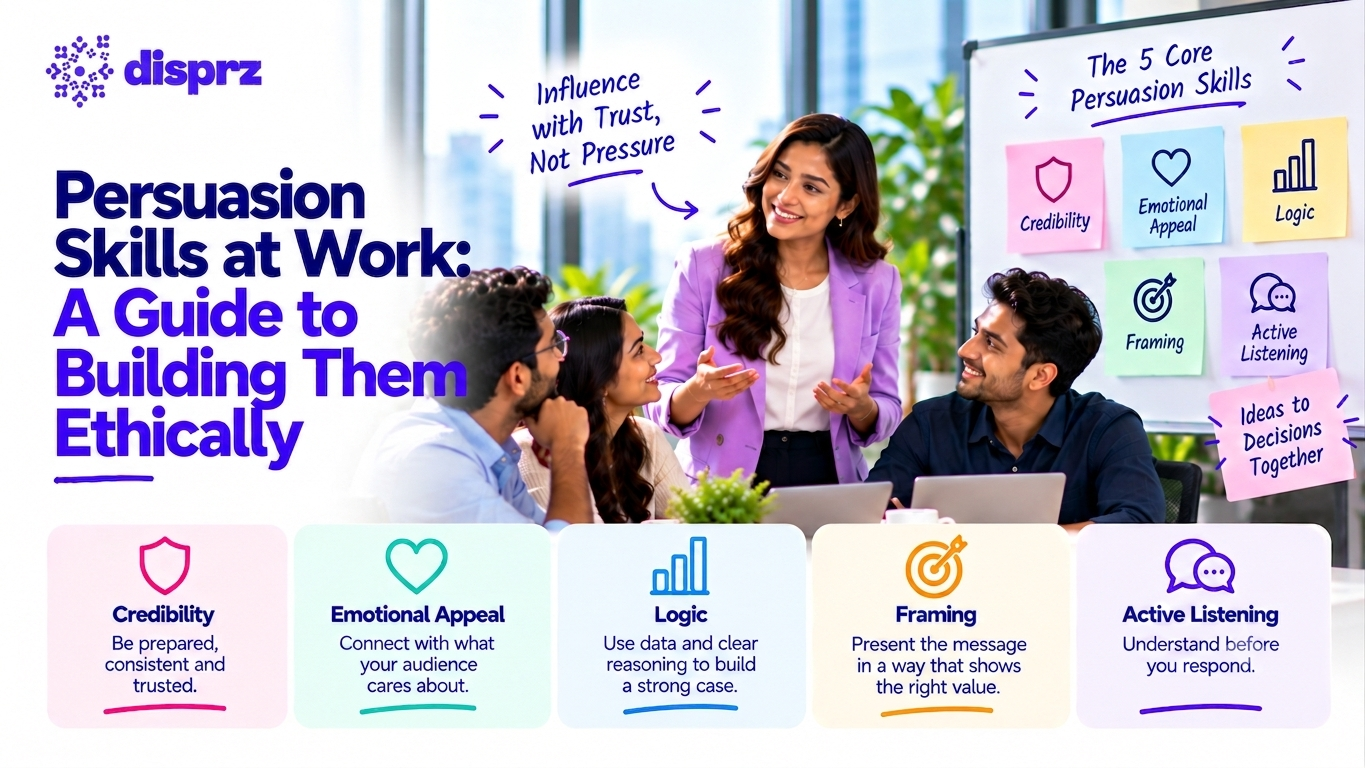
Persuasion skills are the abilities that help you influence a decision through reasoning, credibility, and empathy rather than authority or pressure. They rest on the classical framework of ethos, pathos, and logos, and show up as five trainable behaviours: credibility, emotional appeal, logic, framing, and active listening. For an enterprise, persuasion is trainable and measurable: define the observable behaviour, deliver it in short applied bursts, coach against real proposals and conversations, and track it through win rates, cycle times, and buy-in. Ethical persuasion helps the other person decide well; manipulation hides information to serve you.
Key highlights
- Definition: persuasion skills are the abilities to influence a decision through credibility, reasoning, and empathy, not pressure.
- Classical framework: ethos (credibility), pathos (emotion), and logos (logic), from Aristotle, still the working model.
- Five core skills: credibility, emotional appeal, logic, framing, and active listening.
- Ethical, not manipulative: persuasion helps someone decide well; manipulation hides or distorts to serve the persuader.
- Trainable and measurable: practice, feedback, and coaching move it, and win rates, cycle times, and buy-in show it.
The business case for persuasion
Most enterprises hire and train for expertise, then watch good ideas die in the room. A sound proposal loses to a louder one, a change programme stalls because no one bought in, and a capable specialist cannot get a decision across the line. That gap is a persuasion gap, and it is expensive because it shows up in slow deals, stalled projects, and change fatigue.
The good news for an L&D team: persuasion is not a personality you either have or lack. It is a set of behaviours you can define, train, and measure across a workforce, and it can be built ethically so it strengthens trust rather than eroding it. This guide shows how.
What are persuasion skills?
Persuasion skills are the abilities that help you influence someone's decision or behaviour through credibility, sound reasoning, and empathy, rather than through authority, pressure, or deception. At work they show up as making a clear case for a proposal, framing a change so people see the benefit, handling objections calmly, and getting genuine buy-in rather than reluctant compliance.
Persuasion is distinct from manipulation and from raw authority. You can order compliance, but that does not survive the moment you leave the room. Ethical persuasion earns a durable yes. It is a core soft skill and overlaps closely with influencing skills and negotiation skills, while resting on the same base as strong communication.
The ethos, pathos, and logos framework
The oldest and still most useful model of persuasion, from Aristotle, breaks any persuasive case into three appeals. Use these as the levers you assess and train against, rather than treating persuasion as one vague charisma.
| Appeal | What it is | How it shows up at work |
|---|---|---|
| Ethos | Credibility and character of the speaker | Being trusted, prepared, and consistent so people weigh your case seriously |
| Pathos | Emotional connection with the audience | Naming what the audience cares about and why the decision matters to them |
| Logos | Logic, evidence, and structure of the argument | Backing the ask with data, a clear cause, and a sound next step |
On balance. A case that leans only on logos convinces no one it does not first make care; one that leans only on pathos feels like spin. The strongest persuaders combine all three, with ethos underneath as the reason the audience listens at all.
The five core persuasion skills
The three appeals become trainable when you translate them into observable behaviours. These are the five core persuasion skills to assess and coach against.
- Credibility: being prepared, consistent, and honest so your ethos is established before you make the ask.
- Emotional appeal: connecting the case to what the audience actually cares about, the pathos that makes them lean in.
- Logic: structuring a clear, evidence-backed argument, the logos that stands up to scrutiny.
- Framing: presenting the same facts in the terms that matter to this audience, so the benefit is obvious.
- Active listening: hearing the real objection before answering it, which is what turns a pitch into persuasion.
Persuasion is not manipulation. Ethical persuasion is transparent about its intent, gives the other person the information they need to decide well, and would survive them knowing exactly what you are doing. Manipulation hides or distorts information, exploits pressure or fear, and serves the persuader at the audience's expense. Train the first, and name the line clearly, because a workforce that feels manipulated stops trusting every future message. This is covered in full in the difference section below.
Why persuasion matters, by industry
Persuasion pays off differently across the Disprz ICP. Naming the payoff in each sector is how you get a training budget approved.
| Industry | Pain when persuasion is weak | Payoff when persuasion is trained |
|---|---|---|
| BFSI | Advisers push products, customers disengage and distrust | Needs-led conversations, higher conversion and trust |
| Retail & ecommerce | Floor teams recite features and lose the sale | Confident, benefit-led selling and higher basket value |
| Food services & hospitality | Upsell attempts feel pushy and hurt the experience | Natural recommendations, higher spend and satisfaction |
| Manufacturing & automotive | Safety and process change meets resistance on the floor | Front-line buy-in, faster and safer adoption |
| Pharma & healthcare | Reps overstate, or fail to make an evidence-led case | Compliant, evidence-based influence clinicians respect |
| IT & ITeS | Technical experts cannot get stakeholders to a decision | Specialists who move projects and secure sign-off |
What the research says about persuasion and training
Three independent findings make the enterprise case for training persuasion, not just hiring for it.
Demand: communication and influence are core skills
The World Economic Forum's Future of Jobs Report 2025 names communication, leadership, and social influence, all persuasion behaviours, among the core skills employers prioritise, alongside analytical thinking and resilience. The same report projects that 39% of workers' core skills will change by 2030 and that 59% of the global workforce will need reskilling or upskilling, which puts human skills like persuasion firmly on the training agenda.
First-party evidence: the Disprz Skills Impact Index
Across 47 Disprz enterprise deployments, learning programmes reached a median 92% course completion and 88% platform adoption, with documented outcomes including a 10% skills improvement and 15% business growth. Persuasion sits inside these skills programmes, and the aggregate shows that structured, well-run soft-skills training reaches people and moves outcomes. See the full, sourced Disprz Skills Impact Index.
Trainability: soft skills respond to well-designed training
Persuasion is a communication and influence skill, and the closest large-scale evidence on training such skills is encouraging. A meta-analysis by Mattingly and Kraiger (2019), covering dozens of studies of emotional intelligence, a near neighbour that includes reading and influencing others, found a moderate positive effect of training, robust across participant gender, study location, and study design. An earlier meta-analysis by Hodzic and colleagues (2018) reached the same conclusion and found that ability-based programmes, which teach and practise specific behaviours, outperform generic awareness sessions.
Design implication. The evidence favours structured, practice-based programmes over one-off workshops, which is exactly why the eight-week rollout below builds in practice, coaching, and reinforcement.
What good and poor persuasion look like at work
The difference is always visible in behaviour, which is what makes it trainable and assessable.
| Situation | Weak persuasion | Strong persuasion |
|---|---|---|
| Pitching a budget to leadership | Lists features and hopes for a yes | Frames the outcome, backs it with data, names the risk of no |
| A customer raises an objection | Argues, repeats the pitch louder | Listens, restates the concern, then answers it |
| Rolling out an unpopular change | Announces and defends the mandate | Explains the why, shows the benefit to them, invites input |
| Selling on the shop floor | Recites specs the shopper did not ask for | Asks about the need, recommends to fit it |
Adapting persuasion by role
Persuasion looks different at each level, so training has to be tailored, not one generic workshop. Here is the behaviour shift to coach for each audience.
Individual contributors and junior staff
Focus on credibility and logic: coming prepared, making a clear ask with a reason, and backing it with evidence rather than opinion. For client-facing juniors, add reading the customer's need before recommending, so the pitch fits the person in front of them.
Managers leading a team
Focus on framing and emotional appeal: explaining the why behind a decision, connecting it to what the team cares about, and securing genuine buy-in for change rather than reluctant compliance.
Senior leadership (managing up)
Focus on framing and brevity: leading with the outcome, anticipating the objection, and presenting a problem with a recommended path rather than an open question. A junior persuading a customer should be warm and exploratory; the same person persuading an executive should be concise, evidence-led, and decision-oriented. That deliberate shift is persuasion skill in action.
Customer and client-facing (frontline)
Focus on active listening and honest recommendation under pressure: hearing the real need first, then making the case that fits it. This is where frontline enablement and short mobile practice matter most, because the moment is live and there is no time to prepare a script.
What are the techniques of persuasion?
These are practical, ethical techniques you can teach and practise. Used transparently, they help an audience decide well, which is the line that keeps them ethical.
- Lead with the outcome: open with the result you are proposing, not the background. People decide on the destination, then the detail.
- Reciprocity: give value first, a useful insight or a genuine concession, and people are more willing to give back. Cialdini's classic principle.
- Social proof: show that peers or respected others have already made the choice, which lowers perceived risk.
- Framing and contrast: present the same facts in the terms that matter to this audience, and anchor the option you recommend against a clear alternative.
- Name the objection first: raise the obvious concern before they do. It builds credibility and defuses resistance.
- Tell a concrete story: one vivid, real example lands harder than a page of abstract benefits.
- Ask, then listen: a good question surfaces the real driver, and active listening lets you tailor the case to it.
- Make the ask specific: end with a clear, small, easy next step rather than a vague call to agree.
Quick persuasion self-check
Rate each statement from 1 (rarely true) to 5 (almost always true). It is a directional prompt, not a validated test, but it shows which of the five core skills to prioritise.
- People treat me as prepared and trustworthy when I make a case.
- I connect my ask to what the other person actually cares about.
- I back my proposals with clear evidence and a sound structure.
- I frame the same facts in the terms that matter to my audience.
- I hear the real objection before I answer it.
How do you measure persuasion?
Persuasion feels intangible only until you tie it to behaviour and outcomes. Measure it on three levels.
- Behaviour rubric: score the five core skills against observable behaviours, before and after training.
- 360 and observation: manager, peer, and customer ratings, plus call or meeting reviews, since persuasion is judged by its effect on others.
- Scenario assessment: responses to realistic proposals and objections, scored against a model answer.
- Business signals: track the metrics persuasion moves, such as win or conversion rate, sales cycle length, proposal approval rate, adoption of change, and CSAT.
Benchmark to hold. Do not report a single "persuasion score". Report movement on specific behaviours by role and team, tied to a business metric, so you can see where coaching is working and where it is not.
What is the difference between persuasion and manipulation?
This distinction belongs in the measurement conversation, because an unethical persuader can move a short-term number while destroying trust. The line is about intent, transparency, and whose interest is served.
| Dimension | Ethical persuasion | Manipulation |
|---|---|---|
| Intent | Help the other person decide well | Serve the persuader at the other's expense |
| Information | Transparent, gives what is needed to choose | Hidden, distorted, or selectively withheld |
| Method | Reasoning, credibility, genuine emotion | Pressure, fear, guilt, false urgency |
| Test | Would survive the audience knowing your intent | Depends on the audience not knowing |
| Outcome | Durable buy-in and trust | Short-term compliance, long-term distrust |
Train the line, not just the skill. Make ethics an explicit part of any persuasion programme, especially in sales and frontline roles. A workforce that persuades ethically builds trust that compounds; one that manipulates spends it, and customers and colleagues remember.
How long does it take to build persuasion?
Set realistic expectations with sponsors so the programme is not judged too early.
- Awareness: 2 to 4 weeks with assessment and a first workshop.
- New habits: 1 to 3 months of applied practice and coaching.
- Visible team change: 3 to 6 months as behaviours stick.
- Measurable business impact: 6 to 12 months on win rates, cycle time, and CSAT.
How do you persuade people at work? Turn it into a training programme
Persuading people at work is a repeatable habit, not a knack, and the reliable way to build it across a team is a structured programme with practice and reinforcement built in. This eight-week rollout works across desk and frontline teams.
| Week | Focus | Activity |
|---|---|---|
| 1 | Baseline | Self and 360 assessment, set behaviour goals by role |
| 2 | Credibility | Microlearning on ethos, preparation and consistency drills |
| 3 | Logic | Structuring an argument, evidence and the specific ask |
| 4 | Emotional appeal | Audience mapping, connecting the case to what they value |
| 5 | Framing | Reframing drills, contrast and anchoring, scenario practice |
| 6 | Active listening and objections | Objection-handling role-play, AI coaching on real pitches |
| 7 | Reinforce | Nudges, peer review, manager check-in, ethics scenario |
| 8 | Re-measure | Repeat rubric and 360, report movement and win-rate signal |
Tools and enablers
Match a tool to each stage rather than buying one and hoping.
- Assessment: persuasion rubrics and 360 tools for baseline and re-measure.
- Delivery: an LMS for structured paths and mobile microlearning.
- Discovery: an LXP with skills intelligence to map persuasion behaviours to roles.
- Practice: pitch and objection role-play, delivered on mobile for frontline.
- Coaching: an AI coach that gives feedback on real pitches and calls.
- Analytics: dashboards that report behaviour movement by team.
Results at scale
Behaviour change shows up in numbers when the programme is run properly and reinforced. These are outcomes enterprises have seen running skills programmes on Disprz.
Across 47 Disprz enterprise deployments, learning programmes reached a median 88% course completion and 85% platform adoption, with documented outcomes including a 10% skills improvement and 15% business growth. See the full, sourced Disprz Skills Impact Index.
Customer story: Fabindia. The Indian retail brand runs frontline capability training for its 3,000+ employees on Disprz, putting persuasive, needs-led selling into the hands of store teams. The programme reached 1,000+ frontline learners and is credited with 20% store sales growth from that training, a direct example of persuasion skill turning into a business result. Read the Fabindia case study.
How Disprz helps you build persuasion at scale
The hard part of persuasion training is not the content, it is running it across thousands of people, in many roles and languages, and proving it changed behaviour and results. Disprz brings the LMS, LXP and skills intelligence, and frontline enablement into one platform so each stage of the programme lives in one place.
| Programme stage | What Disprz does | Outcome you can show |
|---|---|---|
| Map | Skills intelligence links the five core persuasion skills to each role and surfaces the gap | A baseline by role, team, and region |
| Build | Turo converts your playbooks and sales SOPs into persuasion microlearning and scenarios | A curriculum stood up in days, not a quarter |
| Deliver | Mobile-first delivery, online and offline, for desk and frontline alike | Reach that includes the frontline, not just HQ |
| Practice | Pitch and objection role-play modules for real situations | Behaviour rehearsed before it is needed |
| Coach | AI coaching gives feedback on real pitches and calls | Coaching at a scale managers cannot cover alone |
| Reinforce | Nudges, spaced reminders, and manager check-ins in the flow of work | Habits that survive past the workshop |
| Measure | Behaviour rubrics, 360 feedback, and progression analytics | Movement on behaviour, tied to win rates and CSAT |
Because the five core persuasion skills are mapped as skills, not just course completions, you can prove progression rather than attendance. That is the difference between a training line item and a capability you can report to the board.
- Role-to-behaviour mapping for the five core persuasion skills
- Microlearning and pitch practice on mobile, including offline
- AI coaching feedback on real pitches and calls
- Behaviour rubrics and 360 assessment built in
- Nudges and reinforcement in the flow of work
- Progression analytics by role, team, and region
Turo, the agentic authoring layer, converts your existing playbooks and sales SOPs into microlearning 80% to 90% faster than manual builds, so a persuasion curriculum does not take a quarter to stand up. Enterprises running skills programmes on Disprz sustain 45%+ frontline completion against an industry average below 30%, which is what makes a soft-skills rollout actually finish.
Where to start. Pick one role and the two persuasion skills that hurt most, map them in skills intelligence, and run the eight-week programme above as a pilot. Prove the movement, then scale it across the workforce.
Key takeaways
- Persuasion is trainable and measurable, not a fixed personality trait.
- Train against the three appeals (ethos, pathos, logos) and their five observable skills, not a vague charisma.
- Keep it ethical: persuasion helps someone decide well, manipulation hides information to serve you.
- Tailor the training by role: credibility and logic for juniors, framing and buy-in for managers, listening for frontline.
- Run it as an eight-week programme with practice and reinforcement, and tie it to win rates, cycle time, and CSAT.
Where should you start?
Persuasion is the human layer that decides whether your expertise and your strategy actually move anyone. For an enterprise, the win is not a single workshop but a repeatable programme that defines the behaviours, trains and reinforces them by role, keeps them ethical, and proves the change. Start with the two skills that hurt most in your context, make them observable, and build from there.
Reviewed for accuracy on 22 Sep 2026.
Persuasion skills FAQs
The questions L&D and people leaders ask most often.
What are persuasion skills?
Persuasion skills are the abilities that help you influence a decision or behaviour through credibility, sound reasoning, and empathy rather than authority or pressure. At work they include making a clear case, framing a change so people see the benefit, handling objections, and earning genuine buy-in. They rest on the classical appeals of ethos, pathos, and logos.
What are the techniques of persuasion?
Common ethical techniques include leading with the outcome, reciprocity (giving value first), social proof, framing and contrast, naming the objection before the audience does, telling a concrete story, asking and then listening for the real driver, and ending with a specific, small next step. Used transparently, each helps the audience decide well.
How do you persuade people at work?
Establish credibility, understand what the other person cares about, make a clear evidence-backed case, frame it in their terms, listen for the real objection, and make a specific ask. Across a team, the reliable way to build this is a structured programme: assess, teach each skill, practise with role-play, coach against real pitches, and re-measure, rather than a one-off workshop.
What is the difference between persuasion and manipulation?
Ethical persuasion is transparent about its intent, gives the other person the information they need, and helps them decide well, so it would survive them knowing exactly what you are doing. Manipulation hides or distorts information, uses pressure or fear, and serves the persuader at the audience's expense. Persuasion builds durable trust; manipulation buys short-term compliance and long-term distrust.
Can persuasion be trained?
Yes. Persuasion is a set of behaviours that improve with deliberate practice, specific feedback, and reinforcement. Meta-analyses of related communication and influence skills show a moderate positive effect of well-designed training, and ability-based programmes that teach and practise specific behaviours outperform generic awareness sessions.
How do you measure persuasion in a workforce?
Through behaviour rubrics scored against the five core skills, 360 feedback and call or meeting observation, scenario assessments, and the business metrics persuasion moves, such as win or conversion rate, sales cycle length, proposal approval rate, adoption of change, and CSAT.
Sources
- Disprz. Disprz Skills Impact Index, 2026. First-party learning and skills outcomes from 47 enterprise deployments. disprz.ai/skills-impact
- World Economic Forum. Future of Jobs Report 2025. January 2025. weforum.org
- Mattingly, V. and Kraiger, K. Can emotional intelligence be trained? A meta-analytical investigation. Human Resource Management Review, 29(2), 2019.
- Hodzic, S., Scharfen, J., Ripoll, P., Holling, H. and Zenasni, F. How efficient are emotional intelligence trainings: A meta-analysis. Emotion Review, 10(2), 2018.
- Disprz master value benchmarks (8X ROI, 50% productivity, 7X CSAT) and frontline completion data, 2026. Aggregated enterprise deployment data.
About the authors


Madhu Karunakaran
Vice President - People & Culture
Madhu Karunakaran is a senior HR and Learning & Development (L&D) leader with 20+ years of experience spanning people strategy, organizational development (OD), talent management, leadershi...
Reviewed for accuracy on 20 Sep 2026