

On this page
The Roleplay Problem Nobody Talks About
Your sales training team has built excellent content. The product pitch is polished. The objection-handling playbook covers every scenario. The onboarding program runs like clockwork. Sales leaders have invested heavily in preparing reps for customer interactions. And yet, the moment a new rep gets on a live sales call with a skeptical buyer, something breaks.
It is not a knowledge gap. The rep knows the pitch, understands the sales process, and has seen how top performers handle objections during training. It is a practice gap; the distance between knowing what to say and being able to say it fluently, under pressure, during real sales conversations when a buyer pushes back.
Traditional sales role plays and cold calling exercises often fail to provide enough realistic, personalized role play opportunities to close this gap. As a result, critical skill gaps remain unaddressed. That gap is where deals are lost, ramp time balloons, and manager hours disappear into call reviews that come too late to change the outcome.
If you are reading this because your sales training program is not moving the revenue needle, the problem is likely not your content. The problem is a form of practice that has been broken from the start: traditional sales roleplay. According to research from MySalesCoach, teams coached weekly hit 76% quota attainment versus just 47% for those coached quarterly or less; a 29-percentage-point gap driven purely by how often reps get to practice and receive feedback. The frequency problem is not a coaching philosophy issue. It is a structural one, and traditional roleplay is at its heart.
This post is about why traditional sales roleplay training fails; not just as a criticism, but as an explanation grounded in learning science; and what AI roleplay does differently. If you want to understand what AI sales coaching actually is before going deeper on practice mechanics, our complete guide to AI sales coaching covers the full landscape, including how the technology works and what outcomes enterprises should expect.
What Learning Science Actually Says About Skill Development
Before diagnosing the failure, it helps to understand what skill development actually requires. Cognitive psychology has been clear on this for decades. The research converges on three conditions that must be present for a skill to transfer from "understood" to "automatic":
Condition 1: High-frequency repetition over time. This is the spacing effect, first identified by Hermann Ebbinghaus in the 1880s. The research shows that without reinforcement, people forget up to 70% of what they have learned within 24 hours of learning it. Spreading practice sessions out over time (rather than massing them in a single event) produces dramatically better long-term retention by exploiting memory consolidation cycles.
Condition 2: Immediate, specific, corrective feedback. Deliberate practice (the framework developed by cognitive psychologist K. Anders Ericsson) requires feedback that is immediate, specific to the error made, and actionable enough to drive a different behavior in the next repetition. Delayed feedback ("your Q3 discovery calls were weak") does not produce skill change. Timestamped, in-context feedback ("at minute 02:14, you responded to the budget objection before you understood the real concern") does.
Condition 3: Psychological safety to fail productively. Learning requires error. Skill development accelerates when the learner can experiment, fail, observe the consequence, and try a different approach in the next repetition; without the failure carrying career stakes. Research published in the Journal of Personal Selling and Sales Management confirms that social anxiety in sales roleplay settings negatively impacts both functional and relational learning outcomes. In plain terms: a rep who is performing for their manager is not practicing. They are protecting their reputation.
Traditional sales roleplay satisfies none of these three conditions reliably. AI roleplay is designed to satisfy all three.
Why Traditional Sales Roleplay Violates Every Principle of Deliberate Practice
Deliberate practice (the mechanism behind expert performance across every high-skill domain, from surgery to chess to concert performance) has a precise definition: structured practice at the edge of current ability, with immediate feedback, repeated over many sessions. Anders Ericsson's foundational research showed that expertise is not a function of talent. It is a function of deliberate practice volume.
Sales is a skill domain. A rep's ability to handle a pricing objection from an analytical CFO, reframe a "we tried something like this before" dismissal, or navigate a multi-stakeholder discovery call is developed through repetition, just like any other high-performance skill. The difference between a rep who handles it fluently and one who freezes is rarely intelligence. It is practice reps.
Traditional roleplay gives most reps two to three practice opportunities per month, in sessions they know are being evaluated. AI roleplay gives them unlimited, on-demand sessions in a private environment. That shift (from episodic and observed to daily and safe) is the core of what AI changes. Everything else follows from it.
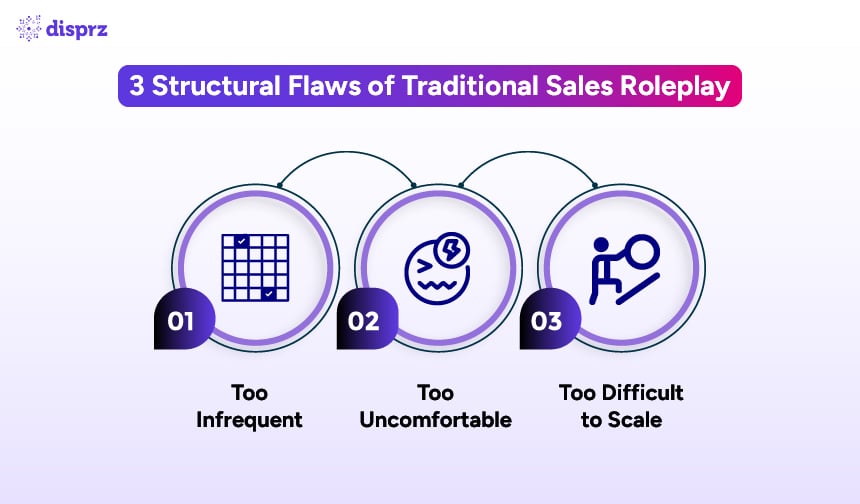
The Three Structural Failures of Traditional Roleplay
Failure 1: It is infrequent
Ask any sales training manager how often their reps run a formal roleplay. The honest answer is usually once a quarter, once before a product launch, or during onboarding; after which it disappears. The constraints are real: manager time is finite, scheduling across distributed teams is hard, and roleplay is uncomfortable enough that most reps and managers quietly agree not to prioritize it.
Research from ATD's State of Sales Training report found that 73% of front-line sales managers report spending fewer than 30 minutes per rep per week on coaching, even as they identify coaching as their highest-leverage activity. Roleplay is a subset of that already-thin coaching time. The practical result: a new rep might run a total of ten structured roleplay sessions in their first six months; one for every three weeks of active selling. That is not enough repetitions to build anything that holds under live-call pressure.
Failure 2: It is uncomfortable (by design)
There is a structural problem with manager-observed roleplay that goes deeper than scheduling. The rep knows they are being evaluated. The manager knows they are evaluating. Both parties know the outcome of the session will influence the rep's performance review, territory allocation, or onboarding timeline. That evaluation dynamic transforms the session from practice into performance. The rep is not experimenting with a new objection-handling approach. They are executing the approach they already know (safely) to avoid looking bad.
This matters because skill development requires error. You cannot build the neural pathways for a new behavior without making mistakes and correcting them. A rep who avoids every mistake in a managed roleplay session learns nothing. They confirm what they already know. The uncomfortable truth is that traditional roleplay, by design, creates conditions that are the opposite of learning.
Failure 3: It is unscalable
Even if frequency and psychological safety were solved, the math of traditional roleplay does not work at enterprise scale. According to data from Gallup via Business Insider, the average sales manager's span of control is growing from 10.9 reps in 2024 to 12.1 in 2025. When managers spend 30–60% of their time on administrative tasks and meetings, a manager with 12 direct reports has roughly 90 minutes of people time per week per rep; and actual skill-coaching time drops to 15 to 20 minutes after 1:1s and team stand-ups. There is simply no time budget for meaningful roleplay frequency.
For an enterprise with 500 frontline sales reps, getting each rep three quality roleplay sessions per month would require thousands of manager hours per month dedicated to roleplay alone. It does not happen. What happens instead is sporadic, inconsistent coaching that produces inconsistent readiness; and a manager who spends their remaining coaching time doing deal inspection rather than skill development.
The Forgetting Curve Is Destroying Your Training ROI
Infrequent roleplay does not just mean less practice. It means the practice that does happen produces very little retention. The Ebbinghaus forgetting curve (the most replicated finding in memory research) shows that without reinforcement, people forget roughly 50% of newly learned information within an hour, and up to 70% within 24 hours.
In a sales training context, this is expensive. Your L&D team invests significant resources in a product launch workshop. Reps attend, pass a knowledge check, and walk out with an 85% score. Two weeks later, without any reinforcement through practice, most of that knowledge has decayed to the point where it cannot be reliably deployed under the pressure of a live objection. Research consistently indicates that salespeople forget approximately 84% of what they learn within 90 days without reinforcement.
Spaced repetition; delivering practice sessions at intervals timed to when memory is about to decay; is the mechanism that defeats this curve. But spaced repetition requires frequent touchpoints over weeks and months. It cannot be delivered through quarterly roleplay sessions. It requires a practice infrastructure that operates daily, not episodically. That is what AI roleplay provides.
Psychological Safety: Why Reps Perform (Not Practice) During Roleplay
The psychological safety problem in traditional roleplay is not a cultural failure. It is a structural one. The evaluator is the manager. The stakes are real: looking incompetent in front of your direct boss, in a session that can be discussed in a performance review, is not a low-stakes environment by any standard.
When psychological safety is absent, learners revert to the behaviors they are most confident in; not the behaviors they are trying to develop. This is well-established in organizational psychology. Amy Edmondson's foundational research at Harvard showed that psychological safety is a prerequisite for learning behavior in team settings; that the willingness to take interpersonal risks, including the risk of looking incompetent, is necessary for any form of genuine skill development. In high-evaluation environments, that willingness collapses.
The practical consequence for sales roleplay is predictable. Reps do not try the new approach their coach suggested. They deliver the pitch they already know works. Managers see a decent performance and offer minor feedback. Everyone feels like something productive happened. Nothing has changed.
AI roleplay removes the evaluator from the room. The session is private. The feedback is automated and objective. The rep can try an unfamiliar objection-handling approach, stumble through it, hear exactly what went wrong, and try again in the next session; without anyone observing the stumble. That shift from performance to practice is not cosmetic. It is the condition under which actual skill development can occur.
The Manager Bandwidth Problem Makes This Worse
The failure of traditional roleplay is compounded by a structural problem that predates AI: managers simply do not have the time to coach every rep at the frequency that drives performance. According to MySalesCoach's State of Sales Coaching research, 45% of reps rate the coaching they receive as below average (up from 29% in 2025) and 41% say they are never or rarely coached.
This is not a management culture problem. It is a math problem. McKinsey research shows frontline sales managers spend 30–60% of their time on administrative tasks and internal meetings, leaving limited windows for actual coaching activity. A manager running pipeline reviews, handling escalations, attending forecast calls, and managing territory planning does not have four hours per rep per week for meaningful skill coaching. The 29-point quota attainment gap between weekly-coached and quarterly-coached reps exists because weekly coaching is structurally impossible for most managers at current span-of-control ratios.
This matters for roleplay specifically because roleplay is the most time-intensive form of coaching. A 15-minute roleplay session requires both the manager's and the rep's time, a debrief, and enough mental headspace to engage seriously with the exercise. When manager bandwidth is the constraint, roleplay is the first thing dropped.
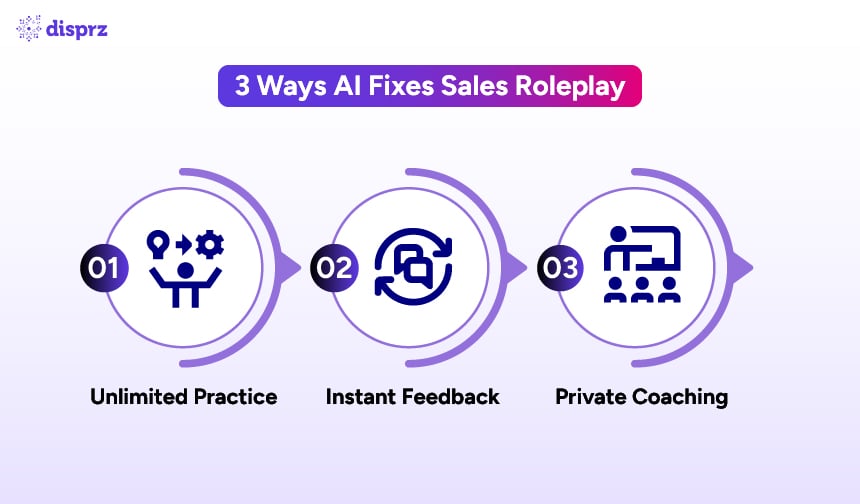
What AI Changes: The Three Fixes Traditional Roleplay Can't Deliver
AI sales roleplay does not make roleplay slightly better. It changes the structural conditions that made traditional roleplay fail. Here is how each failure maps to an AI fix:
Fix 1: Unlimited frequency replaces episodic sessions
With AI roleplay, practice is not gated by manager availability or scheduling. A rep can run a discovery call simulation before their 9am prospect meeting. They can run an objection-handling scenario at the end of the day to review what happened on a tough call. They can run five sessions in a week before a high-stakes renewal conversation. The frequency constraint; the primary driver of the quota attainment gap; is removed.
Spaced repetition can now actually be implemented. A practice cadence can be built into the rep's workflow at the intervals that defeat the forgetting curve. The practice infrastructure becomes always-on rather than event-driven.
Fix 2: Immediate, objective, specific feedback replaces delayed, subjective debriefs
Traditional roleplay feedback is limited by the manager's ability to observe everything in real time and articulate it afterward. AI roleplay generates timestamped feedback on every moment of every session: at 01:14, you acknowledged the objection but did not explore the underlying concern; at 02:47, your talk-to-listen ratio shifted to 80/20, which correlates with losing the discovery thread. The feedback is not a general impression. It is a moment-by-moment analysis against the coaching rubric you defined.
This matters for skill development because the feedback loop is what drives behavior change. Vague feedback ("be more consultative") produces no change. Specific, timestamped feedback tied to a real moment in a session the rep just experienced produces behavioral adjustment in the next session. AI roleplay compresses the feedback loop from days to minutes.
Fix 3: Private practice removes the performance dynamic
When the AI plays the buyer and no manager observes the session, the rep can fail freely. They can try the consultative opener they have never been confident enough to attempt in a managed session. They can fumble through a multi-stakeholder scenario and learn from the fumble. The psychological safety that is structurally absent from manager-observed roleplay is structurally present in AI roleplay, because the stakes of the session are zero.
A meta-analysis published in the International Journal of Instruction found that roleplay-based training produces an effect size of 0.82 (classified as "large") significantly outperforming traditional methods, with the strongest effects on practical skill development. The effect size compounds when the practice environment is psychologically safe enough for genuine experimentation.
See it in action: Request a demo and watch a single rep run a live, AI-scored roleplay end to end (scenario configuration to scorecard) in under 20 minutes. Request a Demo
How Disprz Sales Coach Applies This in Practice
Disprz Sales Coach by Turo is a purpose-built AI coaching agent that puts every sales rep inside realistic, voice-led buyer simulations built from your own product knowledge, buyer personas, and sales playbook; and delivers moment-by-moment feedback on every conversation.
The workflow runs in three stages, each designed to apply the learning science principles above:
Stage 1: Build the scenario
You define the buyer persona, emotional state, decision style, and call objective. You upload your product deck, battle cards, and SOPs. Sales Coach builds a hyper-realistic AI buyer calibrated to your actual ICP; not a generic placeholder. This specificity is what makes the practice transfer to real calls: the scenarios are built from your context, not a generic library.
Stage 2: Practice the roleplay
The rep enters a live, voice-based conversation with the AI buyer. There are no hints and no scripts. The AI adapts dynamically to everything the rep says, just as a real buyer would. The evaluation runs silently in the background. The rep practices under realistic conditions; but in complete privacy.
Stage 3: Get detailed feedback
Post-call analysis produces a scored scorecard across every dimension you care about: discovery quality, needs uncovering, solution positioning, objection handling, and closing. Timestamped missed moments show exactly where the rep lost the thread. A personalized coaching action plan sets the agenda for their next session.
Sales Coach is trained on BANT, SPIN, and Challenger frameworks; so the feedback is not generic communication coaching. It is framework-specific, sales-methodology-grounded analysis tied to the actual stage of the deal the scenario simulated.
The platform is neutral by design; it operates across any LMS or LXP ecosystem without requiring a rip-and-replace. For teams already on the Disprz platform, practice data connects directly into the skill framework and learning journeys, closing the loop between what a rep practised and what they are assigned to work on next.
What AI Sales Roleplay Looks Like in the Wild
Consider a BFSI enterprise with 800 frontline insurance advisors distributed across 40 cities. The traditional coaching problem: one national training manager, regional sales managers stretched across 15–20 direct reports each, and a new product launch requiring every advisor to be able to handle four new objection types within two weeks.
In the traditional model, that looks like a two-day national workshop, a knowledge assessment, and (if the budget allows) a manager-led roleplay session in each region. In practice, the roleplay sessions happen in maybe 60% of regions, last an average of 30 minutes per session, and are observed by a manager who is simultaneously taking call escalations on another device. The forgetting curve does the rest.
In the AI roleplay model, the national training manager uploads the product documentation and defines buyer personas for the four key objection scenarios. Within 48 hours, every advisor across all 40 cities has access to unlimited practice sessions against a calibrated AI buyer. The platform tracks who has run sessions, what their scores are on each objection type, and where the gaps are concentrated: by region, by team, and by individual. The manager can see who is call-ready and who needs targeted intervention, before the product goes live.
The practice infrastructure scales to 800 reps in the same way it scales to 8. That is the structural shift traditional roleplay cannot make.
What AI Roleplay Still Needs From You
AI roleplay is not a replacement for good sales management. It is the practice infrastructure that makes coaching time more valuable. Here is what it still requires to work:
Scenario design investment upfront. Sales Coach scenarios are only as realistic as the buyer personas and product context you give them. A well-configured scenario (with a specific buyer name, emotional state, decision history, and objection profile) produces transferable practice. A generic scenario produces generic practice.
Manager coaching for deal-level insight. AI roleplay coaches skills. Human managers coach deals, strategy, and relationships. The two are complementary. The best-performing teams use AI practice to build the skill baseline and manager coaching to apply those skills to specific pipeline opportunities.
A practice cadence. The forgetting curve is defeated by spaced repetition, not by a single high-volume sprint. A rep who runs three sessions before a product launch and then stops practicing will still decay. The ROI of AI roleplay compounds when it is built into a regular weekly cadence (two or three sessions per week) that delivers the spaced repetition the brain requires.
Key Takeaways
- Traditional sales roleplay fails on three structural dimensions: it is infrequent (two to three sessions per month at best), uncomfortable (performance anxiety in manager-observed settings prevents genuine skill development), and unscalable (manager bandwidth cannot support meaningful practice frequency across large teams).
- The forgetting curve actively destroys training ROI: without reinforcement through practice, reps forget up to 70% of what they learned within 24 hours. Spaced repetition (delivered through frequent practice sessions) is the mechanism that defeats this curve.
- Psychological safety is a prerequisite for practice, not a nice-to-have: reps perform in manager-observed roleplay rather than practicing. The performance dynamic prevents the experimentation and error-making that skill development requires.
- AI roleplay fixes all three structural failures simultaneously: it removes the frequency constraint (unlimited, on-demand sessions), the feedback delay (timestamped, moment-by-moment analysis), and the safety deficit (private practice with no career stakes).
- The coaching bandwidth problem is structural, not motivational: the average manager has 15–20 minutes of actual skill-coaching time per rep per week. AI roleplay scales the practice layer independently of manager capacity.
Conclusion
The failure of traditional sales roleplay is not a people problem. Your managers are not lazy. Your reps are not resistant. The failure is structural: traditional roleplay was designed for a world where practice was an occasional event managed by a scarce resource, delivered to a rep in a high-evaluation environment, on a cadence that the forgetting curve destroys before it can produce durable skill change.
AI roleplay rebuilds that structure from the ground up. It delivers the frequency that spaced repetition requires. It provides the immediate feedback that deliberate practice demands. It creates the psychological safety that transforms performance into genuine learning. And it does all three at the scale that enterprise sales teams actually operate at; hundreds or thousands of reps, distributed across geographies, practicing against scenarios built from your own product and your own buyers.
The question for every revenue leader and L&D head reading this is not whether traditional roleplay is working. You already know it is not. The question is what the practice infrastructure should look like in its place; and whether you can afford to find out through another quarter of deals lost in the gap between knowing and doing.
FAQs
1) What is sales roleplay training?
Sales roleplay training is a practice method in which sales representatives simulate live buyer conversations (typically with a manager or peer playing the customer role) to develop and refine skills such as objection handling, discovery questioning, and closing techniques. The goal is to build the fluency and confidence that reps need to perform effectively on real calls, before those calls happen.
2) Why does traditional sales roleplay fail?
Traditional sales roleplay fails for three structural reasons: it is infrequent (most reps get two to three sessions per month), psychologically unsafe (manager observation transforms practice into performance), and unscalable (manager bandwidth cannot support meaningful practice frequency across large teams). These failures compound: infrequent sessions produce insufficient repetitions, and infrequent sessions in evaluated settings produce performance rather than genuine skill development.
3) What is AI sales roleplay training?
AI sales roleplay training uses an AI agent to play the role of the buyer in a sales simulation. The rep practices the conversation with the AI in real time (no script, no hints) and receives automated, immediate, specific feedback on every moment of the session. Because the environment is private and the stakes are low, reps can experiment freely, build skills through repeated attempts, and receive objective feedback that human managers rarely have time to provide.
4) How does AI roleplay apply spaced repetition to sales training?
Spaced repetition requires practice sessions delivered at intervals that match the brain's forgetting curve; ideally several times per week rather than once per month. AI roleplay removes the scheduling and bandwidth constraints that prevent this frequency in traditional coaching. Reps can practice daily, building the repetition density that produces durable skill acquisition rather than temporary performance.
5) Is AI roleplay psychologically safer than manager-led roleplay?
Yes. The key factor is the absence of the evaluator. When a manager observes a roleplay session, the rep is performing for that audience; avoiding errors rather than experimenting with new approaches. AI roleplay sessions are private. The rep can try an unfamiliar technique, fail, hear exactly what went wrong, and try again in the next session without any career stakes attached to the failure. This psychological safety is the condition under which genuine skill development occurs.
6) Can AI roleplay replace the sales manager's coaching role?
No; and it is not designed to. AI roleplay is a practice infrastructure. It builds the skill baseline that gives manager coaching sessions something to build on. The most effective approach combines AI practice for skill repetition and feedback with manager coaching for deal-level strategy, relationship insight, and career development. The two functions are complementary: AI handles the volume of practice that managers cannot deliver; managers handle the strategic and relational coaching that AI cannot replicate.
7) What sales scenarios can AI roleplay cover?
Modern AI sales coaching platforms like Disprz Sales Coach cover the full range of enterprise sales scenarios: new rep onboarding, discovery calls, product pitch practice, multi-stakeholder demos, objection handling, negotiation and closing, renewal conversations, and cross-sell and upsell situations. For enterprise teams, the most valuable capability is the ability to build custom scenarios from your own product documentation and buyer personas; so reps are practicing against the actual customers they will face, not generic placeholders.
8) How quickly can an enterprise team deploy AI roleplay?
With a platform like Disprz Sales Coach, most teams can configure and launch their first simulation within a single session. The context setup takes minutes once your buyer persona and product materials are ready. This rapid time-to-value makes AI roleplay viable for high-urgency use cases like product launches, territory onboarding, or pre-quarter readiness checks; not just long-term capability programs.
9) How is AI sales roleplay different from a generic AI chatbot?
Sales-specific AI coaching agents are trained on sales frameworks (BANT, SPIN, Challenger); and calibrated to simulate specific buyer personas with defined emotional states, decision styles, and objection profiles. The feedback they generate is framework-specific: did the rep qualify correctly at this stage, ask the right discovery questions, handle the budget objection with the right approach? A generic chatbot engages in conversation. A sales coaching agent evaluates whether that conversation advanced the deal using the methodology your team has defined.
10) What should enterprises look for in an AI sales roleplay platform?
Evaluate platforms on five dimensions: scenario customization (can you build from your own product and personas, or are you limited to generic scenarios?), feedback specificity (are you getting timestamped, moment-by-moment analysis or a broad score?), framework alignment (does the platform score against BANT, SPIN, or Challenger, or only generic communication quality?), analytics depth (can you see rep readiness by skill dimension, track progression over sessions, and identify which individuals need intervention?), and integration with your existing LMS or LXP. Platforms that check all five deliver the most measurable impact on sales readiness.