
On this page
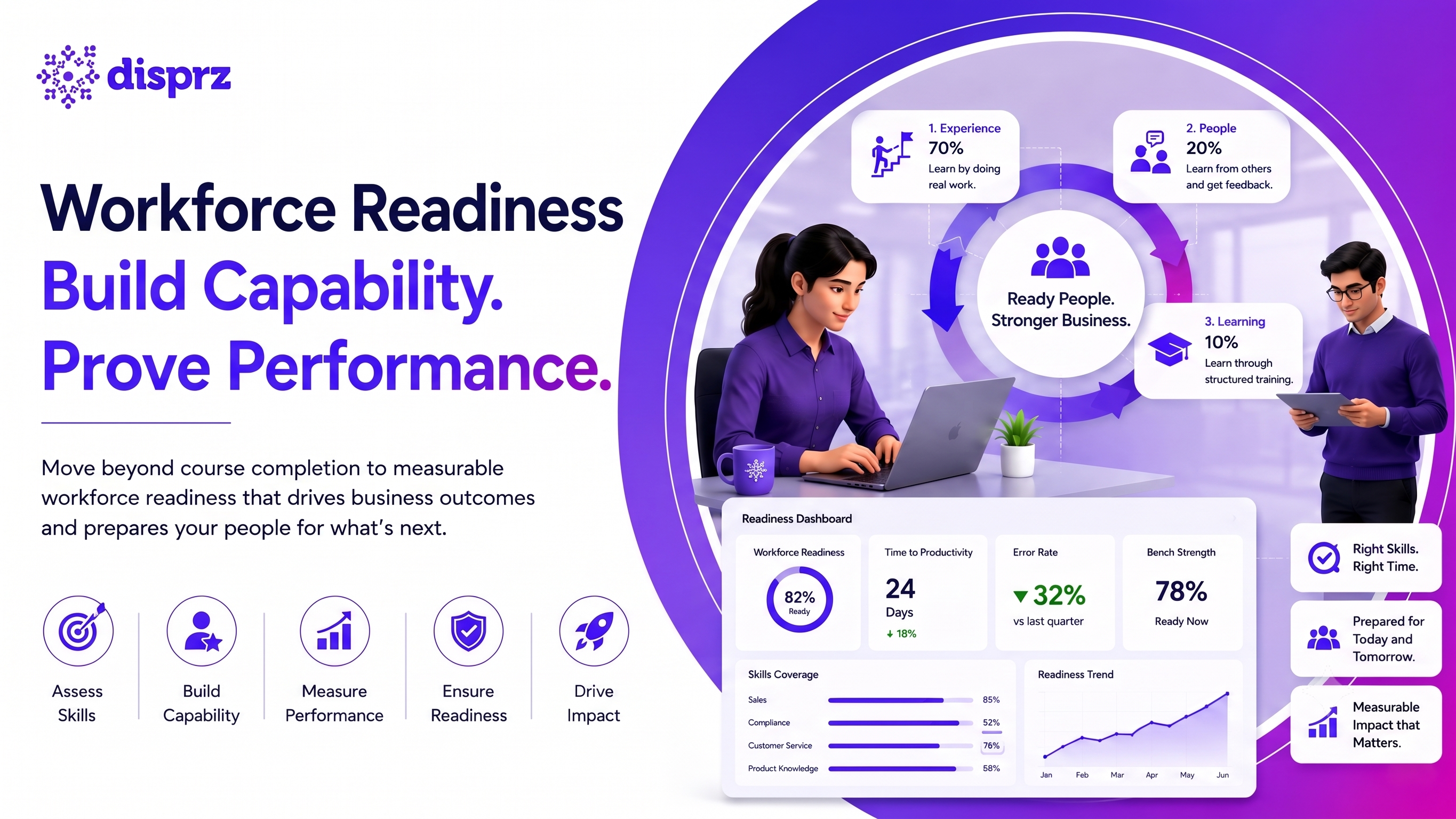
Workforce readiness is how prepared your employees are to perform their roles correctly today and adapt as the work changes. It combines the skills, knowledge, behaviours, and judgment needed to do the job, plus the evidence that the person can actually do it.
It treats capability as something you measure, not something you assume once training is marked complete. That shift, from tracking activity to proving capability, is what separates a readiness programme from a training calendar.
Key points
- Readiness is a business outcome, not a course catalogue.
- It is proven through demonstrated performance, not completion records.
- It applies to a specific role, not to the workforce in general.
- Workforce readiness measures whether employees can perform their roles to standard now and absorb change later, which is a different question from whether they finished a course.
- The four types of employee workforce readiness are foundational, role specific, compliance and regulatory, and leadership and mobility readiness. Most organisations are strong in one and weak in another.
- A readiness programme runs in six steps: define what ready means, baseline current capability, prioritise by risk, build targeted learning, validate on the job, then deploy and measure.
- The gap is well documented. Deloitte's 2026 Global Human Capital Trends research found that 85% of leaders call workforce adaptability critical, while only 7% say their organisation leads at helping people continuously grow and adapt.
- Expected outcome: A working definition of readiness, a diagnostic for finding where your current programme breaks, and a view of how AI powered platforms operate readiness at enterprise scale.
Why Does Workforce Readiness Matter Now for Enterprise L&D?
Most L&D teams are not short of content. They are short of proof that the content changed anything.
The Josh Bersin Company put numbers on that in February 2026. In research on the $400 billion corporate training market, 74% of senior leaders said their companies lack competitive skills, fewer than 5% had deployed AI native learning technology, and 75% still treat learning as something separate from work.
Deloitte's 2026 Global Human Capital Trends research, published in March 2026, found the same disconnect between intent and execution. While 85% of leaders say building workforce adaptability is critical, only 7% report leading at helping their workforce continuously grow and adapt. Just 27% say their organisation manages change well.
Budget reality sharpens the problem. ATD's 2026 State of the Industry report, covering 340 organisations, found direct learning spend fell to $846 per employee, down $408 from the prior period, while learning hours per employee rose to 16.7. The same report found that fewer than a quarter of organisations actually measure whether their training achieved its organisational goals, and an even smaller share measures ROI.
Demand is not slowing to match. Gartner's future of work outlook for CHROs, published in January 2026, found that 85% of L&D leaders expect a surge in skills development needs over the next three years from AI and digital trends. IBM's 2026 CEO study, covering 2,000 CEOs across 33 geographies, put the scale at 29% of employees needing reskilling for different roles and 53% needing upskilling for their current ones between 2026 and 2028.
More learning, less budget per head, almost no measurement, and rising demand. That combination is why precision now matters more than volume.
Simple: Workforce readiness asks one question. Can our people do the work the business needs, and can we show it?
What Is Workforce Readiness and How Does It Actually Work?
Workforce readiness is the organisation's ability to confirm that employees hold the skills, knowledge, behaviours, and judgment their roles require, and can apply them under real conditions.
The definition matters less than the design decision it forces. Readiness moves the question from "did the employee finish the module?" to "can the employee perform this task correctly when it counts?" That reframing changes what you build, how you measure it, and what you report to the board.
Three practical consequences follow for anyone running enterprise programmes.
- You stop treating completion as evidence A 98% completion rate tells you people clicked through content. It says nothing about whether error rates fell or new hires reached quota faster.
- You define readiness per role, not per person Readiness is always relative to a standard. Without a documented role to skill map, there is no benchmark to measure anyone against, which is why competency mapping usually has to happen before any content is built.
- You measure in business terms McKinsey's March 2026 analysis on rethinking learning and development for the AI age makes the case directly. Productivity can fall by as much as 22% when employees lack the skills their work requires, organisations that focus on human capital development are 4.2 times more likely to outperform peers financially, and the metrics worth tracking are time to proficiency and internal redeployment rates rather than hours trained.
Core concepts you will reuse constantly
- Role to skill map: The documented list of skills, with target proficiency levels, that a specific role requires.
- Readiness score: How closely an employee's assessed capability matches their role's requirement, usually expressed as a percentage or fitment score.
- Skill gap: The measured distance between required proficiency and current proficiency.
- Validation: The evidence that a skill can be applied, gathered through assessment, simulation, or supervisor sign off.
- Bench strength: The number of employees already capable of stepping into a role that is not yet vacant.
How Is Workforce Readiness Different From Traditional Training?
Most legacy corporate learning still runs on an assumption from an earlier era. Assign the module, pass the quiz, and close the record. Readiness thinking opens that box and asks what the employee can now do differently.
| Dimension | Traditional training | Workforce readiness |
|---|---|---|
| Core question | Did people complete it? | Can people perform it? |
| Unit of design | The course | The role and its required skills |
| Delivery | Bulk events, annual libraries | Targeted, role based, in the flow of work |
| Evidence | Completion certificate | Assessment, simulation, supervisor sign off, KPI movement |
| Response to change | Reactive, built after a problem appears | Predictive, built from a live skills inventory |
| Reporting to the business | Learning hours and completions | Time to productivity, error rates, bench strength |
| Owner's identity | Content provider | Capability partner |
A concrete example makes the difference visible. A retail bank onboards 400 new relationship managers ahead of a product launch. The traditional route assigns a long product and compliance module, records 97% completion, and closes the project. Six weeks later, mis-sold cases and escalations rise, because the team memorised the script but cannot handle a customer situation that falls outside it.
The readiness route defines what a ready relationship manager must demonstrate, which is explaining the product accurately, running the suitability check, handling three common objections, and completing the process without a compliance exception. It then assesses against that standard before anyone is put in front of a customer.
Mistake: Reporting completion rates as a capability metric. ATD's 2026 research found fewer than a quarter of organisations measure whether training met its organisational goals, which means most L&D functions are reporting consumption and calling it performance.
What Are the Four Types of Employee Workforce Readiness?
Employees are rarely unready across the board. They are usually strong in one dimension and exposed in another, which is why a single blanket programme underperforms. Splitting employee workforce readiness into four types lets you target investment where the risk actually sits.
1. Foundational readiness
The baseline capability needed to work safely and professionally in your environment. Basic digital fluency, communication, workplace safety awareness, reliability, and the ability to follow a documented process.
This is where high volume hiring lives. Retail chains, quick service restaurants, logistics operators, and contact centres run this type continuously because attrition keeps resetting the clock.
2. Role specific readiness
The technical capability to execute a defined job. Operating a machine to specification, underwriting a policy, processing a claim, running a store closing, handling a clinical procedure, or configuring a system.
This type is the most commonly assumed and the least commonly measured. It is also where a documented role to skill map pays for itself, because you cannot score fitment against a standard you never wrote down.
3. Compliance and regulatory readiness
The knowledge and behaviour required to keep the organisation inside legal and regulatory limits. Anti money laundering rules in banking, data privacy, sales suitability standards in insurance, safety protocols in manufacturing, patient privacy in healthcare.
The distinguishing feature here is evidentiary. Regulators generally want proof that named individuals were trained, assessed, and current at a specific point in time. That is a records and validation problem as much as a learning problem.
4. Leadership and mobility readiness
The judgment and behavioural capability needed to manage others or move into a different role. Coaching, delegation, difficult conversations, decision making with incomplete data, and change management.
This type is now under acute pressure, and the evidence points at organisational capability rather than individual talent. Microsoft's 2026 Work Trend Index, published in May 2026 and covering 20,000 workers across 10 countries including India, found that organisational factors account for 67% of reported AI impact against 32% for individual mindset, more than twice the weight. Managers who visibly model new ways of working lift reported value by 17 points and trust in agentic AI by 30 points. Only 19% of AI users sit in the zone where individual capability and organisational readiness reinforce each other.
Gartner's January 2026 research adds the commercial consequence: 88% of HR leaders say their organisations have not realised significant business value from AI tools. Tools were bought. Manager readiness was not built.
Market: SHRM's 2026 Talent Trends report, published in April 2026 and covering 2,094 HR professionals, found that job rotation programmes rank among the most effective ways to fill hard to fill roles at 93% effectiveness, yet fewer than 25% of HR professionals actually use them. Mobility readiness is the most underused of the four types.
What Principles Make Workforce Readiness Programs Work?
The four types tell you what to measure. These principles govern how effective workforce readiness programs are designed once you start building.
- Start from the role, not the content Every readiness programme begins with a documented standard: the skills a role requires and the proficiency level each one needs. Without it, you are assigning content and hoping.
- Baseline before you build Assess current capability first. Assigning the same journey to an employee at 70 out of 100 and one at 30 out of 100 wastes the first person's time and under serves the second.
- Prioritise by risk, not by request Rank gaps by regulatory exposure, business impact, and headcount affected. A compliance gap in 900 frontline agents outranks a nice to have leadership module for 12 managers.
- Design for the working conditions A retail associate on a shift and a credit analyst at a desk cannot consume learning the same way. Format follows context, which is why mobile microlearning has become the default for frontline populations.
- Validate, do not assume Readiness needs evidence. Assessment scores, scenario performance, supervisor sign off, or KPI movement. One of those, at minimum, per critical skill.
- Reinforce on a schedule Capability decays. Without spaced reinforcement, most of what employees learn is unavailable by the time they need it, and your compliance position quietly weakens between annual refreshes.
- Plan past the next two quarters SHRM's Skills (R)evolution research, published in July 2026, found that 72% of HR professionals build L&D strategy around skills needed within one to two years, while only 4% emphasise long term skill development. The organisations SHRM classifies as skills strategists were 2.5 times more likely to report that their learning initiatives effectively close workforce skill gaps.
Mistake: Uploading the existing 200 page SOP library into a new platform and calling it a readiness programme. Changing the container does not change whether anyone can perform the task.
Where Does Your Workforce Readiness Programme Actually Break?
Most articles stop at explaining the concept. The harder question for an L&D leader is which part of their own programme is failing. Readiness breaks at four predictable points, and each one leaves a signature in data you already hold.
- No standard exists The signal is that different managers describe the same role differently, and nobody can answer "ready for what?" in one sentence. Nothing downstream can work until this is fixed.
- No reliable baseline The signal is high completion rates alongside persistent performance variation between teams doing identical work. You are training people you never assessed.
- Learning happens but application does not The signal is employees who pass the assessment and then freeze when a live situation deviates from the example. Knowledge transferred, judgment did not.
- No reinforcement The signal is scores that look strong in week one and collapse by month three, or audit findings that recur in the same area every cycle.
Run this against one high risk programme before redesigning everything. In most enterprises the pattern points at a single weak stage, and fixing one stage costs a fraction of rebuilding a curriculum.
How Does the Workforce Readiness Process Work Step by Step?
This is the sequence a readiness programme follows. Each step is a decision, not a concept.
- Define readiness for the role Write the standard as observable behaviour. "Can complete a KYC review with zero exceptions on a non standard case" is a standard. "Understands KYC" is not.
- Baseline current capability Use self and manager assessment for breadth, then targeted testing or observation for critical skills. The output is a fitment score per employee and a clear view of the skill gaps sitting inside each team.
- Prioritise the gaps Score each gap on regulatory risk, business impact, and population size. Fix the top tier first and publish what you deliberately deprioritised.
- Build targeted learning Personalise from the baseline. Short modules, role specific scenarios, and practice environments beat long generic courses, particularly for frontline and field populations.
- Validate on the job Combine assessment with structured on the job verification. Supervisor checklists, scenario based role plays, and simulation scores give you evidence rather than inference.
- Deploy and measure Feed verified readiness into staffing, promotion, and succession decisions, then report the business metrics: time to productivity, error and incident rates, audit outcomes, internal fill rate.
The step most enterprises skip is five. Without validation, everything upstream is a plan and everything downstream is a guess.
Simple: Define ready, measure where people are, fix the biggest gaps, then prove it on the job.
Which Workforce Readiness Strategies Can L&D Teams Implement?
Principles are only useful once they become tactics someone can run next quarter. These are the strategies that move a programme from completion first to readiness first, grouped by the job each one does.
For establishing the standard (so readiness can be scored rather than described):
1. Role to skill mapping
Document the skills each role requires and the target proficiency for each one, starting with your highest risk roles rather than the whole org chart.
How to apply it: Pick the five roles with the largest headcount or the highest regulatory exposure and map those first.
2. Readiness definitions written as behaviour
Convert each critical skill into an observable action a supervisor can confirm.
How to apply it: Rewrite every "understands" or "is aware of" statement in your existing competency documents as a task the employee performs.
For measuring the gap (so investment goes where the exposure is):
3. Baseline assessment before assignment
Assess capability before assigning content, so learning starts from the employee's actual position.
How to apply it: Run self and manager assessment across one function and publish the fitment distribution to that function's leader.
4. Risk weighted gap prioritisation
Score every gap on regulatory exposure, business impact, and population size, then fund the top tier.
How to apply it: Build a single ranked list and state openly what you are deprioritising, so the trade off is a decision rather than a surprise.
For closing the gap (so learning fits the role and the working day):
5. Personalised journeys from the baseline
Two employees in the same role at different fitment levels should receive different journeys.
How to apply it: Split one existing programme into a foundation track and an advanced track based on assessment results.
6. Microlearning built for the working context
Short, mobile, offline capable modules in the local language for frontline and field populations.
How to apply it: Break one long compliance course into short modules, one risk topic each, and deliver them on mobile between shifts.
For proving readiness (so the claim rests on evidence):
7. On the job validation
Combine assessment with supervisor sign off and structured scenario practice before an employee handles live work.
How to apply it: Add a short supervisor checklist as the final gate on your onboarding journey, and do not mark anyone ready until it is signed.
8. Scheduled reinforcement and recertification
Plan refreshers at intervals rather than waiting for the annual cycle.
How to apply it: Schedule short booster assessments at week two, month one, and month three after any critical programme.
A sensible starting point for most enterprises is to take the role with the highest error rate or slowest ramp, map it properly, baseline it, and add a validation gate. That single change usually produces a measurable result before any wider rollout is approved.
What Are the Benefits of a Ready Workforce?
When readiness is measured rather than assumed, the returns show up in numbers a Head of L&D can put in front of the executive committee.
Business and financial
- Faster time to productivity, because ramps are designed around the gap rather than the calendar.
- Lower cost of error, since employees who understand why a rule exists handle the cases the script does not cover.
- Better return on learning spend, which matters when spend per employee is falling while learning hours rise.
- Stronger financial performance. McKinsey's 2026 analysis found organisations focused on human capital development are 4.2 times more likely to outperform their peers financially.
Operational
- Real internal mobility, because you can name who is ready for a role before it becomes vacant.
- Faster change absorption, since a mapped workforce can be reskilled selectively instead of universally.
- A defensible compliance position, with dated evidence per named individual rather than a completion export.
People and manager
- Fairer progression decisions, based on assessed capability rather than tenure or visibility.
- Better engagement. SHRM's July 2026 research found 78% of global workers at organisations offering L&D said participation positively affects their engagement at work, and that skills strategist organisations were five times more likely to report stronger engagement and culture.
- More confident managers, who can see their team's readiness rather than guess at it.
What Are Real Workforce Readiness Examples Across Industries?
Readiness looks different depending on what failure costs. These workforce readiness examples show what "ready" means in practice, and how it is verified, across the sectors where the stakes are highest.
1. Banking and financial services
Ready means: Accurate product explanation, correct regulatory handling, sound credit judgment, and clean process execution.
Verified by: Assessed compliance certification with dated records, plus scenario reviews on non standard cases. Piramal Finance, running L&D across 10,000+ employees and 300+ locations, cut onboarding time by 50%, from around 60 days to under 30, while learner adoption rose more than 60%.
2. Insurance
Ready means: Current policy and regulatory knowledge, defensible underwriting or claims judgment, and suitability discipline in sales conversations.
Verified by: Continuing professional development completion and case based assessment. AIA Singapore reached 97% CPD completion across 5,000+ agents, with agents averaging over 77 minutes of upskilling a month. HDFC ERGO mapped role to skill frameworks across 200+ roles and lifted monthly active learners from 30% to 80%.
3. Retail and e-commerce
Ready means: Product knowledge, service recovery, system fluency at the counter, and shrink control, delivered by a workforce with constant churn.
Verified by: Time to first full shift, mystery shopper scores, and store level sales movement. Wellness Forever, operating 400+ pharmacy stores across 55 cities, achieved 50% faster onboarding with new employees becoming productive within 30 days, and 92% learner adoption. Fabindia reported 20% store sales growth alongside a frontline capability programme.
4. Manufacturing and automotive
Ready means: Safe equipment operation, adherence to standard operating procedures, quality control judgment, and correct escalation when something looks wrong.
Verified by: Supervisor signed on the job checklists, simulator scores, and correlation between certification currency and incident rates.
5. Healthcare and pharma
Ready means: Clinical or process competence, patient privacy discipline, and correct behaviour under time pressure.
Verified by: Dual sign off clinical checklists, simulation performance, and audit trail completeness for every credentialed individual.
6. Hospitality and food services
Ready means: Guest recovery, brand standard delivery, system navigation, and speed at peak load, again across a high churn population.
Verified by: Timed operational drills, guest satisfaction movement, and review sentiment by property.
The frontline reality behind all of these
McKinsey research published in January 2026 found that roughly three quarters of frontline workers report skill gaps in both foundational and technical competencies, and that organisations spend around $1,200 per employee per year on training against roughly $9,100 per employee on software. The figures are US centric, but the imbalance is recognisable in any enterprise with a large deskless population.
The skills in shortest supply are the ones scripts cannot cover. SHRM's April 2026 talent trends research found that 80% of HR professionals report difficulty finding candidates with systems and resource management skills, which SHRM defines as judgment, decision making, complex problem solving, and time management. Only 41% train existing employees to fill those hard to fill roles.
What Should You Measure When Building a Future-Ready Workforce?
Building a future-ready workforce is a measurement problem before it is a content problem. If the only number you can produce is completion, the business has no reason to treat readiness as strategic, which is why learning analytics that connect capability to results matter more than consumption dashboards.
Four views give leadership something usable
- Capability view: Average role fitment by team, the list of critical gaps, and the employees who already exceed their current role requirement.
- Velocity view: Time to productivity for new hires and internal movers, days to first quota or first full shift, and where people stall on the ramp.
- Risk view: Percentage of required certifications currently valid, certifications expiring in the next 30, 60, and 90 days, and the correlation between training currency and incidents or audit findings.
- Mobility view: Number of employees at or near the readiness threshold for critical roles, internal fill rate, and the share of the workforce qualified in more than one function.
The mobility view is the one most enterprises cannot produce, and the one that pays the most. LinkedIn's 2026 Talent Velocity Advantage Report, the current edition of what was previously the Workplace Learning Report, found that 86% of companies lack adequate talent velocity while only 14% qualify as leaders. It also found 89% of talent leaders concerned about skills agility, 88% concerned about retention, and average adoption of a formal talent architecture sitting at just 31%.
Regional context sharpens the case. PwC's 29th Global CEO Survey, India findings, published in January 2026, found 66% of India CEOs more concerned about keeping pace with technology and AI against 42% globally, and 54% expecting junior level employment to decrease over three years as AI is adopted. Deloitte's India Talent Outlook 2026, published in April 2026, found around 60% of Indian organisations naming measuring learning impact and assessing skill gaps among their most critical L&D challenges, with roughly 75% already holding behavioural and technical competency frameworks.
In the Gulf, PwC's Middle East CEO findings from January 2026 show 88% of regional CEOs expecting economic growth to strengthen against 55% globally, with 82% saying their culture enables AI adoption and 70% holding a clearly defined AI roadmap. Growth at that pace turns readiness into a delivery constraint rather than a development nicety.
Southeast Asia is formalising the same shift through policy. SkillsFuture Singapore's January 2026 update reported that about a quarter of work tasks can be significantly aided by AI, tightened course funding toward skills currently demanded in a person's actual job, and identified strong employer demand for problem solving, collaboration, and communication.
India's skilling ministry reported in April 2026 that PMKVY 4.0 had trained 27.24 lakh candidates across 38 sectors as of 31 March 2026, with around 12.35 lakh apprentices engaged in FY 2025-26 alone.
When national systems and funding rules both move toward demonstrated, currently demanded skills, verified readiness becomes the credential. That is a direct mandate for L&D.
How Do You Choose a Platform That Supports Workforce Readiness?
When evaluating platforms, the useful question is not how many courses the system holds. It is whether the platform can tell you who is ready and who is not. These are the criteria that matter for a readiness first programme.
- Skills and role architecture: A skills dictionary with proficiency levels and a roles directory with role to skill mapping, so readiness can be scored against a standard rather than described in prose.
- Baseline assessment: Self, manager, and 360 degree assessment that produces a fitment score, not just a quiz result.
- Personalisation from the gap: Journeys that adapt to each employee's assessed starting point rather than assigning the same path to everyone in a job title.
- On the job validation: Journey scorecards, supervisor sign off, and structured on the job verification so readiness rests on evidence.
- Practice environments: Role plays and simulations where employees can fail safely before facing a customer, a patient, or a machine.
- Frontline delivery that actually works: Mobile first, offline capable, in local languages, with nudges reaching workers where they already are.
- Business outcome analytics: Dashboards that connect capability movement to time to productivity, sales, quality, and compliance, not only to consumption.
- Reinforcement built in: Scheduled refreshers and recertification tracking, so capability does not quietly decay between annual cycles.
One test separates a readiness platform from a content library. Ask the vendor to show you the screen that tells a business leader which named employees are ready for a specific role today. If that screen does not exist, the system is reporting activity.
Which Platforms Support Workforce Readiness Best?
Running a readiness programme manually across a 5,000 person workforce is not realistic. Maintaining role to skill maps, scoring fitment, personalising journeys, and tracking validation by spreadsheet collapses at scale. The platform becomes the operating layer.
The table below maps established enterprise learning platforms to the readiness job each is strongest at, based on how these products are positioned in the market today.
| Platform | Strongest readiness capability | Best fit use case | Benefit for L&D leaders |
|---|---|---|---|
| Disprz | Full readiness loop in one platform: role to skill mapping, fitment scoring, AI personalised journeys, on the job validation, and outcome analytics across desk and frontline populations | Enterprises building measurable workforce capability across office, retail, field, and agent populations, particularly in India, the Middle East, and Southeast Asia | Connects capability to business metrics such as time to productivity, adoption, and sales, with named regional proof points |
| Cornerstone OnDemand | Structured talent development inside a broad talent management suite, with skills and mobility capability in its newer platform generation | Very large, complex organisations connecting learning to performance, recruiting, and career workflows | Deep talent suite breadth and mature compliance reporting for global headcount |
| SAP SuccessFactors | Governed compliance learning inside an established HCM and succession stack | Enterprises already standardised on SAP for core HR | Native SAP connectivity, strong workforce governance, and integrated succession planning |
| Litmos | Fast deployment with a large off the shelf compliance and skills catalogue | Extended enterprise training across employees, partners, and customers | Quick rollout and broad ready made content when time to launch is the constraint |
| TalentLMS | Simple administration and a low friction learner experience | Smaller teams and business units with straightforward training needs | Easy setup and accessible pricing for generic learning requirements |
Every platform on that list serves a real need. The distinction for a readiness first programme is narrower than a feature count. It is whether the system can score capability against a role standard, validate it on the job, and report it in business terms.
How Does a Readiness First Platform Run the Loop?
Disprz is one example of a platform built around the readiness sequence rather than the course catalogue, which makes it a useful illustration of what the loop looks like in production.
- Defining the standard A skills dictionary with proficiency levels and a roles directory with role to skill mapping give every role a documented benchmark. Almosafer mapped 700+ roles to skill frameworks on this basis, and HDFC ERGO did the same across 200+ roles.
- Baselining capability Self and manager assessment produces a role fitment score, so an employee sees exactly where they stand against their role and how far the next level is.
- Personalising the build Behavioural AI adapts the journey to each employee's gaps in real time, and Turo, the agentic AI layer for L&D teams, converts existing SOPs and internal documents into microlearning far faster than manual authoring allows. That matters against the Bersin finding that fewer than 5% of companies have deployed AI native learning technology.
- Validating on the job Journey scorecards, KPI based coaching, and on the job verification give supervisors a way to confirm performance rather than infer it. Sales Coach adds AI role plays so customer facing teams practise before they are live.
- Reaching the frontline A purpose built frontline enablement variant delivers mobile first, offline capable learning in regional languages, with nudges that reach agents and store staff in the channels they already use.
- Proving impact Analytics dashboards connect capability movement to business outcomes. ROSHN in Saudi Arabia reported 91% platform adoption, a 15% boost in business outcomes, and a 50% reduction in manual L&D work. Wellness Forever cut onboarding time by half, bringing new employees to productivity within 30 days across 400+ stores. Piramal Finance halved onboarding time across 10,000+ employees. Times Internet reduced training delivery time by 60%.
For enterprises in India, the Middle East, and Southeast Asia, regional evidence carries real weight, because global vendors often have limited local reference cases in these markets. Disprz reports 500+ organisations across 25+ countries with delivery teams in each region. That is worth weighing alongside the platform criteria above rather than treating any single vendor as the default answer.
Conclusion
Workforce readiness gives L&D leaders a defensible answer to the question the business actually asks, which is whether people can do the work. Completion rates cannot answer it. A documented role standard, an honest baseline, prioritised gap closure, and on the job validation can.
The 2026 evidence is consistent on where the failure sits. Leaders overwhelmingly say adaptability matters, very few say they deliver it, spend per employee is falling, and fewer than a quarter of organisations measure whether training met a business goal at all. None of that is a content problem.
The practical constraint is scale. Maintaining role standards, scoring fitment, personalising journeys, and validating performance across thousands of employees in multiple languages and locations needs a platform designed for it, not a content library with a reporting tab.
If your next board conversation is about capability rather than course volume, start by auditing which of the four readiness stages your current programme is missing. That single diagnostic usually explains the gap between your training numbers and your business results.
Frequently Asked Questions
What is workforce readiness?
Workforce readiness is how prepared employees are to perform their roles correctly and adapt as the work changes. It covers the required skills, knowledge, behaviours, and judgment, plus the evidence that the employee can apply them on the job.
What are the types of employee workforce readiness?
There are four: foundational readiness, role specific readiness, compliance and regulatory readiness, and leadership and mobility readiness. Most organisations are strong in one and exposed in another.
What are some workforce readiness examples?
A relationship manager who can complete a suitability check on a non standard case without a compliance exception. A store associate who can resolve a return dispute without escalating. A machine operator who stops the line, follows lockout protocol, and logs the fault correctly. In each case the employee handles a situation the script does not cover.
How do you measure workforce readiness?
Score employees against a documented role to skill standard to get a fitment percentage, then validate critical skills through assessment, simulation, or supervisor sign off. Report the result in business terms: time to productivity, error and incident rates, certification currency, and internal fill rate. McKinsey's 2026 guidance points at time to proficiency and internal redeployment rates rather than hours trained.
What are workforce readiness programs?
They are structured programmes that define what ready means for each role, baseline current capability, prioritise gaps by risk and business impact, deliver targeted learning, validate performance on the job, and feed verified readiness into staffing and promotion decisions.
How is workforce readiness different from training?
Training delivers content. Readiness confirms capability. Training success is measured in completions and hours, while readiness success is measured in whether the employee can perform the task and whether the business metric moved.
What does building a future-ready workforce involve?
It means maintaining a live view of the skills your business will need, assessing your current workforce against it continuously, and closing the highest risk gaps before they affect performance. SHRM's 2026 research is a useful warning here, since 72% of HR professionals plan L&D around a one to two year horizon and only 4% emphasise long term skill development.
Why is workforce readiness a priority in regulated industries?
Because the organisation usually has to demonstrate competence, not just claim it. In banking, insurance, healthcare, and manufacturing, an unprepared employee can trigger regulatory exposure, customer harm, or a safety incident, and auditors generally expect dated records showing named individuals were trained, assessed, and current.
About the authors


Shobhit Mathur
Chief Customer Officer
Shobhit Mathur is a senior customer experience and business leader with extensive experience helping enterprises drive learning, skilling, adoption, and workforce transformation through technology....
Reviewed for accuracy on 14 Sep 2026