

On this page
Adaptability is the ability to adjust how you think, feel, and act when conditions change. It works across three dimensions, cognitive, emotional, and behavioural, and shows up as five trainable behaviours: openness to change, learning agility, resilience, flexibility, and curiosity. For an enterprise, adaptability is trainable and measurable: define the observable behaviour, deliver it in short applied bursts, coach against real change events, and track it through behaviour rubrics and the business metrics it moves, such as time to proficiency, adoption of new tools, and speed of response.
Key highlights
- Definition: adaptability is adjusting how you think, feel, and act as conditions change, without losing effectiveness.
- Three dimensions: cognitive (rethinking), emotional (staying steady), and behavioural (acting differently).
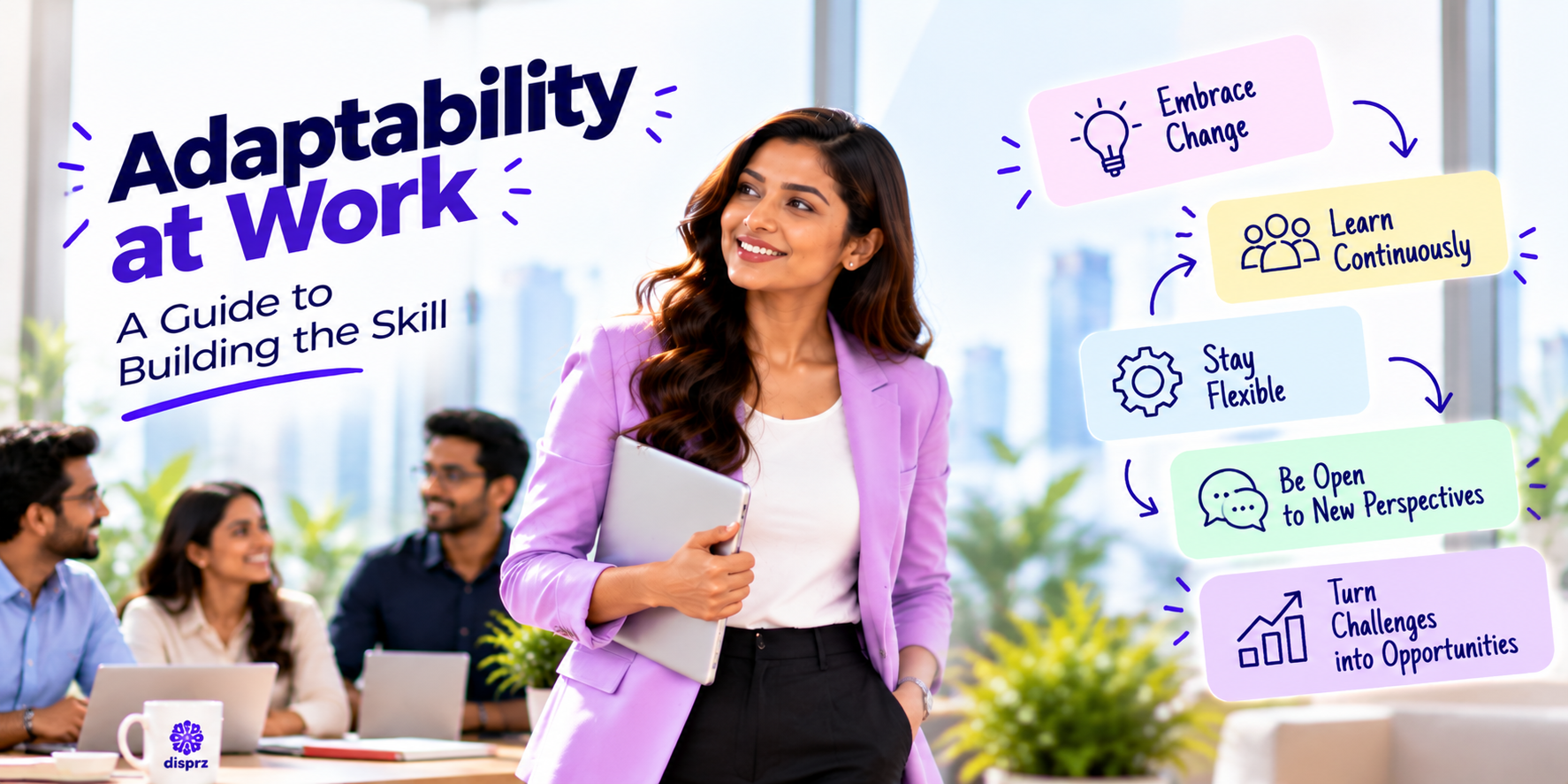
- Five behaviours: openness to change, learning agility, resilience, flexibility, and curiosity.
- Why it matters: the World Economic Forum names resilience and flexibility among the fastest-rising core skills to 2030.
- It is trainable and measurable: behaviour rubrics and change-scenario assessment make adaptability trackable across a workforce.
The business case for adaptability
Every enterprise now reorganises, adopts new tools, and shifts priorities faster than it trains people to cope with it. When a workforce cannot adapt, the cost is not abstract: a system rollout stalls because teams cling to the old way, a restructure loses good people who felt blindsided, and a market shift catches a business flat-footed. That gap is an adaptability gap, and it is one of the most expensive to leave open because it slows down every other change you try to make.
The good news for an L&D team: adaptability is not a fixed trait you either hire or miss. It is a set of behaviours you can define, train, and measure across a workforce. This guide shows how.
What is adaptability?
Adaptability is the ability to adjust how you think, feel, and act when circumstances change, without losing effectiveness. At work it shows up as picking up a new tool quickly, staying composed through a reorganisation, changing an approach when the plan no longer fits, and treating a shift in priorities as a problem to solve rather than a threat to resist.
Adaptability is distinct from raw intelligence or technical skill. A person can be highly capable in a stable role and still struggle the moment the ground moves, which is why it is trained separately and deliberately. It is a core soft skill and it underpins several others, including emotional intelligence and critical thinking.
What are the dimensions and behaviours of adaptability?
Adaptability is easiest to train when you split it into where it happens and what it looks like. It operates across three dimensions, and it shows up as five observable behaviours. Use the behaviours as the competencies you assess and train against, rather than treating adaptability as one vague quality.
| Dimension | What it is | Observable behaviour at work |
|---|---|---|
| Cognitive | Rethinking assumptions and switching mental gears | Revising a plan when new information lands, without digging in |
| Emotional | Staying steady and constructive through uncertainty | Keeping composure and morale during a reorganisation |
| Behavioural | Actually acting differently once things change | Adopting a new process or tool instead of working around it |
Across those three dimensions, adaptability shows up as five behaviours. These are the ones to name, assess, and coach.
- Openness to change: treating a change in plan or priority as workable rather than a personal setback.
- Learning agility: picking up new tools, roles, and ways of working quickly and applying them.
- Resilience: recovering after a setback and staying effective under sustained pressure.
- Flexibility: adjusting your approach, method, or role as the situation demands.
- Curiosity: actively seeking new information, perspectives, and better ways of doing things.
On the labels. Different models use different words for these behaviours, but the five above map cleanly to the three dimensions and to how the SERP and hiring managers describe adaptability. Train against the behaviours, not the vocabulary.
Why adaptability matters, by industry
Adaptability pays off differently across the Disprz ICP. Naming the payoff in each sector is how you get a training budget approved.
| Industry | Pain when adaptability is low | Payoff when adaptability is trained |
|---|---|---|
| BFSI | New regulation and digital tools stall on the frontline | Faster adoption of compliant processes and platforms |
| Retail & ecommerce | Teams freeze when demand, channels, or formats shift | Quicker pivots through peaks and new store models |
| Food services & hospitality | Menu, brand, or process changes break service quality | Smooth rollouts with consistent guest experience |
| Manufacturing & automotive | New lines and equipment slow proficiency and safety | Shorter ramp-up and steadier crews through change |
| Pharma & healthcare | Protocol and system changes meet resistance and error | Faster, safer uptake of updated procedures |
| IT & ITeS | Talent resists new stacks, methods, and client models | Teams reskill quickly and absorb new delivery models |
What the research says about adaptability and training
Three independent findings make the enterprise case for training adaptability, not just hiring for it.
Demand: a fast-rising core skill
The World Economic Forum's Future of Jobs Report 2025 names resilience, flexibility, and agility among the core skills rising fastest in importance to 2030, alongside curiosity and lifelong learning, all of them behaviours inside adaptability. The same report projects that 39% of workers' core skills will change by 2030 and that 59% of the global workforce will need reskilling or upskilling, which is precisely the churn adaptability exists to absorb.
Performance: it shows up across a workforce
The Skills Impact evidence points the same way inside real deployments. Across 23 Disprz enterprise deployments, learning programmes reached a median 92% course completion and 88% platform adoption, with documented outcomes including a 10% skills improvement and 15% business growth. High adoption of new learning is adaptability in aggregate: it is a workforce absorbing change rather than resisting it. See the full, sourced Disprz Skills Impact dataset.
Trainability: human skills respond to well-designed training
This is the finding that matters most for L&D. Adaptability's emotional dimension, resilience and composure under change, overlaps closely with emotional intelligence, where the training evidence is strong. A meta-analysis by Mattingly and Kraiger (2019), covering dozens of studies, found a moderate positive effect of training on these human skills, robust across participant gender, study location, and study design. An earlier meta-analysis by Hodzic and colleagues (2018) reached the same conclusion and found that ability-based programmes, which teach and practise specific behaviours, outperform generic awareness sessions.
Design implication. The evidence favours structured, practice-based programmes over one-off workshops, which is exactly why the eight-week rollout below builds in practice against real change events, coaching, and reinforcement.
What good and poor adaptability look like at work
The difference is always visible in behaviour, which is what makes it trainable and assessable.
| Situation | Low adaptability response | High adaptability response |
|---|---|---|
| A new system replaces the old one | Works around it, waits it out | Learns it early, helps peers adopt |
| Priorities change mid-project | Resists, defends the original plan | Re-plans quickly, keeps the goal in view |
| A restructure is announced | Spreads anxiety, disengages | Stays steady, asks what to focus on now |
| A method stops working | Keeps repeating it, blames tools | Tries a different approach, tests it fast |
Adapting adaptability by role
Adaptability looks different at each level, so training has to be tailored, not one generic workshop. Here is the behaviour shift to coach for each audience.
Individual contributors and junior staff
Focus on learning agility and openness: picking up a new tool without waiting to be pushed, asking what has changed rather than assuming, and trying a new method before declaring it does not work. For client-facing juniors, add reading when a customer's situation has shifted and adjusting the offer.
Managers leading a team
Focus on emotional and behavioural adaptability: absorbing a change and translating it into a clear, calm plan for the team, reallocating work as priorities move, and protecting momentum when the target shifts. A manager sets the team's tolerance for change by how they handle it themselves.
Senior leadership (managing up)
Focus on cognitive adaptability and signalling: changing a position when the evidence changes without looking rudderless, and framing a shift as a decision with a rationale rather than a reversal. A junior briefing leadership on a change should lead with the impact and the proposed response; the same person reassuring a team should lead with stability and what stays the same. That deliberate shift is adaptability in action.
Customer and client-facing (frontline)
Focus on flexibility and resilience in the moment: adjusting to a changed policy, product, or process mid-shift and still delivering a consistent experience. This is where frontline enablement and short mobile practice matter most, because the change is live and there is no time to retrain off the floor.
How do you improve adaptability?
- Reframe change as a problem to solve: replace "why is this happening" with "what does this now ask of me". The reframe is the first behaviour to drill.
- Deliberate discomfort reps: take on one unfamiliar task each week. Adaptability grows from repeated small stretches, not big leaps.
- Learn one new tool on a cadence: a fixed rhythm of adopting something new builds learning agility into a habit.
- Run pre-mortems: ask "if the plan changed tomorrow, what would we do?" so the team rehearses the pivot before it is needed.
- Scenario and change drills: practise responding to a realistic change in a safe setting, then debrief the response.
- Name the fixed and the flexible: separate what genuinely cannot move from what is habit. Most resistance is habit dressed as constraint.
- Build recovery routines: a short, practised reset after a setback protects resilience and shortens the dip.
- Seek disconfirming input: actively ask for the view that would change your mind. Curiosity is trainable when you make it a rule.
- Model it visibly: leaders who say "I have changed my view on this, and here is why" give the team permission to adapt too.
Quick adaptability self-check
Rate each statement from 1 (rarely true) to 5 (almost always true). It is a directional prompt, not a clinical test, but it shows which of the five behaviours to prioritise.
- I welcome changes to plans and priorities rather than resisting them.
- I pick up new tools and ways of working quickly.
- I recover and stay effective after a setback.
- I adjust my approach when the situation shifts.
- I actively seek out new information and different viewpoints.
How do you measure adaptability?
Adaptability feels intangible only until you tie it to behaviour and outcomes. Measure it on three levels.
- Behaviour rubric: score the five behaviours against observable indicators, before and after a real change event.
- 360 feedback: manager, peer, and direct-report ratings, since adaptability is judged by how you show up when things move.
- Change-scenario assessment: responses to realistic change situations, scored against a model answer.
- Business signals: track the metrics adaptability moves, such as time to proficiency on new tools, adoption rate of new processes, and speed of response to a shift.
Benchmark to hold. Do not report a single "adaptability score". Report movement on specific behaviours by role and team, so you can see where coaching is working and where it is not.
Assessments and instruments
Recognised instruments for the components of adaptability include the I-ADAPT-M adaptability measure (Ployhart and Bliese), learning-agility assessments from established publishers, and validated resilience scales such as the Connor-Davidson Resilience Scale. For any decision that affects a person, use a validated instrument from a recognised publisher, not an ad hoc quiz.
On the self-check above. The five-statement prompt earlier in this guide is directional, useful for a quick prioritisation, not a substitute for a validated assessment when you are making development or hiring decisions.
How long does it take to build adaptability?
Set realistic expectations with sponsors so the programme is not judged too early.
- Awareness: 2 to 4 weeks with assessment and a first workshop.
- New habits: 1 to 3 months of applied practice and coaching against real change.
- Visible team change: 3 to 6 months as behaviours stick through actual shifts.
- Measurable business impact: 6 to 12 months on time to proficiency and adoption.
Turn adaptability into a training programme
A single workshop rarely changes behaviour. Run adaptability as a structured programme with practice and reinforcement built in. This eight-week rollout works across desk and frontline teams.
| Week | Focus | Activity |
|---|---|---|
| 1 | Baseline | Self and 360 assessment, set behaviour goals by role |
| 2 | Openness to change | Microlearning + reframing drills on a real change |
| 3 | Learning agility | Learn one new tool on a timer, apply it in work |
| 4 | Resilience | Recovery routines, setback debrief, manager 1:1 |
| 5 | Flexibility | Change-scenario role-play, adjust-the-plan practice |
| 6 | Apply | Real change challenge, AI coaching on the response |
| 7 | Reinforce | Nudges, peer review, manager check-in |
| 8 | Re-measure | Repeat rubric and 360, report movement |
Tools and enablers
Match a tool to each stage rather than buying one and hoping.
- Assessment: adaptability rubrics and 360 tools for baseline and re-measure.
- Delivery: an LMS for structured paths and mobile microlearning.
- Discovery: an LXP with skills intelligence to map adaptability behaviours to roles.
- Practice: change-scenario and role-play, delivered on mobile for frontline.
- Coaching: an AI coach that gives feedback on how people respond to real change.
- Analytics: dashboards that report behaviour movement by team.
Results at scale
Behaviour change shows up in numbers when the programme is run properly and reinforced. These are outcomes enterprises have seen running skills programmes on Disprz.
Across 47 Disprz enterprise deployments, learning programmes reached a median 88% course completion and 85% platform adoption, with documented outcomes including a 10% skills improvement and 15% business growth. See the full, sourced Disprz Skills Impact dataset.
Customer story: Piramal Finance. The financial services leader modernised L&D for its 10,000+ employees across India on Disprz, cutting onboarding time by 50% and driving a 60% surge in learner adoption. Faster onboarding and a jump in adoption are adaptability in practice: a large, distributed frontline absorbing new ways of working rather than resisting them. Read the Piramal Finance case study.
How Disprz helps you build adaptability at scale
The hard part of adaptability training is not the content, it is running it across thousands of people, in many roles and languages, and proving it changed behaviour. Disprz brings the LMS, LXP and skills intelligence, and frontline enablement into one platform so each stage of the programme lives in one place.
| Programme stage | What Disprz does | Outcome you can show |
|---|---|---|
| Map | Skills intelligence links the five adaptability behaviours to each role and surfaces the gap | A baseline by role, team, and region |
| Build | Turo converts your playbooks and change SOPs into microlearning and scenarios | A curriculum stood up in days, not a quarter |
| Deliver | Mobile-first delivery, online and offline, for desk and frontline alike | Reach that includes the frontline, not just HQ |
| Practice | Change-scenario and role-play modules for real situations | The pivot rehearsed before it is needed |
| Coach | AI coaching gives feedback on real change responses | Coaching at a scale managers cannot cover alone |
| Reinforce | Nudges, spaced reminders, and manager check-ins in the flow of work | Habits that survive past the workshop |
| Measure | Behaviour rubrics, 360 feedback, and progression analytics | Movement on behaviour, tied to adoption and time to proficiency |
Because the five adaptability behaviours are mapped as skills, not just course completions, you can prove progression rather than attendance. That is the difference between a training line item and a capability you can report to the board.
- Role-to-behaviour mapping for the five adaptability behaviours
- Microlearning and change-scenario practice on mobile, including offline
- AI coaching feedback on real change responses
- Behaviour rubrics and 360 assessment built in
- Nudges and reinforcement in the flow of work
- Progression analytics by role, team, and region
Turo, the agentic authoring layer, converts your existing playbooks and change SOPs into microlearning 80% to 90% faster than manual builds, so an adaptability curriculum does not take a quarter to stand up. Enterprises running skills programmes on Disprz sustain 45%+ frontline completion against an industry average below 30%, which is what makes a soft-skills rollout actually finish.
Where to start. Pick one role and the two adaptability behaviours that hurt most, map them in skills intelligence, and run the eight-week programme above as a pilot. Prove the movement, then scale it across the workforce.
Key takeaways
- Adaptability is trainable and measurable, not a fixed personality trait.
- Train against the three dimensions and the five behaviours, not a vague quality.
- Tailor the training by role: learning agility for juniors, calm re-planning for managers, decisive change signalling for leaders, in-the-moment flexibility for frontline.
- Measure with behaviour rubrics and 360 feedback, and tie it to time to proficiency, adoption, and speed of response.
- Run it as an eight-week programme with practice against real change and reinforcement, not a one-off workshop.
Where should you start?
Adaptability is the human layer that decides whether every other change your business makes lands or stalls. For an enterprise, the win is not a single workshop but a repeatable programme that defines the behaviours, trains and reinforces them by role, and proves the change. Start with the two behaviours that hurt most in your context, make them observable, and build from there.
Reviewed for accuracy on 22 Sep 2026.
Adaptability FAQs
The questions L&D and people leaders ask most often.
What are adaptability skills?
Adaptability skills are the behaviours that let a person adjust when things change: openness to change, learning agility, resilience, flexibility, and curiosity. They work across three dimensions, cognitive, emotional, and behavioural, and they can be defined, trained, and measured.
What are examples of adaptability in the workplace?
Learning a new system early and helping peers adopt it, re-planning quickly when priorities change mid-project, staying steady and focused through a restructure, and switching to a different method when the current one stops working.
How do you improve adaptability?
Reframe change as a problem to solve, take on one unfamiliar task on a regular cadence, learn a new tool on a rhythm, practise responding to change scenarios, build a recovery routine for setbacks, and actively seek input that could change your mind. Deliberate, repeated practice beats a one-off workshop.
Why is adaptability important at work?
Because change is constant. The World Economic Forum projects that 39% of core skills will change by 2030 and names resilience, flexibility, and agility among the fastest-rising skills. Adaptability is what lets a workforce absorb new tools, processes, and priorities instead of stalling under them.
What are the three dimensions of adaptability?
Cognitive adaptability (rethinking assumptions and switching mental gears), emotional adaptability (staying steady and constructive through uncertainty), and behavioural adaptability (actually acting differently once conditions change).
How do you measure adaptability in a workforce?
Through behaviour rubrics scored against the five behaviours, 360 feedback from managers and peers, change-scenario assessments, and the business metrics adaptability moves, such as time to proficiency on new tools, adoption of new processes, and speed of response to a shift.
Sources
- Disprz. Disprz Skills Impact Dataset, 2026. First-party learning and skills outcomes from 47 enterprise deployments. disprz.ai/skills-impact
- World Economic Forum. Future of Jobs Report 2025. January 2025. weforum.org
- Mattingly, V. and Kraiger, K. Can emotional intelligence be trained? A meta-analytical investigation. Human Resource Management Review, 29(2), 2019.
- Hodzic, S., Scharfen, J., Ripoll, P., Holling, H. and Zenasni, F. How efficient are emotional intelligence trainings: A meta-analysis. Emotion Review, 10(2), 2018.
- Disprz master value benchmarks (8X ROI, 50% productivity, 7X CSAT) and frontline completion data, 2026. Aggregated enterprise deployment data.