

On this page
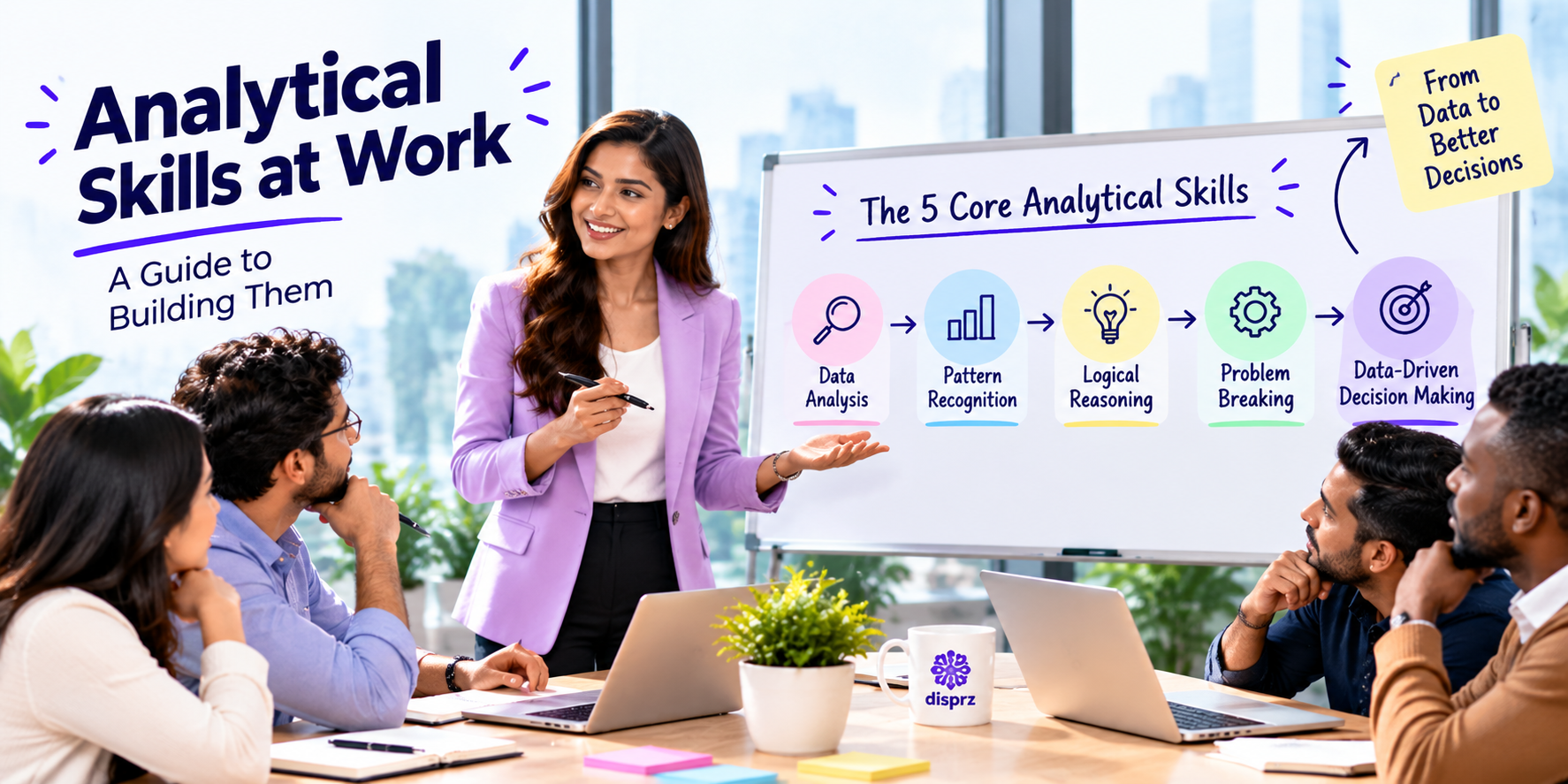
Analytical skills are the ability to gather information, break a problem down, reason through the evidence, and reach a sound, defensible conclusion. They rest on five core competencies: data literacy, critical thinking, research, attention to detail, and problem-solving. For an enterprise, analytical skills are trainable and measurable: define the observable behaviour, deliver it in short applied bursts against real work, coach the reasoning, and track it through work-sample assessment and the business metrics it moves, such as decision quality, error rates, and cycle time.
Key highlights
- Definition: Analytical skills are gathering, interpreting, and reasoning through information to reach a sound conclusion.
- Five core skills: data literacy, critical thinking, research, attention to detail, and problem-solving.
- Why it matters: the World Economic Forum names analytical thinking the number one core skill for 2025, and it drives decision quality, fewer errors, and faster cycle times.
- It is trainable: analytical skills respond to structured practice, feedback, and coaching, not just aptitude.
- It is measurable: work-sample tasks, reasoning rubrics, and scenario assessment make analytical skills trackable across a workforce.
The business case for analytical skills
Most enterprises now have more data, more dashboards, and more tools than ever, and still make slow or poor decisions. A team pulls a report but reads it wrong, a manager acts on a correlation as if it were a cause, or a frontline lead misses the one detail that mattered. That gap is an analytical skills gap, and it is expensive because it shows up in bad calls, rework, and missed opportunities that no amount of extra tooling fixes.
The good news for an L&D team: analytical skill is not a fixed aptitude. It is a set of behaviours you can define, train, and measure across a workforce. This guide shows how.
What are analytical skills?
Analytical skills are the ability to gather information, break a problem into its parts, reason through the evidence, and reach a sound, defensible conclusion. At work they show up as reading data correctly, questioning assumptions before acting, spotting the detail that changes the answer, and turning a messy situation into a clear next step.
Analytical skills are distinct from raw intelligence or technical tool knowledge. A person can know a spreadsheet or BI tool inside out and still draw the wrong conclusion from it, which is why analytical skills are trained separately and deliberately. They are a core soft skill and underpin several others, including critical thinking and problem-solving.
What are the five core analytical skills?
Analytical ability is easiest to train when you treat it as five distinct competencies rather than one vague quality. Use these as the competencies you assess and train against.
| Skill | What it is | Observable behaviour at work |
|---|---|---|
| Data literacy | Reading and interpreting numbers correctly | Choosing the right metric and spotting a misleading chart |
| Critical thinking | Questioning assumptions and testing logic | Asking what evidence would change the conclusion |
| Research | Finding and evaluating relevant information | Sourcing evidence and judging whether it is reliable |
| Attention to detail | Noticing the small facts that change the answer | Catching the exception others skip over |
| Problem-solving | Turning analysis into a workable decision | Framing options and choosing a defensible path |
On the naming. Other lists relabel or split these skills, but the five competencies above cover the analytical cycle from input to decision. Train against the behaviours, not the label.
Why analytical skills matter, by industry
Analytical skills pay off differently across the Disprz ICP. Naming the payoff in each sector is how you get a training budget approved.
| Industry | Pain when analytical skills are low | Payoff when they are trained |
|---|---|---|
| BFSI | Risk and fraud signals misread, decisions made on the wrong metric | Sharper risk calls, cleaner compliance judgement |
| Retail & ecommerce | Merchandising and pricing set on gut, not on demand data | Data-led assortment and pricing, less dead stock |
| Food services & hospitality | Demand and wastage patterns missed shift to shift | Better forecasting, lower wastage and cost |
| Manufacturing & automotive | Root causes of defects guessed at, not diagnosed | Faster root-cause analysis, fewer repeat defects |
| Pharma & healthcare | Reports and study data misinterpreted in high-stakes work | Sounder evidence review, safer decisions |
| IT & ITeS | Teams react to symptoms instead of diagnosing the real issue | Better problem diagnosis, less firefighting |
What the research says about analytical skills and training
Three independent findings make the enterprise case for training analytical skills, not just hiring for them.
Demand: the number one core skill for 2025
The World Economic Forum's Future of Jobs Report 2025 ranks analytical thinking as the number one core skill employers prioritise, ahead of resilience, flexibility, and leadership. The same report projects that 39% of workers' core skills will change by 2030 and that 59% of the global workforce will need reskilling or upskilling, which puts analytical capability firmly at the top of the training agenda.
Trainability: structured training produces a measurable effect
This is the finding that matters most for L&D. Meta-analyses of structured soft-skills training, including Mattingly and Kraiger (2019) and Hodzic and colleagues (2018), found a moderate positive effect of training on the human skills studied, robust across participant gender, study location, and design. Both reviews reached the same practical conclusion: ability-based programmes that teach and practise specific behaviours outperform generic awareness sessions. The principle transfers directly to analytical skills, which are behavioural and practised, not innate.
Design implication. The evidence favours structured, practice-based programmes over one-off workshops, which is exactly why the eight-week rollout below builds in practice, coaching, and reinforcement.
First-party evidence: outcomes across 23 deployments
Across 47 Disprz enterprise deployments, learning programmes reached a median 92% course completion and 88% platform adoption, with documented outcomes including a 10% skills improvement and 15% business growth. See the full, sourced Disprz Skills Impact dataset.
What good and poor analytical skills look like at work
The difference is always visible in behaviour, which is what makes it trainable and assessable.
| Situation | Weak analytical response | Strong analytical response |
|---|---|---|
| Sales dip in a report | Reacts to the headline number | Segments the data to find the real driver |
| A vendor claim in a proposal | Takes the figure at face value | Checks the source and the assumptions behind it |
| A recurring defect | Fixes the symptom each time | Runs a root-cause analysis and removes it |
| Two options on the table | Picks the louder opinion | Compares against clear criteria and evidence |
Adapting analytical skills by role
Analytical skill looks different at each level, so training has to be tailored, not one generic workshop. Here is the behaviour shift to coach for each audience.
Individual contributors and junior staff
Focus on data literacy and attention to detail: choosing the right metric, reading a chart without being misled, and catching the exception before it ships. For client-facing juniors, add checking a figure before it goes into a customer-facing answer.
Managers leading a team
Focus on critical thinking and problem-solving: pressure-testing a team's conclusion, asking what evidence would change it, and framing options against clear criteria rather than the loudest voice in the room.
Senior leadership (managing up)
Focus on synthesis and defensible reasoning: leading with the conclusion, showing the evidence behind it, and naming the assumptions and risks. A junior briefing an executive should present the answer and the two numbers that support it; the same person exploring a problem with peers should show the working. That deliberate shift is analytical skill in action.
Customer and client-facing (frontline)
Focus on quick diagnosis under pressure: reading the real problem behind what a customer reports, checking the detail that changes the fix, and choosing a defensible next step fast. This is where frontline enablement and short mobile practice matter most, because the moment is live and there is no time to run a full analysis.
How do you improve analytical skills?
- Start from the question, not the data: write the decision you are trying to make before you open the report. It stops analysis drifting into noise.
- Ask "so what?" three times: push each finding to its consequence until it points at an action. It separates a fact from an insight.
- Name your assumptions: list what you are taking for granted, then ask which one, if wrong, breaks the conclusion.
- Segment before you conclude: a total hides the story. Break it by segment, time, or cohort before deciding what it means.
- Check the source: before trusting a number, ask where it came from, how it was measured, and who benefits if it is believed.
- Run a five-why on defects: for any recurring problem, ask why five times to reach the root cause instead of the symptom.
- Write the one-page argument: conclusion, evidence, assumptions, risks. Forcing it onto a page exposes weak reasoning.
- Practise on real work: use live reports and decisions in coaching, not abstract puzzles. Analytical skill transfers when it is trained in context.
Quick analytical skills self-check
Rate each statement from 1 (rarely true) to 5 (almost always true). It is a directional prompt, not a validated test, but it shows which of the five core skills to prioritise.
- I choose the right metric and read a chart without being misled.
- I question assumptions before I act on a conclusion.
- I find relevant information and judge whether the source is reliable.
- I notice the small detail or exception that changes the answer.
- I turn my analysis into a clear, defensible decision.
How do you measure analytical skills?
Analytical skills feel intangible only until you tie them to behaviour and outcomes. Measure them on three levels.
- Work-sample tasks: give a realistic dataset or problem and score the reasoning, not just the answer, before and after training.
- Reasoning rubric: score the five core skills against observable behaviours, so you can see which competency is weak.
- Scenario assessment: responses to realistic situations, scored against a model line of reasoning.
- Business signals: track the metrics analytical skill moves, such as decision quality, error and rework rates, cycle time, and forecast accuracy.
Benchmark to hold. Do not report a single "analytical score". Report movement on specific behaviours by role and team, so you can see where coaching is working and where it is not.
How long does it take to build analytical skills?
Set realistic expectations with sponsors so the programme is not judged too early.
- Awareness: 2 to 4 weeks with assessment and a first workshop.
- New habits: 1 to 3 months of applied practice and coaching.
- Visible team change: 3 to 6 months as behaviours stick.
- Measurable business impact: 6 to 12 months on decision quality and error rates.
Turn analytical skills into a training programme
A single workshop rarely changes behaviour. Run analytical skills as a structured programme with practice and reinforcement built in. This eight-week rollout works across desk and frontline teams.
| Week | Focus | Activity |
|---|---|---|
| 1 | Baseline | Work-sample assessment, set behaviour goals by role |
| 2 | Data literacy | Microlearning on metrics and charts, misleading-data drills |
| 3 | Critical thinking | Assumption mapping, question-the-conclusion practice |
| 4 | Research | Source evaluation, finding and judging evidence |
| 5 | Attention to detail | Error-spotting and exception-catching exercises |
| 6 | Problem-solving | Root-cause and options-framing on real work, AI coaching |
| 7 | Reinforce | Nudges, peer review, manager check-in |
| 8 | Re-measure | Repeat work-sample and rubric, report movement |
Tools and enablers
Match a tool to each stage rather than buying one and hoping.
- Assessment: work-sample tasks and reasoning rubrics for baseline and re-measure.
- Delivery: an LMS for structured paths and mobile microlearning.
- Discovery: an LXP with skills intelligence to map analytical behaviours to roles.
- Practice: scenario and case exercises on real data, delivered on mobile for frontline.
- Coaching: an AI coach that gives feedback on the reasoning behind real decisions.
- Analytics: dashboards that report behaviour movement by team.
Results at scale
Behaviour change shows up in numbers when the programme is run properly and reinforced. These are outcomes enterprises have seen running skills programmes on Disprz.
Across 47 Disprz enterprise deployments, learning programmes reached a median 88% course completion and 85% platform adoption, with documented outcomes including a 10% skills improvement and 15% business growth. See the full, sourced Disprz Skills Impact dataset.
Customer story: Department of Finance, Abu Dhabi. The financial-services government entity, with 500+ employees, ran a skills programme on Disprz and improved workforce skills by 10% in a few quarters while sustaining 92%+ engagement. It shows what a skills-first programme, the kind an analytical-skills rollout sits inside, delivers at scale. Read the Department of Finance case study.
How Disprz helps you build analytical skills at scale
The hard part of analytical-skills training is not the content, it is running it across thousands of people, in many roles and languages, and proving it changed behaviour. Disprz brings the LMS, LXP and skills intelligence, and frontline enablement into one platform so each stage of the programme lives in one place.
| Programme stage | What Disprz does | Outcome you can show |
|---|---|---|
| Map | Skills intelligence links the five core analytical skills to each role and surfaces the gap | A baseline by role, team, and region |
| Build | Turo converts your reports, cases, and SOPs into analytical microlearning and scenarios | A curriculum stood up in days, not a quarter |
| Deliver | Mobile-first delivery, online and offline, for desk and frontline alike | Reach that includes the frontline, not just HQ |
| Practice | Work-sample and case modules on real data | Reasoning rehearsed before it is needed |
| Coach | AI coaching gives feedback on the reasoning behind real decisions | Coaching at a scale managers cannot cover alone |
| Reinforce | Nudges, spaced reminders, and manager check-ins in the flow of work | Habits that survive past the workshop |
| Measure | Reasoning rubrics, work-sample scoring, and progression analytics | Movement on behaviour, tied to decision quality and error rates |
Because the five analytical skills are mapped as skills, not just course completions, you can prove progression rather than attendance. That is the difference between a training line item and a capability you can report to the board.
- Role-to-behaviour mapping for the five core analytical skills
- Microlearning and case practice on mobile, including offline
- AI coaching feedback on the reasoning behind real decisions
- Reasoning rubrics and work-sample scoring built in
- Nudges and reinforcement in the flow of work
- Progression analytics by role, team, and region
Turo, the agentic authoring layer, converts your existing reports and SOPs into microlearning 80% to 90% faster than manual builds, so an analytical-skills curriculum does not take a quarter to stand up. Enterprises running skills programmes on Disprz sustain 45%+ frontline completion against an industry average below 30%, which is what makes a soft-skills rollout actually finish, and report outcomes up to 8X ROI on their learning investment.
Where to start. Pick one role and the two analytical skills that hurt most, map them in skills intelligence, and run the eight-week programme above as a pilot. Prove the movement, then scale it across the workforce.
Key takeaways
- Analytical skills are trainable and measurable, not a fixed aptitude.
- Train against the five core skills and their observable behaviours, not a vague quality.
- Tailor the training by role: data literacy and detail for juniors, critical thinking for managers, defensible synthesis for leaders, quick diagnosis for frontline.
- Measure with work-sample tasks and reasoning rubrics, and tie it to decision quality, error rates, and cycle time.
- Run it as an eight-week programme with practice and reinforcement, not a one-off workshop.
Where should you start?
Analytical skill is the layer that decides whether your data and tools turn into good decisions. For an enterprise, the win is not a single workshop but a repeatable programme that defines the behaviours, trains and reinforces them by role, and proves the change. Start with the two core skills that hurt most in your context, make them observable, and build from there.
Reviewed for accuracy on 22 Sep 2026.
Analytical skills FAQs
The questions L&D and people leaders ask most often.
What are analytical skills?
Analytical skills are the ability to gather information, break a problem into its parts, reason through the evidence, and reach a sound, defensible conclusion. At work they cover data literacy, critical thinking, research, attention to detail, and problem-solving.
What are examples of analytical skills?
Choosing the right metric and reading a chart without being misled, questioning an assumption before acting, checking whether a source is reliable, catching the exception others skip, running a root-cause analysis, and framing options against clear criteria.
How do you improve analytical skills?
Start from the decision, not the data, name your assumptions, segment before you conclude, check every source, run a five-why on recurring problems, and practise on real work with feedback. Analytical skill improves fastest with structured, practice-based coaching rather than a single workshop.
Why are analytical skills important?
The World Economic Forum ranks analytical thinking as the number one core skill for 2025. As more data and tools reach every role, the skill that turns them into sound decisions becomes more valuable, driving decision quality, fewer errors, and faster cycle times.
How do you measure analytical skills in a workforce?
Through work-sample tasks that score the reasoning, reasoning rubrics scored against the five core skills, scenario assessments, and the business metrics analytical skill moves, such as decision quality, error and rework rates, cycle time, and forecast accuracy.
Can analytical skills be trained?
Yes. Meta-analyses of structured soft-skills training find a moderate positive effect, and ability-based programmes that teach and practise specific behaviours outperform generic awareness sessions. Define the observable behaviour, deliver short applied practice, coach the reasoning, and re-measure.
Sources
- Disprz. Disprz Skills Impact Dataset, 2026. First-party learning and skills outcomes from 47 enterprise deployments. disprz.ai/skills-impact
- World Economic Forum. Future of Jobs Report 2025 (analytical thinking ranked the number one core skill). January 2025. weforum.org
- Mattingly, V. and Kraiger, K. Can emotional intelligence be trained? A meta-analytical investigation. Human Resource Management Review, 29(2), 2019. Evidence that structured soft-skills training produces a moderate positive effect.
- Hodzic, S., Scharfen, J., Ripoll, P., Holling, H. and Zenasni, F. How efficient are emotional intelligence trainings: A meta-analysis. Emotion Review, 10(2), 2018. Ability-based programmes outperform generic awareness sessions.
- Disprz master value benchmarks (8X ROI, 50% productivity, 7X CSAT, Turo 80-90% faster) and frontline completion data, 2026. Aggregated enterprise deployment data.