

On this page
Banking employee training is very different from training in most other industries. Banks must continuously train employees on compliance, regulations, product updates, cybersecurity, customer service, and digital banking processes. A single compliance failure can lead to regulatory penalties, financial losses, and reputational damage.
At the same time, banks must train employees across large branch networks, regional offices, contact centers, and digital channels. This makes mobile learning, certification tracking, and audit-ready reporting essential.
The best banking LMS platforms help banks manage compliance training, workforce upskilling, onboarding, and role-based learning from a single platform. In this guide, we compare the best LMS for banking, including solutions built for compliance management, frontline employee training, AI-powered skill development, and large-scale banking workforce training.
What Makes Employee Training in Banking Unique?
Banking is one of the most regulated and rapidly changing industries. Employee training must cover compliance, operations, customer service, digital banking, and risk management. Unlike traditional corporate training, banks must also prove that training happened, who completed it, and when certifications were renewed.
Regulatory and compliance requirements
Public and private sector banks operate under strict regulatory frameworks. Training programs often include:
- Anti-Money Laundering (AML)
- Know Your Customer (KYC)
- RBI compliance requirements
- SEBI regulations
- PCI DSS security standards
- GDPR for international operations
- FINRA and SEC requirements for global financial institutions
A strong LMS for banking & financial services should track completions, certifications, assessments, and renewal dates automatically.
Large distributed branch networks
Many banks have employees spread across hundreds or thousands of branches. Training must reach frontline banking employees, relationship managers, operations staff, and regional teams consistently. Mobile access and multilingual learning become critical for regional and branch workforce training.
Continuous onboarding and certification
Banking organizations hire regularly and launch new products frequently. Employees need ongoing onboarding, refresher courses, and mandatory certifications. A banking learning management system should support recurring training schedules and automated reminders.
Role-based learning requirements
Training needs vary by role. For example:
| Role | Typical Training Needs |
|---|---|
| Relationship Managers | Sales, wealth products, compliance |
| Branch Operations Staff | KYC, AML, transaction procedures |
| Contact Center Teams | Customer service, fraud prevention |
| Credit and Risk Teams | Risk policies, regulatory updates |
| Insurance Advisors | Product knowledge, certification programs |
The best banking LMS platforms provide role-based learning paths and certifications.
Audit readiness and documentation
During internal audits or regulatory inspections, banks must demonstrate training compliance. This requires detailed records of enrollments, completions, assessment scores, certification validity, and employee acknowledgments. Audit-ready reporting is a key feature of any financial services LMS.
Regulatory complexity varies by geography
Banking regulations differ significantly across regions, making compliance training more complex for institutions operating across multiple markets. For example, banks in India must comply with RBI guidelines and sector-specific regulations, while global financial institutions may need to support frameworks such as FINRA, SEC, FCA, and MiFID II.
Training requirements, certification cycles, reporting standards, and audit expectations can vary from one jurisdiction to another. A banking LMS should provide the flexibility to manage country-specific learning programs, compliance certifications, and regulatory updates while maintaining centralized oversight. This ensures organizations can meet both local and international compliance obligations without increasing administrative burden.
You can also explore the best LMS platforms available in India to compare regional options.
Banking LMS Platforms at a Glance
The best banking LMS platforms help financial institutions manage compliance training, employee onboarding, certification tracking, workforce upskilling, and digital learning at scale. While some platforms focus heavily on compliance and enterprise learning, others specialize in AI-powered skill development, mobile learning, or collaborative training.
The table below provides a quick comparison of the leading banking learning platforms for banks, NBFCs, insurance companies, and other financial services organizations.
| Platform | Best For | Mobile Learning | Compliance Tracking | AI Capabilities | G2 Rating |
|---|---|---|---|---|---|
| Disprz | Frontline banking workforce training and upskilling | Yes | Advanced | Advanced | 4.5 / 5 |
| Cornerstone Learning | Large global banking institutions | Yes | Advanced | Advanced | 4.1 / 5 |
| 360Learning | Collaborative learning and knowledge sharing | Yes | Good | Moderate | 4.6 / 5 |
| LearnUpon | Multi-entity banking groups | Yes | Good | Moderate | 4.5 / 5 |
| Absorb LMS | Enterprise compliance training | Yes | Advanced | Advanced | 4.6 / 5 |
| Litmos | Fast deployment and compliance training | Yes | Good | Moderate | 4.3 / 5 |
| TalentLMS | Small and mid-sized financial institutions | Yes | Good | Basic | 4.6 / 5 |
| Paradiso LMS | Mid-sized banks and flexible integrations | Yes | Good | Moderate | 4.1 / 5 |
| CYPHER Learning | AI-driven personalized learning | Yes | Good | Advanced | 4.4 / 5 |
| MapleLMS | Compliance-focused corporate training | Yes | Good | Moderate | 4.8 / 5 |
| Sana Labs | AI-powered banking workforce development | Yes | Good | Advanced | 4.8 / 5 |
Whether you're evaluating a banking LMS software for a large private bank, a public sector bank, an NBFC, or a digital-first financial institution, this comparison will help you identify the right solution for your training and compliance needs.
How to Choose an LMS for Banking?
Selecting the right LMS for financial services goes beyond standard employee training features. Banks must manage compliance requirements, workforce certification, onboarding, and continuous skill development while ensuring every training activity can be tracked and audited.
Here are the most important factors to evaluate when choosing a banking learning management system.
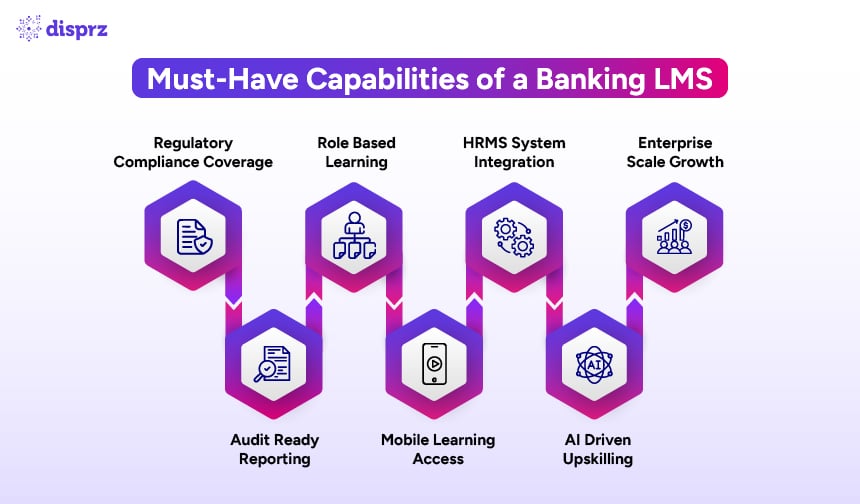
Regulatory Coverage
Regulatory requirements vary across regions and financial sectors, making compliance capabilities a critical consideration when evaluating a banking LMS. Your platform should support training and certification programs aligned with the regulations that apply to your organization.
This may include:
- RBI and SEBI requirements for banks and financial institutions in India
- FINRA, SEC, and MiFID II regulations for global financial services organizations
- AML and KYC training programs
- Cybersecurity and data privacy awareness training
- Industry-specific compliance certifications
A robust compliance training LMS for banks should automate training assignments, reminders, recertification workflows, and audit-ready reporting while adapting to evolving regulatory requirements across multiple jurisdictions.
Audit-Ready Reporting
During audits, banks need immediate access to training records. Manual tracking through spreadsheets can create compliance risks and administrative overhead.
Look for:
- Real-time compliance dashboards
- Certification tracking
- Automated audit reports
- Training completion records
- Assessment and quiz results
- Regulatory training history
- Exportable reports for auditors
Audit-ready reporting is a must-have feature for any modern financial services LMS.
Role-Based Learning Paths
Different banking roles require different learning journeys. A one-size-fits-all approach rarely works.
Your LMS should allow you to create role-specific training paths for:
- Relationship managers
- Branch managers
- Customer service teams
- Credit and risk teams
- Operations staff
- Insurance advisors
- Wealth management professionals
- Compliance officers
Role-based certification ensures employees receive training relevant to their responsibilities.
Mobile Learning for Frontline Employees
Many banking employees spend most of their time serving customers rather than sitting at a desk. Mobile learning helps employees complete training anytime and anywhere.
Look for:
- Mobile apps for iOS and Android
- Offline learning capabilities
- Microlearning modules
- Push notifications and reminders
- Mobile assessments and certifications
- Learning in low-bandwidth environments
Mobile learning for bank employees is especially important for branch networks, field teams, and regional workforce training initiatives.
HRMS Integrations
Training platforms should work seamlessly with existing HR and business systems.
Common integrations include:
- HRMS platforms
- Employee directories
- Performance management systems
- Single Sign-On (SSO)
- Microsoft Teams
- Collaboration tools
- Content libraries
- Compliance management systems
Strong integrations reduce manual administration and improve data accuracy.
AI-Driven Skill Development
Banks are increasingly focusing on workforce upskilling alongside compliance training. AI can help identify skill gaps and recommend personalized learning paths.
Look for capabilities such as:
- AI-powered skill assessments
- Personalized learning recommendations
- Skill gap analysis
- Career path mapping
- Learning content recommendations
- Automated coaching suggestions
AI-powered skill development is becoming a key differentiator among the best banking LMS platforms.
Scalability
Your LMS should support growth without requiring a platform change later.
Consider whether the platform can support:
- Thousands of learners
- Multiple business units
- Regional and branch workforce training
- Multilingual learning programs
- Complex compliance requirements
- Multiple countries and regulatory environments
Scalability is particularly important for large banks, NBFCs, insurance companies, and organizations undergoing digital banking transformation.
Quick Checklist for Banking LMS Evaluation
Before making a decision, ensure your shortlisted platform can:
- Manage compliance and certification training
- Support RBI and SEBI-related learning requirements
- Deliver mobile learning for frontline banking employees
- Provide audit-ready reporting
- Create role-based learning journeys
- Integrate with HRMS and enterprise systems
- Support multilingual learning
- Offer AI-powered workforce upskilling
- Scale across branches, regions, and business units
A platform that checks all these boxes will be better positioned to support both compliance requirements and long-term banking workforce development. You can also checkout the LMS pricing models that suit your institution requirements.
Which LMS Is Best for Different Types of Banks?
Not every bank has the same training requirements. A large global bank may prioritize compliance management and enterprise scalability, while an NBFC may focus on rapid onboarding and sales enablement. Similarly, insurance companies often require certification tracking, and digital banks may place greater emphasis on continuous upskilling and product training.
The table below highlights the platforms that are typically best suited for different types of financial institutions.
| Organization Type | Recommended Platform |
|---|---|
| Retail Banks | Disprz |
| Private Banks | Disprz, Cornerstone Learning |
| NBFCs | Disprz |
| Insurance Companies | Disprz, Absorb LMS |
| Co-operative Banks | TalentLMS |
| Regional Rural Banks | Disprz |
| Large Global Banks | Cornerstone Learning |
| Digital Banks | Sana Labs, Disprz |
| Microfinance Institutions | Disprz |
Retail Banks
Retail banks typically manage large branch networks, frontline customer-facing teams, and frequent compliance training requirements. They need a banking learning platform that combines mobile learning, certification tracking, and workforce upskilling.
Recommended: Disprz
Private Banks
Private sector banks often focus on relationship manager training, wealth management certifications, customer experience, and digital banking initiatives. They require advanced reporting and scalable learning infrastructure.
Recommended: Disprz, Cornerstone Learning
NBFCs
NBFC employee training programs usually involve sales readiness, compliance education, onboarding, and product knowledge training. Mobile-first learning is especially important for distributed field teams.
Recommended: Disprz
Insurance Companies
Insurance organizations need continuous product training, regulatory certification, and agent enablement. Training platforms must support recurring certification programs and compliance reporting.
Recommended: Disprz, Absorb LMS
Co-operative Banks
Co-operative banks often require an affordable and easy-to-deploy LMS with essential compliance tracking and employee training capabilities.
Recommended: TalentLMS
Regional Rural Banks
Regional Rural Banks (RRBs) operate across geographically dispersed locations and often support financial inclusion initiatives. Multilingual learning and mobile access are critical.
Recommended: Disprz
Large Global Banks
Global banking institutions must manage training across multiple countries, business units, and regulatory environments. Enterprise-grade governance and compliance controls become essential.
Recommended: Cornerstone Learning
Digital Banks
Digital-first banks operate in fast-changing environments where employees need continuous learning on products, technology, cybersecurity, and customer experience.
Recommended: Sana Labs, Disprz
Microfinance Institutions
Microfinance organizations often have highly distributed workforces operating across urban and rural markets. Mobile learning and regional language support are key requirements.
Recommended: Disprz
Key Insight
The best LMS for banking depends on your organization's size, regulatory requirements, workforce structure, and digital maturity. While enterprise banks may prioritize governance and compliance, growing financial institutions often benefit more from platforms that combine mobile learning, AI-powered skill development, multilingual learning, and frontline workforce training in a single solution.
Best LMS Platforms for Banking and Financial Services
Choosing the right banking learning management system can help you improve compliance, accelerate onboarding, increase certification completion rates, and support continuous workforce upskilling.
Below, we review the leading banking LMS platforms used by banks, NBFCs, insurance organizations, and other financial services companies.
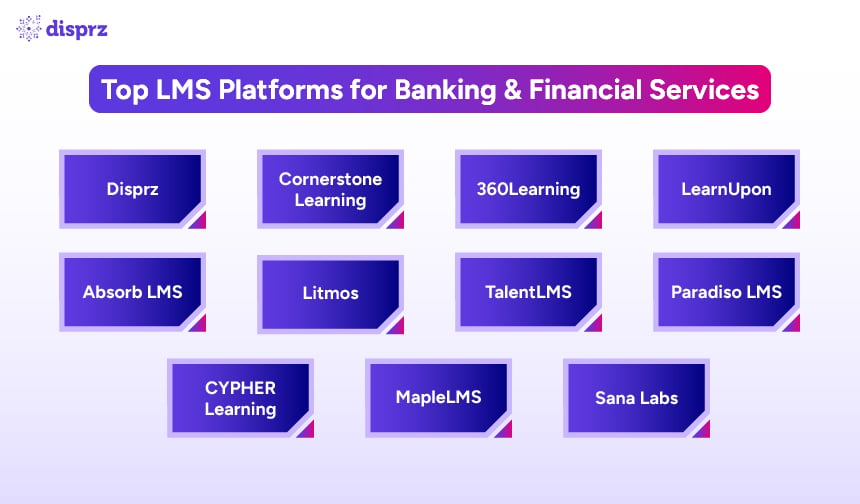
1) Disprz: Best for Frontline Banking Workforces in India, UAE, and Southeast Asia
Overview
Disprz is an AI-powered learning and skilling platform designed for frontline and distributed workforces. It is widely used by banks, NBFCs, insurance companies, and financial services organizations that need to train employees across multiple branches, regions, and business units.
The platform combines learning management, skill development, performance support, and workforce capability building in a single solution. Its mobile-first approach makes it particularly effective for frontline banking employees and regional workforce training.
Key Features
- AI-powered skill development and personalized learning
- Mobile-first learning experience
- Role-based learning journeys
- KYC and AML certification tracking
- Compliance training management
- Multilingual learning support
- Microlearning delivery
- Digital onboarding workflows
- Manager dashboards and coaching tools
- Audit-ready reporting and analytics
Best For
- Retail banks
- Private sector banks
- NBFCs
- Insurance organizations
- Microfinance institutions
- Regional banking networks
Pros
- Built for frontline and distributed workforces
- Strong mobile learning capabilities
- Excellent support for multilingual learning
- AI-powered workforce upskilling
- Supports compliance and certification management
- Suitable for large branch banking workforces
Limitations
- May offer more functionality than required for very small institutions
Integrations
- HRMS platforms
- Microsoft Teams
- Single Sign-On (SSO)
- CRM systems
- Content providers
- Performance management tools
G2 Rating
- 4.5 / 5
2) Cornerstone Learning: Best for Large Global Banking and Financial Institutions
Overview
Cornerstone Learning is one of the most established enterprise learning platforms in the market. It serves large organizations that require extensive compliance management, governance controls, workforce development, and global scalability.
For multinational banks, the platform offers sophisticated reporting, certification management, and enterprise learning capabilities.
Key Features
- Enterprise learning management
- Compliance training administration
- Certification tracking
- Skills intelligence capabilities
- Learning content management
- Global reporting and analytics
- Career development pathways
- Extended enterprise learning
Best For
- Large global banks
- International financial institutions
- Enterprise financial services organizations
Pros
- Strong compliance capabilities
- Highly scalable platform
- Comprehensive reporting tools
- Extensive enterprise functionality
- Global deployment support
Limitations
- Higher complexity compared to mid-market solutions
Integrations
- Workday
- SAP SuccessFactors
- Oracle HCM
- Microsoft ecosystem
- Enterprise HR systems
G2 Rating
- 4.1 / 5
3) 360Learning: Best for Collaborative Learning
Overview
360Learning focuses on collaborative learning and knowledge sharing. It enables subject matter experts to create and distribute learning content quickly, making it useful for banks that frequently update policies, products, and compliance requirements.
Key Features
- Collaborative course creation
- Social learning features
- Knowledge sharing workflows
- Learning analytics
- Mobile learning
- Compliance tracking
- Content authoring tools
Best For
- Banks with strong internal knowledge-sharing cultures
- Financial institutions with frequent policy updates
- Learning teams focused on peer-to-peer learning
Pros
- Fast content creation
- Strong collaboration capabilities
- User-friendly interface
- Good mobile experience
- Active learner engagement tools
Limitations
- Compliance functionality may not be as extensive as some enterprise-focused platforms
Integrations
- Salesforce
- Microsoft Teams
- HR systems
- Content libraries
- Collaboration tools
G2 Rating
- 4.6 / 5
4) LearnUpon: Best for Multi-Entity Banking Groups
Overview
LearnUpon is known for helping organizations manage training across multiple business units, subsidiaries, and partner networks. This makes it a strong choice for banking groups operating across several brands or regions.
Key Features
- Multi-portal architecture
- Compliance training management
- Certification tracking
- Automated enrollments
- Mobile learning
- Learning analytics
- Course management tools
Best For
- Banking groups
- Multi-brand financial institutions
- Organizations with separate business units
Pros
- Easy administration across multiple entities
- Strong reporting capabilities
- Intuitive learner experience
- Reliable compliance tracking
- Good customer support
Limitations
- Skill development features are less extensive than specialized platforms
Integrations
- Salesforce
- Zoom
- Microsoft Teams
- HR systems
- Webinar platforms
G2 Rating
- 4.5 / 5
5) Absorb LMS: Best for Enterprise Compliance Training
Overview
Absorb LMS is widely recognized for its compliance management capabilities and enterprise learning functionality. It helps financial institutions automate training assignments, track certifications, and maintain audit-ready records.
Key Features
- Compliance training automation
- Certification management
- Learning analytics
- AI-assisted content recommendations
- Mobile learning
- E-commerce capabilities
- Advanced reporting
Best For
- Compliance-driven financial institutions
- Insurance organizations
- Enterprise banking environments
Pros
- Strong compliance management
- Easy-to-use learner interface
- Flexible reporting tools
- Good scalability
- Extensive integration ecosystem
Limitations
- Some advanced features may require additional configuration
Integrations
- HRMS platforms
- CRM systems
- Content providers
- SSO solutions
- Webinar tools
G2 Rating
- 4.6 / 5
6) Litmos: Best for Fast Deployment
Overview
Litmos is known for quick implementation and ease of use. Banks that want to launch compliance and employee training programs rapidly often consider Litmos because of its straightforward setup and extensive content ecosystem.
Key Features
- Rapid deployment
- Compliance training support
- Mobile learning
- Learning paths
- Certification tracking
- Reporting dashboards
- Content library access
Best For
- Mid-sized banks
- Fast-growing financial institutions
- Organizations requiring quick LMS rollout
Pros
- Fast implementation
- User-friendly administration
- Good mobile experience
- Strong compliance support
- Large content marketplace
Limitations
- Advanced workforce skilling features may require additional tools
Integrations
- Salesforce
- Microsoft Teams
- HR platforms
- Content providers
- Webinar systems
G2 Rating
- 4.3 / 5
7) TalentLMS: Best for Small and Mid-Sized Financial Institutions
Overview
TalentLMS is a simple and cost-effective learning platform that helps smaller banks, co-operative banks, and regional financial institutions manage employee training without requiring large IT teams.
Key Features
- Course management
- Mobile learning
- Certification tracking
- Compliance training
- Learning paths
- Reporting dashboards
- Assessment tools
Best For
- Co-operative banks
- Community banks
- Small and mid-sized financial institutions
Pros
- Easy to implement
- User-friendly interface
- Affordable compared to enterprise solutions
- Good compliance tracking
- Minimal administration effort
Limitations
- Fewer advanced AI and skill intelligence features
Integrations
- HR systems
- Zoom
- Salesforce
- Microsoft Teams
- Automation tools
G2 Rating
- 4.6 / 5
8) Paradiso LMS: Best for Mid-Sized Banks
Overview
Paradiso LMS is a flexible learning management system that supports compliance training, employee onboarding, certification management, and blended learning. It offers a broad range of integrations, making it a suitable choice for mid-sized banks looking to connect learning with existing HR and business systems.
The platform supports both cloud and on-premise deployment options, which can be attractive for financial institutions with specific security or infrastructure requirements.
Key Features
- Compliance training management
- Certification tracking
- Blended learning support
- Mobile learning
- Multitenant architecture
- Course authoring tools
- Learning analytics and reporting
- Gamification capabilities
Best For
- Mid-sized banks
- Regional financial institutions
- Financial services organizations requiring extensive integrations
Pros
- Flexible deployment options
- Strong integration capabilities
- Supports compliance and certification programs
- Mobile learning support
- Customizable learning environments
Limitations
- User experience can feel less modern than some competitors
Integrations
- HRMS platforms
- Salesforce
- Microsoft Teams
- Zoom
- ERP systems
- Content providers
G2 Rating
- 4.1 / 5
9) CYPHER Learning: Best for AI-Powered Personalized Learning
Overview
CYPHER Learning is an AI-first learning platform that focuses on creating personalized learning experiences at scale. For banks undergoing digital banking transformation, the platform can help deliver targeted learning based on employee roles, skills, and career goals.
Its AI capabilities help reduce administrative work while improving learner engagement and knowledge retention.
Key Features
- AI-powered learning recommendations
- Personalized learning paths
- Automated course creation assistance
- Skills tracking
- Mobile learning
- Certification management
- Advanced analytics
- Gamification features
Best For
- Digital banks
- Fast-growing financial institutions
- Organizations focused on banking workforce upskilling
Pros
- Strong AI functionality
- Personalized learning experiences
- Easy-to-use learner interface
- Mobile-first design
- Good automation capabilities
Limitations
- Enterprise governance features may not be as extensive as some legacy platforms
Integrations
- Microsoft Teams
- Google Workspace
- HR systems
- Salesforce
- Video conferencing tools
G2 Rating
- 4.4 / 5
10) MapleLMS: Best for Compliance-Focused Financial Services Training
Overview
MapleLMS is designed for organizations that require structured learning, certification tracking, and compliance management. It is often considered by banks, NBFCs, and insurance companies looking for a balance between functionality and ease of administration.
The platform supports employee onboarding, mandatory compliance training, and workforce development initiatives.
Key Features
- Compliance training workflows
- Certification management
- Mobile learning
- Assessment engine
- Learning paths
- Reporting dashboards
- Onboarding programs
- Skill development support
Best For
- NBFCs
- Insurance companies
- Mid-sized banks
- Compliance-focused organizations
Pros
- Strong compliance training capabilities
- Easy administration
- Mobile learning support
- Good certification tracking
- Supports workforce development initiatives
Limitations
- AI functionality is less advanced than AI-native platforms
Integrations
- HRMS systems
- SSO providers
- CRM platforms
- Collaboration tools
- Content libraries
G2 Rating
- 4.8 / 5
11) Sana Labs: Best for AI-Powered Banking Workforce Development
Overview
Sana Labs is an AI-driven learning platform built to help organizations develop workforce skills faster. It combines learning management, knowledge discovery, and AI-powered content recommendations to create highly personalized learning experiences.
For banks investing heavily in digital banking transformation and future-ready workforce development, Sana Labs offers advanced capabilities for continuous learning and skill growth.
Key Features
- AI-powered learning recommendations
- Skill gap identification
- Knowledge management capabilities
- Personalized learning journeys
- Mobile learning
- Content generation support
- Learning analytics
- Workforce capability insights
Best For
- Digital banks
- Private sector banks
- Large financial institutions focused on AI-powered skill development
Pros
- Advanced AI capabilities
- Strong personalization features
- Excellent support for workforce upskilling
- Modern user experience
- Supports continuous learning culture
Limitations
- Compliance-focused organizations may require additional configuration
Integrations
- Microsoft 365
- Google Workspace
- HR platforms
- Collaboration tools
- Enterprise content systems
G2 Rating
- 4.8 / 5
Final Thoughts on the Top Banking LMS Platforms
The best banking LMS platforms combine compliance management, workforce upskilling, mobile learning, certification tracking, and AI-powered development in one system.
- If your priority is frontline banking workforce training, multilingual learning, and regional branch enablement, Disprz is a strong choice.
- If you need enterprise-scale compliance and governance, Cornerstone Learning and Absorb LMS stand out.
- If you're focused on AI-powered skill development and digital banking transformation, Sana Labs and CYPHER Learning are worth considering.
- If you're a mid-sized bank or NBFC, platforms such as TalentLMS, Paradiso LMS, and MapleLMS can provide the right balance of functionality and simplicity.
The right platform depends on your compliance requirements, workforce size, branch network complexity, and long-term learning strategy.
Common Training Challenges in Banking
Even the most established banks face training challenges. Regulatory requirements change frequently, employees work across distributed branch networks, and compliance deadlines never stop. Without the right banking learning platform, training teams often struggle to keep learning programs effective, engaging, and audit-ready.
Here are some of the most common challenges banks face today.
Compliance Fatigue
Bank employees regularly complete mandatory training on AML, KYC, cybersecurity, data privacy, fraud prevention, and regulatory policies. Over time, repeated compliance programs can feel repetitive, leading to lower engagement and knowledge retention.
A modern compliance training LMS for banks can address this challenge through:
- Microlearning modules
- Personalized learning journeys
- Interactive assessments
- Scenario-based training
- Gamification features
- Mobile learning experiences
These approaches help employees stay engaged while meeting compliance requirements.
Low Completion Rates Among Branch Employees
Frontline banking employees often spend most of their day serving customers. As a result, training can become a lower priority, especially when employees must access courses through desktop systems.
This challenge is common across:
- Retail banks
- Public sector banks
- Private sector banks
- NBFCs
- Insurance organizations
- Microfinance institutions
A mobile-first banking LMS software helps improve completion rates by allowing employees to learn anytime and anywhere.
Frequent Regulatory Changes
Banking regulations evolve continuously. New RBI circulars, SEBI updates, cybersecurity requirements, and risk management guidelines often require rapid employee training.
Training teams frequently struggle with:
- Updating training content quickly
- Delivering new policies across branches
- Tracking completion status
- Managing recertification requirements
- Demonstrating compliance during audits
The best LMS for banking enables administrators to distribute updated training content across the organization within hours rather than weeks.
Manual Training Administration
Many banks still rely on spreadsheets, emails, and manual follow-ups to manage training programs. This approach consumes significant administrative time and increases the risk of errors.
Common manual tasks include:
- Assigning courses
- Sending reminders
- Tracking completions
- Managing certifications
- Creating reports
- Monitoring compliance deadlines
A modern financial services LMS automates these activities, allowing L&D and compliance teams to focus on strategic initiatives rather than administrative work.
Tracking Certification Expiry
Many banking roles require certifications that must be renewed periodically. Missing certification deadlines can create compliance risks and operational challenges.
Examples include:
- KYC and AML certification
- Risk management certifications
- Insurance product certifications
- Cybersecurity awareness programs
- Internal compliance certifications
An effective banking learning management system automatically tracks certification validity, sends renewal reminders, and generates compliance reports.
Lack of Visibility Into Skill Gaps
While compliance remains important, banks are increasingly focused on workforce capability development. However, many organizations struggle to identify skill gaps across teams and branches.
This challenge affects areas such as:
- Relationship manager training
- Digital banking capabilities
- Customer service excellence
- Sales effectiveness
- Leadership development
- Technology adoption
AI-powered learning platforms can help identify capability gaps, recommend learning paths, and support ongoing banking workforce upskilling initiatives.
Why These Challenges Matter
Training challenges directly affect business performance. Poor compliance management can increase regulatory risk. Low training completion rates can impact customer service quality. Skill gaps can slow digital transformation efforts.
The best banking LMS platforms help financial institutions overcome these challenges through:
- Mobile learning for bank employees
- Role-based certification programs
- Audit-ready reporting
- AI-powered skill development
- Automated compliance management
- Multilingual learning support
- Regional and branch workforce training capabilities
By addressing these challenges proactively, banks can build a more compliant, skilled, and future-ready workforce.
Banking LMS Use Cases
Banks use learning management systems for far more than compliance training. Modern banking LMS platforms support employee onboarding, certification management, workforce upskilling, sales enablement, and continuous learning across branch networks. Here are some of the most common banking LMS use cases.
Employee Onboarding for Banks
Banks frequently hire relationship managers, branch employees, customer service representatives, operations staff, and sales teams. Managing high-volume hiring across multiple locations can be challenging without a centralized training platform.
A banking LMS helps organizations standardize digital onboarding by delivering orientation programs, compliance training, product knowledge, and role-specific learning journeys. This ensures new hires become productive faster while maintaining consistent training experiences across branches and business units.
AML and KYC Compliance Training
Compliance training remains one of the most important use cases for a banking LMS. Financial institutions must ensure employees understand Anti-Money Laundering (AML) policies, Know Your Customer (KYC) procedures, fraud prevention measures, and regulatory requirements.
A modern compliance training LMS helps banks deliver mandatory learning aligned with RBI guidelines, automate certification tracking, and generate audit-ready reporting. This simplifies compliance management while reducing regulatory risk, and helps banks build a lasting culture of compliance.
Training Relationship Managers and Sales Teams
Relationship managers and sales teams require ongoing training to stay updated on financial products, customer engagement strategies, regulatory requirements, and sales best practices.
A banking LMS enables organizations to create role-based learning paths that combine product training, compliance education, customer service skills, and sales enablement programs. Continuous learning helps teams improve customer relationships, increase productivity, and deliver better financial advisory services.
Upskilling Frontline Branch Employees
Frontline branch employees are often the face of the bank and play a critical role in customer experience. They need continuous training on products, processes, compliance requirements, and digital banking services.
Modern banking LMS platforms support mobile learning and multilingual learning, making training accessible to employees across large Indian branch networks. Mobile-first delivery enables employees to learn anytime and anywhere, improving engagement and training completion rates.
Certification and Mandatory Compliance Tracking
Many banking roles require employees to maintain certifications and complete recurring compliance training. Tracking certifications manually can be time-consuming and increase compliance risks.
A banking LMS automates certification management by monitoring completion status, tracking renewal dates, sending reminders, and maintaining detailed training records. This helps banks ensure employees remain compliant while simplifying audit preparation and regulatory reporting.
Key Takeaways
- The best banking LMS platforms combine compliance management, workforce upskilling, mobile learning, and analytics.
- Banks need audit-ready reporting to track certifications, training completion, and regulatory compliance requirements.
- Mobile-first learning improves engagement and completion rates among frontline banking employees and branch teams.
- AI-powered learning helps identify skill gaps and supports continuous banking workforce upskilling initiatives.
- The right LMS scales across branches, regions, business units, and evolving regulatory requirements.
Choosing the Right LMS for Your Bank
Selecting the right banking LMS is about more than delivering training content. The ideal platform should help your organization stay compliant, accelerate onboarding, improve workforce skills, and support employees wherever they work.
When evaluating the best banking LMS platforms, focus on your compliance requirements, mobile learning capabilities, certification management, integration options, and long-term workforce development goals. If your bank is investing in digital transformation, AI-powered learning and skill development should also be part of your evaluation criteria.
Whether you're a bank, NBFC, insurance company, or fintech organization, the right banking learning platform can help you build a more skilled, compliant, and future-ready workforce.
Frequently Asked Questions about Banking LMS
1) What is an LMS for banking?
A banking LMS is a learning management system designed specifically for banks, NBFCs, insurance companies, and other financial services organizations. It helps manage employee onboarding, compliance training, certifications, workforce upskilling, and regulatory learning programs from a centralized platform.
2) Which LMS is best for banks in India?
The best LMS for banks in India depends on your organization's size, workforce structure, and compliance requirements. For banks with large frontline and branch-based workforces, platforms like Disprz offer strong capabilities for mobile learning, multilingual training, compliance management, and AI-powered workforce development.
3) Why do banks need compliance training software?
Banks operate in a highly regulated environment and must regularly train employees on AML, KYC, RBI guidelines, SEBI regulations, cybersecurity, and risk management policies. A compliance training LMS for banks helps automate training assignments, certification tracking, reporting, and audit preparation.
4) Can an LMS track AML and KYC certification?
Yes. Most modern banking LMS software platforms can automate AML and KYC certification tracking. They can assign courses, monitor completion status, track certification validity, send renewal reminders, and generate compliance reports for audits.
5) How much does a banking LMS cost?
Banking LMS pricing varies based on the number of users, features, integrations, support requirements, and deployment model. Some vendors offer subscription-based pricing, while others provide custom enterprise pricing. Most banking and financial services organizations request a customized quote based on their requirements.
6) What features should banks look for in an LMS?
Banks should look for features such as compliance management, certification tracking, audit-ready reporting, role-based learning paths, mobile learning, multilingual support, HRMS integrations, AI-powered skill development, and analytics. Scalability is also important for organizations with large branch networks.
7) Can a banking LMS integrate with HRMS systems?
Yes. Most modern LMS platforms integrate with popular HRMS, HCM, payroll, and identity management systems. These integrations help automate user provisioning, reporting, organizational updates, and learning administration.
8) Which LMS is suitable for NBFCs and insurance companies?
NBFCs and insurance organizations typically benefit from platforms that support compliance training, onboarding, certification management, sales enablement, and mobile learning. Solutions such as Disprz, Absorb LMS, and MapleLMS are often considered for these use cases.
9) What is the difference between an LMS and an LXP in banking?
An LMS focuses on structured learning, compliance training, certifications, and administrative control. An LXP (Learning Experience Platform) focuses on personalized learning, content discovery, skill development, and learner-driven experiences. Many modern platforms combine LMS and LXP capabilities to support both compliance and workforce upskilling.
10) Is mobile learning important for bank employees?
Yes. Mobile learning is critical for frontline banking employees, branch staff, field teams, relationship managers, and distributed workforces. It allows employees to complete training, certifications, and learning activities anytime and anywhere, helping improve engagement and completion rates.