
On this page
Giving feedback is the ability to tell someone clearly and kindly what to keep doing and what to change, so their performance improves. It rests on five core skills: specificity, timeliness, balance, empathy, and follow-up, and it is best structured with the SBI model (Situation, Behaviour, Impact). For an enterprise, feedback is trainable and measurable: define the observable behaviour, practise it against real situations, coach managers as they deliver it, and track it through 360 feedback and the business metrics it moves, such as retention, engagement, and performance.
Key highlights
- Definition: giving feedback is describing specific behaviour and its impact so a person can repeat or change it.
- Five core skills: specificity, timeliness, balance, empathy, and follow-up.
- The SBI model: structure every message as Situation, Behaviour, Impact to keep it factual and fair.
- Two modes: constructive and positive feedback both matter, and a feedforward focus keeps it future-facing.
- It is trainable and measurable: practice, coaching, and 360 feedback make it stick and let you prove it moved.
The business case for giving feedback well
Most enterprises promote strong performers into management and then leave the hardest part of the job to instinct. The result is predictable: managers who avoid the hard conversation until a review, praise that is too vague to repeat, and criticism that lands as a personal attack. Each of those is a feedback failure, and together they show up in the numbers that leaders care about most, namely engagement, performance, and voluntary attrition.
The good news for an L&D team: giving feedback is not a personality trait some managers have and others lack. It is a set of behaviours you can define, train, and measure across a workforce. This guide shows how.
What is giving feedback at work?
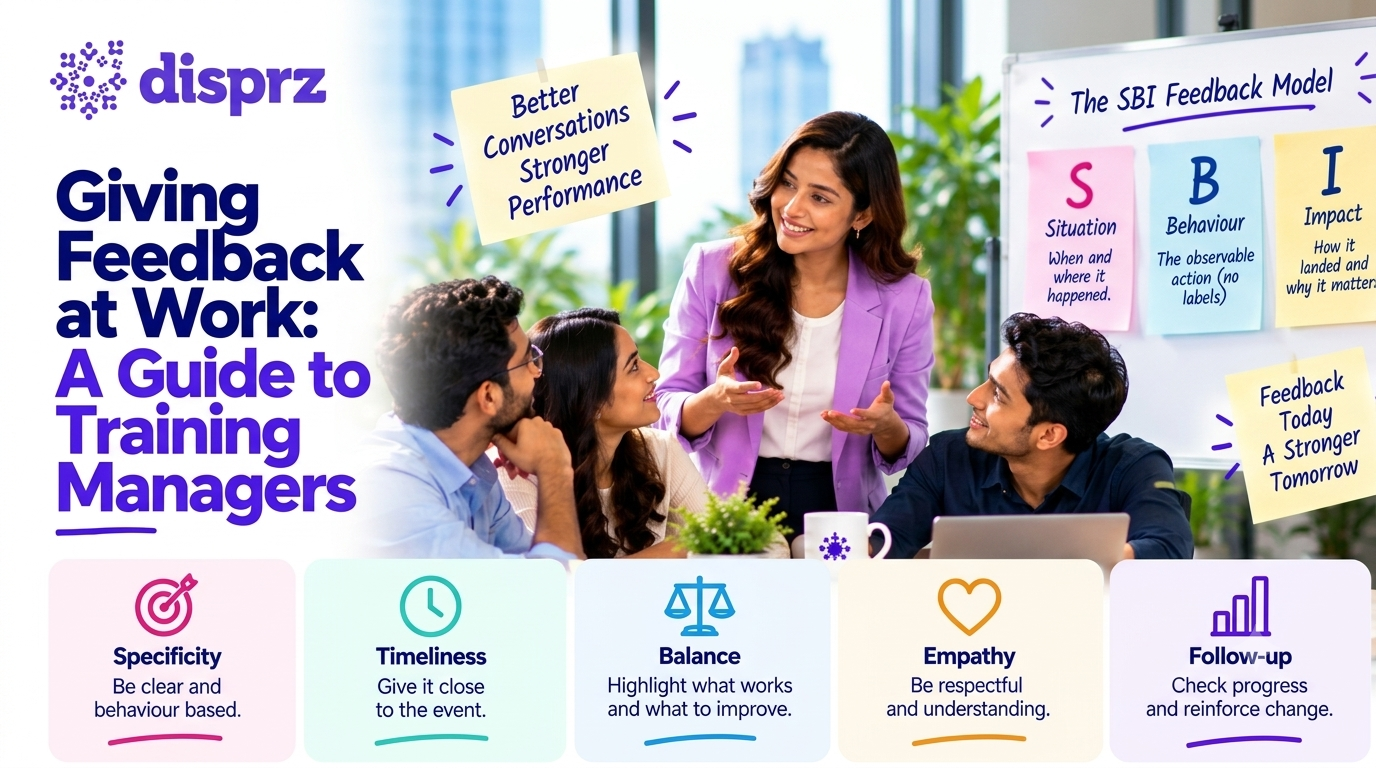
Giving feedback is the skill of describing a specific behaviour and its impact so that a person can keep doing what works and change what does not. Done well it is timely, specific, balanced, and empathetic, and it is followed up so the change actually sticks. It is the everyday engine of performance, not a once-a-year review ritual.
Feedback is distinct from evaluation and from praise for its own sake. A rating tells someone where they stand; feedback tells them what to do next. It is a core soft skill and underpins several others, including coaching and workplace communication.
What are the five core feedback skills?
Treat giving feedback as five trainable skills rather than one vague ability. Assess and coach against each of these, and the quality of feedback across your managers becomes something you can improve deliberately.
| Skill | What it is | Observable behaviour at work |
|---|---|---|
| Specificity | Naming the exact behaviour, not a trait | "In Tuesday's call you talked over the client twice", not "you are rude" |
| Timeliness | Giving it close to the event, not months later | Raising an issue the same week, not saving it for the review |
| Balance | Reinforcing what works and what to change | Recognising a real strength as readily as a gap |
| Empathy | Reading the person and the moment | Choosing a private setting and a calm tone for hard news |
| Follow-up | Closing the loop on the agreed change | Checking back in a fortnight and recognising the shift |
The SBI feedback model (Situation, Behaviour, Impact)
The most widely taught structure for a single feedback message is SBI, developed by the Center for Creative Leadership. It keeps feedback factual and fair by separating what happened from how it landed, which is exactly what stops a message tipping into a personal judgement.
| Step | What you describe | Worked example |
|---|---|---|
| Situation | Anchor the moment: when and where | "In yesterday's client review..." |
| Behaviour | State the observable action, no labels | "...you answered the pricing question before the client finished asking it." |
| Impact | Describe the effect on you, the team, or the outcome | "The client went quiet, and we did not hear their real concern." |
Constructive vs positive feedback. Constructive feedback names something to change; positive feedback names something to repeat. Both use SBI, and both are needed. Teams that hear only criticism disengage, and teams that hear only praise stop growing. Coach managers to give both, with the specificity that lets the person actually repeat the win.
A note on feedforward. Feedforward, popularised by Marshall Goldsmith, shifts the conversation from what went wrong to what to do differently next time. Pair SBI with one forward-looking ask ("next call, leave a beat after each question") and feedback stops feeling like a verdict and starts feeling like coaching.
Why giving feedback matters, by industry
The payoff from better feedback looks different across the Disprz ICP. Naming it in each sector is how you get a training budget approved.
| Industry | Pain when feedback is poor | Payoff when feedback is trained |
|---|---|---|
| BFSI | Compliance slips go uncorrected until an audit finds them | Early, specific correction and a stronger risk culture |
| Retail & ecommerce | New floor staff get no coaching and quit in weeks | Faster ramp, better service, lower early attrition |
| Food services & hospitality | Service errors repeat because no one names them in the moment | Same-shift correction, higher guest CSAT |
| Manufacturing & automotive | Safety shortcuts persist because feedback feels confrontational | Routine, blameless correction and fewer incidents |
| Pharma & healthcare | Hierarchy suppresses upward feedback on real risks | Speak-up culture and safer clinical handovers |
| IT & ITeS | New team leads avoid hard conversations and lose good engineers | Managers who coach, and retained technical talent |
What the research says about feedback and training
Three findings make the enterprise case for training feedback as a skill, not leaving it to instinct.
Demand: a core skill employers now expect
The World Economic Forum's Future of Jobs Report 2025 ranks communication and people skills, which giving feedback sits squarely inside, among the core skills employers prioritise, alongside resilience, flexibility, and leadership. The same report projects that 39% of workers' core skills will change by 2030 and that 59% of the global workforce will need reskilling or upskilling, which puts human skills firmly on the training agenda.
First-party evidence: outcomes across Disprz deployments
Across 47 Disprz enterprise deployments, learning programmes reached a median 92% course completion and 88% platform adoption, with documented outcomes including a 10% skills improvement and 15% business growth. Feedback and coaching programmes ride on exactly this kind of high-completion, high-adoption delivery, which is why the reach matters as much as the content. See the full, sourced Disprz Skills Impact Index.
Trainability: skill-based programmes work when they are practised
The wider evidence on training human skills is encouraging for L&D. A meta-analysis by Mattingly and Kraiger (2019), covering dozens of studies, found a moderate positive effect of training on emotional intelligence, the empathy and self-regulation that underpin good feedback, robust across participant gender, study location, and study design. An earlier meta-analysis by Hodzic and colleagues (2018) reached the same conclusion and found that ability-based programmes, which teach and practise specific behaviours, outperform generic awareness sessions.
Design implication. The evidence favours structured, practice-based programmes over one-off workshops, which is exactly why the eight-week rollout below builds in practice, coaching, and reinforcement rather than a single training day.
What good and poor feedback look like at work
The difference is always visible in the wording, which is what makes it trainable and assessable.
| Situation | Poor feedback | Good feedback (SBI) |
|---|---|---|
| A rushed client presentation | "That was sloppy." | "In today's demo you skipped the pricing slide, and the client asked about it twice afterwards." |
| A strong recovery on a support call | "Good job today." | "On the 11am call you acknowledged the delay first, then fixed it, and the customer thanked you by name." |
| A repeated missed handover | "You are unreliable." | "The last two handovers came in after the shift change, so the next team started blind." |
| A junior who over-promised a date | "Never do that again." | "You committed to Friday in the standup; when it slipped, the client had already told their board. Next time, let us agree the date together first." |
Adapting feedback by role
Feedback looks different at each level, so training has to be tailored, not one generic workshop. Here is the behaviour shift to coach for each audience.
Individual contributors and junior staff
Focus on receiving feedback well and giving peer feedback: asking clarifying questions instead of defending, acting on one change at a time, and offering a colleague a specific observation rather than staying silent. For client-facing juniors, add reading the moment before offering an opinion.
Managers leading a team
This is the primary audience. Focus on the hard conversation: using SBI so criticism stays factual, balancing correction with genuine recognition, giving it in the moment rather than saving it, and following up so the change sticks. Managers set the feedback culture the rest of the team copies.
Senior leadership (managing up)
Focus on giving upward feedback safely and inviting it in return: leading with the shared outcome, framing a concern with a proposed path rather than a complaint, and signalling that challenge is welcome. A junior giving upward feedback should be concise and evidence-led; the same person coaching a peer can be warmer and more exploratory. That deliberate shift is the skill in action.
Customer and client-facing (frontline)
Focus on in-the-moment, blameless correction: naming the behaviour on the same shift, keeping it short, and pairing it with recognition so it does not feel like policing. This is where frontline enablement and short mobile practice matter most, because there is rarely time for a formal sit-down.
How do you give constructive feedback?
Give constructive feedback in private and soon after the event. Anchor it with SBI: name the situation, describe the specific behaviour without labels, and explain its impact. Then agree one forward-looking change together and follow up. Keep it factual, keep it kind, and focus on the behaviour rather than the person.
- Ask permission first: "can I share an observation from that call?" lowers defences and signals respect.
- Use SBI: situation, behaviour, impact. It keeps you on facts and off character.
- Be specific: one named behaviour beats a general verdict every time. Vague feedback cannot be acted on.
- Make it timely: raise it within days, not at the next review. Old feedback feels like an ambush.
- Balance it: recognise a real strength as readily as a gap, and never manufacture praise to soften a point.
- Feedforward: end with one concrete thing to do differently next time, agreed together.
- Own your view: "here is how it landed for me" invites a conversation rather than issuing a ruling.
- Follow up: check back in a fortnight and recognise the change. Feedback without follow-up rarely sticks.
Quick feedback self-check
Rate each statement from 1 (rarely true) to 5 (almost always true). It is a directional prompt, not a validated test, but it shows which of the five feedback skills to prioritise.
- I name the exact behaviour rather than a general trait.
- I give feedback soon after the event, not at the next review.
- I recognise what works as readily as what needs to change.
- I choose the right moment, setting, and tone for the person.
- I check back later to see whether the change stuck.
How do you measure feedback quality?
Feedback feels intangible only until you tie it to behaviour and outcomes. Measure it on three levels.
- Behaviour rubric: score the five feedback skills against observable behaviours, before and after training.
- 360 feedback: direct-report and peer ratings of a manager's feedback, since it is judged by how others receive it.
- Scenario assessment: responses to realistic situations, scored against an SBI model answer.
- Business signals: track the metrics feedback moves, such as engagement scores, voluntary attrition, time-to-competence for new hires, and performance ratings.
Benchmark to hold. Do not report a single "feedback score". Report movement on specific behaviours by manager and team, so you can see where coaching is working and where it is not.
How long does it take to build feedback skill?
Set realistic expectations with sponsors so the programme is not judged too early.
- Awareness: 2 to 4 weeks with assessment and a first workshop.
- New habits: 1 to 3 months of applied practice and coaching.
- Visible team change: 3 to 6 months as managers give feedback routinely.
- Measurable business impact: 6 to 12 months on engagement and retention.
Turn feedback into a training programme
A single workshop rarely changes behaviour. Run feedback as a structured programme with practice and reinforcement built in. This eight-week rollout works across desk and frontline teams.
| Week | Focus | Activity |
|---|---|---|
| 1 | Baseline | Self and 360 assessment, set behaviour goals by role |
| 2 | Specificity and SBI | Microlearning on SBI, rewrite vague feedback into specific |
| 3 | Timeliness | In-the-moment practice, the same-week rule, manager 1:1 |
| 4 | Balance | Positive and constructive drills, avoid the false sandwich |
| 5 | Empathy and delivery | Difficult-conversation role-play, reading the moment |
| 6 | Apply | Real-work feedback challenge, AI coaching on delivery |
| 7 | Follow-up | Loop-closing check-ins, peer review, manager check-in |
| 8 | Re-measure | Repeat rubric and 360, report movement |
Tools and enablers
Match a tool to each stage rather than buying one and hoping.
- Assessment: feedback rubrics and 360 tools for baseline and re-measure.
- Delivery: an LMS for structured paths and mobile microlearning.
- Discovery: an LXP with skills intelligence to map feedback behaviours to roles.
- Practice: scenario and role-play, delivered on mobile for frontline.
- Coaching: an AI coach that gives feedback on how a manager delivered feedback.
- Analytics: dashboards that report behaviour movement by team.
Results at scale
Behaviour change shows up in numbers when the programme is run properly and reinforced. These are outcomes enterprises have seen running skills programmes on Disprz.
Across 47 Disprz enterprise deployments, learning programmes reached a median 88% course completion and 85% platform adoption, with documented outcomes including a 10% skills improvement and 15% business growth. See the full, sourced Disprz Skills Impact Index.
Customer story: Bajaj Allianz. The Indian insurance leader unified skilling for its 7,000+ employees on a single Disprz platform and reached 95% course completion across the workforce. It shows what a skills-first programme, the kind a feedback and manager-capability rollout sits inside, sustains at scale. Read the Bajaj Allianz case study.
How Disprz helps you build feedback skill at scale
The hard part of feedback training is not the content, it is running it across thousands of managers, in many roles and languages, and proving it changed behaviour. Disprz brings the LMS, LXP and skills intelligence, and frontline enablement into one platform so each stage of the programme lives in one place.
| Programme stage | What Disprz does | Outcome you can show |
|---|---|---|
| Map | Skills intelligence links the five feedback skills to each role and surfaces the gap | A baseline by role, team, and region |
| Build | Turo converts your playbooks and SOPs into feedback microlearning and scenarios | A curriculum stood up in days, not a quarter |
| Deliver | Mobile-first delivery, online and offline, for desk and frontline alike | Reach that includes the frontline, not just HQ |
| Practice | SBI scenario and role-play modules for real situations | The hard conversation rehearsed before it is needed |
| Coach | AI coaching gives feedback on how the manager delivered feedback | Coaching at a scale L&D cannot cover alone |
| Reinforce | Nudges, spaced reminders, and manager check-ins in the flow of work | Habits that survive past the workshop |
| Measure | Behaviour rubrics, 360 feedback, and progression analytics | Movement on behaviour, tied to engagement and retention |
Because the five feedback skills are mapped as skills, not just course completions, you can prove progression rather than attendance. That is the difference between a training line item and a capability you can report to the board.
- Role-to-behaviour mapping for the five feedback skills
- SBI microlearning and scenario practice on mobile, including offline
- AI coaching feedback on real conversations
- Behaviour rubrics and 360 assessment built in
- Nudges and reinforcement in the flow of work
- Progression analytics by role, team, and region
Turo, the agentic authoring layer, converts your existing playbooks and SOPs into microlearning 80% to 90% faster than manual builds, so a feedback curriculum does not take a quarter to stand up. Enterprises running skills programmes on Disprz sustain 45%+ frontline completion against an industry average below 30%, which is what makes a soft-skills rollout actually finish.
Where to start. Pick one manager population and the two feedback skills that hurt most, map them in skills intelligence, and run the eight-week programme above as a pilot. Prove the movement, then scale it across the workforce.
Key takeaways
- Giving feedback is trainable and measurable, not a trait some managers are born with.
- Train against the five core skills, specificity, timeliness, balance, empathy, and follow-up, not a vague ability.
- Structure every message with SBI (Situation, Behaviour, Impact) and give both constructive and positive feedback.
- Tailor the training by role: receiving well for juniors, the hard conversation for managers, upward feedback for leaders, in-the-moment correction for frontline.
- Run it as an eight-week programme with practice and reinforcement, and tie it to engagement, retention, and performance.
Where should you start?
Giving feedback is the human layer that decides whether your technical training turns into performance. For an enterprise, the win is not a single workshop but a repeatable programme that defines the behaviours, trains and reinforces them by role, and proves the change. Start with the manager population and the two feedback skills that hurt most in your context, make them observable, and build from there.
Reviewed for accuracy on 22 Sep 2026.
Giving feedback FAQs
The questions L&D and people leaders ask most often.
How do you give constructive feedback?
Give it in private and soon after the event. Anchor it with SBI: name the situation, describe the specific behaviour without labels, and explain its impact. Agree one forward-looking change together, then follow up. Keep it factual and kind, and focus on the behaviour rather than the person.
What is the SBI feedback model?
SBI stands for Situation, Behaviour, Impact, a structure from the Center for Creative Leadership. You anchor the moment (situation), state the observable action without labels (behaviour), and describe the effect it had (impact). Separating fact from judgement keeps feedback fair and easier to act on.
What are examples of constructive feedback?
"In today's demo you skipped the pricing slide, and the client asked about it twice afterwards, so next time let us cover it upfront." Or: "The last two handovers came in after the shift change, which left the next team starting blind; can we agree a cut-off time?" Each names a specific behaviour and its impact, then proposes a change.
Why is feedback important at work?
Feedback is how performance actually improves between reviews. It drives engagement, speeds up how quickly new hires become competent, corrects small problems before they become big ones, and shapes whether people stay. Teams that get specific, timely feedback grow; teams that get none stall or leave.
What is the difference between constructive and positive feedback?
Constructive feedback names something to change; positive feedback names something to repeat. Both should be specific and use SBI. Teams that hear only criticism disengage, and teams that hear only praise stop growing, so managers need to give both.
How do you measure feedback quality in a workforce?
Through behaviour rubrics scored against the five core skills, 360 feedback from direct reports and peers, scenario assessments marked against an SBI model answer, and the business metrics feedback moves, such as engagement, attrition, time-to-competence, and performance ratings.
Sources
- Disprz. Disprz Skills Impact Index, 2026. First-party learning and skills outcomes from 47 enterprise deployments (median 88% completion, 85% adoption, 10% skills improvement, 15% business growth). disprz.ai/skills-impact
- World Economic Forum. Future of Jobs Report 2025. January 2025. Communication and people skills among prioritised core skills; 39% of core skills change by 2030; 59% of workers need reskilling. weforum.org
- Mattingly, V. and Kraiger, K. Can emotional intelligence be trained? A meta-analytical investigation. Human Resource Management Review, 29(2), 2019. Moderate positive effect of training.
- Hodzic, S., Scharfen, J., Ripoll, P., Holling, H. and Zenasni, F. How efficient are emotional intelligence trainings: A meta-analysis. Emotion Review, 10(2), 2018. Ability-based programmes outperform generic awareness sessions.
- Disprz master value benchmarks (8X ROI, 50% productivity, 7X CSAT, Turo 80-90% faster authoring) and frontline completion data, 2026. Aggregated enterprise deployment data.
About the authors


Madhu Karunakaran
Vice President - People & Culture
Madhu Karunakaran is a senior HR and Learning & Development (L&D) leader with 20+ years of experience spanning people strategy, organizational development (OD), talent management, leadershi...
Reviewed for accuracy on 20 Sep 2026