
On this page
Interpersonal skills are the behaviours that let people work effectively with each other, including communication, active listening, empathy, teamwork, dependability, self-awareness, conflict management, and leadership. For an enterprise, they are trainable and measurable: define the observable behaviour, deliver it in short applied bursts, coach against real interactions, and track it through 360 feedback and the business metrics it moves, such as collaboration speed, rework, and retention.
Key highlights
- Definition: interpersonal skills are the behaviours people use to interact and work well with others.
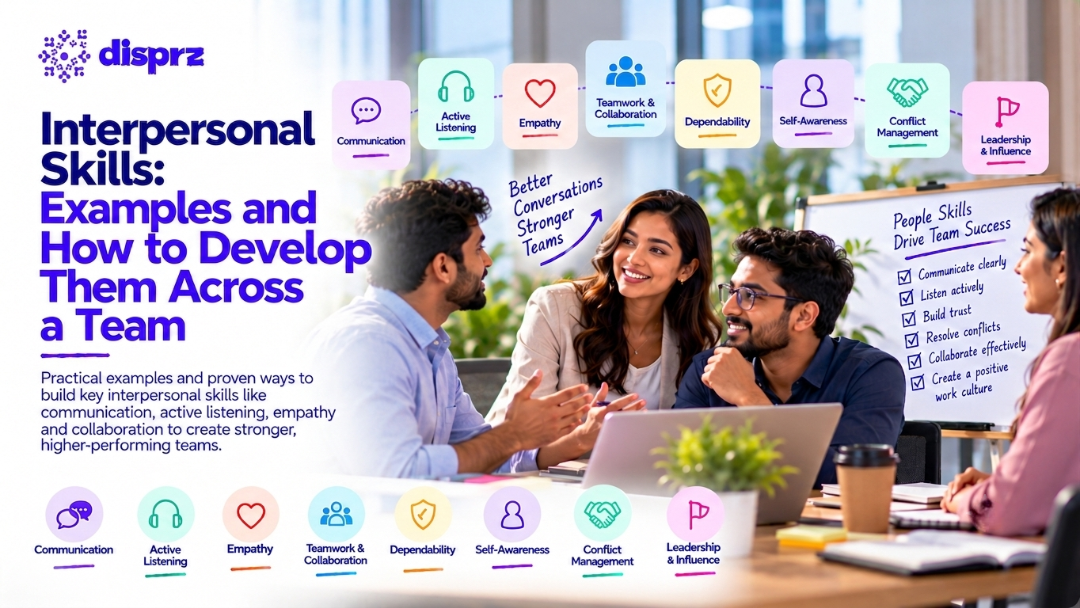
- Eight core skills: communication, active listening, empathy, teamwork, dependability, self-awareness, conflict management, and leadership.
- Why it matters: in matrixed, cross-functional orgs, work moves through people, so weak interpersonal skills slow everything down.
- It is trainable: interpersonal skills respond to practice, feedback, and coaching, not just personality.
- It is measurable: behaviour rubrics, 360 feedback, and scenario assessment make them trackable across a workforce.
The business case for interpersonal skills
Most enterprises hire for technical ability and assume people will figure out how to work together. Then a capable specialist stalls a cross-functional project because they cannot align stakeholders, or a high performer becomes a manager nobody wants to report to. That gap is an interpersonal skills gap, and in a matrixed organisation where work moves through people, it is one of the most expensive gaps to leave open because it shows up as slow delivery, rework, and attrition.
A quick note on scope. This guide is about interpersonal skills at work, the behaviours that make collaboration effective. It is not about interpersonal learning styles, the idea that some people learn best through interaction with others, which we cover separately in our guide to interpersonal learning styles. The good news for an L&D team: interpersonal skills are not fixed traits. They are behaviours you can define, train, and measure across a workforce. This guide shows how.
What are interpersonal skills?
Interpersonal skills are the behaviours people use to communicate and work well with others, including listening, expressing ideas clearly, collaborating, showing empathy, and handling disagreement. Sometimes called people skills, they are how work actually gets done in a team: they turn individual ability into collective results.
Interpersonal skills are a family of related soft skills rather than a single ability. They overlap with, and depend on, emotional intelligence, active listening, and conflict resolution. A person can be technically excellent and still have weak interpersonal skills, which is why they are trained separately and deliberately.
What are the eight core interpersonal skills?
Interpersonal skills is a broad label, so break it into named competencies you can assess and train against, rather than treating it as one vague quality. These eight cover the behaviours that matter most at work.
| Skill | What it is | Observable behaviour at work |
|---|---|---|
| Communication | Expressing ideas clearly and to the right audience | Leading with the point, adjusting to the listener |
| Active listening | Understanding before responding | Paraphrasing back before offering a view |
| Empathy | Reading and considering others' perspective | Adjusting a request when a colleague is stretched |
| Teamwork and collaboration | Working toward a shared goal across people | Sharing credit, unblocking others, aligning on the plan |
| Dependability | Doing what you said, when you said | Meeting commitments and flagging risk early |
| Self-awareness | Knowing how you come across to others | Adjusting tone after noticing your effect on a room |
| Conflict management | Handling disagreement without damage | Naming the issue calmly and seeking a shared path |
| Leadership and influence | Moving people toward an outcome, with or without authority | Building buy-in across a group you do not manage |
The ten interpersonal skills that matter most at work are communication, active listening, empathy, teamwork and collaboration, dependability, self-awareness, conflict management, leadership and influence, adaptability, and negotiation. The first eight are the core competencies above; adaptability and negotiation extend them for changing and high-stakes situations.
On "7 types" and "four types". Some lists name seven types (communication, active listening, teamwork, empathy, dependability, conflict management, and leadership) and some group them into four broad types (verbal communication, non-verbal communication, listening, and collaboration or conflict handling). These are the same behaviours grouped at different levels. Train against the specific behaviours, not the count.
Why interpersonal skills matter, by industry
Interpersonal skills pay off differently across the Disprz ICP. Naming the payoff in each sector is how you get a training budget approved.
| Industry | Pain when skills are weak | Payoff when they are trained |
|---|---|---|
| BFSI | Advisers and relationship managers lose trust in tense conversations | Stronger client relationships, higher retention and cross-sell |
| Retail & ecommerce | Floor teams and support clash under peak pressure | Better peak-season teamwork, smoother service, lower attrition |
| Food services & hospitality | Guest-facing friction turns into poor reviews | Warmer guest recovery, higher CSAT and repeat visits |
| Manufacturing & automotive | Shift handovers and cross-team requests break down | Cleaner handovers, fewer errors from poor coordination |
| Pharma & healthcare | Siloed teams miscommunicate in high-stakes work | Clearer handovers and safer, better-aligned collaboration |
| IT & ITeS | Technical talent cannot align stakeholders or lead a team | Engineers who influence, collaborate, and become effective leads |
What the research says about interpersonal skills and training
Three independent findings make the enterprise case for training interpersonal skills, not just hiring for them.
Demand: a core skill employers now expect
The World Economic Forum's Future of Jobs Report 2025 names empathy and active listening, both interpersonal behaviours, among the core skills employers prioritise, alongside resilience, flexibility, and leadership. The same report projects that 39% of workers' core skills will change by 2030 and that 59% of the global workforce will need reskilling or upskilling, which puts human skills firmly on the training agenda.
Performance: interpersonal skills show up in results
Across 47 Disprz enterprise deployments, learning programmes reached a median 92% course completion and 88% platform adoption, with documented outcomes including a 10% skills improvement and 15% business growth. Interpersonal skills sit inside those programmes: because they are mapped as skills rather than course completions, the improvement is measured as behaviour movement, not attendance. See the full, sourced Disprz Skills Impact dataset.
Trainability: it responds to well-designed training
This is the finding that matters most for L&D. Interpersonal skills draw heavily on emotional intelligence, and the meta-analytic evidence there is encouraging. A meta-analysis by Mattingly and Kraiger (2019), covering dozens of studies, found a moderate positive effect of training on emotional intelligence, robust across participant gender, study location, and study design. An earlier meta-analysis by Hodzic and colleagues (2018) reached the same conclusion and found that ability-based programmes, which teach and practise specific behaviours, outperform generic awareness sessions.
Design implication. The evidence favours structured, practice-based programmes over one-off workshops, which is exactly why the eight-week rollout below builds in practice, coaching, and reinforcement.
What good and poor interpersonal skills look like at work
The clearest example is handling disagreement well: staying calm, listening to understand the other person's position, acknowledging it, and steering toward a shared solution rather than winning the argument. It combines communication, active listening, empathy, and conflict management in one visible behaviour, which is why interviewers and managers use it as the test.
The difference is always visible in behaviour, which is what makes it trainable and assessable.
| Situation | Poor interpersonal skills | Good interpersonal skills |
|---|---|---|
| A colleague disagrees in a meeting | Talks over them, defends position | Listens, restates their point, finds common ground |
| A cross-team request is blocking you | Escalates by email, assigns blame | Aligns on the shared goal, unblocks together |
| A commitment is going to slip | Goes quiet, misses the deadline silently | Flags the risk early with a revised plan |
| A teammate is struggling | Ignores it, pushes for output | Notices, checks in, adjusts the ask |
Adapting interpersonal skills by role
Interpersonal skills look different at each level, so training has to be tailored, not one generic workshop. Here is the behaviour shift to coach for each audience.
Individual contributors and junior staff
Focus on communication, active listening, and dependability: asking clear questions, paraphrasing before acting, meeting commitments, and flagging risk early. For juniors, the biggest shift is learning to raise a problem with a proposed option rather than staying silent or dumping it on a manager.
Managers leading a team
Focus on empathy, collaboration, and conflict management: running a one-to-one that surfaces real issues, aligning a team around a shared goal, giving hard feedback that lands, and de-escalating conflict between team members without taking sides.
Senior leadership (managing up)
Focus on influence and self-awareness: leading with the outcome, reading intent, and framing a problem with a proposed path rather than venting it. A junior briefing an executive should be concise and decision-oriented; the same person with a client should be warmer and more exploratory. That deliberate shift is interpersonal skill in action.
Customer and client-facing (frontline)
Focus on empathy under pressure, listening, and service recovery: acknowledging the person first, then solving. This is where frontline enablement and short mobile practice matter most, because the moment is live and there is no time to reflect.
How can you improve interpersonal skills?
- Paraphrase before you reply: restate what you heard before offering your view. It forces listening and checks understanding.
- Lead with the point: open with the outcome or ask, then give context. It respects the listener's time and lands the message.
- Match the message to the audience: brief an executive differently from a client or a peer. Deciding this on purpose is a skill.
- Make and keep small commitments: dependability is built one kept promise at a time. Flag slippage early rather than going quiet.
- Ask for the perspective, not just the facts: "how are you finding this?" surfaces what a status update hides.
- Name tension early and calmly: address a disagreement while it is small, focusing on the issue rather than the person.
- Give and ask for feedback both ways: ask peers how you come across. Interpersonal skills improve fastest with a mirror.
- Share credit and unblock others: collaboration is judged by whether the people around you do better work.
Quick interpersonal skills self-check
Rate each statement from 1 (rarely true) to 5 (almost always true). It is a directional prompt, not a validated test, but it shows which interpersonal skill to prioritise.
- I express ideas clearly and adapt them to the person I am talking to.
- I read how others are feeling and adjust my approach.
- I collaborate well and help unblock the people around me.
- I keep my commitments and flag risk early.
- I address disagreement calmly and steer toward a shared solution.
How do you measure interpersonal skills?
Interpersonal skills feel intangible only until you tie them to behaviour and outcomes. Measure them on three levels.
- Behaviour rubric: score each of the eight skills against observable behaviours, before and after training.
- 360 feedback: manager, peer, and direct-report ratings, since interpersonal skill is judged by how others experience you.
- Scenario assessment: responses to realistic situations (a disagreement, a blocked request), scored against a model answer.
- Business signals: track the metrics these skills move, such as collaboration or delivery speed, rework and error rates, engagement scores, and voluntary attrition.
Benchmark to hold. Do not report a single "people skills score". Report movement on specific behaviours by role and team, so you can see where coaching is working and where it is not.
Validated, science-based assessments
For decisions that affect a person, use a recognised instrument from a reputable publisher rather than an ad hoc quiz. Interpersonal skills overlap with emotional intelligence and behavioural style, so the commonly used tools sit in those families. Treat them as inputs to development, not verdicts.
On the self-check above. The five-statement prompt earlier in this guide is directional, useful for a quick prioritisation, not a substitute for a validated assessment or 360 feedback when you are making development or hiring decisions.
How long does it take to build interpersonal skills?
Set realistic expectations with sponsors so the programme is not judged too early.
- Awareness: 2 to 4 weeks with assessment and a first workshop.
- New habits: 1 to 3 months of applied practice and coaching.
- Visible team change: 3 to 6 months as behaviours stick.
- Measurable business impact: 6 to 12 months on collaboration, rework, and retention.
Turn interpersonal skills into a training programme
A single workshop rarely changes behaviour. Run interpersonal skills as a structured programme with practice and reinforcement built in. This eight-week rollout works across desk and frontline teams.
| Week | Focus | Activity |
|---|---|---|
| 1 | Baseline | Self and 360 assessment, set behaviour goals by role |
| 2 | Communication | Microlearning on clear, audience-fit messaging |
| 3 | Active listening | Paraphrase and clarify drills in real 1:1s |
| 4 | Empathy and collaboration | Perspective-taking and cross-team scenario practice |
| 5 | Conflict management | Difficult-conversation role-play, feedback |
| 6 | Apply | Real-work challenge, AI coaching on interactions |
| 7 | Reinforce | Nudges, peer review, manager check-in |
| 8 | Re-measure | Repeat rubric and 360, report movement |
Tools and enablers
Match a tool to each stage rather than buying one and hoping.
- Assessment: behaviour rubrics and 360 tools for baseline and re-measure.
- Delivery: an LMS for structured paths and mobile microlearning.
- Discovery: an LXP with skills intelligence to map interpersonal behaviours to roles.
- Practice: scenario and role-play, delivered on mobile for frontline.
- Coaching: an AI coach that gives feedback on real interactions.
- Analytics: dashboards that report behaviour movement by team.
Results at scale
Behaviour change shows up in numbers when the programme is run properly and reinforced. These are outcomes enterprises have seen running skills programmes on Disprz.
Across 47 Disprz enterprise deployments, learning programmes reached a median 88% course completion and 85% platform adoption, with documented outcomes including a 10% skills improvement and 15% business growth, alongside up to 8X ROI where programmes are reinforced. See the full, sourced Disprz Skills Impact dataset.
Customer story: Telkomsel. The Indonesian telecom leader runs learning across its 6,600+ employees on Disprz, reaching 97% platform adoption and 92%+ course completion, with 100% of employees completing AI training. It shows what a skills-first programme, the kind an interpersonal-skills rollout sits inside, sustains at scale. Read the Telkomsel case study.
How Disprz helps you build interpersonal skills at scale
The hard part of interpersonal skills training is not the content, it is running it across thousands of people, in many roles and languages, and proving it changed behaviour. Disprz brings the LMS, LXP and skills intelligence, and frontline enablement into one platform so each stage of the programme lives in one place.
| Programme stage | What Disprz does | Outcome you can show |
|---|---|---|
| Map | Skills intelligence links the eight interpersonal skills to each role and surfaces the gap | A baseline by role, team, and region |
| Build | Turo converts your playbooks and SOPs into microlearning and scenarios | A curriculum stood up in days, not a quarter |
| Deliver | Mobile-first delivery, online and offline, for desk and frontline alike | Reach that includes the frontline, not just HQ |
| Practice | Scenario and role-play modules for real situations | Behaviour rehearsed before it is needed |
| Coach | AI coaching gives feedback on real interactions | Coaching at a scale managers cannot cover alone |
| Reinforce | Nudges, spaced reminders, and manager check-ins in the flow of work | Habits that survive past the workshop |
| Measure | Behaviour rubrics, 360 feedback, and progression analytics | Movement on behaviour, tied to collaboration and retention |
Because the eight interpersonal skills are mapped as skills, not just course completions, you can prove progression rather than attendance. That is the difference between a training line item and a capability you can report to the board.
- Role-to-behaviour mapping for the eight interpersonal skills
- Microlearning and scenario practice on mobile, including offline
- AI coaching feedback on real conversations
- Behaviour rubrics and 360 assessment built in
- Nudges and reinforcement in the flow of work
- Progression analytics by role, team, and region
Turo, the agentic authoring layer, converts your existing playbooks and SOPs into microlearning 80% to 90% faster than manual builds, so an interpersonal-skills curriculum does not take a quarter to stand up. Enterprises running skills programmes on Disprz sustain 45%+ frontline completion against an industry average below 30%, which is what makes a soft-skills rollout actually finish.
Where to start. Pick one role and the two interpersonal skills that hurt most, map them in skills intelligence, and run the eight-week programme above as a pilot. Prove the movement, then scale it across the workforce.
Key takeaways
- Interpersonal skills are trainable and measurable, not fixed personality traits.
- Train against the eight core skills and their observable behaviours, not a vague "people skills" quality.
- Tailor the training by role: communication and dependability for juniors, empathy and conflict management for managers, composure and listening for frontline.
- Measure with behaviour rubrics and 360 feedback, and tie it to collaboration speed, rework, and retention.
- Run it as an eight-week programme with practice and reinforcement, not a one-off workshop.
Where should you start?
Interpersonal skills are the layer that decides whether your technical training turns into results, because in a modern organisation work moves through people. For an enterprise, the win is not a single workshop but a repeatable programme that defines the behaviours, trains and reinforces them by role, and proves the change. Start with the two skills that hurt most in your context, make them observable, and build from there.
Reviewed for accuracy on 22 Sep 2026.
Interpersonal skills FAQs
The questions L&D and people leaders ask most often.
What is the best example of good interpersonal skills?
Handling a disagreement well: staying calm, listening to understand the other person's position, acknowledging it, and steering toward a shared solution instead of winning the argument. It combines communication, active listening, empathy, and conflict management in one visible behaviour.
What are 10 important interpersonal skills?
Communication, active listening, empathy, teamwork and collaboration, dependability, self-awareness, conflict management, leadership and influence, adaptability, and negotiation. The first eight are the core competencies; adaptability and negotiation extend them for changing and high-stakes situations.
What are the 7 types of interpersonal skills in the workplace?
A common list of seven is communication, active listening, teamwork, empathy, dependability, conflict management, and leadership. These are the everyday behaviours that let people work effectively with each other.
What are the four types of interpersonal skills?
Interpersonal skills are often grouped into four broad types: verbal communication, non-verbal communication, listening, and collaboration or conflict handling. These are the same behaviours grouped at a higher level than the seven or eight named skills.
Can interpersonal skills be trained?
Yes. They improve with deliberate practice, specific feedback, and reinforcement. The key is to define the observable behaviour, deliver short applied practice, coach against real interactions, and re-measure, rather than run a single workshop.
How do you measure interpersonal skills in a workforce?
Through behaviour rubrics scored against the core skills, 360 feedback from managers and peers, scenario assessments, and the business metrics they move, such as collaboration speed, rework and error rates, engagement, and voluntary attrition.
Sources
- Disprz. Disprz Skills Impact Dataset, 2026. First-party learning and skills outcomes from 47 enterprise deployments. disprz.ai/skills-impact
- World Economic Forum. Future of Jobs Report 2025. January 2025. weforum.org
- Mattingly, V. and Kraiger, K. Can emotional intelligence be trained? A meta-analytical investigation. Human Resource Management Review, 29(2), 2019.
- Hodzic, S., Scharfen, J., Ripoll, P., Holling, H. and Zenasni, F. How efficient are emotional intelligence trainings: A meta-analysis. Emotion Review, 10(2), 2018.
- Disprz master value benchmarks (8X ROI, 50% productivity, 7X CSAT) and frontline completion data, 2026. Aggregated enterprise deployment data.
About the authors


Madhu Karunakaran
Vice President - People & Culture
Madhu Karunakaran is a senior HR and Learning & Development (L&D) leader with 20+ years of experience spanning people strategy, organizational development (OD), talent management, leadershi...
Reviewed for accuracy on 21 Sep 2026