
On this page
A leadership style is the pattern of behaviour a manager uses to direct, motivate, and develop a team. The main styles are autocratic, democratic, transformational, transactional, servant, laissez-faire, and coaching. None is universally best. Effective managers move along a spectrum from directive to supportive depending on the task and the person, an approach known as situational leadership. For an enterprise, style is trainable and measurable: define the behaviours, teach managers to read the situation, coach against real interactions, and track it through 360 feedback and the business metrics it moves, such as retention, engagement, and delivery.
Key highlights
- Definition: a leadership style is how a manager directs, motivates, and develops a team, the behaviour pattern others experience.
- The seven styles: autocratic, democratic, transformational, transactional, servant, laissez-faire, and coaching.
- No single best style: the most effective managers switch styles to fit the task, the person, and the moment.
- Situational leadership: match your style to the follower's competence and commitment on a given task.
- It is trainable: style range responds to practice, feedback, and coaching, and it is measurable across a workforce.
Why leadership style decides whether managers work
Most enterprises promote their best individual performers into management and then leave the hardest part to instinct. The result is predictable: a brilliant engineer manages a team the only way they know, one rigid style applied to every person and every problem, and their best people quietly start to leave. The gap is not effort or intelligence. It is leadership style, the one variable a manager controls that most shapes how a team performs and stays.
This guide is about the styles themselves, not the underlying capabilities. If you want the toolkit of skills that leaders draw on, such as delegation, feedback, and decision-making, read our companion guide to leadership skills. Here the focus is the styles a manager can deploy and, crucially for an L&D team, how to teach managers to choose the right one at the right moment across a whole workforce.
What are leadership styles?
Leadership styles are the distinct patterns of behaviour a manager uses to set direction, make decisions, and motivate a team. They range from directive styles, where the leader decides and instructs, to supportive styles, where the leader enables and develops. The main styles are autocratic, democratic, transformational, transactional, servant, laissez-faire, and coaching, and the strongest leaders move between them to fit the situation rather than defaulting to one.
Style is distinct from personality and from raw skill. Two managers with the same technical ability can get very different results because one adapts their style to the person in front of them and the other does not. That is why style is trained deliberately as a core soft skill, and why it sits so close to emotional intelligence, which is what lets a leader read when to switch, and to coaching skills, the developmental style most managers use least.
What are the 7 leadership styles?
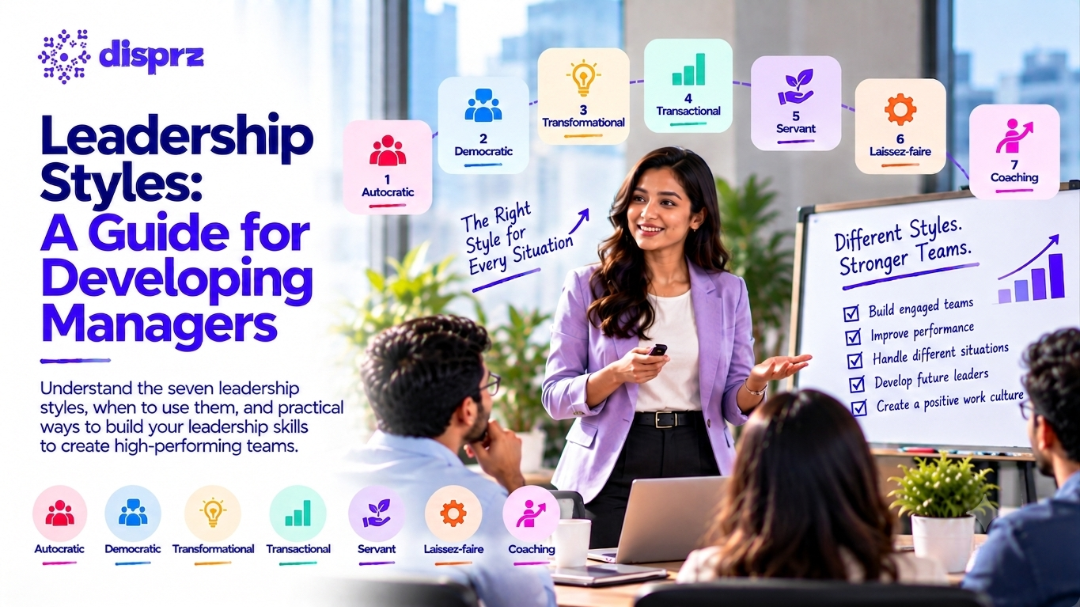
The seven most widely taught leadership styles are autocratic, democratic, transformational, transactional, servant, laissez-faire, and coaching. Each is a legitimate tool with a situation it suits and a situation it damages. The skill to train is not picking one favourite, it is knowing when each applies.
Use the styles below as the vocabulary your managers assess and train against, rather than treating leadership as one vague quality. The final column is the one that matters most for development: when to use it.
| Style | What the leader does | When to use it |
|---|---|---|
| Autocratic | Decides alone and instructs, tight control | Crises, safety-critical work, low-experience teams under time pressure |
| Democratic | Invites input, then decides with the team | Complex problems where buy-in and diverse views improve the outcome |
| Transformational | Sets a compelling vision and raises ambition | Change programmes and growth, when a team needs energy and direction |
| Transactional | Sets clear targets, rewards and corrects on results | Repeatable, measurable work such as sales floors and operations |
| Servant | Puts the team's growth and needs first, removes blockers | Mature teams and cultures built on trust and long-term retention |
| Laissez-faire | Delegates fully, minimal intervention | Expert, self-directed teams who need autonomy, not oversight |
| Coaching | Develops each person through questions and feedback | Building capability over time, high-potential and stretch situations |
On the count. Some frameworks list five styles, some list twelve, and Goleman's widely cited model names six. The seven above cover the styles that appear across almost every model. Train against the behaviours and the when, not the number.
What is situational leadership?
Situational leadership is the practice of matching your style to the person and the task in front of you, rather than leading everyone the same way. On a task where someone is new or unsure, you direct more. As their competence and commitment grow, you shift to coaching, then supporting, then delegating. The style is a response to the situation, not a fixed personality.
The classic model, from Hersey and Blanchard, describes four leader behaviours, directing, coaching, supporting, and delegating, chosen by reading the follower's readiness on a specific task. The practical lesson for managers is simple and hard to do: the same team member may need directing on a brand-new responsibility and delegating on something they have mastered, often in the same week. Teaching managers to diagnose readiness first, then choose a style, is the heart of leadership development.
Why leadership style matters, by industry
The cost of a rigid style shows up differently across the Disprz ICP. Naming the payoff in each sector is how you get a leadership programme funded.
| Industry | Pain when style is rigid | Payoff when managers adapt style |
|---|---|---|
| BFSI | Command-and-control stifles advisers, attrition rises | Managers coach and retain talent, service quality holds |
| Retail & ecommerce | One rigid style fails across peak and quiet floor teams | Directive in a rush, developmental off-peak, lower turnover |
| Food services & hospitality | Autocratic shift leads burn out frontline crews | Situational shift leads keep teams and CSAT steady |
| Manufacturing & automotive | Only autocratic safety leadership, no development | Directive on safety, coaching on capability and succession |
| Pharma & healthcare | Hierarchy blocks the input high-stakes work needs | Democratic input where it counts, clear direction where it must |
| IT & ITeS | New engineer-managers over-direct expert teams | Delegating and servant styles fit autonomous experts, retention rises |
What the research says about leadership and training
Three independent findings make the enterprise case for training leadership style, not just hoping managers pick it up.
Demand: leadership is a core skill employers now prioritise
The World Economic Forum's Future of Jobs Report 2025 names leadership and social influence among the top-ten core skills employers prioritise, alongside resilience, flexibility, and analytical thinking. The same report projects that 39% of workers' core skills will change by 2030 and that 59% of the global workforce will need reskilling or upskilling, which puts management capability firmly on the training agenda rather than the hiring one.
Trainability: adaptive leadership responds to training
This is the finding that matters most for L&D. The behaviours behind adaptive leadership sit close to emotional intelligence, the capacity to read a situation and regulate your response, and the evidence there is encouraging. A meta-analysis by Mattingly and Kraiger (2019), covering dozens of studies, found a moderate positive effect of training on emotional intelligence, robust across participant gender, study location, and study design. An earlier meta-analysis by Hodzic and colleagues (2018) reached the same conclusion and found that ability-based programmes, which teach and practise specific behaviours, outperform generic awareness sessions.
Design implication. The evidence favours structured, practice-based programmes over one-off leadership workshops, which is exactly why the eight-week rollout below builds in situational practice, coaching, and reinforcement rather than a single classroom day.
First-party evidence: what enterprises see on Disprz
Across 47 Disprz enterprise deployments, learning programmes reached a median 92% course completion and 88% platform adoption, with documented outcomes including a 10% skills improvement and 15% business growth. Leadership programmes benefit directly from that completion and adoption, because a style change only sticks if managers actually finish the practice and keep using the platform. See the full, sourced Disprz Skills Impact dataset.
What good and poor use of leadership style looks like
The difference is always visible in behaviour, which is what makes it trainable and assessable.
| Situation | Rigid, one-style response | Adaptive, situational response |
|---|---|---|
| A new hire on an unfamiliar task | Delegates fully, hire flounders | Directs first, then loosens as skill grows |
| An expert team member, mastered work | Micromanages, expert disengages | Delegates and gets out of the way |
| A live safety or crisis moment | Opens a debate, wastes the moment | Takes clear autocratic control fast |
| A complex change no one owns yet | Issues orders, no buy-in | Sets vision, invites input, builds ownership |
Adapting leadership style by role
Style development looks different at each level, so a leadership programme has to be tailored, not one generic course. Here is the behaviour shift to coach for each audience.
New and aspiring leaders
Focus on breaking the single-style habit. First-time managers usually lead the way they were led, or the way that suits their own personality. The shift to coach is diagnosis: read whether a person needs direction or autonomy on this task before choosing how to respond, rather than defaulting.
Managers leading a team
Focus on range and on the coaching style specifically, which most managers use least. The shift is moving deliberately between directing, coaching, supporting, and delegating across different people and tasks, and knowing they can switch mid-project as readiness changes.
Senior leaders and leaders of leaders
Focus on transformational and servant styles at scale: setting a vision that other managers can carry, and modelling the style flexibility you want them to adopt. A senior leader who only ever commands teaches every manager below them to do the same, so their own style becomes the ceiling on the whole system.
Frontline and shift leaders
Focus on switching between directive and developmental fast: autocratic clarity in a rush or a safety moment, coaching and servant behaviours in the quieter windows that build a team worth keeping. This is where frontline enablement and short mobile practice matter most, because the shift lead is on the floor with no time to reflect.
How can managers develop leadership-style range?
- Name your default: most managers over-use one style. Naming it is the first step to choosing others on purpose.
- Diagnose before deciding: ask "how ready is this person for this task?" before choosing how to respond. Style follows diagnosis.
- Practise the coaching style: replace an instruction with a question in one conversation a day. It is the style most managers under-use.
- Match style to task, not to person: the same person may need directing on new work and delegating on mastered work.
- Borrow the crisis switch: rehearse taking clear autocratic control for genuine crises, then handing it back. Both moves are skills.
- Ask for the mirror: ask the team how they experience your style under pressure. Range improves fastest with feedback.
- Study a range model: read one situational leadership case a week and map it to your own team.
- Model the switch out loud: "I am going to direct on this one because it is urgent" teaches the team that style is a choice, not a mood.
Quick leadership-style self-check
Rate each statement from 1 (rarely true) to 5 (almost always true). It is a directional prompt, not a validated instrument, but it shows which leadership behaviour to prioritise.
- I give clear direction and take control when a task is urgent or high-risk.
- I set a compelling vision that raises what the team believes it can do.
- I put my team's growth and blockers ahead of my own convenience.
- I invite real input and decide with the team on complex problems.
- I develop people with questions and feedback rather than only instructions.
How do you measure leadership style across a workforce?
Style feels intangible only until you tie it to behaviour and outcomes. Measure it on three levels.
- Behaviour rubric: score how well a manager matches style to situation, before and after training, against observable behaviours.
- 360 feedback: team, peer, and manager ratings, since a leadership style is judged by how others experience it, not by self-perception.
- Scenario assessment: responses to realistic situations, scored on whether the chosen style fits the readiness of the team.
- Business signals: track the metrics leadership moves, such as voluntary attrition by manager, engagement scores, internal promotion rates, and team delivery.
Benchmark to hold. Do not report a single "leadership score" or crown one style as best. Report range and fit: whether managers can deploy more than one style and match it to the situation, by team and by level.
On the self-check above. The five-statement prompt earlier in this guide is directional, useful for a quick prioritisation, not a substitute for a validated leadership instrument when you are making development or promotion decisions.
How long does it take to build leadership-style range?
Set realistic expectations with sponsors so the programme is not judged too early.
- Awareness: 2 to 4 weeks with assessment and a first workshop on the styles.
- New habits: 1 to 3 months of applied situational practice and coaching.
- Visible team change: 3 to 6 months as managers switch styles reliably.
- Measurable business impact: 6 to 12 months on retention, engagement, and delivery.
Turn leadership style into a training programme
A single leadership workshop rarely changes behaviour. Run it as a structured programme with situational practice and reinforcement built in. This eight-week rollout works across desk and frontline managers.
| Week | Focus | Activity |
|---|---|---|
| 1 | Baseline | Self and 360 assessment, identify each manager's default style |
| 2 | The styles | Microlearning on the seven styles and when each applies |
| 3 | Situational diagnosis | Practice reading follower readiness, match style to task |
| 4 | Directive styles | Autocratic and transactional scenarios, crisis and target setting |
| 5 | Developmental styles | Coaching and servant role-play, feedback conversations |
| 6 | Apply | Real-work challenge, AI coaching on live leadership interactions |
| 7 | Reinforce | Nudges, peer review, manager-of-manager check-in |
| 8 | Re-measure | Repeat rubric and 360, report movement on range and fit |
Tools and enablers
Match a tool to each stage rather than buying one and hoping.
- Assessment: style rubrics and 360 tools for baseline and re-measure.
- Delivery: an LMS for structured leadership paths and mobile microlearning.
- Discovery: an LXP with skills intelligence to map leadership behaviours to roles and levels.
- Practice: situational scenario and role-play, delivered on mobile for frontline managers.
- Coaching: an AI coach that gives feedback on real leadership interactions.
- Analytics: dashboards that report style range and fit by team and level.
Results at scale
Behaviour change shows up in numbers when the programme is run properly and reinforced. These are outcomes enterprises have seen running skills programmes on Disprz.
Across 47 Disprz enterprise deployments, learning programmes reached a median 88% course completion and 85% platform adoption, with documented outcomes including a 10% skills improvement and 15% business growth. See the full, sourced Disprz Skills Impact dataset.
Customer story: Maxis Communications. The Malaysian telecom leader runs leadership development and capability academies for its 5,300+ employees on Disprz, delivering 80,000+ hours of annual learning and upskilling 2,000+ employees through a purpose-built GenAI academy. It shows what a skills-first leadership programme, the kind a style rollout sits inside, sustains at scale. Read the Maxis case study.
How Disprz helps you build adaptive leadership at scale
The hard part of leadership training is not the content, it is running it across thousands of managers, in many roles and languages, and proving their style actually changed. Disprz brings the LMS, LXP and skills intelligence, and frontline enablement into one platform so each stage of the programme lives in one place.
| Programme stage | What Disprz does | Outcome you can show |
|---|---|---|
| Map | Skills intelligence links leadership behaviours to each role and level and surfaces the gap | A baseline by role, team, and region |
| Build | Turo converts your leadership playbooks and SOPs into microlearning and scenarios | A curriculum stood up in days, not a quarter |
| Deliver | Mobile-first delivery, online and offline, for desk and frontline managers alike | Reach that includes shift leads, not just HQ |
| Practice | Situational scenario and role-play modules for real leadership moments | Style switches rehearsed before they are needed |
| Coach | AI coaching gives feedback on real leadership interactions | Coaching at a scale senior leaders cannot cover alone |
| Reinforce | Nudges, spaced reminders, and manager-of-manager check-ins in the flow of work | Habits that survive past the workshop |
| Measure | Behaviour rubrics, 360 feedback, and progression analytics | Movement on style range and fit, tied to retention |
Because leadership behaviours are mapped as skills, not just course completions, you can prove progression rather than attendance. That is the difference between a leadership training line item and a management capability you can report to the board.
- Role-to-behaviour mapping across the leadership styles
- Situational microlearning and role-play on mobile, including offline
- AI coaching feedback on real leadership conversations
- Behaviour rubrics and 360 assessment built in
- Nudges and reinforcement in the flow of work
- Progression analytics by role, team, and level
Turo, the agentic authoring layer, converts your existing leadership playbooks and SOPs into microlearning 80% to 90% faster than manual builds, so a leadership curriculum does not take a quarter to stand up. Enterprises running skills programmes on Disprz sustain 45%+ frontline completion against an industry average below 30%, which is what makes a leadership rollout actually finish, and typically report up to 8X ROI on skills investment.
Where to start. Pick one manager population and the one style shift that hurts most, usually breaking a single default style, map it in skills intelligence, and run the eight-week programme above as a pilot. Prove the movement, then scale it across the workforce.
Key takeaways
- There is no single best leadership style. The most effective managers switch styles to fit the situation.
- Train against the seven styles and their observable behaviours, and against when each one applies.
- Situational leadership is the core skill: diagnose the person's readiness on a task, then choose a style.
- Tailor the training by level: breaking the default style for new managers, range for team leaders, modelling for senior leaders.
- Measure range and fit with behaviour rubrics and 360 feedback, and tie it to retention, engagement, and delivery.
Where should you start?
Leadership style is the human layer that decides whether a promotion into management turns into performance or attrition. For an enterprise, the win is not crowning one style but building managers who can move between them on purpose. Start with the manager population where a rigid default is costing you most, make the style behaviours observable, and build from there.
Reviewed for accuracy on 22 Sep 2026.
Leadership styles FAQs
The questions L&D and people leaders ask most often.
What are the main leadership styles?
The main leadership styles are autocratic, democratic, transformational, transactional, servant, laissez-faire, and coaching. Each suits a different situation, so the skill to develop is knowing when to use each rather than picking one favourite.
What are the 7 leadership styles?
The seven most widely taught styles are autocratic (the leader decides and instructs), democratic (decides with the team), transformational (inspires with a vision), transactional (sets targets and rewards results), servant (puts the team first), laissez-faire (delegates fully), and coaching (develops each person through questions and feedback).
Which leadership style is most effective?
No single style is most effective in every situation. The most effective managers read the task and the person and switch styles accordingly, directing in a crisis and delegating with an expert team. This adaptive approach, known as situational leadership, is what predicts results, not loyalty to one style.
What is situational leadership?
Situational leadership is matching your style to the person and task in front of you rather than leading everyone the same way. On the Hersey and Blanchard model, the leader shifts between directing, coaching, supporting, and delegating based on how ready the team member is for that specific task.
What is the difference between leadership styles and leadership skills?
Leadership styles are the patterns of behaviour a manager uses, such as autocratic or coaching. Leadership skills are the underlying capabilities that make any style work, such as delegation, feedback, and decision-making. You choose a style, and you draw on skills to execute it. See our guide to leadership skills for the toolkit.
Can leadership style be trained?
Yes. Style range improves with deliberate practice, specific feedback, and reinforcement. The key is to define the observable behaviours, teach managers to diagnose the situation, deliver short applied practice, coach against real interactions, and re-measure, rather than run a single workshop.
Sources
- Disprz. Disprz Skills Impact Dataset, 2026. First-party learning and skills outcomes from 47 enterprise deployments. disprz.ai/skills-impact
- World Economic Forum. Future of Jobs Report 2025. January 2025. Leadership and social influence ranked among the top-ten core skills. weforum.org
- Mattingly, V. and Kraiger, K. Can emotional intelligence be trained? A meta-analytical investigation. Human Resource Management Review, 29(2), 2019.
- Hodzic, S., Scharfen, J., Ripoll, P., Holling, H. and Zenasni, F. How efficient are emotional intelligence trainings: A meta-analysis. Emotion Review, 10(2), 2018.
- Disprz master value benchmarks (8X ROI, 50% productivity, 7X CSAT) and frontline completion data, 2026. Aggregated enterprise deployment data.
About the authors


Madhu Karunakaran
Vice President - People & Culture
Madhu Karunakaran is a senior HR and Learning & Development (L&D) leader with 20+ years of experience spanning people strategy, organizational development (OD), talent management, leadershi...
Reviewed for accuracy on 20 Sep 2026