
On this page
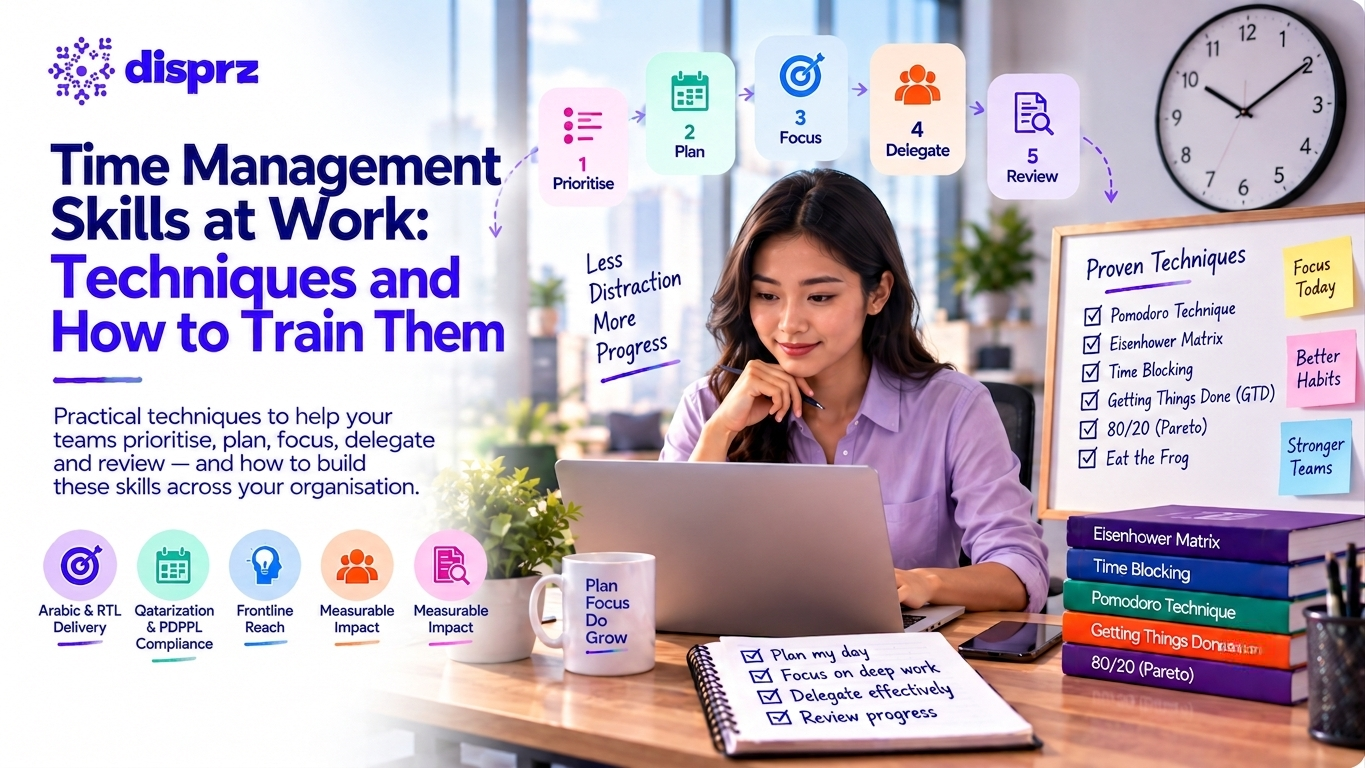
Time management is the ability to plan and control how you spend your hours so the highest-value work gets done. It rests on five skills: prioritisation, planning, focus, delegation, and review. For an enterprise, it is trainable and measurable: define the observable behaviour, teach a named method such as the Eisenhower Matrix or time blocking, coach against real workloads, and track it through throughput, deep-work hours, and on-time delivery.
Key highlights
- Definition: time management is planning and controlling how you spend your hours so the most important work gets done.
- Five skills: prioritisation, planning, focus, delegation, and review.
- Named methods: Pomodoro, the Eisenhower Matrix, 80/20 (Pareto), time blocking, Getting Things Done (GTD), and Eat the Frog.
- Why it matters: it protects capacity, cuts meeting waste, and turns effort into on-time delivery.
- It is trainable and measurable: teach a method, coach against real work, and track throughput and deep-work hours.
The business case for time management
Most enterprises hire for output and then bury it under meetings, context switching, and unclear priorities. A capable analyst spends the morning on low-value email, a manager loses their week to back-to-back calls, and the strategic work that actually moves the number slips again. That is a time management gap, and it is expensive because it shows up as missed deadlines, burnout, and rework rather than as a single obvious cost.
The good news for an L&D team: time management is not a personality trait. It is a set of skills and named methods you can define, train, and measure across a workforce. This guide shows how.
What are time management skills?
Time management skills are the abilities that let a person plan and control how they spend their working hours so the highest-value tasks get done on time. At work they show up as choosing the right task next, protecting focused time, saying no or delegating, and reviewing what actually got done against the plan.
Time management is not about doing more in less time. It is about spending finite hours on the work that matters most. It is a core soft skill and underpins several others, including problem solving and critical thinking, both of which need protected, focused time to happen at all.
What are the five core time management skills?
Treat time management as five distinct skills you can assess and train against, rather than one vague quality. This is the answer to the common "what are the 5 time management skills?" question.
| Skill | What it is | Observable behaviour at work |
|---|---|---|
| Prioritisation | Deciding what matters most, and in what order | Sorting the day by impact, not by what shouts loudest |
| Planning | Mapping tasks to time and sequencing them | Time blocking the week before it starts |
| Focus | Protecting attention from interruption | Doing deep work in a distraction-free block |
| Delegation | Assigning work to the right person and letting go | Handing off a task with a clear brief and deadline |
| Review | Checking what got done and adjusting | A weekly review that resets the next week's plan |
On the "7 essential skills". Some lists expand these five into seven by adding goal setting and saying no (boundary setting). They are the same discipline: set goals so you can prioritise, and set boundaries so you can protect focus. Train against the behaviours, not the count.
Named time management methods
The five skills are the "what". The methods below are the proven "how". Teach a small set and let people choose the one that fits the task, rather than mandating a single system for everyone.
| Method | What it is | Best used for |
|---|---|---|
| Pomodoro Technique | Work in 25-minute focused sprints with short breaks | Beating procrastination and sustaining focus on a single task |
| Eisenhower Matrix | Sort tasks by urgent vs important into four quadrants | Deciding what to do now, schedule, delegate, or drop |
| 80/20 (Pareto) | Focus on the 20% of work that drives 80% of results | Prioritising when everything feels equally busy |
| Time blocking | Assign specific tasks to fixed slots in the calendar | Protecting deep work and making a realistic weekly plan |
| Getting Things Done (GTD) | Capture every task, clarify it, and review a trusted list | Roles with high task volume from many inputs |
| Eat the Frog | Do the biggest, hardest task first thing each day | Stopping important work from being pushed to "later" |
The 3-3-3 rule. A popular lightweight method: spend three hours on your most important task, complete three shorter tasks, and do three maintenance tasks each day. It is a quick way to structure a day without a full system.
Why time management matters, by industry
Poor time management costs something different in each sector of the Disprz ICP. Naming the payoff in each is how you get a training budget approved.
| Industry | Pain when it is poor | Payoff when it is trained |
|---|---|---|
| BFSI | Advisers firefight service tickets, compliance work slips | Protected time for high-value clients and controls |
| Retail & ecommerce | Peak-season chaos, tasks dropped under load | Prioritised shift plans, fewer missed peak tasks |
| Food services & hospitality | Prep and service collide, guests wait | Sequenced prep, smoother service, higher CSAT |
| Manufacturing & automotive | Line changeovers and maintenance run over | Planned handovers, less unplanned downtime |
| Pharma & healthcare | Documentation backs up, clinicians burn out | Blocked admin time, more time with patients |
| IT & ITeS | Engineers lose the day to context switching | Protected deep-work blocks, faster delivery |
What the research says about time management and training
Three independent findings make the enterprise case for training time management, not just expecting it.
Demand: a core skill employers now expect
The World Economic Forum's Future of Jobs Report 2025 names self-management skills, such as resilience, flexibility, and agility, among the core skills rising in importance for the workforce. Time management is the practical, trainable expression of that self-management. The same report projects that 39% of workers' core skills will change by 2030 and that 59% of the global workforce will need reskilling or upskilling, which puts these human skills firmly on the training agenda.
Performance: time management shows up in results
Time management is a self-management behaviour, and self-management skills are among the ones employers now prioritise precisely because they show up in delivery and resilience. Rather than lean on a single vendor statistic, treat the case as this: work that is prioritised, planned, and protected reaches completion more reliably than work that is left to react to whatever arrives, which is consistent with the demand signal above and the trainability evidence below.
Trainability: it responds to well-designed training
This is the finding that matters most for L&D. Meta-analyses of soft-skill and self-management training find a moderate positive effect from structured programmes. A meta-analysis by Mattingly and Kraiger (2019) found a moderate positive effect of training on a related self-management skill, emotional intelligence, robust across gender, location, and study design. An earlier meta-analysis by Hodzic and colleagues (2018) reached the same conclusion and found that ability-based programmes, which teach and practise specific behaviours, outperform generic awareness sessions.
Design implication. The evidence favours structured, practice-based programmes over one-off workshops, which is exactly why the eight-week rollout below builds in method practice, coaching, and reinforcement.
What good and poor time management look like at work
The difference is always visible in behaviour, which is what makes it trainable and assessable. This also answers "what are examples of poor time management?".
| Situation | Poor time management | Good time management |
|---|---|---|
| Start of the day | Opens email and reacts to whatever is loudest | Does the most important task first (Eat the Frog) |
| A full task list | Treats everything as equally urgent, misses the big one | Sorts with the Eisenhower Matrix, drops the trivial |
| Deep work needed | Multitasks between chat, email, and the task | Blocks a focused slot and silences notifications |
| Too much on one plate | Says yes to all of it, then works late and slips | Delegates or renegotiates the deadline early |
| End of the week | No review, repeats the same overload next week | Reviews what got done and resets the plan |
Adapting time management by role
Time management looks different at each level, so training has to be tailored, not one generic workshop. Here is the behaviour shift to coach for each audience.
Individual contributors and junior staff
Focus on prioritisation and focus: choosing the right task next rather than the easiest, and protecting a daily focus block from interruption. Teach a single simple method first, usually Pomodoro or Eat the Frog, and the habit of a short end-of-day review. The aim is to stop the day being run by the inbox.
Managers leading a team
Focus on delegation and meeting hygiene. A manager's time leaks through unnecessary meetings and work they should have handed off. Coach for a clear delegation brief, a default meeting length that is shorter than an hour, agendas and decisions rather than status updates, and protecting team focus time as a policy, not a preference.
Senior leadership (managing up)
Focus on protecting strategic time and setting expectations upward. The skill is to distinguish the urgent from the important on behalf of the wider function, to say no or "not yet" to work that does not serve the priority, and to protect blocks for the thinking that only leaders can do. Coach for renegotiating deadlines with evidence rather than absorbing every request silently.
Customer and client-facing (frontline)
Focus on task sequencing and boundaries under live pressure: ordering prep and service so nothing is dropped, and handling interruptions without losing the thread. This is where frontline enablement and short mobile practice matter most, because the shift is live and there is no time to plan on the spot.
How can you improve time management?
- Plan tomorrow tonight: a three-line plan written the evening before removes the morning drift and starts the day on the priority.
- Eat the frog: do the biggest, hardest task first, before the inbox has a chance to reset your priorities for you.
- Time block the week: put deep work in the calendar as fixed appointments so it is defended, not squeezed into gaps.
- Use the Eisenhower Matrix: sort by urgent and important, then schedule, delegate, or drop the rest deliberately.
- Batch shallow work: group email, admin, and small tasks into set windows instead of letting them interrupt deep work.
- Run in Pomodoro sprints: 25 focused minutes then a short break sustains attention and makes big tasks feel startable.
- Say no and delegate: a clear no protects the plan, and a clean delegation brief frees your time and grows someone else's.
- Do a weekly review: 15 minutes to check what got done, what slipped, and what next week must protect.
Quick time management self-check
Rate each statement from 1 (rarely true) to 5 (almost always true). It is a directional prompt, not a validated test, but it shows which of the five skills to prioritise.
- I choose the highest-value task next, not the loudest one.
- I plan my week and block time before it starts.
- I protect focused blocks from interruption for deep work.
- I delegate or say no rather than overload myself.
- I review what got done each week and adjust the plan.
How do you measure time management?
Time management feels intangible only until you tie it to behaviour and outcomes. Measure it on three levels.
- Behaviour rubric: score the five skills against observable behaviours, before and after training.
- Work signals: on-time delivery rate, cycle time, and the share of the week spent in focused deep work versus meetings.
- Scenario assessment: responses to a realistic overloaded week, scored against a model prioritisation.
- Business signals: track the metrics time management moves, such as throughput, project on-time rate, overtime, and burnout or engagement scores.
Benchmark to hold. Do not report a single "productivity score". Report movement on specific behaviours by role and team, so you can see where coaching is working and where it is not.
How long does it take to build time management?
Set realistic expectations with sponsors so the programme is not judged too early.
- Awareness: 2 to 4 weeks with assessment and a first method workshop.
- New habits: 1 to 3 months of applied practice and coaching.
- Visible team change: 3 to 6 months as planning and focus habits stick.
- Measurable business impact: 6 to 12 months on delivery and capacity.
Turn time management into a training programme
A single workshop rarely changes behaviour. Run time management as a structured programme with method practice and reinforcement built in. This eight-week rollout works across desk and frontline teams.
| Week | Focus | Activity |
|---|---|---|
| 1 | Baseline | Self and manager assessment, time audit, set goals by role |
| 2 | Prioritisation | Microlearning + Eisenhower Matrix and 80/20 practice |
| 3 | Planning | Time blocking the week, the 3-3-3 rule, manager 1:1 |
| 4 | Focus | Pomodoro sprints, notification and meeting hygiene |
| 5 | Delegation | Delegation brief practice, saying no, role-play |
| 6 | Apply | Real-work challenge, AI coaching on the week's plan |
| 7 | Reinforce | Nudges, peer review, manager check-in |
| 8 | Re-measure | Repeat rubric and time audit, report movement |
Tools and enablers
Match a tool to each stage rather than buying one and hoping.
- Assessment: time-audit and behaviour rubrics for baseline and re-measure.
- Delivery: an LMS for structured paths and mobile microlearning.
- Discovery: an LXP with skills intelligence to map time management behaviours to roles.
- Practice: scenario and role-play on an overloaded week, delivered on mobile for frontline.
- Coaching: an AI coach that gives feedback on a real weekly plan.
- Analytics: dashboards that report behaviour movement by team.
Results at scale
Behaviour change shows up in numbers when the programme is run properly and reinforced. These are outcomes enterprises have seen running skills programmes on Disprz.
Across 47 Disprz enterprise deployments, learning programmes reached a median 88% course completion and 85% platform adoption, with documented outcomes including a 10% skills improvement and 15% business growth. See the full, sourced Disprz Skills Impact dataset.
Customer story: Times Internet. The Indian digital media leader, with 4,000+ employees, moved to role-based learning on Disprz and reported 60% time saved in training delivery, 70% learning completion, and 70% platform engagement. Time saved in delivery is a direct time management win for the L&D function itself, freeing capacity that a manual programme would consume. Read the Times Internet case study.
How Disprz helps you build time management at scale
The hard part of time management training is not the content, it is running it across thousands of people, in many roles and languages, and proving it changed behaviour. Disprz brings the LMS, LXP and skills intelligence, and frontline enablement into one platform so each stage of the programme lives in one place.
| Programme stage | What Disprz does | Outcome you can show |
|---|---|---|
| Map | Skills intelligence links the five skills to each role and surfaces the gap | A baseline by role, team, and region |
| Build | Turo converts your playbooks and SOPs into method microlearning and scenarios | A curriculum stood up in days, not a quarter |
| Deliver | Mobile-first delivery, online and offline, for desk and frontline alike | Reach that includes the frontline, not just HQ |
| Practice | Scenario and role-play on realistic overloaded weeks | Behaviour rehearsed before it is needed |
| Coach | AI coaching gives feedback on a real weekly plan | Coaching at a scale managers cannot cover alone |
| Reinforce | Nudges, spaced reminders, and manager check-ins in the flow of work | Habits that survive past the workshop |
| Measure | Behaviour rubrics, time audits, and progression analytics | Movement on behaviour, tied to delivery and capacity |
Because the five skills are mapped as skills, not just course completions, you can prove progression rather than attendance. That is the difference between a training line item and a capability you can report to the board.
- Role-to-behaviour mapping for the five time management skills
- Method microlearning and scenario practice on mobile, including offline
- AI coaching feedback on a real weekly plan
- Behaviour rubrics and time audits built in
- Nudges and reinforcement in the flow of work
- Progression analytics by role, team, and region
Turo, the agentic authoring layer, converts your existing playbooks and SOPs into microlearning 80% to 90% faster than manual builds, so a time management curriculum does not take a quarter to stand up. Enterprises running skills programmes on Disprz sustain 45%+ frontline completion against an industry average below 30%, and see gains such as a 7X increase in CSAT where the skill reaches customer-facing teams.
Where to start. Pick one role and the two skills that hurt most, usually prioritisation and focus, map them in skills intelligence, and run the eight-week programme above as a pilot. Prove the movement, then scale it across the workforce.
Key takeaways
- Time management is a trainable, measurable set of skills, not a personality trait.
- Train against the five skills and their observable behaviours: prioritisation, planning, focus, delegation, and review.
- Teach a small set of named methods (Eisenhower, Pomodoro, 80/20, time blocking, GTD, Eat the Frog) and let people match the method to the task.
- Tailor the training by role: focus and prioritisation for juniors, delegation and meeting hygiene for managers, protecting strategic time for leaders.
- Measure with behaviour rubrics and work signals, and run it as an eight-week programme with practice and reinforcement, not a one-off workshop.
Where should you start?
Time management is the discipline that decides whether your team's capability turns into delivery. For an enterprise, the win is not a productivity poster but a repeatable programme that defines the behaviours, teaches the methods, and proves the change by role. Start with the two skills that hurt most in your context, make them observable, and build from there.
Reviewed for accuracy on 22 Sep 2026.
Time management FAQs
The questions L&D and people leaders ask most often.
What are the 5 time management skills?
Prioritisation, planning, focus, delegation, and review. Prioritisation chooses what matters, planning maps it to time, focus protects attention, delegation moves work to the right person, and review checks and adjusts. These are the behaviours to train and assess against.
What are the 7 essential time management skills?
The five core skills (prioritisation, planning, focus, delegation, and review) plus goal setting and boundary setting (saying no). Goals let you prioritise well, and boundaries let you protect focused time, so the seven are really the five with those two enablers named separately.
What is the 3-3-3 rule for time management?
A lightweight daily method: spend three hours on your most important task, complete three shorter tasks, and do three maintenance tasks. It structures a day around one deep-work block without needing a full system.
What are examples of poor time management?
Starting the day in the inbox instead of on the priority, treating every task as equally urgent, multitasking through deep work, saying yes to everything and then working late, missing deadlines, and never reviewing the week so the same overload repeats.
What are the best time management methods?
The most widely used are the Pomodoro Technique for focus, the Eisenhower Matrix and 80/20 (Pareto) for prioritisation, time blocking for planning, Getting Things Done (GTD) for high task volume, and Eat the Frog for tackling the hardest task first. Teach a small set and match the method to the task.
Can time management be trained across a workforce?
Yes. Like other self-management skills, it improves with a defined behaviour, a taught method, applied practice, feedback, and reinforcement. The key is to run it as a structured programme with coaching and re-measurement rather than a single workshop.
Sources
- Disprz. Disprz Skills Impact Dataset, 2026. First-party learning and skills outcomes from 47 enterprise deployments. disprz.ai/skills-impact
- World Economic Forum. Future of Jobs Report 2025. January 2025. weforum.org
- Mattingly, V. and Kraiger, K. Can emotional intelligence be trained? A meta-analytical investigation. Human Resource Management Review, 29(2), 2019.
- Hodzic, S., Scharfen, J., Ripoll, P., Holling, H. and Zenasni, F. How efficient are emotional intelligence trainings: A meta-analysis. Emotion Review, 10(2), 2018.
- Disprz master value benchmarks (8X ROI, 50% productivity, 7X CSAT, Turo 80-90% faster) and frontline completion data, 2026. Aggregated enterprise deployment data.
- Disprz. Times Internet streamlines role-based learning with Disprz, case study, 2026. disprz.ai
About the authors


Madhu Karunakaran
Vice President - People & Culture
Madhu Karunakaran is a senior HR and Learning & Development (L&D) leader with 20+ years of experience spanning people strategy, organizational development (OD), talent management, leadershi...
Reviewed for accuracy on 19 Sep 2026