
On this page
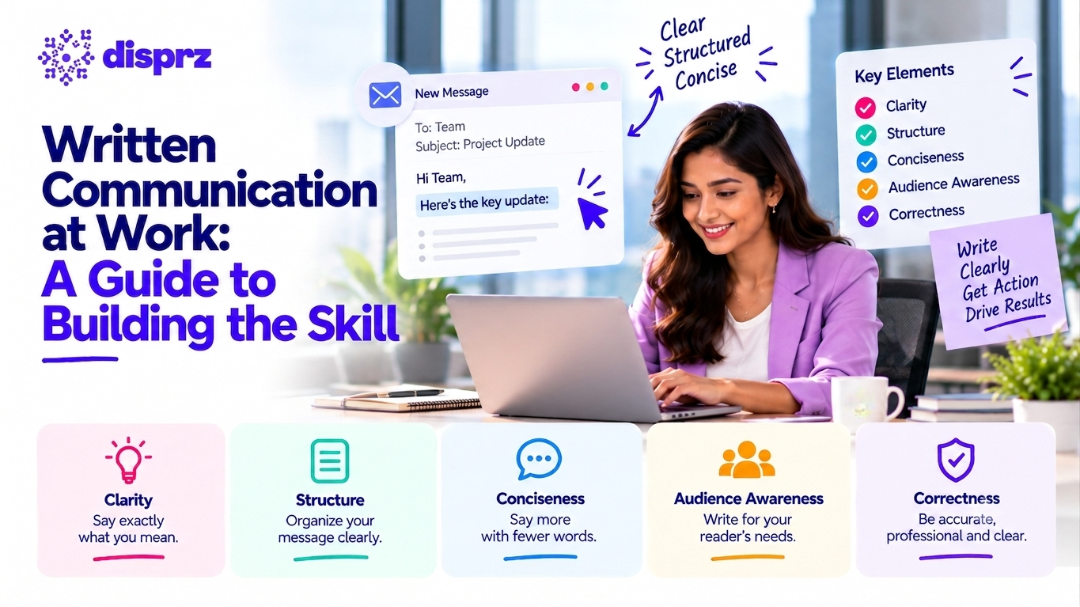
Written communication is the ability to convey information clearly and accurately in text so the reader can act on it without a follow-up. It rests on five core skills: clarity, structure, conciseness, audience awareness, and correctness. For an enterprise, it is trainable and measurable: define the observable standard, teach practical habits such as BLUF (bottom line up front), practise on real work with feedback, and track it through document review, before-and-after samples, and the business metrics it moves, such as reply cycles, ticket reopens, and error rates.
Key highlights
- Definition: written communication is conveying information clearly and accurately in text so a reader can act on it.
- Five core skills: clarity, structure, conciseness, audience awareness, and correctness.
- Why it matters: weak writing costs re-reads, back-and-forth, rework, and errors across every role in the business.
- It is trainable: writing responds to standards, practice on real work, and feedback, not just talent.
- It is measurable: document review, before-and-after samples, and cycle metrics make writing trackable across a workforce.
The business case for written communication
Most enterprises treat writing as something people either can or cannot do, and leave it out of the training plan entirely. Then a status report buries the one decision it needed, a customer email creates three more tickets, or a policy change is misread across a region because the message was ambiguous. Every one of those is a written communication gap, and it is expensive precisely because it is invisible: the cost shows up as re-reads, clarifying replies, rework, and errors rather than as a line item.
The good news for an L&D team: writing is not a fixed talent. It is a set of habits you can define, train, and measure across a workforce. This guide sits within the broader workplace communication L&D guide and focuses specifically on the written half. It shows how to build the skill and prove it moved.
What is written communication?
Written communication is the ability to convey information, ideas, and instructions clearly and accurately in text so the reader understands and can act without needing a follow-up. At work it shows up as emails, chat messages, reports, proposals, support responses, documentation, and policies that land the first time.
Written communication is distinct from verbal communication: the reader has no tone of voice or body language to fall back on, so the words have to carry the whole message. It is a core soft skill and works alongside its siblings, including verbal communication and presentation skills.
What are the core written communication skills?
Strong writing at work comes down to five core skills. Use these as the competencies you assess and train against, rather than treating writing as one vague quality.
| Skill | What it is | Observable behaviour at work |
|---|---|---|
| Clarity | Saying exactly what you mean, once | One idea per sentence, no ambiguity about the ask |
| Structure | Ordering the message so it is easy to follow | Bottom line first, then supporting detail and next steps |
| Conciseness | Cutting words that do not earn their place | A short email that still answers everything |
| Audience awareness | Writing for the reader's context and needs | A brief for an executive reads differently to a spec for an engineer |
| Correctness | Accuracy in facts, grammar, and tone | Right numbers, clean grammar, professional but human tone |
Lead with BLUF. The single highest-leverage habit is bottom line up front (BLUF): open with the decision, request, or headline before the background. A reader who sees the point in the first line can act immediately, and everyone below them in the thread saves a re-read. Train BLUF first, because it improves structure and conciseness at the same time.
Business-writing basics that apply everywhere
On top of the five skills, a handful of business-writing basics travel across every format, from a one-line chat message to a board paper.
- State the purpose in the first line. Tell the reader what this is and what you need.
- One message, one ask. If there are three requests, they will lose two. Split them or number them.
- Front-load the action. Put deadlines, owners, and next steps where they cannot be missed.
- Write for the skim. Short paragraphs, headings, and lists, because busy readers scan before they read.
- Prefer plain words. Say "use", not "utilise"; cut jargon that does not add meaning.
- Proof before you send. A wrong figure or a mis-sent name costs more than the minute it takes to check.
Why written communication matters, by industry
Weak writing costs something different in each sector. Naming the payoff in each is how you get a training budget approved.
| Industry | Pain when writing is weak | Payoff when writing is trained |
|---|---|---|
| BFSI | Ambiguous customer emails trigger complaints and compliance risk | Clear, accurate correspondence, fewer disputes and re-contacts |
| Retail & ecommerce | Vague product and support copy drives returns and tickets | Precise responses that resolve on first reply |
| Food services & hospitality | Muddled shift notes and guest replies erode service | Consistent handovers and composed guest responses |
| Manufacturing & automotive | Unclear work instructions cause errors and safety incidents | Unambiguous SOPs and reports, fewer costly mistakes |
| Pharma & healthcare | Imprecise documentation creates clinical and regulatory risk | Accurate records and handovers that stand up to audit |
| IT & ITeS | Poor tickets, PRs, and specs slow delivery and rework | Clear written handoffs that cut cycle time and reopens |
What the research says about written communication and training
Three independent findings make the enterprise case for training communication skills, not just hiring for them.
Demand: communication is a core skill employers now expect
The World Economic Forum's Future of Jobs Report 2025 names communication among the core skills employers prioritise, alongside analytical thinking, resilience, and leadership. The same report projects that 39% of workers' core skills will change by 2030 and that 59% of the global workforce will need reskilling or upskilling, which puts human skills such as clear writing firmly on the training agenda.
Trainability: human skills respond to well-designed training
This is the finding that matters most for L&D. Meta-analyses of soft-skill training show a consistent, moderate positive effect on the skill being taught. A meta-analysis by Mattingly and Kraiger (2019), covering dozens of studies, found a moderate positive effect of training, robust across participant gender, study location, and study design. An earlier meta-analysis by Hodzic and colleagues (2018) reached the same conclusion and found that ability-based programmes, which teach and practise specific behaviours, outperform generic awareness sessions. Both studied emotional intelligence, but the design lesson generalises to written communication: teach a specific, practisable standard rather than run a one-off talk.
Design implication. The evidence favours structured, practice-based programmes over one-off workshops, which is exactly why the eight-week rollout below builds in practice on real documents, feedback, and reinforcement.
First-party evidence: outcomes at enterprise scale
Across 47 Disprz enterprise deployments, learning programmes reached a median 88% course completion and 85% platform adoption, with documented outcomes including a 10% skills improvement and 15% business growth. See the full, sourced Disprz Skills Impact dataset for the method and the customers behind those figures.
What good and poor written communication look like at work
The difference is always visible in the text itself, which is what makes it trainable and assessable.
| Situation | Poor writing | Strong writing |
|---|---|---|
| Asking for a decision by email | Buries the ask in paragraph four | Leads with the decision needed and the deadline |
| A status update to a sponsor | Lists activity with no bottom line | Headline first: on track, one risk, one ask |
| A support reply to a customer | Jargon-heavy, creates three follow-ups | Plain, complete, resolves on first reply |
| A work instruction or SOP | Ambiguous steps, assumes context | Numbered, unambiguous, testable steps |
Adapting written communication by role
Good writing changes shape for the reader, so training has to be tailored, not one generic workshop. Here is the behaviour shift to coach for each audience.
Individual contributors and junior staff
Focus on clarity and structure: one ask per message, the point in the first line, and proofing before sending. A junior writing to a client should be warmer and more explanatory; the same person briefing their own manager should be shorter and more direct. Teaching that deliberate shift early prevents a lot of re-reads later.
Managers writing to a team
Focus on audience awareness and conciseness: announcements that state the change and the why, feedback in writing that is specific and actionable, and instructions that a busy team can follow without a meeting. Managers set the house style by example, so their writing matters twice.
Writing for senior leadership (managing up)
Focus on BLUF and ruthless structure: lead with the decision or recommendation, put the detail in an appendix, and never make an executive hunt for the ask. A one-page brief that opens with the recommendation and the risk is worth more than a five-page report that builds to it.
Customer and client-facing (frontline)
Focus on correctness and empathy under time pressure: accurate, complete, on-brand replies written fast. This is where frontline enablement and short mobile practice matter most, because the reply is live and a template only goes so far.
How do you improve written communication?
- Lead with BLUF: open every message with the decision, request, or headline before the background.
- One ask per message: if there are several requests, number them or split the message.
- Write, then cut: draft freely, then remove a quarter of the words. Conciseness is an edit, not a first draft.
- Name the reader: before sending, ask who reads this and what they need to do next.
- Read it aloud: anything you stumble over is a sentence the reader will too.
- Use structure cues: headings, short paragraphs, and lists so the message survives a skim.
- Keep a template library: reusable openings for common messages raise the floor for everyone.
- Proof the facts, not just the grammar: check names, numbers, and dates before you send.
Quick written communication self-check
Rate each statement from 1 (rarely true) to 5 (almost always true). It is a directional prompt, not a validated test, but it shows which of the five core skills to prioritise.
- My messages say exactly what I mean, with no ambiguity about the ask.
- I lead with the bottom line and order the rest so it is easy to follow.
- I cut words that do not earn their place before I send.
- I adapt tone and detail to the reader in front of me.
- I check facts, grammar, and tone before anything goes out.
How do you measure written communication?
Writing feels intangible only until you tie it to the document and the outcome. Measure it on three levels.
- Document review: score real messages against a rubric on the five core skills, before and after training.
- Before-and-after samples: a held sample of each person's writing, blind-scored, shows movement rather than opinion.
- Peer and manager feedback: since writing is judged by whether the reader could act, ask the readers.
- Business signals: track the metrics writing moves, such as email reply cycles, ticket reopens and first-reply resolution, rework on documents, and error rates in records.
Benchmark to hold. Do not report a single "writing score". Report movement on specific skills, such as clarity and structure, by role and team, so you can see where coaching is working and where it is not.
How long does it take to build written communication?
Set realistic expectations with sponsors so the programme is not judged too early.
- Awareness: 2 to 4 weeks with a baseline sample and a first workshop.
- New habits: 1 to 3 months of applied practice on real documents and feedback.
- Visible team change: 3 to 6 months as BLUF and structure become default.
- Measurable business impact: 6 to 12 months on reply cycles, reopens, and error rates.
Turn written communication into a training programme
A single writing workshop rarely changes behaviour. Run it as a structured programme with practice on real work and reinforcement built in. This eight-week rollout works across desk and frontline teams.
| Week | Focus | Activity |
|---|---|---|
| 1 | Baseline | Collect a writing sample, score against the rubric, set goals by role |
| 2 | Clarity | Microlearning + rewrite drills on real messages |
| 3 | Structure and BLUF | Bottom-line-up-front practice, before-and-after on live emails |
| 4 | Conciseness | Cut-the-draft exercises, manager 1:1 on a real document |
| 5 | Audience awareness | Same message re-written for three audiences, feedback |
| 6 | Apply | Real-work writing challenge, AI coaching on drafts |
| 7 | Reinforce | Nudges, peer review, template library rollout |
| 8 | Re-measure | Repeat the rubric on a fresh sample, report movement |
Tools and enablers
Match a tool to each stage rather than buying one and hoping.
- Assessment: writing rubrics and blind before-and-after sampling for baseline and re-measure.
- Delivery: an LMS for structured paths and mobile microlearning.
- Discovery: an LXP with skills intelligence to map writing standards to roles.
- Practice: rewrite drills and scenario writing, delivered on mobile for frontline.
- Coaching: an AI coach that gives feedback on real drafts against your standard.
- Analytics: dashboards that report skill movement by team.
Results at scale
Skill change shows up in numbers when the programme is run properly and reinforced. These are outcomes enterprises have seen running skills programmes on Disprz.
Behind an 8X return on the learning investment sits a simple pattern: programmes that actually finish, because they are short, mobile, and reinforced. Across 47 Disprz enterprise deployments, learning programmes reached a median 88% course completion and 85% platform adoption. See the full, sourced Disprz Skills Impact dataset.
Customer story: SMBC Indonesia. The bank digitised workforce learning across its 6,500 employees on Disprz, reaching 90%+ platform adoption, 75%+ module completion, and 64%+ monthly active users. It shows what a skills-first programme, the kind a written communication rollout sits inside, sustains at scale in a large, regulated, document-heavy business. Read the SMBC Indonesia case study.
How Disprz helps you build written communication at scale
The hard part of writing training is not the content, it is running it across thousands of people, in many roles and languages, and proving their documents actually improved. Disprz brings the LMS, LXP and skills intelligence, and frontline enablement into one platform so each stage of the programme lives in one place.
| Programme stage | What Disprz does | Outcome you can show |
|---|---|---|
| Map | Skills intelligence links the five writing skills to each role and surfaces the gap | A baseline by role, team, and region |
| Build | Turo converts your playbooks and style guide into writing microlearning and drills | A curriculum stood up in days, not a quarter |
| Deliver | Mobile-first delivery, online and offline, for desk and frontline alike | Reach that includes the frontline, not just HQ |
| Practice | Rewrite and scenario-writing modules on real message types | Habits rehearsed on the writing people actually do |
| Coach | AI coaching gives feedback on real drafts against your standard | Coaching at a scale managers cannot cover alone |
| Reinforce | Nudges, spaced reminders, and a template library in the flow of work | A house style that survives past the workshop |
| Measure | Writing rubrics, before-and-after samples, and progression analytics | Movement on the skill, tied to reply cycles and reopens |
Because the five writing skills are mapped as skills, not just course completions, you can prove progression rather than attendance. That is the difference between a training line item and a capability you can report to the board.
- Role-to-skill mapping for the five writing skills
- Microlearning and rewrite practice on mobile, including offline
- AI coaching feedback on real drafts
- Writing rubrics and before-and-after sampling built in
- Nudges, a template library, and reinforcement in the flow of work
- Progression analytics by role, team, and region
Turo, the agentic authoring layer, converts your existing style guide and playbooks into microlearning 80% to 90% faster than manual builds, so a writing curriculum does not take a quarter to stand up. Enterprises running skills programmes on Disprz sustain 45%+ frontline completion against an industry average below 30%, which is what makes a soft-skills rollout actually finish.
Where to start. Pick one role and the two writing skills that hurt most, usually clarity and structure, map them in skills intelligence, and run the eight-week programme above as a pilot. Prove the movement, then scale it across the workforce.
Key takeaways
- Written communication is trainable and measurable, not a fixed talent.
- Train against the five core skills: clarity, structure, conciseness, audience awareness, and correctness.
- Teach BLUF first: leading with the bottom line improves structure and conciseness at once.
- Tailor the training by role: clarity for juniors, audience awareness for managers, BLUF for leadership, correctness at speed for frontline.
- Measure with document review and before-and-after samples, and tie it to reply cycles, reopens, and error rates.
- Run it as an eight-week programme with practice on real work and reinforcement, not a one-off workshop.
Where should you start?
Written communication is the skill your workforce exercises more than any other, and the one most often left untrained. For an enterprise, the win is not a single workshop but a repeatable programme that defines the standard, teaches habits such as BLUF, practises them on real documents, and proves the change. Start with the two skills that hurt most in your context, usually clarity and structure, make the standard observable, and build from there.
Reviewed for accuracy on 22 Sep 2026.
Written communication FAQs
The questions L&D and people leaders ask most often.
What is written communication?
Written communication is the ability to convey information, ideas, and instructions clearly and accurately in text so the reader understands and can act without a follow-up. At work it covers emails, chat, reports, proposals, support responses, documentation, and policies.
What are examples of written communication?
Emails, instant messages, reports and status updates, proposals and business cases, customer support replies, product and technical documentation, work instructions and SOPs, meeting notes, and policies. Anything where the message is carried in text rather than speech.
How do you improve written communication?
Lead with the bottom line (BLUF), keep one ask per message, draft then cut, name the reader before you send, use headings and lists so it survives a skim, and proof facts as well as grammar. Across a team, set a written standard, practise it on real documents, and give feedback against a rubric.
What makes good business writing?
Good business writing states its purpose in the first line, puts the bottom line up front, uses plain words, carries one clear ask, and is accurate in facts, grammar, and tone. It is written for the reader to skim and act on, not to admire.
Can written communication be trained?
Yes. Writing improves with a clear standard, deliberate practice on real work, specific feedback, and reinforcement. The key is to define the observable standard, deliver short applied practice, coach against real drafts, and re-measure rather than run a single workshop.
How do you measure written communication in a workforce?
Through document review scored against the five core skills, blind before-and-after writing samples, peer and manager feedback, and the business metrics writing moves, such as email reply cycles, ticket reopens and first-reply resolution, rework, and error rates.
Sources
- Disprz. Disprz Skills Impact Dataset, 2026. First-party learning and skills outcomes from 47 enterprise deployments. disprz.ai/skills-impact
- World Economic Forum. Future of Jobs Report 2025. January 2025. weforum.org
- Mattingly, V. and Kraiger, K. Can emotional intelligence be trained? A meta-analytical investigation. Human Resource Management Review, 29(2), 2019. Cited for the moderate positive effect of structured soft-skill training.
- Hodzic, S., Scharfen, J., Ripoll, P., Holling, H. and Zenasni, F. How efficient are emotional intelligence trainings: A meta-analysis. Emotion Review, 10(2), 2018. Cited for the advantage of ability-based over awareness-only programmes.
- Disprz master value benchmarks (8X ROI, 50% productivity, 7X CSAT) and frontline completion data, 2026. Aggregated enterprise deployment data.
About the authors


Madhu Karunakaran
Vice President - People & Culture
Madhu Karunakaran is a senior HR and Learning & Development (L&D) leader with 20+ years of experience spanning people strategy, organizational development (OD), talent management, leadershi...
Reviewed for accuracy on 21 Sep 2026