

On this page
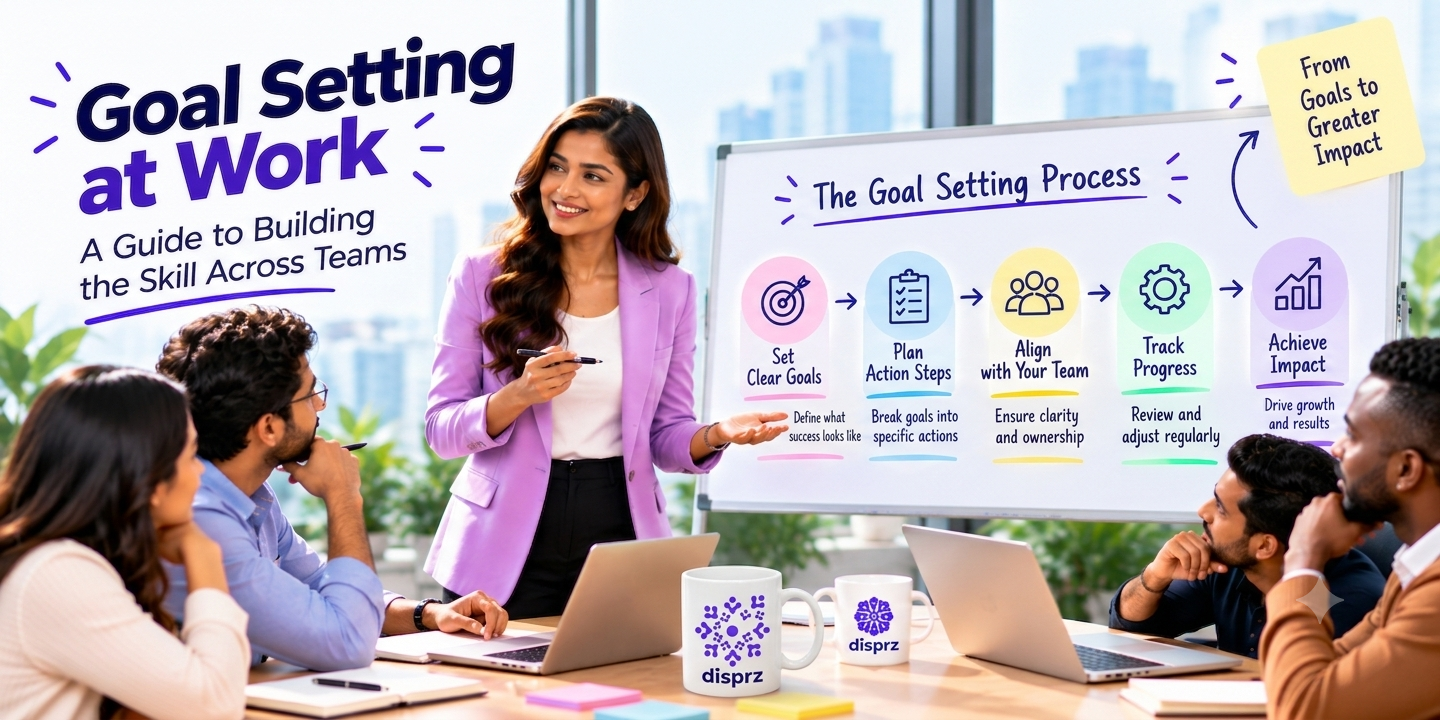
Goal setting is the skill of defining clear, measurable outcomes and aligning them to strategy so that individuals and teams know what to achieve and by when. The main methods are SMART goals, OKRs, KPIs, stretch goals, and cascading (aligned) goals, each suited to a different job. For an enterprise, goal setting is trainable and measurable: teach a shared method, cascade objectives from strategy to individual development plans, set a review cadence, and track completion, alignment, and the business outcomes goals are meant to move.
Key highlights
- Definition: goal setting is defining specific, measurable outcomes and aligning them to strategy and a timeframe.
- Five methods: SMART goals, OKRs, KPIs, stretch goals, and cascading (aligned) goals, each with a best use.
- Why it matters: clear goals drive focus, prioritisation, and accountability, and connect daily work to strategy.
- It is trainable: a shared goal-setting method and a review cadence can be taught and reinforced across a workforce.
- It is measurable: goal-quality rubrics, completion and alignment rates, and the business KPI each goal moves make it trackable.
The business case for goal setting
Most enterprises set goals once a year, write them down, and never look at them again until review season. Teams then work hard on the wrong things, priorities drift, and no one can say whether the year actually moved the strategy. That is not a motivation problem. It is a goal-setting skills gap, and it is expensive because it shows up as wasted effort, missed targets, and disengaged people who cannot see how their work matters.
The good news for an L&D team: goal setting is not an innate talent. It is a set of skills you can define, train, and measure across a workforce, from the method people use to write a goal to the cadence by which they review it. This guide shows how.
What is goal setting?
Goal setting is the practice of defining specific, measurable outcomes, aligning them to a wider strategy, and setting a timeframe and owner for each. At work it shows up as writing a goal that is clear enough to know when it is met, connecting an individual's objectives to team and company priorities, and reviewing progress on a regular cadence rather than only at year end.
Good goal setting is more than wishing for a result. It is a repeatable method that turns strategy into prioritised, trackable work. It is a core soft skill and underpins several others, including time management and leadership, because you cannot prioritise time or lead a team without clear goals to point them at.
The goal-setting methods, and when to use each
There is no single "right" way to set a goal. There are recognised methods, each built for a different job. Teach your workforce which one fits which situation, rather than defaulting to whatever the last template used.
| Method | What it is | Best use |
|---|---|---|
| SMART goals | A goal that is Specific, Measurable, Achievable, Relevant, and Time-bound | Individual and team goals where clarity and accountability matter most |
| OKRs | A qualitative Objective paired with a few quantitative Key Results | Aligning ambitious, cross-functional priorities each quarter |
| KPIs | Ongoing metrics that track the health of a role, team, or process | Monitoring steady-state performance, not one-off change |
| Stretch goals | Deliberately ambitious targets beyond current capacity | Driving innovation and step-change, where partial success is a win |
| Cascading (aligned) goals | Goals that flow from company to team to individual so each level supports the one above | Connecting daily work to strategy across a large workforce |
Methods combine. Most enterprises use more than one: OKRs to set direction each quarter, SMART goals to make individual objectives concrete, KPIs to watch the ongoing numbers, and cascading to keep it all aligned. Train the method, not just the template.
Why goal setting matters, by industry
Clear goals pay off differently across the Disprz ICP. Naming the payoff in each sector is how you get a training budget approved.
| Industry | Pain when goal setting is weak | Payoff when it is trained |
|---|---|---|
| BFSI | Sales and service targets set in isolation, effort scattered | Cascaded targets, clear priorities, measurable pipeline |
| Retail & ecommerce | Store and category goals drift from the season plan | Aligned peak-season goals, faster course correction |
| Food services & hospitality | Vague service goals no one can act on at shift level | Concrete, measurable shift goals tied to CSAT |
| Manufacturing & automotive | Output and safety goals disconnected from plant KPIs | Cascaded KPIs, clearer ownership on the floor |
| Pharma & healthcare | Compliance and quality goals lost in annual reviews | Reviewed cadence keeps critical goals live |
| IT & ITeS | Delivery teams optimise locally, miss the wider objective | OKRs align squads to the company outcome |
What the research says about goal setting and training
Three independent findings make the enterprise case for training goal setting, not just assuming people can do it.
Demand: self-management is now a core skill
The World Economic Forum's Future of Jobs Report 2025 names self-management skills, including self-efficacy and the ability to set and pursue objectives, among the core skills rising in importance, alongside resilience, flexibility, and analytical thinking. The same report projects that 39% of workers' core skills will change by 2030 and that 59% of the global workforce will need reskilling or upskilling, which puts structured self-management and goal-setting skills firmly on the training agenda.
Performance: clear goals drive results
Decades of goal-setting research, most associated with Edwin Locke and Gary Latham, established that specific and suitably challenging goals lead to higher performance than vague "do your best" goals, provided the person is committed and gets feedback. The practical lesson for an enterprise is that the quality of the goal, how specific, measurable, and aligned it is, is itself a lever on output, not just an admin exercise.
Trainability: self-management skills respond to training
This is the finding that matters most for L&D. Meta-analyses of self-management and emotional capability training, including Mattingly and Kraiger (2019) and Hodzic and colleagues (2018), found a moderate positive effect of structured training on these human skills, and that programmes teaching and practising specific behaviours outperform generic awareness sessions. Goal setting behaves the same way: a taught method, applied to real objectives with feedback, changes how people set goals, where a one-off talk does not.
Design implication. The evidence favours structured, practice-based programmes over one-off workshops, which is exactly why the eight-week rollout below builds in practice, coaching, and a review cadence.
What good and poor goal setting look like at work
The difference is always visible in the goal itself, which is what makes it trainable and assessable.
| Situation | Poor goal | Good goal |
|---|---|---|
| A sales team target | "Sell more this quarter" | "Close 15 new logos worth 500k by 31 Mar" |
| A support quality aim | "Improve customer service" | "Lift CSAT from 78% to 85% by Q3" |
| An individual development plan | "Get better at leadership" | "Run 6 team 1:1s a month and lead one project by June" |
| A company priority | "Focus on the frontline" | "Reach 45% frontline course completion by year end" |
Adapting goal setting by role
Goal setting looks different at each level, so training has to be tailored, not one generic workshop. Here is the behaviour shift to coach for each audience.
Individual contributors and junior staff
Focus on writing a SMART goal and connecting it to the team objective above it. The shift is from a vague to-do ("help with the launch") to a specific, measurable, time-bound outcome captured in an individual development plan (IDP) that they own and review.
Managers leading a team
Focus on cascading and alignment: translating the company or department objective into a handful of team goals, then helping each report set individual goals that ladder up to them. Managers also own the review cadence, the regular check-in that keeps goals live rather than annual.
Senior leadership (managing up)
Focus on setting the objectives everything else cascades from, and on modelling the method. When a leader frames a priority as a clear OKR with two or three measurable key results, the whole organisation gets a template to follow. A junior briefing an executive should present a goal with its metric and timeframe; the executive should reply with how it aligns to the company objective. That deliberate discipline is goal setting in action.
Customer and client-facing (frontline)
Focus on short, concrete, shift-level goals tied to a KPI the person can influence, such as resolution time or CSAT. This is where frontline enablement and short mobile nudges matter most, because goals have to be simple enough to act on mid-shift with no time to reflect.
How do you set goals at work?
A practical goal-setting routine anyone can be taught. Use these as the techniques you train and reinforce, not a one-off checklist.
- Start from the level above: read the team or company objective first, then write goals that ladder up to it. Alignment before ambition.
- Make it SMART: specific, measurable, achievable, relevant, and time-bound. If you cannot name the number and the date, it is not a goal yet.
- Limit the count: three to five goals per person per cycle. More than that and nothing is a priority.
- Separate KPIs from goals: KPIs monitor the steady state, goals drive change. Do not dress one up as the other.
- Use a stretch goal deliberately: mark it as a stretch so partial progress counts as a win, not a failure.
- Write it down and make it visible: a goal no one can see is a goal no one is accountable for.
- Set a review cadence: a fixed weekly or fortnightly check-in on progress and blockers, not just an annual review.
- Capture it in an IDP: tie development goals to an individual development plan so growth is planned, not accidental.
Quick goal-setting self-check
Rate each statement from 1 (rarely true) to 5 (almost always true). It is a directional prompt, not a validated assessment, but it shows which part of goal setting to prioritise.
- My goals are specific enough that I know exactly what "done" looks like.
- Every goal I set has a number and a date attached.
- My goals clearly ladder up to my team or company objectives.
- Each of my goals has a single, named owner.
- I review progress on my goals on a regular cadence, not just at year end.
How do you measure goal setting?
Goal setting feels intangible only until you tie it to goal quality and outcomes. Measure it on three levels.
- Goal-quality rubric: score a sample of goals against SMART criteria and alignment, before and after training.
- Alignment rate: the share of individual goals that clearly ladder up to a team or company objective (cascading working).
- Review cadence adherence: how often goals are actually reviewed and updated, not just set once.
- Business signals: track the metrics the goals were meant to move, such as completion rates, sales targets hit, CSAT, and IDP progression.
Benchmark to hold. Do not report only "goals set". Report goal quality and alignment by team, and the outcome each goal set out to move, so you can see where the method is landing and where it is not.
How long does it take to build goal-setting skill?
Set realistic expectations with sponsors so the programme is not judged too early.
- Awareness: 2 to 4 weeks to teach the method and rewrite existing goals.
- New habits: 1 to 3 months of applied practice and a live review cadence.
- Visible team change: 3 to 6 months as alignment and goal quality stick.
- Measurable business impact: 6 to 12 months on the outcomes goals were set to move.
Turn goal setting into a training programme
A single workshop rarely changes behaviour. Run goal setting as a structured programme with practice and a review cadence built in. This eight-week rollout works across desk and frontline teams.
| Week | Focus | Activity |
|---|---|---|
| 1 | Baseline | Audit existing goals against a quality rubric, set the method |
| 2 | The methods | Microlearning on SMART, OKRs, KPIs, stretch, and cascading |
| 3 | Write SMART goals | Rewrite each person's goals, manager review |
| 4 | Cascade and align | Ladder individual goals up to team and company objectives |
| 5 | IDPs | Build individual development plans, tie growth goals in |
| 6 | Review cadence | Run the first structured check-in, AI coaching on goal quality |
| 7 | Reinforce | Nudges, peer review, manager check-in on progress |
| 8 | Re-measure | Re-score goal quality and alignment, report movement |
Tools and enablers
Match a tool to each stage rather than buying one and hoping.
- Assessment: goal-quality rubrics and alignment checks for baseline and re-measure.
- Delivery: an LMS for structured paths and mobile microlearning on the methods.
- Discovery: an LXP with skills intelligence to link goals and IDPs to role skills.
- Practice: goal-writing and cascading exercises on real objectives, on mobile for frontline.
- Coaching: an AI coach that gives feedback on goal quality and alignment.
- Analytics: dashboards that report goal quality, alignment, and cadence by team.
Results at scale
Better goal setting shows up in numbers when the programme is run properly and reinforced. These are outcomes enterprises have seen running skills programmes on Disprz.
Across 47 Disprz enterprise deployments, learning programmes reached a median 88% course completion and 85% platform adoption, with documented outcomes including a 10% skills improvement and 15% business growth. See the full, sourced Disprz Skills Impact Index.
Customer story: Department of Finance, Abu Dhabi. The Financial Services organisation, with 500+ employees, used Disprz to map 70% of its custom job roles to skills, and drove a 10% improvement in workforce skills in a few quarters at 92%+ engagement. It shows what a goal-aligned, skills-first programme, the kind a goal-setting rollout sits inside, achieves at scale. Read the Department of Finance case study.
How Disprz helps you build goal setting at scale
The hard part of goal-setting training is not the content, it is running it across thousands of people, in many roles and languages, keeping goals aligned to strategy, and proving the method changed the work. Disprz brings the LMS, LXP and skills intelligence, and frontline enablement into one platform so each stage of the programme lives in one place.
| Programme stage | What Disprz does | Outcome you can show |
|---|---|---|
| Map | Skills intelligence links goals and IDPs to each role and surfaces the gap | A baseline of goal quality by role, team, and region |
| Build | Turo converts your playbooks into goal-setting microlearning and templates | A curriculum stood up in days, not a quarter |
| Deliver | Mobile-first delivery, online and offline, for desk and frontline alike | Reach that includes the frontline, not just HQ |
| Cascade | Objectives flow from company to team to individual and IDP | Individual goals that ladder up to strategy |
| Coach | AI coaching gives feedback on goal quality and alignment | Coaching at a scale managers cannot cover alone |
| Reinforce | Nudges, review-cadence reminders, and manager check-ins in the flow of work | Goals that stay live past the workshop |
| Measure | Goal-quality rubrics, alignment rates, and progression analytics | Movement on goal quality, tied to business outcomes |
Because goals and IDPs are mapped as skills, not just tasks, you can prove progression rather than attendance. That is the difference between a training line item and a capability you can report to the board.
- Goal and IDP mapping to role skills
- Microlearning and goal-writing practice on mobile, including offline
- AI coaching feedback on goal quality and alignment
- Cascading from company objective to individual goal
- Review-cadence nudges and reinforcement in the flow of work
- Goal-quality and alignment analytics by role, team, and region
Turo, the agentic authoring layer, converts your existing playbooks and templates into microlearning 80% to 90% faster than manual builds, so a goal-setting curriculum does not take a quarter to stand up. Enterprises running skills programmes on Disprz sustain 45%+ frontline completion against an industry average below 30%, which is what makes a soft-skills rollout actually finish.
Where to start. Pick one team, audit their current goals against a quality rubric, teach one method, and run the eight-week programme above as a pilot. Prove the movement in goal quality and alignment, then scale it across the workforce.
Key takeaways
- Goal setting is a trainable, measurable skill, not an innate talent or an annual admin task.
- Teach the methods and when to use each: SMART, OKRs, KPIs, stretch, and cascading goals.
- Tailor the training by role: SMART goals and IDPs for juniors, cascading and cadence for managers, objective-setting for leaders, simple KPIs for frontline.
- Measure goal quality and alignment, not just goals set, and tie each goal to the outcome it should move.
- Run it as an eight-week programme with practice and a live review cadence, not a one-off workshop.
Where should you start?
Goal setting is the discipline that decides whether your strategy turns into work people actually do. For an enterprise, the win is not a single workshop but a repeatable programme that teaches a shared method, cascades objectives to the individual, sets a review cadence, and proves the change. Start with one team, audit their goals against a quality rubric, and build from there.
Reviewed for accuracy on 22 Sep 2026.
Goal-setting FAQs
The questions L&D and people leaders ask most often.
What are SMART goals?
SMART goals are goals that are Specific, Measurable, Achievable, Relevant, and Time-bound. The criteria turn a vague intention into a clear, trackable outcome with a number and a date, which is why SMART is the most widely used method for individual and team goals.
What is the difference between OKRs and SMART goals?
SMART is a way to write a single, well-formed goal so it is clear and measurable. OKRs are a way to structure and align priorities: a qualitative Objective paired with a few quantitative Key Results, usually set each quarter and cascaded across teams. In practice enterprises use OKRs to set direction and SMART to make each supporting goal concrete.
What are the 5 golden rules of goal setting?
The five principles most often cited, from goal-setting theory, are clarity (specific goals), challenge (suitably ambitious), commitment (the person is bought in), feedback (regular progress signals), and task complexity (goals broken down so they stay achievable). Together they explain why specific, challenging, reviewed goals outperform vague ones.
How do you set goals at work?
Start from the objective above you, write each goal in SMART form with a number and a date, limit yourself to three to five priorities, separate KPIs from change goals, capture development goals in an IDP, make the goals visible, and set a regular review cadence rather than only checking at year end.
What is the difference between a KPI and a goal?
A KPI is an ongoing metric that tracks the health of a role, team, or process, such as CSAT or resolution time. A goal is a specific outcome you are trying to reach in a set period. KPIs tell you how the steady state is doing; goals drive a change. Do not dress one up as the other.
What are cascading goals?
Cascading (or aligned) goals flow from the company objective down to team goals and then to individual goals, so each level clearly supports the one above. Done well, every person can see how their work connects to strategy, which is the main way large enterprises keep effort aligned.
Sources
- Disprz. Disprz Skills Impact Index, 2026. First-party learning and skills outcomes from 47 enterprise deployments. disprz.ai/skills-impact
- World Economic Forum. Future of Jobs Report 2025. January 2025. weforum.org
- Mattingly, V. and Kraiger, K. Can emotional intelligence be trained? A meta-analytical investigation. Human Resource Management Review, 29(2), 2019. Evidence that structured self-management training produces a moderate positive effect.
- Hodzic, S., Scharfen, J., Ripoll, P., Holling, H. and Zenasni, F. How efficient are emotional intelligence trainings: A meta-analysis. Emotion Review, 10(2), 2018. Supports the trainability of self-management skills through practice-based programmes.
- Disprz master value benchmarks (8X ROI, 50% productivity, 7X CSAT) and frontline completion data, 2026. Aggregated enterprise deployment data.