
On this page
A management style is the pattern of behaviour a manager uses to direct, develop, and get results from a team. The most useful model, from Daniel Goleman, sets out six styles: commanding, visionary, affiliative, democratic, pacesetting, and coaching. No single style is best. Effective managers read the situation and switch. For an enterprise, style is trainable and measurable: define the observable behaviour, teach when to use each style, coach against real interactions, and track it through 360 feedback and the metrics it moves, such as retention, engagement, and productivity.
Key highlights
- Definition: a management style is how a manager directs, develops, and gets results from a team day to day.
- Six styles: commanding, visionary, affiliative, democratic, pacesetting, and coaching (Goleman's model).
- No single best style: the strongest managers flex between styles to fit the person and the moment.
- It is trainable: style flexibility responds to practice, feedback, and coaching, not just personality.
- It is measurable: behaviour rubrics, 360 feedback, and scenario assessment make style trackable across a workforce.
Why management style decides whether a new manager succeeds
Most enterprises promote their best individual performers into management and then leave the hardest part to chance: how to actually manage. The result is familiar. A brilliant engineer becomes a manager who micromanages every decision, or a warm team lead who avoids every hard conversation. Both are style problems, and both are expensive because management style is the factor employees cite most when they explain why they stayed or left.
A quick distinction before we start. This guide is about management styles, the day-to-day behaviours a manager uses to run a team: how they set direction, delegate, give feedback, and make decisions. That is related to but distinct from leadership styles, which describe the broader way a leader sets vision and influences an organisation. Management style is the closer-in, operational lens. The good news for an L&D team: like other soft skills, management style is not a fixed trait. It is a set of behaviours you can define, train, and measure across a workforce. This guide shows how.
What is a management style?
A management style is the consistent pattern of behaviour a manager uses to direct, motivate, and develop a team and get work done. It shows up in how they set expectations, make decisions, delegate, and give feedback. The strongest managers do not have one fixed style. They read the person and the situation and deliberately switch between several.
Management style sits alongside broader leadership skills and overlaps heavily with coaching skills, since coaching is itself one of the six recognised styles. Treating style as a trainable behaviour, rather than a personality you are stuck with, is what lets an enterprise build management capability at scale.
What are the six management styles?
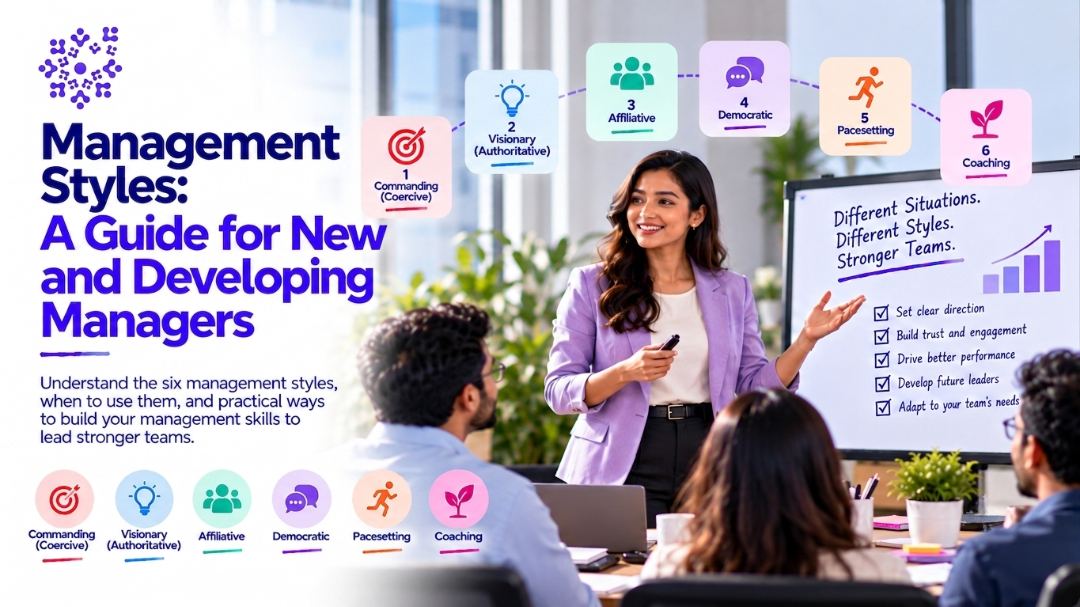
The six management styles, from Daniel Goleman's research, are commanding (coercive), visionary (authoritative), affiliative, democratic, pacesetting, and coaching. Each suits a different situation. Commanding fits a crisis, visionary fits a new direction, affiliative heals a fractured team, democratic builds buy-in, pacesetting drives a capable team hard, and coaching develops people for the future.
Use these six as the behaviours you assess and train against, rather than treating management as one vague quality. Each style has a clear best use and a clear watch-out when it is overused.
| Style | What it sounds like | Best used when | Watch-out |
|---|---|---|---|
| Commanding (coercive) | "Do what I tell you" | A crisis, a turnaround, or a serious performance issue | Erodes morale and initiative if it becomes the default |
| Visionary (authoritative) | "Come with me" | The team needs a clear new direction and a reason why | Falls flat if the manager lacks credibility with the team |
| Affiliative | "People come first" | Healing rifts, rebuilding trust, or motivating under stress | Praise-only can let poor performance drift unaddressed |
| Democratic | "What do you think?" | You need buy-in or genuine input from capable people | Endless consultation stalls decisions in a crisis |
| Pacesetting | "Do as I do, now" | A motivated, skilled team needs fast results | Overwhelms and burns out the team if sustained |
| Coaching | "Try this" | Developing people for the longer term | Wasted if the person resists learning or time is short |
On other models. You will also see older classifications such as autocratic, democratic, and laissez-faire, or the Blake and Mouton grid of task versus people focus. They map onto the six styles above. Train against observable behaviours and the situation, not the label.
Which management style is best?
No single management style is best. The research is consistent that the most effective managers use several styles and switch fluidly based on the person and the situation. Visionary, affiliative, democratic, and coaching styles tend to lift climate and results most often, while commanding and pacesetting work in the right moment but damage a team when overused. The skill to train is not picking one style, it is knowing when to flex.
Why management style matters, by industry
The cost of the wrong management style shows up differently across the Disprz ICP. Naming the payoff in each sector is how you get a training budget approved.
| Industry | Pain with the wrong style | Payoff when style is trained |
|---|---|---|
| BFSI | Command-and-control managers drive attrition among skilled advisers | Managers who coach and delegate retain talent and lift service |
| Retail & ecommerce | Store managers default to pacesetting and burn out peak teams | Flexible styles sustain peak performance without churn |
| Food services & hospitality | Shift leaders either bark orders or avoid conflict entirely | Situational managers steady the floor and raise CSAT |
| Manufacturing & automotive | Line supervisors manage by pressure, safety and morale slip | Balanced direction plus coaching improves safety and output |
| Pharma & healthcare | High-stakes teams under rigid managers hide problems | Affiliative and democratic styles surface issues early |
| IT & ITeS | Technical experts promoted to manage keep doing, not leading | New managers learn to delegate and develop, not just deliver |
What the research says about management style and training
Three independent findings make the enterprise case for training management capability, not just promoting for it.
Demand: leadership and people management are core skills
The World Economic Forum's Future of Jobs Report 2025 names leadership and social influence, and people management, among the core skills employers prioritise, alongside analytical thinking, resilience, and flexibility. The same report projects that 39% of workers' core skills will change by 2030 and that 59% of the global workforce will need reskilling or upskilling, which puts management capability firmly on the training agenda rather than leaving it to on-the-job luck.
Impact: skills programmes deliver measurable results
The first-party evidence comes from the Disprz Skills Impact dataset. Across 47 Disprz enterprise deployments, learning programmes reached a median 92% course completion and 88% platform adoption, with documented outcomes including a 10% skills improvement and 15% business growth. Management and leadership development sits inside exactly this kind of skills-first programme.
Trainability: the underlying behaviours respond to training
This is the finding that matters most for L&D. Goleman's six styles rest on emotional-intelligence competencies such as self-awareness, empathy, and self-regulation, and those competencies are trainable. A meta-analysis by Mattingly and Kraiger (2019), covering dozens of studies, found a moderate positive effect of training on emotional intelligence, robust across participant gender, study location, and study design. An earlier meta-analysis by Hodzic and colleagues (2018) reached the same conclusion and found that ability-based programmes, which teach and practise specific behaviours, outperform generic awareness sessions.
Design implication. The evidence favours structured, practice-based programmes over one-off workshops, which is exactly why the eight-week rollout below builds in practice, coaching, and reinforcement.
What good and poor management style look like at work
The difference is always visible in behaviour, which is what makes it trainable and assessable. The mark of poor management is not one bad style, it is using the same style everywhere.
| Situation | Poor: one rigid style | Good: the right style for the moment |
|---|---|---|
| A capable senior wants ownership | Micromanages every step (pacesetting) | Delegates the outcome and gets out of the way |
| A genuine crisis or outage | Opens it up for debate, loses time (democratic) | Takes clear command, decides fast (commanding) |
| A demotivated, fractured team | Pushes harder on targets (pacesetting) | Rebuilds trust first (affiliative), then direction |
| A junior ready to grow | Gives the answer to save time (commanding) | Asks questions and lets them work it out (coaching) |
Adapting management style by role
Management style has to flex not only by situation but by who is being managed and who the manager answers to. Here is the behaviour shift to coach for each audience.
Managing individual contributors and junior staff
Lean towards visionary and coaching: set a clear why, then develop skill through questions rather than instructions. Use commanding only when safety, quality, or a deadline genuinely demands it, and explain the switch so it does not read as distrust.
Managing experienced team members
Lean towards democratic and delegation: invite input, agree the outcome, and let capable people choose the approach. The failure mode here is pacesetting, where a manager keeps demonstrating rather than trusting, which stalls the very people who need room to grow.
Managing up to senior leadership
With your own leaders, regulate your signals and lead with the outcome: frame a problem with a proposed path rather than venting it, and match their pace and decision style. A new manager who brings solutions and a clear recommendation manages up well, the same skill that makes them credible when they set direction downward.
Managing customer and client-facing (frontline) teams
Frontline management blends affiliative and clear direction: acknowledge the pressure of live customer moments, then set crisp, confident expectations. This is where short mobile practice matters most, because shift leaders coach in the flow of a busy floor with no time to reflect.
How can a new manager develop their management style?
- Learn all six, then diagnose: before reaching for a style, read the person and the situation. The choice, not the habit, is the skill.
- Name your default: most managers overuse one style under pressure. Knowing yours is the first step to widening the range.
- Delegate outcomes, not tasks: hand over the result and the boundaries, not a step-by-step script. It is the fastest fix for a doer-turned-manager.
- Match feedback to the person: a growing junior needs coaching questions, a struggling performer needs clear direction. Same manager, different style.
- Practise the hard conversation: rehearse difficult feedback out loud or in role-play before the real one. Avoidance is a style failure.
- Use democratic before you decide, commanding after: gather input openly, then own the call. Mixing the two up is where teams lose trust.
- Ask for a mirror: a short 360 or a peer observation shows how your style actually lands versus how you think it does.
- Reserve pacesetting and commanding: both work in the right moment and corrode a team as a default. Spend them deliberately.
Quick management-style self-check
Rate each statement from 1 (rarely true) to 5 (almost always true). It is a directional prompt, not a validated instrument, but it shows which management behaviour to prioritise.
- I give clear direction and expectations when a task is urgent or unfamiliar.
- I coach people towards their own answers rather than solving it for them.
- I invite input and build buy-in before making a team decision.
- I delegate outcomes and let capable people choose their own approach.
- I give timely, specific feedback that people can act on.
How do you measure management style?
Management style feels intangible only until you tie it to behaviour and outcomes. Measure it on three levels.
- Behaviour rubric: score how well a manager matches style to situation, before and after training, not whether they have one favourite style.
- 360 feedback: manager, peer, and direct-report ratings, since style is judged by how the team experiences it.
- Scenario assessment: responses to realistic situations, scored against which style fits and why.
- Business signals: track the metrics style moves, such as voluntary attrition on the team, engagement scores, internal promotion rate, and productivity.
Benchmark to hold. Do not report a single "management score". Report style range and situational fit by manager and team, so you can see where flexibility is growing and where a rigid default is hurting.
Recognised management and leadership style models
Several established models describe and assess management style. Use a recognised framework rather than an ad hoc quiz for any decision that affects a person, and treat the self-check above as directional.
| Model | What it describes | Originator |
|---|---|---|
| Six leadership styles | Situational styles tied to emotional-intelligence competencies | Daniel Goleman |
| Managerial Grid | Style plotted on concern for people vs concern for results | Blake & Mouton |
| Situational Leadership | Matching style to a person's competence and commitment | Hersey & Blanchard |
| Transformational vs transactional | Inspiring change vs managing through exchange | Bass & Avolio (MLQ) |
On the self-check above. The five-statement prompt earlier in this guide is directional, useful for a quick prioritisation, not a substitute for a validated instrument when you are making development or promotion decisions.
How long does it take to develop management style?
Set realistic expectations with sponsors so the programme is not judged too early.
- Awareness: 2 to 4 weeks with a style assessment and a first workshop.
- New habits: 1 to 3 months of applied practice and coaching.
- Visible team change: 3 to 6 months as flexible styles stick.
- Measurable business impact: 6 to 12 months on retention and engagement.
Turn management styles into a training programme
A single workshop rarely changes how a manager behaves under pressure. Run management development as a structured programme with practice and reinforcement built in. This eight-week rollout works for new and developing managers across desk and frontline teams.
| Week | Focus | Activity |
|---|---|---|
| 1 | Baseline | Style self-assessment and 360, set behaviour goals by team |
| 2 | The six styles | Microlearning on each style, when to use, and the watch-out |
| 3 | Diagnose the situation | Scenario drills: read the person and pick the fit |
| 4 | Direction and delegation | Practise commanding vs delegating outcomes |
| 5 | Coaching and feedback | Coaching-question and difficult-conversation role-play |
| 6 | Apply | Real-work challenge, AI coaching on real interactions |
| 7 | Reinforce | Nudges, peer observation, skip-level check-in |
| 8 | Re-measure | Repeat rubric and 360, report movement in style range |
Tools and enablers
Match a tool to each stage rather than buying one and hoping.
- Assessment: style rubrics and 360 tools for baseline and re-measure.
- Delivery: an LMS for structured manager paths and mobile microlearning.
- Discovery: an LXP with skills intelligence to map management behaviours to roles.
- Practice: scenario and role-play for diagnosing situations, delivered on mobile for frontline.
- Coaching: an AI coach that gives feedback on real management interactions.
- Analytics: dashboards that report style range and behaviour movement by team.
Results at scale
Better management shows up in numbers when the programme is run properly and reinforced. These are outcomes enterprises have seen running skills programmes on Disprz.
Across 47 Disprz enterprise deployments, learning programmes reached a median 88% course completion and 85% platform adoption, with documented outcomes including a 10% skills improvement and 15% business growth. See the full, sourced Disprz Skills Impact dataset.
Customer story: HDFC ERGO. The Indian general insurer runs skills-first learning for its 11,000+ employees on Disprz, driving a 7X surge in learner engagement and lifting monthly active learners to 80%, up from 30%. It shows what a skills-first programme, the kind a management-development rollout sits inside, sustains at scale. Read the HDFC ERGO case study.
How Disprz helps you build management capability at scale
The hard part of management training is not the content, it is running it across thousands of new and developing managers, in many roles and languages, and proving it changed behaviour. Disprz brings the LMS, LXP and skills intelligence, and frontline enablement into one platform so each stage of the programme lives in one place.
| Programme stage | What Disprz does | Outcome you can show |
|---|---|---|
| Map | Skills intelligence links the six styles to each management role and surfaces the gap | A baseline by role, team, and region |
| Build | Turo converts your management playbooks and SOPs into microlearning and scenarios | A curriculum stood up in days, not a quarter |
| Deliver | Mobile-first delivery, online and offline, for desk and frontline managers alike | Reach that includes shift leaders, not just HQ |
| Practice | Scenario and role-play modules for diagnosing the right style | Judgement rehearsed before it is needed |
| Coach | AI coaching gives feedback on real management interactions | Coaching at a scale senior leaders cannot cover alone |
| Reinforce | Nudges, spaced reminders, and skip-level check-ins in the flow of work | Habits that survive past the workshop |
| Measure | Behaviour rubrics, 360 feedback, and progression analytics | Movement in style range, tied to retention and engagement |
Because the six styles are mapped as skills, not just course completions, you can prove progression rather than attendance. That is the difference between a training line item and a management capability you can report to the board.
- Role-to-behaviour mapping for the six management styles
- Microlearning and scenario practice on mobile, including offline
- AI coaching feedback on real management conversations
- Behaviour rubrics and 360 assessment built in
- Nudges and reinforcement in the flow of work
- Progression analytics by role, team, and region
Turo, the agentic authoring layer, converts your existing playbooks and SOPs into microlearning 80% to 90% faster than manual builds, so a management curriculum does not take a quarter to stand up. Enterprises running skills programmes on Disprz sustain 45%+ frontline completion against an industry average below 30%, which is what makes a manager rollout actually finish.
Where to start. Pick one manager population and the two situations they handle worst, map the styles those situations need in skills intelligence, and run the eight-week programme above as a pilot. Prove the movement, then scale it across the workforce.
Key takeaways
- A management style is trainable behaviour, not a fixed personality trait.
- Train against the six styles and when to use each, not one favourite approach.
- No single style is best. The skill is flexing to fit the person and the situation.
- Measure style range and situational fit with behaviour rubrics and 360 feedback, tied to retention and engagement.
- Run it as an eight-week programme with practice and reinforcement, not a one-off workshop.
Where should you start?
Management style is the human layer that decides whether a technically strong team actually performs. For an enterprise, the win is not a single workshop but a repeatable programme that defines the behaviours, teaches new managers when to switch styles, reinforces it by team, and proves the change. Start with the two situations your managers handle worst, make the right style observable, and build from there.
Reviewed for accuracy on 22 Sep 2026.
Management styles FAQs
The questions L&D and people leaders ask most often.
What are the different management styles?
The most widely used model sets out six: commanding (coercive), visionary (authoritative), affiliative, democratic, pacesetting, and coaching. Older classifications such as autocratic, democratic, and laissez-faire, or the Blake and Mouton grid of task versus people focus, map onto these six.
What are the 6 management styles?
From Daniel Goleman's research: commanding for a crisis, visionary to set a new direction, affiliative to heal a team and build trust, democratic to gain buy-in, pacesetting to drive a capable team hard, and coaching to develop people for the future. Each has a clear best use and a watch-out when overused.
Which management style is best?
No single style is best. The most effective managers use several and switch based on the person and the situation. Visionary, affiliative, democratic, and coaching styles tend to lift climate and results most often, while commanding and pacesetting work in the right moment but damage a team when they become the default.
What is the difference between leadership and management styles?
Management styles describe day-to-day behaviours for running a team: setting direction, delegating, giving feedback, and making decisions. Leadership styles describe the broader way a leader sets vision and influences an organisation. They overlap, but management style is the closer-in, operational lens. See our guide to leadership styles for the broader view.
Can management style be trained?
Yes. Style flexibility improves with deliberate practice, specific feedback, and reinforcement. The key is to define the observable behaviour for each style, teach when to use it, coach against real interactions, and re-measure, rather than run a single workshop.
How do you measure management style in a workforce?
Through behaviour rubrics that score situational fit across the six styles, 360 feedback from managers, peers, and direct reports, scenario assessments, and the business metrics style moves, such as team attrition, engagement, internal promotion rate, and productivity.
Sources
- Disprz. Disprz Skills Impact Dataset, 2026. First-party learning and skills outcomes from 47 enterprise deployments. disprz.ai/skills-impact
- World Economic Forum. Future of Jobs Report 2025. January 2025. weforum.org
- Mattingly, V. and Kraiger, K. Can emotional intelligence be trained? A meta-analytical investigation. Human Resource Management Review, 29(2), 2019.
- Hodzic, S., Scharfen, J., Ripoll, P., Holling, H. and Zenasni, F. How efficient are emotional intelligence trainings: A meta-analysis. Emotion Review, 10(2), 2018.
- Disprz master value benchmarks (8X ROI, 50% productivity, 7X CSAT, Turo 80-90% faster) and frontline completion data, 2026. Aggregated enterprise deployment data.
About the authors


Madhu Karunakaran
Vice President - People & Culture
Madhu Karunakaran is a senior HR and Learning & Development (L&D) leader with 20+ years of experience spanning people strategy, organizational development (OD), talent management, leadershi...
Reviewed for accuracy on 20 Sep 2026