
On this page
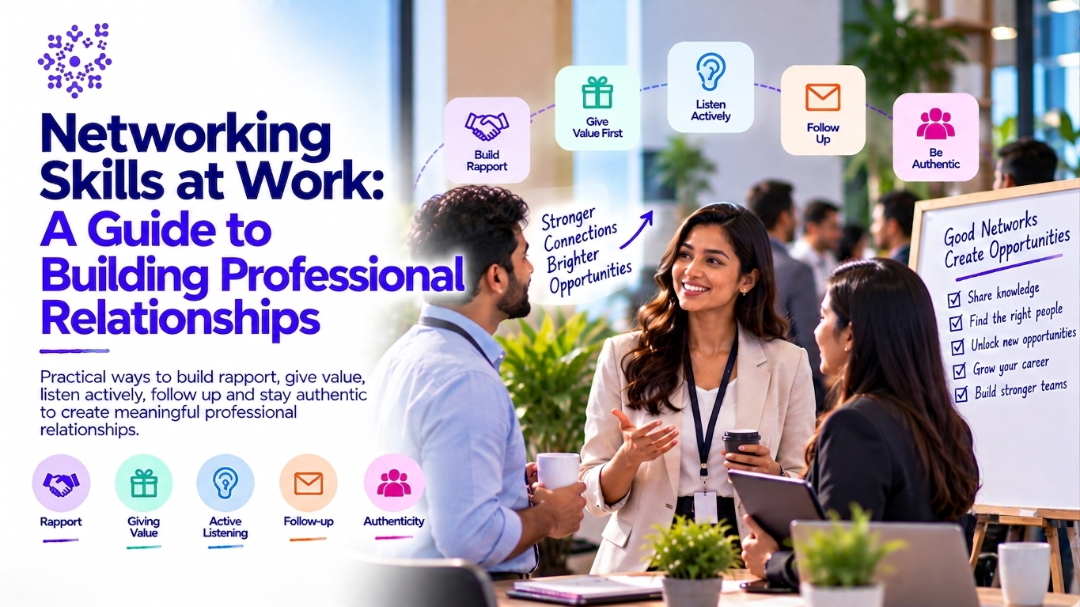
Networking skills are the abilities that let someone build and sustain useful professional relationships. They rest on five behaviours: rapport, giving value, active listening, follow-up, and authenticity. For an enterprise, networking is trainable and measurable: define the observable behaviour, teach a give-before-you-get approach, practise it internally as well as externally, and track it through relationship maps, referral and mobility data, and the business outcomes it moves.
Key highlights
- Definition: networking skills are the abilities to start, build, and maintain professional relationships that create mutual value.
- Five core skills: rapport, giving value, active listening, follow-up, and authenticity.
- Why it matters: networks decide how fast information, referrals, and opportunities move, inside the company and out.
- Internal counts most: cross-team networking often drives more day-to-day value than external events.
- It is trainable and measurable: behaviour rubrics, relationship maps, and referral or mobility data make networking trackable across a workforce.
The business case for networking skills
Most enterprises invest in the technical half of a role and assume relationships will form on their own. Then a capable specialist cannot get a cross-team project unblocked, a strong candidate is never referred, or institutional knowledge walks out the door because it lived in one person's head and one person's contacts. That is a networking gap, and it is expensive because it shows up as slow delivery, weak internal mobility, and opportunities that never reach the people who could act on them.
The good news for an L&D team: networking is not a personality you are born with. It is a set of behaviours you can define, train, and measure across a workforce, including the introverts who quietly build the strongest relationships of all. This guide shows how.
What are networking skills?
Networking skills are the abilities that let you start, build, and maintain professional relationships that create mutual value. At work they show up as building rapport quickly, offering help before you ask for it, listening to understand what someone actually needs, following up so a contact becomes a relationship, and staying genuine rather than transactional.
Networking is not the same as collecting contacts or working a room. The skill is relational, not performative: it is closer to a set of habits than a single event. It draws on several other soft skills, especially interpersonal skills, relationship building, and the composure and empathy of emotional intelligence.
What are the five core networking skills?
Treat networking as five trainable behaviours rather than one vague quality. Use these as the competencies you assess and coach against.
| Skill | What it is | Observable behaviour at work |
|---|---|---|
| Rapport | Establishing warmth and common ground quickly | Opening with genuine interest, not a pitch |
| Giving value | Offering help, introductions, or insight first | Sending a useful contact or resource unprompted |
| Active listening | Understanding what the other person needs | Asking a second question before talking about yourself |
| Follow-up | Turning a first contact into a relationship | A specific, timely note that references the conversation |
| Authenticity | Being genuine rather than transactional | Staying in touch when there is nothing to gain |
On "networking" as a dirty word. Many people resist networking because they picture forced small talk and self-promotion. Reframe it around these five behaviours, led by giving value, and it becomes something even reluctant networkers will do.
Why networking skills matter, by industry
Networking pays off differently across the Disprz ICP. Naming the payoff in each sector is how you get a training budget approved.
| Industry | Pain when networking is weak | Payoff when networking is trained |
|---|---|---|
| BFSI | Relationship managers rely on a few personal contacts that leave with them | Referrals and client trust that outlast any one banker |
| Retail & ecommerce | Store and category teams work in silos, best practice never travels | Cross-store peer networks that spread what works fast |
| Food services & hospitality | Supplier and partner relationships sit with one manager | Resilient partner networks that survive turnover |
| Manufacturing & automotive | Plants solve the same problem twice, cut off from each other | Engineer-to-engineer networks that reuse solutions |
| Pharma & healthcare | Knowledge stays trapped in specialist pockets | Cross-functional relationships that speed up handovers |
| IT & ITeS | Talent cannot find internal projects, so they leave to grow | Internal networks that fuel mobility and retention |
What the research says about networking skills and training
Three independent lines of evidence make the enterprise case for training networking, not just hoping it happens.
Demand: relationship skills are rising, not fading
The World Economic Forum's Future of Jobs Report 2025 lists networking behaviours, including relationship building and social influence, among the core skills rising in importance for the workforce, alongside resilience, leadership, and flexibility. The same report projects that 39% of workers' core skills will change by 2030 and that 59% of the global workforce will need reskilling or upskilling, which puts human, relational skills firmly on the training agenda rather than leaving them to chance.
Performance: networks decide how opportunity moves
Decades of organisational research show that people with broader, better-connected networks hear about opportunities sooner, get projects unblocked faster, and are more likely to be referred and promoted. Inside a company, the same pattern drives internal mobility: employees who are well networked across teams find their next role without leaving. The practical lesson for L&D is that networking is a lever on retention and delivery speed, not a soft extra.
Trainability: relational skills respond to well-designed training
This is the finding that matters most for L&D. Networking rests heavily on interpersonal and emotional skills, and the strongest trainability evidence comes from that adjacent research. A meta-analysis by Mattingly and Kraiger (2019), covering dozens of studies, found a moderate positive effect of training on emotional intelligence, robust across participant gender, study location, and study design. An earlier meta-analysis by Hodzic and colleagues (2018) reached the same conclusion and found that programmes which teach and practise specific behaviours outperform generic awareness sessions. The implication holds for networking: teach the observable behaviours, then practise them.
Design implication. The evidence favours structured, practice-based programmes over one-off "networking events", which is exactly why the eight-week rollout below builds in practice, coaching, and reinforcement.
What are examples of good and poor networking at work?
The difference is always visible in behaviour, which is what makes it trainable and assessable.
| Situation | Weak networking | Strong networking |
|---|---|---|
| Meeting a new colleague | Pitches own project, moves on | Asks what they are working on, offers help |
| After a useful conversation | Never follows up | Sends a specific note within 48 hours |
| Needing a cross-team favour | Cold asks a stranger under deadline | Draws on a relationship built before it was needed |
| A contact goes quiet | Only reaches out when they want something | Stays in touch with value, no agenda |
Give before you get: the habit that makes networking work
The single behaviour that separates strong networkers from card-collectors is that they lead with value. They send the useful article, make the introduction, or share the contact before they have any ask of their own. This is not selflessness for its own sake: relationships built on early, genuine help are the ones that respond when you eventually do need something. For a workforce, coaching a give-before-you-get default is the highest-leverage thing you can teach, because it removes the awkwardness that stops reluctant networkers before they start.
Adapting networking by role
Networking looks different at each level, so training has to be tailored, not one generic session. Here is the behaviour shift to coach for each audience.
Individual contributors and junior staff
Focus on internal networking and rapport: introducing themselves across teams, asking good questions, and building relationships before they need them. For client-facing juniors, add reading who the real decision-influencers are and following up consistently.
Managers building a team's network
Focus on giving value at scale and connecting people: making introductions across silos, sponsoring junior staff into the right rooms, and modelling follow-up. A manager's network becomes the team's network when they share it deliberately.
Senior leadership and executive relationships
Focus on relevance and reciprocity: leading with a clear, useful point of view, respecting time, and offering value that matches an executive's priorities rather than asking for airtime. A junior networking with a peer can be exploratory and warm; the same person networking with a leader should be concise and bring something worth the meeting. That deliberate shift is networking skill in action.
Customer and client-facing (frontline)
Focus on rapport under time pressure and consistent follow-up: building a genuine connection in a short interaction, then staying in touch so the relationship compounds. This is where frontline enablement and short mobile practice matter most, because the moment is live and there is no time to prepare.
How do you network at work?
- Start internal: map the teams you depend on and build relationships there first. Internal networks pay off daily.
- Lead with value: before any ask, offer a useful introduction, resource, or insight. Give-before-you-get is the whole game.
- Ask a second question: stay curious past the first answer. It signals genuine interest and surfaces how you can help.
- Follow up within 48 hours: a specific note that references the conversation turns a contact into a relationship.
- Keep a simple relationship list: a short record of who you know, what matters to them, and when you last spoke.
- Stay in touch with no agenda: reach out when you want nothing, so the relationship is real when you eventually do.
- Play to your strengths: introverts often network best one-to-one and in writing. Depth beats working a room.
- Make introductions: connecting two people who should know each other builds your reputation as a connector.
Quick networking skills self-check
Rate each statement from 1 (rarely true) to 5 (almost always true). It is a directional prompt, not a validated test, but it shows which of the five core skills to prioritise.
- I build warmth and common ground quickly with new people.
- I offer help or introductions before I ask for anything.
- I ask questions and listen before talking about myself.
- I follow up specifically and on time after a conversation.
- I stay in touch with contacts even when I want nothing.
How do you measure networking skills?
Networking feels intangible only until you tie it to behaviour and outcomes. Measure it on three levels.
- Behaviour rubric: score the five core skills against observable behaviours, before and after training.
- Relationship mapping: ask people to map the breadth and health of their internal and external network, and track how it grows.
- Scenario assessment: responses to realistic situations, such as a cold introduction or a re-connection, scored against a model answer.
- Business signals: track the metrics networking moves, such as internal mobility and fill rates, referrals, cross-team project speed, and voluntary attrition.
Benchmark to hold. Do not report a single "networking score". Report movement on specific behaviours by role and team, so you can see where coaching is working and where it is not.
A note on assessment
Unlike emotional intelligence, networking has no single dominant validated instrument. The practical approach is a behaviour rubric tied to the five core skills, combined with network-mapping exercises and 360 input on how a person is experienced as a connector. Treat the self-check above as directional, useful for a quick prioritisation, not a substitute for structured observation when you are making development decisions.
How long does it take to build networking skills?
Set realistic expectations with sponsors so the programme is not judged too early.
- Awareness: 2 to 4 weeks with assessment and a first workshop.
- New habits: 1 to 3 months of applied practice and follow-up routines.
- Visible network growth: 3 to 6 months as relationships compound.
- Measurable business impact: 6 to 12 months on mobility, referrals, and retention.
Turn networking into a training programme
A single "networking event" rarely changes behaviour. Run networking as a structured programme with practice and reinforcement built in. This eight-week rollout works across desk and frontline teams.
| Week | Focus | Activity |
|---|---|---|
| 1 | Baseline | Self-assessment and relationship map, set behaviour goals by role |
| 2 | Rapport | Microlearning + one internal introduction per person |
| 3 | Giving value | Give-before-you-get practice, share a useful resource or intro |
| 4 | Active listening | Curiosity drills, scenario practice in conversations |
| 5 | Follow-up | Follow-up templates, build a simple relationship list |
| 6 | Apply | Real-work challenge, AI coaching on outreach messages |
| 7 | Reinforce | Nudges, peer review, manager check-in |
| 8 | Re-measure | Repeat rubric and relationship map, report movement |
Maintaining relationships once you have built them
The hardest part of networking is not the first contact, it is the twentieth touch. Relationships decay without attention, and most people only reach out when they need something, which is exactly what makes networking feel transactional. Coach a light maintenance habit instead: a short relationship list, a recurring prompt to check in with a handful of contacts each month, and a bias toward sharing something useful rather than asking. A network that is tended quietly over years is worth far more than a burst of activity before a job search or a target.
Tools and enablers
Match a tool to each stage rather than buying one and hoping.
- Assessment: networking rubrics and relationship-mapping exercises for baseline and re-measure.
- Delivery: an LMS for structured paths and mobile microlearning.
- Discovery: an LXP with skills intelligence to map networking behaviours to roles and surface internal connections.
- Practice: scenario and role-play, delivered on mobile for frontline.
- Coaching: an AI coach that gives feedback on real outreach and follow-up messages.
- Analytics: dashboards that report behaviour movement by team.
Results at scale
Behaviour change shows up in numbers when the programme is run properly and reinforced. These are outcomes enterprises have seen running skills programmes on Disprz.
Across 47 Disprz enterprise deployments, learning programmes reached a median 88% course completion and 85% platform adoption, with documented outcomes including a 10% skills improvement and 15% business growth. See the full, sourced Disprz Skills Impact dataset.
Customer story: Yoma Bank. The Myanmar bank runs a personalised learning hub across its branches for 3,500+ employees on Disprz, delivering a 5X increase in average learning hours, 80% higher training reach, and 85% platform adoption. It shows what a skills-first programme, the kind a networking rollout sits inside, sustains across a distributed, branch-based workforce. Read the Yoma Bank case study.
How Disprz helps you build networking skills at scale
The hard part of networking training is not the content, it is running it across thousands of people, in many roles and locations, and proving it changed behaviour. Disprz brings the LMS, LXP and skills intelligence, and frontline enablement into one platform so each stage of the programme lives in one place.
| Programme stage | What Disprz does | Outcome you can show |
|---|---|---|
| Map | Skills intelligence links the five networking skills to each role and surfaces the gap | A baseline by role, team, and region |
| Build | Turo converts your playbooks and SOPs into networking microlearning and scenarios | A curriculum stood up in days, not a quarter |
| Deliver | Mobile-first delivery, online and offline, for desk and frontline alike | Reach that includes the frontline, not just HQ |
| Practice | Scenario and role-play modules for introductions, follow-up, and re-connection | Behaviour rehearsed before it is needed |
| Coach | AI coaching gives feedback on real outreach and follow-up messages | Coaching at a scale managers cannot cover alone |
| Reinforce | Nudges, spaced reminders, and manager check-ins in the flow of work | Habits that survive past the workshop |
| Measure | Behaviour rubrics, relationship maps, and progression analytics | Movement on behaviour, tied to mobility and retention |
Because the five networking skills are mapped as skills, not just course completions, you can prove progression rather than attendance. That is the difference between a training line item and a capability you can report to the board.
- Role-to-behaviour mapping for the five networking skills
- Microlearning and scenario practice on mobile, including offline
- AI coaching feedback on real outreach and follow-up
- Behaviour rubrics and relationship mapping built in
- Nudges and reinforcement in the flow of work
- Progression analytics by role, team, and region
Turo, the agentic authoring layer, converts your existing playbooks and SOPs into microlearning 80% to 90% faster than manual builds, so a networking curriculum does not take a quarter to stand up. Enterprises running skills programmes on Disprz sustain 45%+ frontline completion against an industry average below 30%, which is what makes a soft-skills rollout actually finish.
Where to start. Pick one role and the two networking skills that hurt most, map them in skills intelligence, and run the eight-week programme above as a pilot. Prove the movement, then scale it across the workforce.
Key takeaways
- Networking is a trainable, measurable skill set, not a personality you either have or lack.
- Train against the five core skills and their observable behaviours: rapport, giving value, active listening, follow-up, and authenticity.
- Lead with give-before-you-get, and start with internal networking, which drives most day-to-day value.
- Measure with behaviour rubrics and relationship maps, and tie it to mobility, referrals, and retention.
- Run it as an eight-week programme with practice and reinforcement, not a single networking event.
Where should you start?
Networking is the connective layer that decides whether your talent and knowledge actually reach the opportunities that need them. For an enterprise, the win is not a single event but a repeatable programme that defines the behaviours, trains and reinforces them by role, and proves the change. Start with the two core skills that hurt most in your context, make them observable, lead with giving value, and build from there.
Reviewed for accuracy on 22 Sep 2026.
Networking skills FAQs
The questions L&D and people leaders ask most often.
What are networking skills?
Networking skills are the abilities that let you start, build, and maintain professional relationships that create mutual value. The five core skills are rapport, giving value, active listening, follow-up, and authenticity.
How do you network at work?
Start internally by building relationships with the teams you depend on, lead with value before you ask for anything, ask questions and listen, follow up within 48 hours, and stay in touch with no agenda so the relationship is real when you need it.
Why is networking important?
Networks decide how fast information, referrals, and opportunities move, both inside a company and out. Well-networked employees find internal roles without leaving, get projects unblocked faster, and are more likely to be referred and promoted, which makes networking a lever on delivery speed and retention.
What are examples of networking?
Introducing yourself to a colleague on another team and offering help, sending a useful resource or introduction with no ask attached, following up specifically after a conversation, staying in touch with a contact when you want nothing, and connecting two people who should know each other.
Can introverts be good at networking?
Yes, and often better. Introverts tend to network well one-to-one and in writing, where depth and genuine follow-up matter more than working a crowded room. The five core skills favour listening and giving value, both of which play to quieter strengths.
Can networking skills be trained across a workforce?
Yes. Networking rests on interpersonal behaviours that respond to deliberate practice, feedback, and reinforcement. Define the observable behaviour, deliver short applied practice, coach against real outreach and follow-up, and re-measure, rather than running a single event.
Sources
- Disprz. Disprz Skills Impact Dataset, 2026. First-party learning and skills outcomes from 47 enterprise deployments. disprz.ai/skills-impact
- World Economic Forum. Future of Jobs Report 2025. January 2025. Relationship building and social influence among rising core skills; 39% of core skills changing and 59% of workers needing reskilling by 2030. weforum.org
- Mattingly, V. and Kraiger, K. Can emotional intelligence be trained? A meta-analytical investigation. Human Resource Management Review, 29(2), 2019. Evidence that interpersonal skills respond to training.
- Hodzic, S., Scharfen, J., Ripoll, P., Holling, H. and Zenasni, F. How efficient are emotional intelligence trainings: A meta-analysis. Emotion Review, 10(2), 2018. Behaviour-based programmes outperform generic awareness sessions.
- Disprz master value benchmarks (8X ROI, 50% productivity, 7X CSAT) and frontline completion data, 2026. Aggregated enterprise deployment data.
About the authors


Madhu Karunakaran
Vice President - People & Culture
Madhu Karunakaran is a senior HR and Learning & Development (L&D) leader with 20+ years of experience spanning people strategy, organizational development (OD), talent management, leadershi...
Reviewed for accuracy on 22 Sep 2026