
On this page
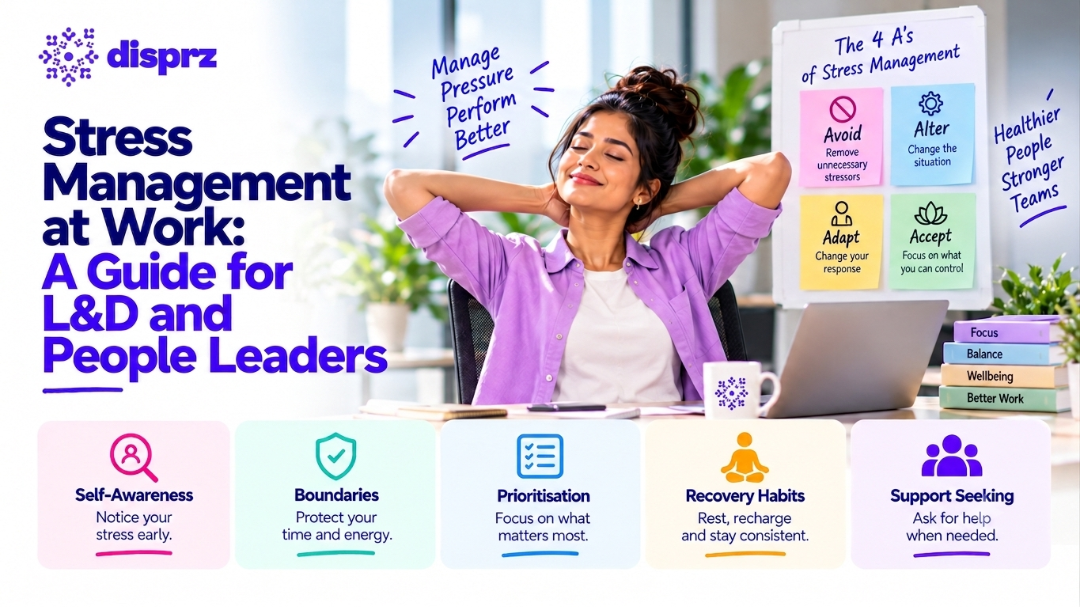
Stress management is the set of skills people use to keep pressure at a productive level rather than a harmful one. The most practical framework is the 4 A's: avoid, alter, adapt, and accept. For an enterprise it is trainable and measurable: build five core skills (self-awareness, boundaries, prioritisation, recovery habits, and support seeking), coach managers on duty of care, and track it through workload signals, engagement, and attrition. Serious or clinical stress is not an L&D problem: route it to professional support and your employee assistance programme.
Key highlights
- Definition: stress management is keeping workplace pressure within a range where people still perform and recover, using learned skills rather than willpower.
- The 4 A's: avoid, alter, adapt, and accept, the practical decision tree for any stressor.
- Five core skills: self-awareness, boundaries, prioritisation, recovery habits, and support seeking.
- Manager duty of care: managers shape workload, clarity, and psychological safety, so they are the highest-leverage audience to train.
- Know the boundary: workplace skills reduce ordinary pressure; clinical stress, burnout, and mental-health conditions need professional support and an EAP.
The business case for stress management
Most enterprises treat stress as a private problem and offer a wellness app when it spills over. But unmanaged pressure is an organisational cost: it shows up as sick days, errors on the shift floor, brittle communication, and the quiet attrition of people who simply stop coping. Left to chance, it undoes the technical training you have already paid for.
The useful reframing for an L&D team is that stress management is a skill, not a mood. It is a set of behaviours people can learn, that managers can support through workload and clarity, and that you can measure. This guide shows how to build it across a workforce, and where the line sits between a training programme and professional care.
A note on scope. This is a workplace-resilience and L&D guide, not medical advice. The skills here help with ordinary work pressure. Serious, persistent, or clinical stress, including burnout, anxiety, and depression, needs professional support. Point people to your employee assistance programme (EAP) and occupational health, and make sure managers know how to signpost rather than diagnose.
What is stress management?
Stress management is the practice of recognising pressure early and using deliberate skills to keep it at a level that supports performance rather than harming health. At work it shows up as setting boundaries on workload, prioritising under competing demands, taking real recovery, and asking for help before pressure becomes overload. A useful decision tree is the 4 A's: avoid, alter, adapt, and accept.
Some pressure is useful: it focuses attention and drives output. Stress management is not about removing pressure, it is about keeping it in the productive range and recovering from the peaks. It is a core soft skill that sits close to time management and emotional intelligence, and it underpins the wider capability people call resilience.
What are the 4 A's of stress management?
The 4 A's give people a fast way to decide what to do with a stressor instead of absorbing all of it. Teach it as a sequence: can I avoid it, alter it, adapt to it, or do I need to accept it? Use these as the competencies you coach against, not a poster.
| The A | What it means | At work |
|---|---|---|
| Avoid | Remove or step away from unnecessary stressors | Declining a low-value meeting, saying no to scope you cannot take on |
| Alter | Change the situation so it stresses you less | Renegotiating a deadline, asking a colleague to change a behaviour |
| Adapt | Change how you respond to what you cannot change | Resetting expectations, reframing a setback, adjusting standards |
| Accept | Make peace with what is out of your control | Accepting a reorganisation you cannot influence, seeking support to cope |
On the order. The 4 A's are a triage, not a ranking. Avoid and alter change the stressor; adapt and accept change your response when the stressor is fixed. Most workplace stress needs a mix, which is why the core skills below matter alongside the framework.
The five core stress-management skills
The 4 A's tell you what to do with a stressor. These five skills are what you actually train, and they map directly to the self-check further down this guide.
- Self-awareness: noticing your stress signals early, before they become errors or outbursts.
- Boundaries: protecting focus time, workload limits, and off-hours so pressure does not run unchecked.
- Prioritisation: deciding what matters most under competing demands, closely tied to time management.
- Recovery habits: deliberate rest, breaks, and switch-off routines that let people reset.
- Support seeking: asking for help from a manager, peer, or the EAP before pressure becomes overload.
Why stress management matters, by industry
Unmanaged stress costs something different in each sector. Naming the payoff in each is how you get a training budget approved.
| Industry | Pain when stress is unmanaged | Payoff when it is trained |
|---|---|---|
| BFSI | Advisers burn out under targets, errors and complaints rise | Steadier judgement, fewer costly mistakes, lower attrition |
| Retail & ecommerce | Peak-season overload breaks floor teams and service | Teams that hold up through peaks, better retention |
| Food services & hospitality | Guest-facing pressure spills into poor experiences | Composed recovery under load, higher CSAT |
| Manufacturing & automotive | Fatigue and pressure drive safety shortcuts and incidents | Alert crews, fewer incidents from rushed decisions |
| Pharma & healthcare | High-stakes work leads to burnout and turnover | Resilient teams, sustained quality in critical work |
| IT & ITeS | On-call load and deadline crunch erode retention | Sustainable pace, protected focus, lower churn |
What the research says about stress management and training
Three independent findings make the enterprise case for training these skills, not just hoping people cope.
Demand: self-management is now a core skill
The World Economic Forum's Future of Jobs Report 2025 names resilience, flexibility, and self-management, the family that stress management belongs to, among the core skills employers now prioritise. The same report projects that 39% of workers' core skills will change by 2030 and that 59% of the global workforce will need reskilling or upskilling, which puts human skills such as stress management firmly on the training agenda rather than the wellness sidelines.
Trainability: stress and coping skills respond to training
This is the finding that matters most for L&D. Meta-analyses of emotional and self-management competency training, including Mattingly and Kraiger (2019) and Hodzic and colleagues (2018), report a moderate positive effect of well-designed training on these competencies, robust across participant gender, study location, and study design. Both found that ability-based programmes, which teach and practise specific behaviours, outperform generic awareness sessions.
Design implication. The evidence favours structured, practice-based programmes over one-off wellness webinars, which is exactly why the eight-week rollout below builds in practice, manager coaching, and reinforcement.
First-party signal: what enterprises see on Disprz
Across 47 Disprz enterprise deployments, learning programmes reached a median 92% course completion and 88% platform adoption, with documented outcomes including a 10% skills improvement and 15% business growth. That is the completion and adoption base a stress-management rollout needs to actually land. See the full, sourced Disprz Skills Impact Index.
What good and poor stress management look like at work
The difference is always visible in behaviour, which is what makes it trainable and assessable.
| Situation | Unmanaged response | Managed response |
|---|---|---|
| Workload spikes past capacity | Absorbs it silently, quality slips | Names the limit, renegotiates or reprioritises |
| A tight, moving deadline | Skips breaks, works late, burns out | Prioritises ruthlessly, protects recovery |
| Pressure from a demanding client | Reacts sharply, tension escalates | Pauses, resets, handles it composed |
| A change no one controls | Ruminates, spreads anxiety to the team | Accepts what is fixed, seeks support, refocuses |
Adapting stress management by role
Stress looks different at each level, so training has to be tailored, not one generic wellness session. Here is the behaviour shift to coach for each audience.
Individual contributors and junior staff
Focus on self-awareness and boundaries: noticing early stress signals, protecting focus time, and asking for help without treating it as failure. For frontline juniors, add a simple in-the-moment reset they can use between customers or shifts.
Managers leading a team
Managers are the highest-leverage audience because they shape workload, clarity, and safety. Coach the duty of care: spotting the signs of overload, running one-to-ones that surface it early, distributing work fairly, and signposting the EAP rather than trying to counsel. A manager who protects a team's capacity prevents more stress than any individual technique.
Senior leadership (managing up)
Focus on modelling and system-level choices: leaders who take visible recovery, set realistic targets, and name their own limits give the whole organisation permission to manage pressure. The behaviour shift is from projecting relentless availability to protecting sustainable pace.
Customer and client-facing (frontline)
Focus on in-the-moment regulation and recovery between interactions: a brief reset, a way to hand off when overloaded, and clear escalation. This is where frontline enablement and short mobile practice matter most, because the pressure is live and there is no time to reflect.
What are effective stress management techniques?
- Run the 4 A's: for any stressor, ask can I avoid, alter, adapt, or accept it, before absorbing it.
- Spot your signals early: name the two or three signs that mean you are tipping into overload, and act on them.
- Set a workload boundary: make the trade-off explicit when new work arrives, rather than silently taking it all.
- Prioritise ruthlessly: use a simple most-important-task rule so pressure does not scatter your focus. See time management.
- Protect recovery: real breaks, a switch-off routine, and time away are performance tools, not indulgences.
- Use a reset: a short breathing or pause routine between demanding tasks or interactions lowers the peak.
- Ask for support early: raise pressure with a manager or peer before it becomes overload, and know where the EAP is.
- Reframe what is fixed: for stressors you cannot change, adapt the response and standards rather than fighting the situation.
Quick stress-management self-check
Rate each statement from 1 (rarely true) to 5 (almost always true). It is a directional prompt, not a clinical test, but it shows which of the five core skills to prioritise. If pressure feels unmanageable, speak to a manager or your EAP.
- I notice my stress signals before they affect my work.
- I set clear boundaries on workload and off-hours.
- I can prioritise calmly when demands compete.
- I take real recovery and switch off between peaks.
- I ask for help early rather than absorbing overload.
How do you measure stress management?
Stress management feels intangible only until you tie it to behaviour and outcomes. Measure it on three levels, and keep it anonymous and aggregated so people are honest.
- Behaviour rubric: score the five core skills against observable behaviours, before and after training.
- Workload and wellbeing signals: anonymous pulse surveys on pressure, control, and support, tracked over time.
- Manager practice: whether managers hold regular one-to-ones, redistribute work, and signpost support.
- Business signals: the metrics unmanaged stress moves, such as absence, voluntary attrition, safety incidents, and CSAT.
Benchmark to hold. Do not report a single "stress score". Report movement on specific behaviours and on workload signals by team, so you can see where the pressure is structural and needs a management fix, not just more training.
On the self-check above. The five-statement prompt is directional, useful for a quick prioritisation, and never a clinical assessment. For anything affecting a person's health or a development decision, use occupational health and your EAP, not a quiz.
How long does it take to build stress-management skills?
Set realistic expectations with sponsors so the programme is not judged too early.
- Awareness: 2 to 4 weeks with assessment and a first workshop.
- New habits: 1 to 3 months of applied practice and manager coaching.
- Visible team change: 3 to 6 months as boundaries and recovery stick.
- Measurable business impact: 6 to 12 months on absence, attrition, and CSAT.
Turn stress management into a training programme
A single wellness webinar rarely changes behaviour. Run stress management as a structured programme with practice, manager involvement, and reinforcement built in. This eight-week rollout works across desk and frontline teams.
| Week | Focus | Activity |
|---|---|---|
| 1 | Baseline | Self and pulse assessment, set behaviour goals and workload signals by role |
| 2 | Self-awareness | Microlearning on stress signals, the 4 A's introduced |
| 3 | Boundaries | Workload boundary practice, manager 1:1 on capacity |
| 4 | Prioritisation | Most-important-task drills, link to time management |
| 5 | Recovery habits | Reset routines, switch-off practice, break norms agreed |
| 6 | Support seeking | How to raise pressure early, EAP and signposting made clear |
| 7 | Reinforce | Nudges, peer check-ins, manager duty-of-care check |
| 8 | Re-measure | Repeat rubric and pulse, report movement |
Tools and enablers
Match a tool to each stage rather than buying one and hoping.
- Assessment: behaviour rubrics and anonymous pulse surveys for baseline and re-measure.
- Delivery: an LMS for structured paths and mobile microlearning.
- Discovery: an LXP with skills intelligence to map the skills to roles.
- Practice: scenario and reset practice, delivered on mobile for frontline.
- Coaching: manager enablement and an AI coach for in-the-flow feedback.
- Support: a clear route to your EAP and occupational health, surfaced in the flow of work.
Results at scale
Behaviour change shows up in numbers when the programme is run properly and reinforced. These are outcomes enterprises have seen running skills programmes on Disprz.
Across 47 Disprz enterprise deployments, learning programmes reached a median 88% course completion and 85% platform adoption, with documented outcomes including a 10% skills improvement and 15% business growth, and enterprises report up to 8X ROI on skills programmes. See the full, sourced Disprz Skills Impact Index.
Customer story: Duopharma Biotech. The Malaysian pharmaceutical manufacturer runs learning across its 1,900+ employees on Disprz, reaching an 81% employee engagement index and 70% learning adoption. It shows what a skills-first programme, the kind a stress-management rollout sits inside, sustains at scale in a high-pressure pharma environment. Read the Duopharma case study.
How Disprz helps you build stress management at scale
The hard part of stress-management training is not the content, it is running it across thousands of people, in many roles and languages, involving managers, and proving it changed behaviour. Disprz brings the LMS, LXP and skills intelligence, and frontline enablement into one platform so each stage of the programme lives in one place.
| Programme stage | What Disprz does | Outcome you can show |
|---|---|---|
| Map | Skills intelligence links the five core skills to each role and surfaces the gap | A baseline by role, team, and region |
| Build | Turo converts your policies and playbooks into microlearning and scenarios | A curriculum stood up in days, not a quarter |
| Deliver | Mobile-first delivery, online and offline, for desk and frontline alike | Reach that includes the frontline, not just HQ |
| Practice | Scenario and reset modules for real pressure moments | Coping rehearsed before it is needed |
| Coach | Manager enablement and AI coaching on real situations | Duty of care at a scale managers cannot cover alone |
| Reinforce | Nudges, spaced reminders, and manager check-ins in the flow of work | Habits that survive past the workshop |
| Measure | Behaviour rubrics, pulse signals, and progression analytics | Movement on behaviour, tied to absence and attrition |
Because the five core skills are mapped as skills, not just course completions, you can prove progression rather than attendance. That is the difference between a wellness line item and a capability you can report to the board.
- Role-to-behaviour mapping for the five core skills
- Microlearning and reset practice on mobile, including offline
- Manager duty-of-care enablement and AI coaching
- Behaviour rubrics and anonymous pulse signals built in
- Nudges and reinforcement in the flow of work
- Progression analytics by role, team, and region
Turo, the agentic authoring layer, converts your existing policies and playbooks into microlearning 80% to 90% faster than manual builds, so a stress-management curriculum does not take a quarter to stand up. Enterprises running skills programmes on Disprz sustain 45%+ frontline completion against an industry average below 30%, which is what makes a soft-skills rollout actually finish.
Where to start. Pick one high-pressure role and the two core skills that hurt most, map them in skills intelligence, and run the eight-week programme above as a pilot. Prove the movement, then scale it across the workforce.
Key takeaways
- Stress management is a trainable workplace skill, not a personality trait or a wellness perk.
- Teach the 4 A's as a decision tree and train the five core skills behind them.
- Managers are the highest-leverage audience: their duty of care shapes workload and prevents stress at source.
- Measure behaviour and workload signals by team, and tie it to absence, attrition, and CSAT.
- Know the boundary: route serious or clinical stress to professional support and your EAP.
Where should you start?
Stress management is the capability that decides whether pressure fuels performance or quietly erodes your workforce. For an enterprise, the win is not a single webinar but a repeatable programme that defines the behaviours, trains and reinforces them by role, equips managers with a duty of care, and proves the change, while routing serious stress to professional support. Start with the highest-pressure role and the two skills that hurt most, make them observable, and build from there.
Reviewed for accuracy on 22 Sep 2026.
Stress management FAQs
The questions L&D and people leaders ask most often.
What are the 4 A's of stress management?
Avoid, alter, adapt, and accept. Avoid and alter change the stressor itself, by removing it or renegotiating it, while adapt and accept change your response when the stressor is fixed. It is a fast decision tree for any workplace pressure.
What are effective stress management techniques?
Running the 4 A's on each stressor, spotting your stress signals early, setting workload boundaries, prioritising ruthlessly, protecting recovery with breaks and switch-off routines, using a short reset between demanding tasks, and asking for support early, including your EAP.
How do you manage stress at work?
Keep pressure in the productive range: notice it early, set boundaries on workload and off-hours, prioritise what matters most, take real recovery, and raise it with a manager or the EAP before it becomes overload. Managers help by distributing work fairly and signposting support.
What causes workplace stress?
Common drivers are excessive workload, tight or moving deadlines, lack of control or clarity, poor management and unfair treatment, conflict, job insecurity, and always-on demands. Many are structural, which is why manager and workload changes often matter more than individual techniques.
Can stress management be trained?
Yes. Stress and coping skills improve with deliberate practice, specific feedback, and reinforcement. Define the observable behaviour, deliver short applied practice, coach managers on duty of care, and re-measure, rather than running a single wellness session.
When should stress be referred to professional support?
When pressure is persistent, feels unmanageable, or shows signs of burnout, anxiety, or depression, it goes beyond workplace skills. Route it to your employee assistance programme (EAP) and occupational health. Managers should signpost and support, not diagnose or counsel.
Sources
- Disprz. Disprz Skills Impact Index, 2026. First-party learning and skills outcomes from 47 enterprise deployments (median 88% completion, 85% adoption, 10% skills improvement, 15% business growth). disprz.ai/skills-impact
- World Economic Forum. Future of Jobs Report 2025. January 2025. Resilience, flexibility, and self-management named among rising core skills; 39% of core skills change by 2030 and 59% of workers need reskilling. weforum.org
- Mattingly, V. and Kraiger, K. Can emotional intelligence be trained? A meta-analytical investigation. Human Resource Management Review, 29(2), 2019. Moderate positive training effect on emotional and self-management competencies.
- Hodzic, S., Scharfen, J., Ripoll, P., Holling, H. and Zenasni, F. How efficient are emotional intelligence trainings: A meta-analysis. Emotion Review, 10(2), 2018. Ability-based training outperforms generic awareness sessions.
- Disprz master value benchmarks (8X ROI, 50% productivity, 7X CSAT, Turo 80-90% faster authoring) and frontline completion data, 2026. Aggregated enterprise deployment data.
About the authors


Madhu Karunakaran
Vice President - People & Culture
Madhu Karunakaran is a senior HR and Learning & Development (L&D) leader with 20+ years of experience spanning people strategy, organizational development (OD), talent management, leadershi...
Reviewed for accuracy on 21 Sep 2026