
On this page
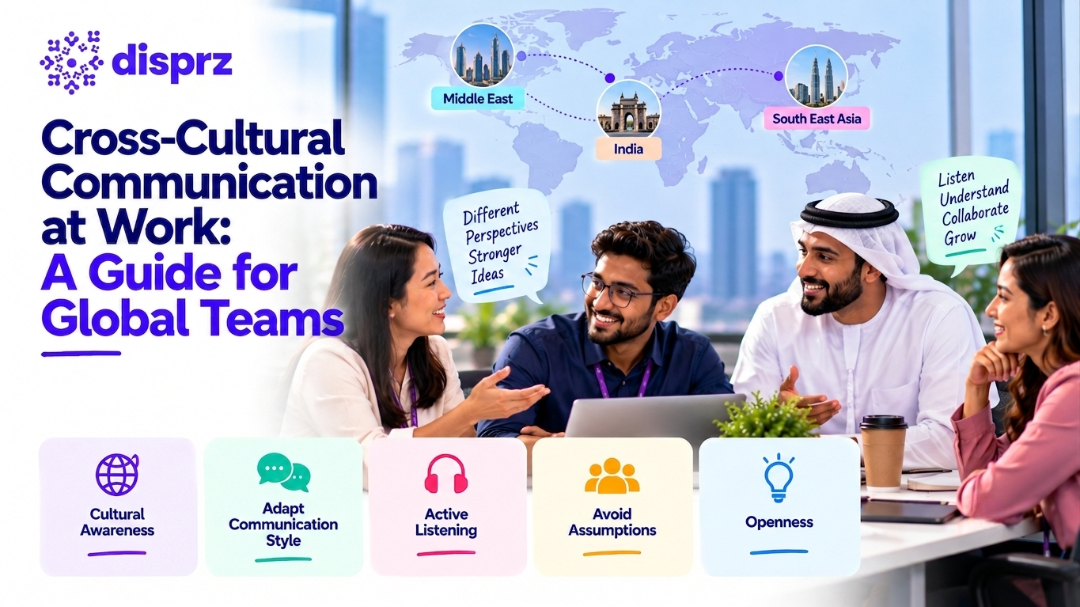
Cross-cultural communication is the ability to exchange information clearly and respectfully with people whose cultural norms, language, and expectations differ from your own. It rests on five core skills: cultural awareness, adapting your communication style, active listening, avoiding assumptions, and openness. For an enterprise operating across the Middle East, South East Asia, and India, it is trainable and measurable: define the observable behaviour, deliver it in short applied bursts, coach against real interactions, and track it through 360 feedback and the business metrics it moves, such as project cycle time, rework, and customer satisfaction.
Key highlights
- Definition: cross-cultural communication is exchanging meaning clearly and respectfully across cultural, linguistic, and national differences.
- Five core skills: cultural awareness, adapting communication style, active listening, avoiding assumptions, and openness.
- Two key models: high-context versus low-context cultures, and Hofstede's cultural dimensions as a lens, not a rule.
- Why it matters: it decides whether distributed and multi-region teams collaborate or misfire, and it drives cycle time, rework, and customer trust.
- It is trainable and measurable: behaviour rubrics, 360 feedback, and scenario assessment make it trackable across a global workforce.
The business case for cross-cultural communication
Most enterprises now run teams that span several countries. A product manager in Bengaluru briefs a delivery team in Manila, a sales lead in Dubai closes with a buyer in Riyadh, and a shared-services hub in Kuala Lumpur supports customers across three continents. The technical work is well trained. The human layer that decides whether those handoffs land, cross-cultural communication, is usually left to chance. Then a direct email reads as rude to one team, an indirect "we will try" is heard as a firm yes by another, and a project slips because nobody said out loud what everyone assumed.
The good news for an L&D team: cross-cultural communication is not a personality trait or a fixed national style. It is a set of behaviours you can define, train, and measure across a distributed workforce. This guide shows how.
What is cross-cultural communication?
Cross-cultural communication is the ability to exchange information clearly and respectfully with people whose cultural norms, language, and expectations differ from your own. At work it shows up as adapting your tone and directness to the person in front of you, checking understanding instead of assuming it, reading indirect signals, and staying open when a colleague's way of working is not yours.
It is distinct from language fluency. Two colleagues can share perfect English and still misread each other because directness, hierarchy, and the meaning of silence differ by culture. Cross-cultural communication is a core soft skill and draws on several others, including active listening, interpersonal skills, and emotional intelligence.
What are the five core cross-cultural communication skills?
Treat cross-cultural communication as five trainable skills rather than one vague quality. Use these as the competencies you assess and coach against, in order from noticing difference to acting on it.
| Skill | What it is | Observable behaviour at work |
|---|---|---|
| Cultural awareness | Knowing your own norms and that others differ | Noticing when a "normal" habit may read differently abroad |
| Adapting communication style | Flexing tone, directness, and channel to the audience | Softening a direct request for a high-context team |
| Active listening | Hearing the meaning behind words and silence | Paraphrasing to confirm before acting on a brief |
| Avoiding assumptions | Checking rather than projecting your own defaults | Asking what a deadline or "yes" means in practice |
| Openness | Curiosity and respect for a different approach | Treating an unfamiliar working style as valid, not wrong |
On naming. Some frameworks bundle these under labels such as the "3 C's" or expand them to seven. The five skills above are what you can actually observe and train. Coach against the behaviours, not the acronym.
High-context and low-context cultures
The single most useful model for a global team is the high-context and low-context distinction. In high-context cultures much of the meaning sits in the situation, the relationship, and what is left unsaid; in low-context cultures meaning is carried explicitly in the words. Many teams across the Middle East, South East Asia, and India lean higher-context, where relationship and indirectness matter, while much of Western Europe and North America leans lower-context and direct. These are tendencies, not fixed rules, and individuals vary widely.
| Signal | Higher-context tendency | Lower-context tendency |
|---|---|---|
| Directness | Indirect, reads between the lines | Explicit, says it plainly |
| Disagreement | Softened, protects face and harmony | Stated openly, debated on merit |
| A "yes" | May mean "I hear you", not "I agree" | Usually a firm commitment |
| Relationship | Built first, before business | Follows the task, secondary to it |
| Silence | Meaningful, a form of response | Often read as a gap to fill |
A second widely cited model is Hofstede's cultural dimensions: power distance, individualism versus collectivism, uncertainty avoidance, motivation towards achievement, long-term orientation, and indulgence. It is helpful for framing why, for example, a team with higher power distance may wait to be asked rather than volunteer a view.
Use it as a lens, not a label. Hofstede's dimensions describe broad national averages from research, not individuals. Train people to hold them as a hypothesis to check, never as a script that predicts a specific colleague. Applied as a stereotype, the model does more harm than good.
Why cross-cultural communication matters, by industry
The payoff differs across the Disprz ICP, and it is sharpest where teams and customers span regions. Naming the payoff in each sector is how you get a training budget approved.
| Industry | Pain when it is weak | Payoff when it is trained |
|---|---|---|
| BFSI | Advisers misread a multi-region client's expectations, trust erodes | Culturally tuned service, stronger cross-border retention |
| Retail & ecommerce | Regional marketing and support miss local nuance | Localised customer experience, fewer complaints |
| Food services & hospitality | Diverse guest expectations mishandled, poor reviews | Composed, culturally aware guest recovery, higher CSAT |
| Manufacturing & automotive | Cross-site handovers between plants and hubs stall | Cleaner global handoffs, fewer rework loops |
| Pharma & healthcare | Multi-country trial and clinical teams miscommunicate | Clearer handovers, safer cross-border collaboration |
| IT & ITeS | Offshore and onshore teams clash on directness and deadlines | Faster delivery, less friction across time zones |
What the research says about cross-cultural communication and training
Two independent lines of evidence make the enterprise case for training these skills, not just hiring for them.
Demand: a core skill employers now expect
The World Economic Forum's Future of Jobs Report 2025 names communication and active listening, both central to cross-cultural communication, among the core skills employers prioritise, alongside resilience, flexibility, and leadership. The same report projects that 39% of workers' core skills will change by 2030 and that 59% of the global workforce will need reskilling or upskilling, which puts human skills firmly on the training agenda for any organisation operating across borders.
Trainability: human skills respond to well-designed training
Cross-cultural communication draws on the same emotional and interpersonal skills that researchers have studied directly. A meta-analysis by Mattingly and Kraiger (2019), covering dozens of studies, found a moderate positive effect of training on emotional and social skills, robust across participant gender, study location, and study design. An earlier meta-analysis by Hodzic and colleagues (2018) reached the same conclusion and found that ability-based programmes, which teach and practise specific behaviours, outperform generic awareness sessions. The read-across for L&D is clear: structured, practice-based cultural communication programmes should move behaviour, one-off awareness talks rarely do.
Design implication. The evidence favours structured, practice-based programmes over one-off workshops, which is exactly why the eight-week rollout below builds in practice, coaching, and reinforcement.
What good and poor cross-cultural communication look like at work
The difference is always visible in behaviour, which is what makes it trainable and assessable.
| Situation | Weak response | Strong response |
|---|---|---|
| A colleague in Manila says "we will try" | Records it as a firm yes, plans around it | Checks what "try" means and by when |
| Emailing a senior buyer in Riyadh | Opens with a blunt ask, no relationship | Builds rapport first, then makes the request |
| A quiet team member in a global call | Reads silence as agreement, moves on | Invites the view directly and privately after |
| Feedback to a higher power-distance team | Public, direct criticism, causes loss of face | Private, framed feedback that protects standing |
Adapting cross-cultural communication by role
The skill looks different at each level, so training has to be tailored, not one generic workshop. Here is the behaviour shift to coach for each audience.
Individual contributors and junior staff
Focus on cultural awareness and avoiding assumptions: noticing when a habit that is normal at home may read differently to a colleague abroad, and asking what a deadline, a "yes", or a request actually means rather than projecting their own defaults. For client-facing juniors, add reading the customer's context before pushing a solution.
Managers leading a distributed team
Focus on adapting style and active listening: running a call that draws out quieter, higher-context team members, giving feedback in a way that protects standing, and setting explicit norms so an offshore and onshore team share the same meaning of "done".
Senior leadership (managing up and across)
Focus on openness and reading intent across cultures: framing a decision so it lands with regional leaders who weigh hierarchy and consensus differently, and staying composed when a challenge is voiced indirectly. A junior briefing a Gulf-based executive should be more relationship-led and deferential; the same person with a low-context European peer should be concise and direct. That deliberate shift is cross-cultural communication in action.
Customer and client-facing (frontline)
Focus on adapting style under pressure and openness: matching tone and formality to a diverse customer base, and acknowledging a cultural expectation before solving. This is where frontline enablement and short mobile practice matter most, because the moment is live and there is no time to reflect.
How do you improve cross-cultural communication?
- Map the context: before a cross-region project, note where each team sits on high versus low context, and agree explicit norms.
- Paraphrase to confirm: repeat back a brief in your own words. It surfaces a misread "yes" before it costs a sprint.
- Ask, do not assume: when a deadline, tone, or commitment is ambiguous, ask what it means in practice rather than projecting your default.
- Flex your directness: soften a blunt request for higher-context teams, and be explicit for lower-context ones.
- Slow down on silence: in a global call, leave space and invite quieter voices directly rather than filling the gap.
- Prefer plain language: drop idioms, sarcasm, and local slang that do not translate across a mixed-language team.
- Build the relationship first: in relationship-led cultures, invest in rapport before pushing the task.
- Use a cultural buddy: pair people across regions so each has a low-stakes way to check "how would this land with your team?"
Quick cross-cultural communication self-check
Rate each statement from 1 (rarely true) to 5 (almost always true). It is a directional prompt, not a validated test, but it shows which of the five skills to prioritise.
- I notice when my own norms may read differently to another culture.
- I adjust my tone and directness to suit the person I am talking to.
- I paraphrase to confirm meaning before I act on a brief.
- I check what a deadline or "yes" means rather than assuming.
- I treat an unfamiliar working style as valid, not wrong.
How do you measure cross-cultural communication?
The skill feels intangible only until you tie it to behaviour and outcomes. Measure it on three levels.
- Behaviour rubric: score the five skills against observable behaviours, before and after training.
- 360 feedback: manager, peer, and cross-region ratings, since this skill is judged by how colleagues in other cultures experience you.
- Scenario assessment: responses to realistic cross-cultural situations, scored against a model answer.
- Business signals: track the metrics it moves, such as project cycle time, rework and rejoin rates, cross-site collaboration scores, and CSAT by region.
Benchmark to hold. Do not report a single "cultural score". Report movement on specific behaviours by role, team, and region, so you can see where coaching is working and where it is not.
Validated, science-based assessments
For any decision that affects a person, use a validated instrument from a recognised publisher, not an ad hoc quiz. The recognised tools measure related constructs such as intercultural competence and cultural intelligence.
| Assessment | Type / construct | Publisher or institute |
|---|---|---|
| IDI (Intercultural Development Inventory) | Intercultural competence, developmental | IDI, LLC |
| CQ (Cultural Intelligence Scale) | Cultural intelligence, self-report | Cultural Intelligence Center; Ang & Van Dyne model |
| GlobeSmart Profile | Work-style dimensions, self-report | Aperian |
| Hofstede Insights country comparison | National dimension averages (a lens) | Hofstede Insights |
| The Culture Map assessment | Eight communication scales | Erin Meyer / INSEAD framework |
On the self-check above. The five-statement prompt earlier in this guide is directional, useful for a quick prioritisation, not a substitute for a validated assessment when you are making development or hiring decisions.
How long does it take to build cross-cultural communication?
Set realistic expectations with sponsors so the programme is not judged too early.
- Awareness: 2 to 4 weeks with assessment and a first workshop.
- New habits: 1 to 3 months of applied practice and coaching.
- Visible team change: 3 to 6 months as behaviours stick across regions.
- Measurable business impact: 6 to 12 months on cycle time and CSAT.
Turn cross-cultural communication into a training programme
A single workshop rarely changes behaviour. Run it as a structured programme with practice and reinforcement built in. This eight-week rollout works across desk and frontline teams and across regions.
| Week | Focus | Activity |
|---|---|---|
| 1 | Baseline | Self and 360 assessment, set behaviour goals by role and region |
| 2 | Cultural awareness | Microlearning on high vs low context, reflective journalling starts |
| 3 | Adapting style | Directness and tone drills, manager 1:1 |
| 4 | Active listening | Paraphrasing and clarifying drills, scenario practice |
| 5 | Avoiding assumptions | Assumption-check role-play across regions, feedback |
| 6 | Apply | Real cross-region challenge, AI coaching on interactions |
| 7 | Reinforce | Nudges, cultural-buddy peer review, manager check-in |
| 8 | Re-measure | Repeat rubric and 360, report movement by region |
Tools and enablers
Match a tool to each stage rather than buying one and hoping.
- Assessment: behaviour rubrics and 360 tools for baseline and re-measure.
- Delivery: an LMS for structured paths and mobile microlearning in local languages.
- Discovery: an LXP with skills intelligence to map the five skills to roles and regions.
- Practice: scenario and role-play built on real cross-cultural situations, on mobile for frontline.
- Coaching: an AI coach that gives feedback on real interactions.
- Analytics: dashboards that report behaviour movement by team and region.
Results at scale
Behaviour change shows up in numbers when the programme is run properly and reinforced. These are outcomes enterprises have seen running skills programmes on Disprz.
Across 47 Disprz enterprise deployments, learning programmes reached a median 88% course completion and 85% platform adoption, with documented outcomes including a 10% skills improvement and 15% business growth. See the full, sourced Disprz Skills Impact dataset.
Customer story: Al Shirawi Group. The UAE-based diversified conglomerate runs unified learning across 15+ business units for its 1,500+ employees on Disprz, reaching 90% course completion and 75% platform adoption. It shows what a single, culturally aware skills programme, the kind a cross-cultural communication rollout sits inside, sustains across a multi-business, multi-region workforce. Read the Al Shirawi case study.
How Disprz helps you build cross-cultural communication at scale
The hard part is not the content, it is running it across thousands of people, in many regions and languages, and proving it changed behaviour. Disprz brings the LMS, LXP and skills intelligence, and frontline enablement into one platform so each stage of the programme lives in one place.
| Programme stage | What Disprz does | Outcome you can show |
|---|---|---|
| Map | Skills intelligence links the five skills to each role and surfaces the gap by region | A baseline by role, team, and region |
| Build | Turo converts your playbooks and SOPs into cultural microlearning and scenarios | A curriculum stood up in days, not a quarter |
| Deliver | Mobile-first delivery in local languages, online and offline, desk and frontline alike | Reach that includes every region, not just HQ |
| Practice | Scenario and role-play modules for real cross-cultural situations | Behaviour rehearsed before it is needed |
| Coach | AI coaching gives feedback on real interactions | Coaching at a scale managers cannot cover alone |
| Reinforce | Nudges, spaced reminders, and manager check-ins in the flow of work | Habits that survive past the workshop |
| Measure | Behaviour rubrics, 360 feedback, and progression analytics | Movement on behaviour, tied to cycle time and CSAT |
Because the five skills are mapped as skills, not just course completions, you can prove progression rather than attendance. That is the difference between a training line item and a capability you can report to the board.
- Role-to-behaviour mapping for the five cross-cultural skills
- Microlearning and scenario practice on mobile, including offline and in local languages
- AI coaching feedback on real conversations
- Behaviour rubrics and 360 assessment built in
- Nudges and reinforcement in the flow of work
- Progression analytics by role, team, and region
Turo, the agentic authoring layer, converts your existing playbooks and SOPs into microlearning 80% to 90% faster than manual builds, so a cross-cultural curriculum does not take a quarter to stand up. Enterprises running skills programmes on Disprz sustain 45%+ frontline completion against an industry average below 30%, which is what makes a soft-skills rollout actually finish across every region.
Where to start. Pick one cross-region team and the two skills that hurt most, map them in skills intelligence, and run the eight-week programme above as a pilot. Prove the movement, then scale it across the workforce.
Key takeaways
- Cross-cultural communication is trainable and measurable, not a fixed national style.
- Train against the five skills and their observable behaviours: cultural awareness, adapting style, active listening, avoiding assumptions, and openness.
- Use high versus low context and Hofstede's dimensions as a lens to check, never as a stereotype.
- Tailor the training by role and region, and measure with behaviour rubrics and 360 feedback tied to cycle time and CSAT.
- Run it as an eight-week programme with practice and reinforcement, not a one-off workshop.
Where should you start?
Cross-cultural communication is the human layer that decides whether a global team collaborates or misfires. For an enterprise operating across the Middle East, South East Asia, and India, the win is not a single workshop but a repeatable programme that defines the behaviours, trains and reinforces them by role and region, and proves the change. Start with the one cross-region team and the two skills that hurt most in your context, make them observable, and build from there.
Reviewed for accuracy on 22 Sep 2026.
Cross-cultural communication FAQs
The questions L&D and people leaders ask most often.
What is cross-cultural communication?
Cross-cultural communication is the ability to exchange information clearly and respectfully with people whose cultural norms, language, and expectations differ from your own. At work it means adapting tone and directness, checking understanding rather than assuming it, and reading indirect signals across regions.
Why is cross-cultural communication important?
It decides whether distributed, multi-region teams collaborate or misfire. Strong cross-cultural communication reduces rework and delivery friction, protects customer trust across markets, and becomes more valuable as more organisations operate across borders.
What are examples of cross-cultural communication?
Checking what a colleague's "we will try" actually means before planning around it, building rapport before a request with a relationship-led buyer, softening direct feedback for a higher power-distance team, inviting a quiet team member's view directly rather than reading silence as agreement, and dropping idioms that do not translate across a mixed-language team.
How do you improve cross-cultural communication?
Map where each team sits on high versus low context and agree explicit norms, paraphrase to confirm meaning, ask instead of assuming, flex your directness by audience, prefer plain language, and practise real scenarios with coaching. Run it as a structured programme with reinforcement, not a one-off workshop.
What is the difference between high-context and low-context cultures?
In high-context cultures much of the meaning sits in the situation, relationship, and what is left unsaid, so communication is more indirect. In low-context cultures meaning is carried explicitly in the words, so communication is more direct. These are tendencies, not fixed rules, and individuals vary.
How do you measure cross-cultural communication in a workforce?
Through behaviour rubrics scored against the five skills, 360 feedback from managers and cross-region peers, scenario assessments, and the business metrics it moves, such as project cycle time, rework rates, cross-site collaboration scores, and CSAT by region.
Sources
- Disprz. Disprz Skills Impact Dataset, 2026. First-party learning and skills outcomes from 47 enterprise deployments. disprz.ai/skills-impact
- World Economic Forum. Future of Jobs Report 2025. January 2025. weforum.org
- Mattingly, V. and Kraiger, K. Can emotional intelligence be trained? A meta-analytical investigation. Human Resource Management Review, 29(2), 2019.
- Hodzic, S., Scharfen, J., Ripoll, P., Holling, H. and Zenasni, F. How efficient are emotional intelligence trainings: A meta-analysis. Emotion Review, 10(2), 2018.
- Disprz master value benchmarks (8X ROI, 50% productivity, 7X CSAT) and frontline completion data, 2026. Aggregated enterprise deployment data.
About the authors


Madhu Karunakaran
Vice President - People & Culture
Madhu Karunakaran is a senior HR and Learning & Development (L&D) leader with 20+ years of experience spanning people strategy, organizational development (OD), talent management, leadershi...
Reviewed for accuracy on 21 Sep 2026