
On this page
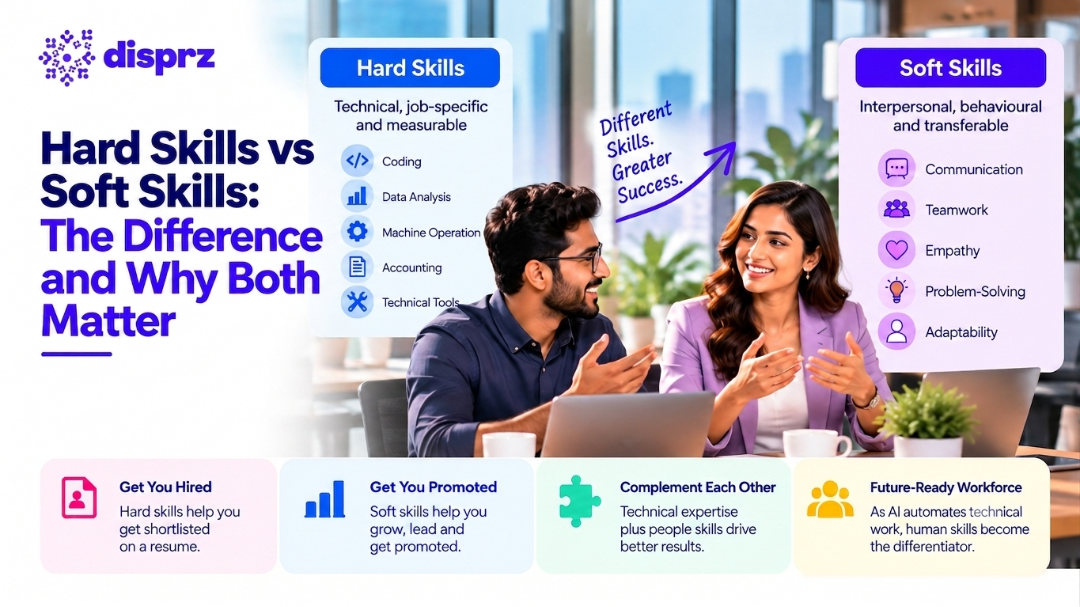
Hard skills are teachable, technical, job-specific abilities (coding, accounting, machine operation) gained through education and certification and measured with tests and credentials. Soft skills are the interpersonal and behavioural qualities (communication, teamwork, adaptability) gained through experience and coaching and measured through behaviour and 360 feedback. Enterprises need both: hard skills win the role, soft skills win the promotion. Map them in one framework, train each with the right method, and prove movement rather than attendance.
Key highlights
- The difference: hard skills are technical and job-specific, soft skills are interpersonal and behavioural.
- How gained: hard skills through education, training, and certification, soft skills through experience, feedback, and coaching.
- How measured: hard skills with tests and credentials, soft skills with behaviour rubrics and 360 feedback.
- Resume vs promotion: hard skills get you shortlisted, soft skills get you promoted.
- AI raises the value of soft skills: as automation handles technical execution, human skills become the differentiator.
The business case for building both
Most enterprises hire and train for hard skills because they are easy to specify and easy to test, then wonder why capable people stall. A certified engineer cannot lead a team. A top analyst cannot land a difficult message. The technical half of the role is covered and the human half is left to chance, and that gap shows up in stalled promotions, friction, and customer churn.
Hard skills and soft skills are not rivals. They are two halves of one capability, and the modern skills gap is usually a shortage of the second. This guide explains the real difference, gives examples of each, and shows how an L&D team can build both across a workforce and prove it.
What are hard skills and soft skills?
Hard skills are teachable, technical, job-specific abilities you can prove with a test or a credential, such as coding, accounting, or operating a machine. Soft skills are the interpersonal and behavioural qualities that shape how you work with others, such as communication, empathy, and adaptability. Hard skills tend to get you hired; soft skills tend to determine how far you progress.
The simplest test: if a skill can be measured with a certificate or a right-or-wrong assessment, it is usually a hard skill. If it can only be judged by watching how someone behaves over time, it is usually a soft skill. Soft skills are a core part of the wider soft skills family, and they include several this cluster covers in depth, such as emotional intelligence, interpersonal skills, and critical thinking.
How do hard skills and soft skills compare?
The clearest way to see the difference is to compare the two across the dimensions that matter for training: what they are, how they are gained, how they are measured, and how long they last. Use this as the map for how you build each one.
| Dimension | Hard skills | Soft skills |
|---|---|---|
| Nature | Teachable, technical, job-specific abilities | Interpersonal, behavioural, transferable qualities |
| How gained | Formal education, training, certification, and practice | Experience, feedback, coaching, and reflection |
| How measured | Tests, credentials, portfolios, demonstrable output | Behaviour rubrics, 360 feedback, scenario judgement |
| Shelf life | Shorter: changes as tools and technology change | Longer: transfers across roles, tools, and industries |
| Examples | Coding, accounting, data analysis, machine operation | Communication, empathy, teamwork, adaptability |
The resume vs promotion framing. Hard skills are what a recruiter screens for on a CV, so they open the door. Soft skills are what a manager promotes for, so they decide the ceiling. Building only one is why so many technically strong people plateau.
What are the 7 hard skills?
Seven hard skills in high demand across enterprises are: data analysis, programming or software proficiency, project management, financial literacy and accounting, digital marketing and SEO, foreign-language proficiency, and machine or equipment operation. Each can be taught, certified, and tested, which is exactly what makes it a hard skill.
What are the 7 major soft skills?
Seven major soft skills employers prioritise are: communication, teamwork and collaboration, adaptability, problem solving, emotional intelligence, time management, and leadership. They are hard to certify but visible in behaviour, and they transfer across almost every role.
What are 5 hard skills and soft skills?
Five hard skills: coding, data analysis, accounting, a foreign language, and machine operation. Five soft skills: communication, teamwork, adaptability, problem solving, and emotional intelligence. A strong profile pairs a technical core with the human skills that make it usable.
What is an example of a hard skill?
Proficiency in a programming language such as Python is a clear example of a hard skill. It is specific, teachable, and provable: you can certify it, test it, and see the output. Operating a particular machine or preparing a set of financial accounts works the same way.
Why both matter, by industry
The balance between hard and soft skills pays off differently across the Disprz ICP. Naming the payoff in each sector is how you get a training budget for both approved, not just the technical half.
| Industry | Pain when one half is missing | Payoff when both are trained |
|---|---|---|
| BFSI | Technically sound advisers who cannot handle anxious customers | Compliant and trusted advice, higher retention |
| Retail & ecommerce | Trained on the till but not on peak-pressure teamwork | Smoother peak seasons, lower attrition |
| Food services & hospitality | Correct process, poor guest recovery under stress | Composed service recovery, higher CSAT |
| Manufacturing & automotive | Machine-certified crews with weak communication on safety | Fewer incidents, steadier shift-floor coordination |
| Pharma & healthcare | Clinical competence undercut by brittle handovers | Clearer handovers, more resilient teams |
| IT & ITeS | Strong engineers who stall at the manager transition | Technical talent that becomes effective, retained leads |
What the research says about the shift to soft skills
Two independent bodies of evidence make the enterprise case for training both halves, and for treating soft skills as trainable rather than fixed.
Demand: human skills are now core skills
The World Economic Forum's Future of Jobs Report 2025 names empathy and active listening, both soft skills, among the core skills employers prioritise, alongside technical and analytical abilities. The same report projects that 39% of workers' core skills will change by 2030 and that 59% of the global workforce will need reskilling or upskilling. That churn hits hard skills fastest, which is precisely why the more durable soft skills are rising in relative value.
AI is raising the value of soft skills
As AI and automation absorb more technical execution, the tasks left to people lean heavily on judgement, communication, and collaboration. A hard skill can be automated or made obsolete by the next tool; a soft skill transfers to whatever comes next. This does not make hard skills irrelevant, it makes the pairing more important: people still need the technical grounding to direct the tools well.
Trainability: soft skills respond to well-designed training
The finding that matters most for L&D is that soft skills are not fixed traits. A meta-analysis by Mattingly and Kraiger (2019), covering dozens of studies, found a moderate positive effect of training on emotional intelligence, one of the core soft skills, robust across participant gender, study location, and study design. An earlier meta-analysis by Hodzic and colleagues (2018) reached the same conclusion and found that programmes teaching and practising specific behaviours outperform generic awareness sessions.
Design implication. Hard skills respond to instruction and practice; soft skills respond to practice, feedback, and coaching. The eight-week rollout below builds in both, so you can train the two halves in one programme.
When each type of skill decides the outcome
The two show up differently in the same situation, which is what makes it worth training both deliberately.
| Situation | The hard skill | The soft skill that decides the outcome |
|---|---|---|
| Presenting an analysis to the board | Building the model correctly | Communicating it clearly and handling challenge |
| A production fault on the line | Diagnosing the machine issue | Coordinating the crew calmly under pressure |
| An escalated customer complaint | Knowing the policy and the fix | Empathy and service recovery so they stay |
| A new engineer becoming a team lead | Deep technical credibility | Delegation, feedback, and conflict handling |
How the hard and soft mix shifts by role
The balance is not fixed. As people move up and outward, the weighting tips from hard toward soft, so training has to be tailored rather than one generic programme.
Junior and individual contributor
The mix leans hard: the priority is proving technical competence and delivering reliable output. Build the credential and the craft first, then layer in the foundational soft skills of receiving feedback well, communicating status clearly, and asking for help without defensiveness.
Manager leading a team
The mix tips toward soft. Technical work is increasingly done through others, so delegation, giving feedback that lands, and de-escalating conflict now matter more than personal output. This transition, from strong contributor to effective manager, is where the soft-skill gap costs the most.
Managing up to senior leadership
The mix is almost entirely soft: influence, reading intent, and framing. Leading with the outcome, staying composed when challenged, and presenting a problem with a proposed path rather than venting it. A junior briefing an executive should be concise and decision-oriented, a deliberate shift from how the same person would explore an idea with a peer.
Customer and client-facing (frontline)
The two are inseparable and live: product knowledge (hard) is useless without empathy and composure under pressure (soft), because the moment is happening in real time. This is where frontline enablement and short mobile practice matter most, since there is no time to reflect between the customer and the response.
How can you improve hard and soft skills?
- Map both in one framework: define the hard and soft skills each role needs together, so neither half is treated as optional.
- Match the method to the skill: instruction and certification for hard skills, practice and coaching for soft skills.
- Certify the technical, observe the behavioural: use tests for hard skills and behaviour rubrics for soft ones, not the same tool for both.
- Pair a technical path with a human one: when you roll out a systems upgrade, roll out the communication and change skills alongside it.
- Use real work as the practice ground: soft skills stick when rehearsed on live scenarios, not slides.
- Coach the manager transition explicitly: the shift from doing to leading is a soft-skill programme, not a title change.
- Make soft skills promotable: put behaviours in progression criteria so people invest in them, not just in the next certificate.
- Reinforce in the flow of work: nudges and spaced practice keep both halves current as tools and teams change.
Quick balanced-skills self-check
Rate how true each statement is of your team's development today, from 1 (rarely true) to 5 (almost always true). It is a directional prompt, not a validated audit, but it shows where your hard-plus-soft strategy has a gap.
- We define the hard and soft skills each role needs in one framework.
- We train technical skills with instruction and certification.
- We train soft skills with practice, feedback, and coaching.
- We measure behaviour change, not just course completions.
- We reinforce both in the flow of work, not one-off events.
How do you measure each type of skill?
The two halves need different instruments. Measuring a soft skill with a multiple-choice test, or a hard skill with a 360, tells you almost nothing.
- Hard skills: knowledge tests, certifications, portfolios, and demonstrable output against a standard.
- Soft skills: behaviour rubrics scored against observable behaviours, before and after training.
- Soft skills, multi-rater: 360 feedback from manager, peers, and direct reports, since soft skills are judged by how others experience you.
- Both, at the business level: the KPIs the skill moves, such as error and rework rates for hard skills, and attrition, conflict frequency, engagement, and CSAT for soft skills.
Benchmark to hold. Do not roll a single number for a role. Report the hard-skill certification rate and the soft-skill behaviour movement separately, so you can see which half is lagging and coach it.
How long does it take to build hard and soft skills?
Set realistic expectations with sponsors: the two halves move on different clocks.
- A discrete hard skill: days to a few weeks of instruction and practice to competent.
- Soft-skill awareness: 2 to 4 weeks with assessment and a first workshop.
- New soft-skill habits: 1 to 3 months of applied practice and coaching.
- Measurable business impact: 6 to 12 months as behaviours stick and hard skills stay current.
Turn both into a training programme
You can build both halves in one structured programme rather than running technical and behavioural training as separate silos. This eight-week rollout pairs a hard-skill track with a soft-skill track and works across desk and frontline teams.
| Week | Focus | Activity |
|---|---|---|
| 1 | Baseline | Map the hard and soft skills for the role, assess both, set goals |
| 2 | Hard-skill core | Instruction and guided practice on the technical skill |
| 3 | Hard-skill proof | Assessment or certification against a standard |
| 4 | Soft-skill awareness | Microlearning plus reflective prompts on the target behaviour |
| 5 | Soft-skill practice | Scenario and role-play drills, peer feedback |
| 6 | Apply together | Real-work challenge using both, AI coaching on interactions |
| 7 | Reinforce | Nudges, spaced practice, manager check-in |
| 8 | Re-measure | Re-test the hard skill, re-run the behaviour rubric, report movement |
Tools and enablers
Match a tool to each stage and each type of skill, rather than buying one and hoping.
- Assessment: knowledge tests for hard skills, rubrics and 360 tools for soft skills.
- Delivery: an LMS for structured paths, certification, and mobile microlearning.
- Discovery: an LXP with skills intelligence to map both skill types to every role.
- Practice: scenario and role-play for soft skills, delivered on mobile for frontline.
- Coaching: an AI coach that gives feedback on real interactions.
- Analytics: dashboards that report certification and behaviour movement side by side.
Results at scale
Building both halves shows up in numbers when the programme is run properly and reinforced. These are outcomes enterprises have seen running skills programmes on Disprz.
Across 47 Disprz enterprise deployments, learning programmes reached a median 88% course completion and 85% platform adoption, with documented outcomes including a 10% skills improvement and 15% business growth. See the full, sourced Disprz Skills Impact dataset.
Customer story: Almosafer (Seera Group). The Saudi travel and tourism leader modernised learning at scale for its 2,000+ employees on Disprz, reaching 90% training completion, upskilling 50% of its employees, and mapping 700+ roles to skills. Mapping roles to skills is what lets an enterprise build the right hard-plus-soft mix for each one. Read the Almosafer case study.
How Disprz helps you build both at scale
The hard part is not the content, it is running both technical and behavioural training across thousands of people, in many roles and languages, and proving each half moved. Disprz brings the LMS, LXP and skills intelligence, and frontline enablement into one platform so hard and soft skills live in one framework instead of two silos.
| Programme stage | What Disprz does | Outcome you can show |
|---|---|---|
| Map | Skills intelligence links both hard and soft skills to each role and surfaces the gap | A baseline by role, team, and region |
| Build | Turo converts your playbooks and SOPs into technical modules and soft-skill scenarios | A curriculum stood up in days, not a quarter |
| Deliver | Mobile-first delivery, online and offline, for desk and frontline alike | Reach that includes the frontline, not just HQ |
| Certify | Assessments and certification for the technical skills | Proof of competence against a standard |
| Practise | Scenario and role-play modules for the behavioural skills | Behaviour rehearsed before it is needed |
| Coach | AI coaching gives feedback on real interactions | Coaching at a scale managers cannot cover alone |
| Measure | Certification rates plus behaviour rubrics and progression analytics | Movement on both halves, tied to business KPIs |
Because both skill types are mapped as skills, not just course completions, you can prove progression rather than attendance. That is the difference between a training line item and a capability you can report to the board.
- Role-to-skill mapping for both hard and soft skills
- Certification for technical skills, rubrics for behavioural ones
- Microlearning and scenario practice on mobile, including offline
- AI coaching feedback on real conversations
- Nudges and reinforcement in the flow of work
- Progression analytics by role, team, and region
Turo, the agentic authoring layer, converts your existing playbooks and SOPs into microlearning 80% to 90% faster than manual builds, so a combined curriculum does not take a quarter to stand up. Enterprises running skills programmes on Disprz sustain 45%+ frontline completion against an industry average below 30%, and report up to a 7X increase in CSAT where the human skills land.
Where to start. Pick one role, map its hard and soft skills together, and run the eight-week programme above as a pilot. Prove the movement on both halves, then scale it across the workforce.
Key takeaways
- Hard skills are technical and provable, soft skills are behavioural and observed. Enterprises need both.
- Hard skills get you hired, soft skills get you promoted, so build the whole capability, not half of it.
- Train each with the right method: instruction and certification for hard skills, practice and coaching for soft skills.
- Measure them with different instruments: tests and credentials for hard skills, rubrics and 360 for soft skills.
- AI raises the relative value of soft skills, but the pairing wins: technical grounding to direct the tools, human skills to make it count.
Where should you start?
Hard skills and soft skills are not a choice, they are two halves of one capability. The technical half opens the door and the human half decides the ceiling, and as automation absorbs more execution, the durable human skills are rising in value. For an enterprise, the win is a single skills framework that maps both for every role, trains each with the right method, and proves movement on both. Start with one role, map the mix, and build from there.
Reviewed for accuracy on 22 Sep 2026.
Hard skills vs soft skills FAQs
The questions L&D and people leaders ask most often.
What are 5 hard skills and soft skills?
Five hard skills: coding, data analysis, accounting, a foreign language, and machine operation. Five soft skills: communication, teamwork, adaptability, problem solving, and emotional intelligence. A strong profile pairs a technical core with the human skills that make it usable.
What are the 7 major soft skills?
Communication, teamwork and collaboration, adaptability, problem solving, emotional intelligence, time management, and leadership. They are hard to certify but visible in behaviour, and they transfer across almost every role.
What are the 7 hard skills?
Data analysis, programming or software proficiency, project management, financial literacy and accounting, digital marketing and SEO, foreign-language proficiency, and machine or equipment operation. Each can be taught, certified, and tested.
What is an example of a hard skill?
Proficiency in a programming language such as Python. It is specific, teachable, and provable: you can certify it, test it, and see the output. Operating a particular machine or preparing financial accounts are further examples.
What is the main difference between hard and soft skills?
Hard skills are technical, job-specific abilities gained through education and measured with tests and credentials. Soft skills are interpersonal, behavioural qualities gained through experience and coaching and measured through behaviour and 360 feedback. Hard skills tend to get you hired, soft skills tend to get you promoted.
Are soft skills more important than hard skills?
Neither is more important on its own, but the balance is shifting. As AI and automation absorb technical execution, durable soft skills rise in relative value, while hard skills still provide the grounding to direct the tools well. The strongest strategy builds both in one framework.
Can soft skills be trained like hard skills?
Yes, but with a different method. Hard skills respond to instruction, practice, and certification. Soft skills respond to practice, specific feedback, and coaching. Meta-analyses find soft skills such as emotional intelligence improve with well-designed, practice-based training.
Sources
- Disprz. Disprz Skills Impact Dataset, 2026. First-party learning and skills outcomes from 47 enterprise deployments. disprz.ai/skills-impact
- World Economic Forum. Future of Jobs Report 2025. January 2025. weforum.org
- Mattingly, V. and Kraiger, K. Can emotional intelligence be trained? A meta-analytical investigation. Human Resource Management Review, 29(2), 2019.
- Hodzic, S., Scharfen, J., Ripoll, P., Holling, H. and Zenasni, F. How efficient are emotional intelligence trainings: A meta-analysis. Emotion Review, 10(2), 2018.
- Disprz master value benchmarks (8X ROI, 50% productivity, 7X CSAT) and frontline completion data, 2026. Aggregated enterprise deployment data.
About the authors


Madhu Karunakaran
Vice President - People & Culture
Madhu Karunakaran is a senior HR and Learning & Development (L&D) leader with 20+ years of experience spanning people strategy, organizational development (OD), talent management, leadershi...
Reviewed for accuracy on 21 Sep 2026